November 27, 2026
How to Reduce Carbon Emissions in Shipping: What NYK's Digital Strategy Teaches Fleet Teams


November 27, 2026
A ship doesn't need a major breakdown to burn more fuel than it should. A fuel pump that keeps losing pressure, a generator alarm nobody has got to the bottom of, an exhaust temperature that has been drifting for weeks: small technical problems like these add up.
Most conversations about how to reduce carbon emissions in shipping focus on new fuels and new ships. Those matter. But one of the largest shipowners in the world has just put a number on something engineers have long suspected: running the existing fleet better can rival the gains from new tonnage.
In November 2026, The Digital Ship reported that NYK expects "optimal operations" to cut more greenhouse gas by 2030 than its 28 LNG-fuelled vessels, at well under half the annual cost.
That finding is worth unpacking, because a large part of running a fleet well comes down to how quickly engineers can find, understand and fix the technical problems in front of them.
NYK's medium-term plan, Sail Green, Drive Transformations 2026, was published in March 2023 and covers FY2023 to FY2026. It targets a cut of more than 30% in vessel greenhouse gas emissions by FY2030 against FY2021, with net zero by 2050.
Digital transformation is one of three support strategies, alongside talent and organisation and energy transformation. In practice that means cloud and digital tools, NYK's Ship Information Management System, shared data across group companies and a zero-emission fleet simulator. The simulator breaks emissions down by factors such as EEXI and CII rules, alternative-fuel timing and each ship's propulsion performance and operating profile, then runs scenarios by business unit and by vessel.
The Digital Ship report highlights two of NYK's FY2030 projections side by side:
These are company projections for NYK's own fleet, not measured results or industry benchmarks. Nobody should read them as proof that operations can replace cleaner fuels; NYK is pursuing both.
What they do show is that how existing ships are run belongs near the top of any decarbonisation plan. And for a technical department, "how ships are run" includes how well machinery performs and how fast faults get fixed.
The principle is simple. A ship burns fuel to make propulsion power, electricity and steam. When equipment runs inefficiently, it can take more energy to get the same useful work done. How much more depends on the machinery, the operating conditions and how the crew responds.
Four areas tend to matter most.
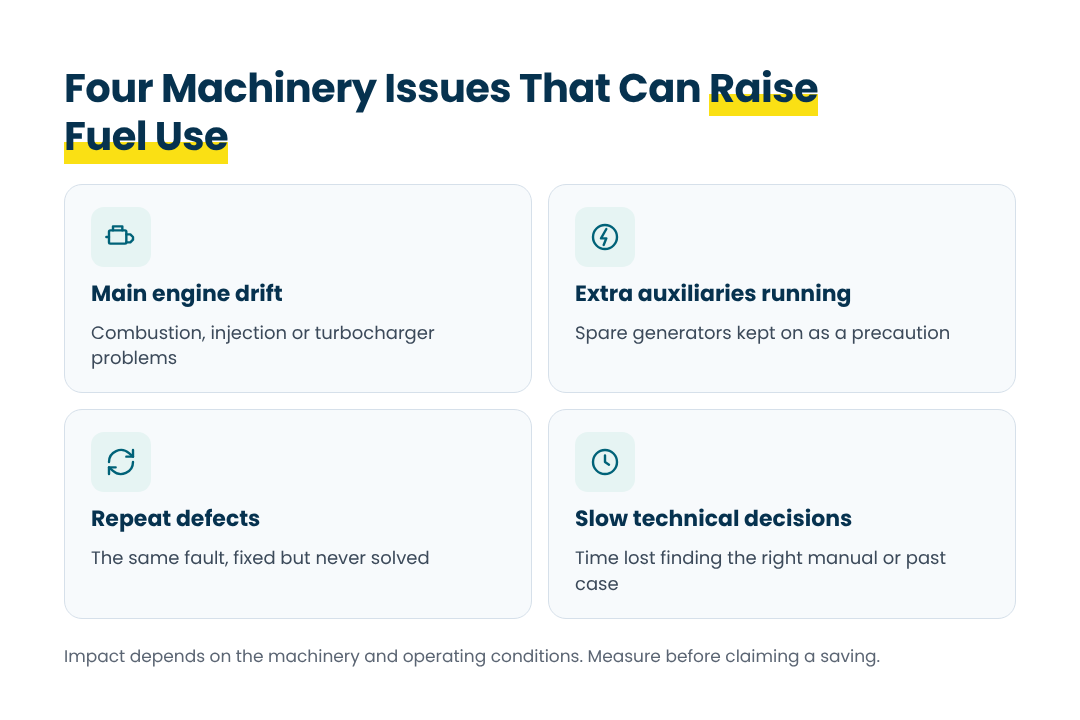
Four machinery issues that can raise fuel use.
An engine running outside its intended parameters may use more fuel for the same power. Combustion problems, fuel injection irregularities, turbocharger fouling or poor settings can all contribute. But not every abnormal reading is an efficiency loss, so engineers need OEM guidance, performance measurements and maintenance history to tell the difference.
Generators, pumps and compressors all draw on the fuel bill. Take recurring generator alarms: the crew may run an extra generator as a precaution. That can be the right safety call, but if it goes on for weeks it can raise consumption at some loads. Fixing the underlying fault lets the vessel return to a normal configuration.
Picture a fuel pump that loses pressure every few weeks. The crew restores it each time, but nobody finds the root cause. The disruption repeats, and the machinery may keep running below par. The fuel impact can't be assumed without data, yet removing a recurring fault removes an avoidable source of inefficiency. We cover this in more depth in our guide to reducing vessel downtime from repeated machinery failures.
When a fault appears, engineers often dig through OEM manuals, planned maintenance records, defect reports, service bulletins and old emails before deciding what to check. The harder that information is to reach, the longer the machinery stays below its best.
Most shipping companies already have plenty of software: vessel maintenance software for planned jobs, a defect system, a performance platform, voyage optimisation and environmental reporting. The trouble is that each holds only part of the story.
Say a performance platform flags an unexpected rise in fuel consumption. The clues to why might be spread like this:
All of it exists inside the fleet. None of it sits in the same place as the alert.
That's why maritime digital transformation has to go beyond collecting data. The value comes when the right information reaches the person making the next technical decision.
AI doesn't cut emissions by answering questions. Its contribution is indirect: helping crews and shore teams find and fix the technical problems that can push fuel use up. AI-powered maritime troubleshooting helps in five ways.
A Chief Engineer sees exhaust temperature climbing on one unit. Normally that means searching the engine manual, checking recent maintenance and scrolling through old defects. With AI-assisted search, they can ask:
"Which previous defects involved high exhaust temperature on this engine, and which OEM checks apply?"
A source-linked answer can surface past cases, the right manual sections and earlier corrective actions in one place. The engineer still verifies everything and decides what to do. If the cause turns out to be a genuine efficiency problem, fixing it sooner restores normal performance sooner.
A problem solved on one ship can save time on its sisters. Too often, though, the defect report records only the fix, while the reasoning sits in emails or someone's notebook. Good retrieval, combined with sound ship system diagnostics, lets teams find comparable cases and see how they were investigated.
Maintenance records show what was done, not always why a problem keeps coming back. If a pump keeps failing seals, engineers may need to look at alignment, vibration, suction conditions and repair history together. Bringing those records together supports proper root-cause analysis. This isn't predictive maintenance based on sensor trends; it's another layer of decision support that can sit alongside it.
A superintendent reading a defect report often has to ask the ship for parameters, records and repair history before advising. When both sides can see the same evidence from the start, that back-and-forth shrinks, and so does the time the machinery runs below par.
Experienced engineers carry know-how that never makes it into a manual. Recording what they find and making it searchable across vessels helps the whole fleet spot recurring problems and respond consistently, long after individual engineers have signed off.
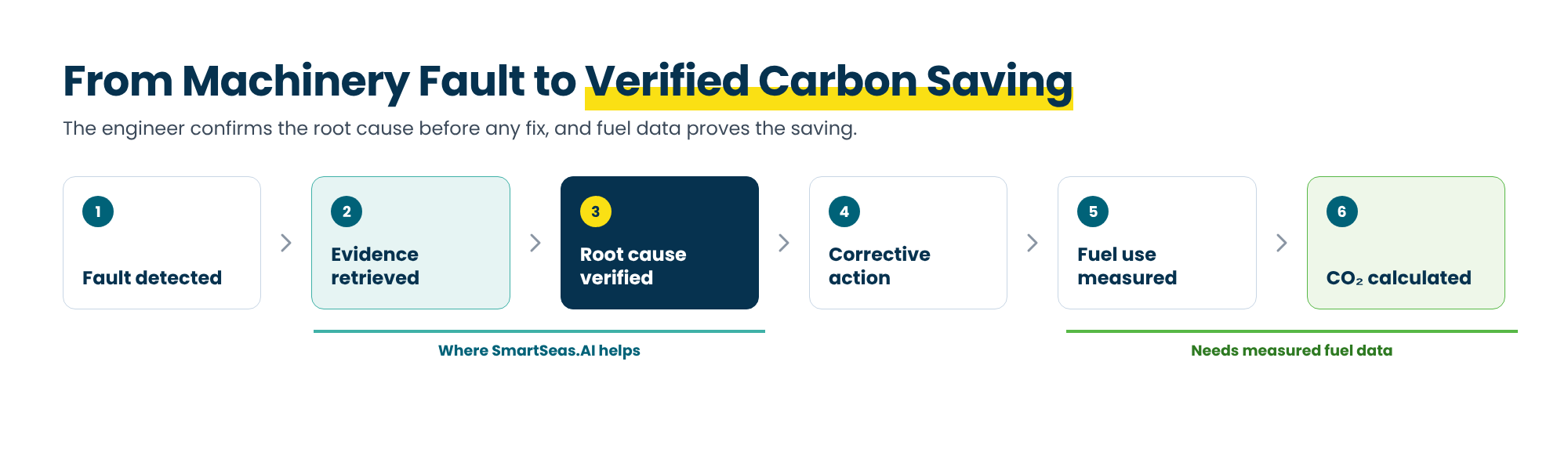
From machinery fault to verified carbon saving.
SmartSeas.AI is a Maritime AI platform focused on one part of the efficiency challenge: helping engineers and fleet teams find and use technical knowledge when machinery problems arise. It brings together equipment manuals, defect records, incident histories and procedures, and shows the sources behind every answer.
Here's how that works for a vessel reporting abnormal fuel pump performance:
SmartSeas.AI supports steps 2 and 3. It doesn't measure emissions, optimise routes or guarantee fuel savings. As a fleet intelligence platform, its job is to get trustworthy technical context to the engineer faster, so faults that affect efficiency get resolved properly.
NYK's approach goes beyond fleet simulation. In April 2026, NYK and its R&D company MTI launched a trial with Signol that analyses operational data from 33 NYK Group vessels. Seafarers get personalised goals and feedback on how their decisions affect fuel use, focused on specific engine-related machinery, over roughly six months.
The two approaches tackle different problems. Signol targets operating behaviour; SmartSeas.AI targets technical knowledge and troubleshooting. Both rest on the same idea: data only helps when it reaches the people making decisions on board, not just a dashboard ashore. That is where maritime fleet management using AI is heading.
AI shortens the search. It doesn't remove the need for engineering judgement, validated measurements or established maintenance procedures.
Yes, but only under the right conditions. Plenty of defects affect safety, availability or maintenance cost without touching fuel consumption. And even where a fault does waste fuel, fixing it faster doesn't automatically prove a saving.
A credible claim has to answer three questions:
Imagine a fault that costs a vessel an extra 0.5 tonnes of fuel a day, and better troubleshooting resolves it ten days earlier.
This is arithmetic, not a SmartSeas.AI result. The factor must match the fuel actually burned (marine gas oil, for example, uses 3.206), and the fuel saving itself has to be demonstrated before any CO₂ figure is claimed.
Don't start by assigning an emissions percentage to an AI tool. Start by measuring the technical workflow, then check whether improvements there turn into verified fuel savings.
Keep these in order and don't treat them as interchangeable. Faster retrieval is a leading indicator. Lower verified fuel consumption is an operational outcome. Avoided CO₂ is an environmental outcome, and only as good as the fuel measurement behind it.
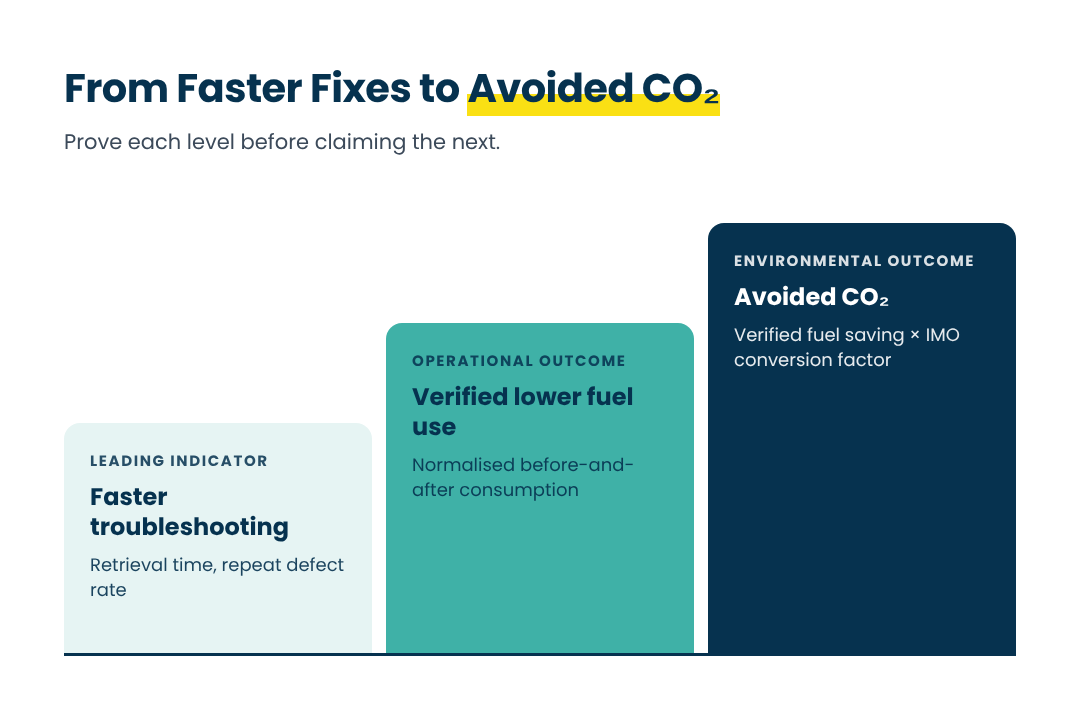
From faster fixes to avoided CO₂: prove each level before claiming the next.
You don't need to overhaul every technical workflow at once. Work in stages:
Even where no fuel saving can be proven, these steps improve reliability and maritime operational efficiency. That's a worthwhile result on its own. For more ideas, see these practical ways to reduce vessel downtime.
AI troubleshooting is not a decarbonisation strategy by itself. It can't replace cleaner fuels, energy-saving technology, hull maintenance or voyage optimisation.
It is also only as good as the records behind it. Thin defect reports, outdated manuals or wrong equipment details will limit what it can find. Every AI-generated interpretation has to be checked against approved documentation by qualified people, and safety-critical decisions stay with the vessel's responsible crew and management system. If you're comparing platforms, it helps to know what to look for in AI-driven maritime solutions.
Above all: a faster troubleshooting process is not, by itself, proof of lower emissions.
NYK's plan makes one thing clear. To reduce carbon emissions in shipping, fleets need cleaner fuels and better ships, but they also need to run and maintain the ships they already have more effectively.
For technical teams, that starts with getting the right manual section, the right previous defect and the right fleet experience in front of the engineer when a fault appears. Where that leads to fixing a verified source of wasted fuel, it supports the fleet's carbon goals too.
AI won't make shipping green on its own. Its value is in putting useful technical knowledge in the hands of the people who can turn it into safer, more reliable and more efficient operations.
AI can support emissions cuts through voyage optimisation, performance analysis, maintenance intelligence and faster machinery troubleshooting. The actual reduction depends on the application and must be backed by verified fuel savings.
Indirectly. SmartSeas.AI helps engineers investigate machinery problems and find relevant technical knowledge faster. Any fuel saving has to be measured separately.
Poorly performing machinery can need more energy for the same output. Good maintenance and troubleshooting restore normal efficiency and can cut unnecessary fuel use.
Sail Green, Drive Transformations 2026 is NYK's medium-term management plan for FY2023 to FY2026. It targets a cut of more than 30% in vessel GHG emissions by FY2030 against FY2021, supported by digital, talent and energy strategies.
No. Troubleshooting support helps engineers investigate issues using manuals and past evidence. Predictive maintenance analyses machinery condition trends to anticipate wear. The two work well together.
Compare fuel consumption before and after the corrective action under comparable conditions, account for other factors such as weather and load, and apply the correct IMO conversion factor for the fuel burned.
Explore how SmartSeas.AI helps fleet teams connect technical knowledge and operational experience.

Get Started Today
Transform the way you troubleshoot and manage maritime operations. Join the next wave of Maritime Digital Transformation with SmartSeas AI.