October 31, 2026
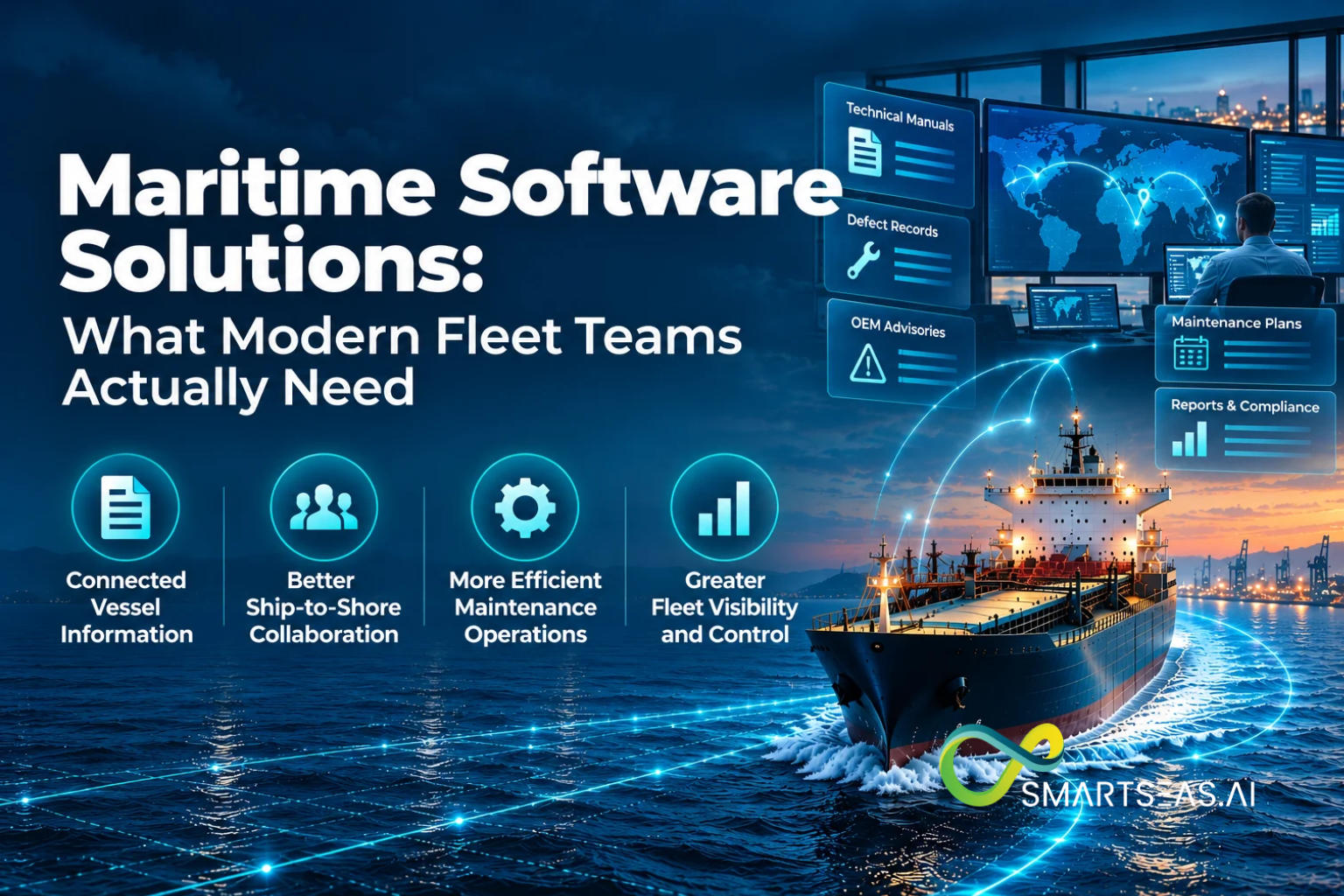
Maritime Software Solutions: What Modern Fleet Teams Actually Need

October 31, 2026
When a vessel experiences an unexpected machinery fault, engineers must review manuals, maintenance records and previous defects while coordinating with shore teams. The information needed to resolve the issue may already exist within the fleet, but finding it quickly remains a challenge.
This is where maritime software solutions become essential. While shipping companies use multiple digital systems for maintenance, compliance and operations, disconnected information can delay technical decisions.
Modern fleet teams need connected vessel knowledge, faster troubleshooting, reliable technical information and better ship-to-shore coordination to improve operational efficiency.
Shipping companies face growing pressure to manage vessel reliability, operational costs, regulatory requirements and crew workloads.
According to UNCTAD's Review of Maritime Transport 2025, geopolitical uncertainty and trade disruptions continue to challenge shipping operations. Meanwhile, Allianz Commercial's Safety and Shipping Review 2026 highlights machinery damage and failure as a leading cause of shipping incidents.
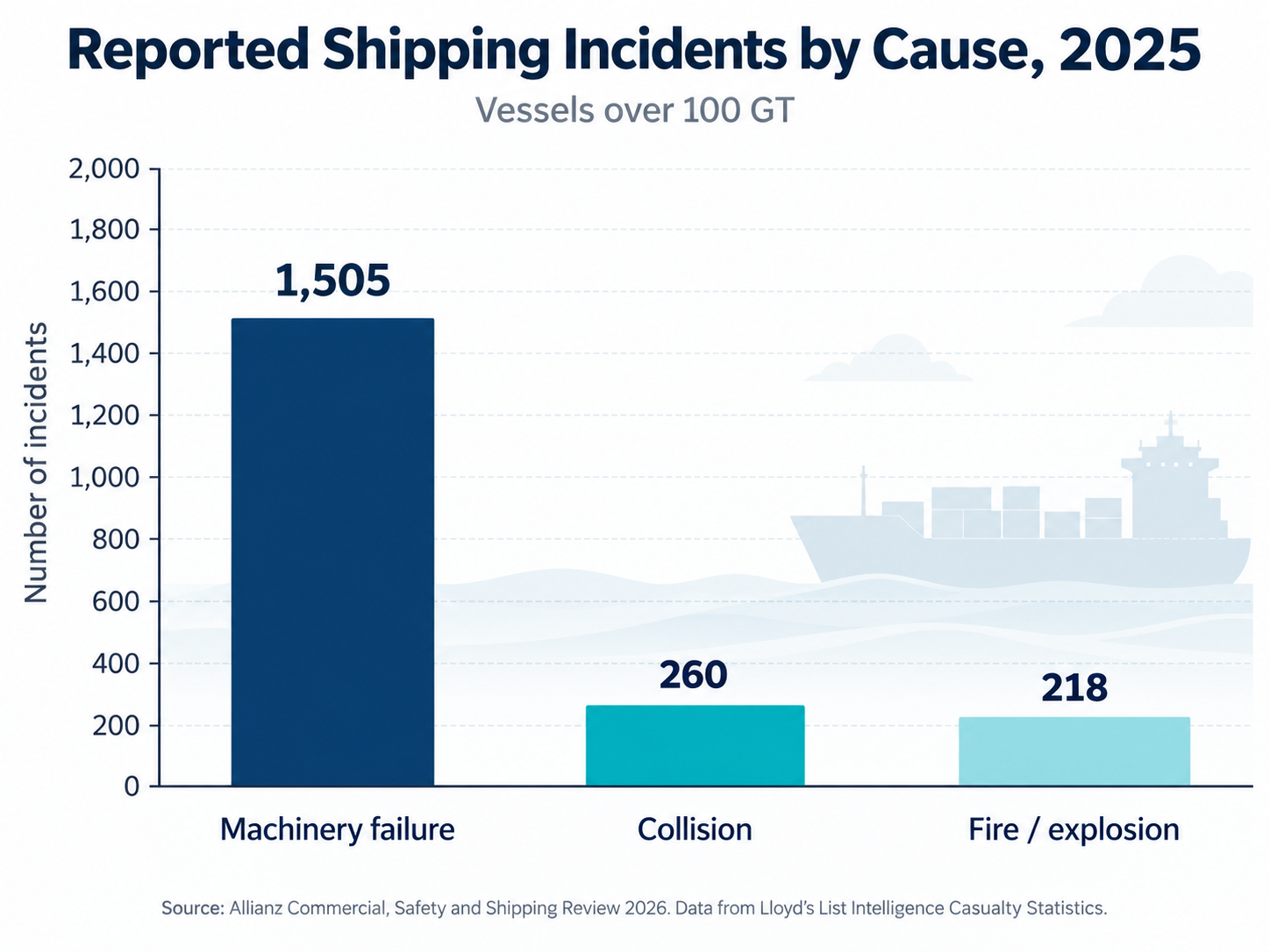
These challenges increase the need for maritime software solutions that improve operational efficiency, vessel reliability and technical decision-making.
Traditional maritime software helps manage:
While these functions remain essential, modern software must go further.
Fleet teams need connected information, searchable technical histories and faster access to relevant operational knowledge.
The goal is to move beyond storing data and use it to support faster, better-informed fleet decisions.
A technical superintendent may need information from several platforms to understand a single machinery problem.
Equipment manuals might be stored in a document management system. Maintenance activities may be recorded in vessel maintenance software. Previous defects could be available in a separate reporting application, while service recommendations remain in emails.
Each system serves a purpose, but the information is not always connected.
This creates additional work whenever engineers need to investigate recurring faults or prepare technical recommendations.
Experienced marine engineers develop valuable practical knowledge through years of troubleshooting.
However, that knowledge may not be consistently documented or easily accessible to other vessels.
When an engineer changes vessels or leaves the company, useful experience can become difficult to recover.
Modern maritime software solutions should help preserve previous troubleshooting knowledge so that it remains available across the fleet.
When a vessel reports a defect, shore teams often need additional information before recommending the next step.
They may request photographs, equipment details, alarm histories, operating conditions or previous maintenance records.
Without a shared view of the issue, communication can involve multiple exchanges.
Better-connected software can help ensure both shipboard and shore-based teams work from the same technical information.
A machinery issue may occur on one vessel and later appear on another vessel with similar equipment.
If defect records are not searchable across the fleet, the second crew may repeat much of the original investigation.
This can increase troubleshooting time and create avoidable operational delays.
Fleet managers may have access to multiple dashboards showing maintenance status, defects, inspections and vessel performance.
However, dashboards alone do not explain why a problem keeps occurring or which previous corrective actions were effective.
Operational visibility becomes more useful when teams can move from a reported problem to the supporting technical evidence.
Suggested supporting visual: Connected maritime operations linking vessel information with shore-based fleet teams.
One of the most valuable capabilities is the ability to access relevant technical information without searching multiple systems manually.
A connected maritime platform should help bring together:
The objective is not necessarily to replace every existing application.
Instead, it is to connect useful information so that engineers can find relevant answers more efficiently.
AI-powered maritime troubleshooting can help engineers retrieve relevant technical guidance, compare previous failures and identify possible causes requiring investigation.
Consider a generator that repeatedly trips during load changes.
A conventional workflow might require an engineer to review several manuals, inspect previous defect records and contact shore support.
An AI-assisted workflow can help retrieve relevant documentation and historical cases from connected sources.
The engineer can then review the evidence, conduct appropriate checks and determine the next action.
AI should support technical judgment rather than replace it. Equipment-specific procedures, maker guidance and safety requirements must remain authoritative.
Vessel maintenance software remains a core component of modern fleet operations.
It helps technical departments organize planned maintenance, equipment inspections, spare-parts requirements and maintenance histories.
However, maintenance information becomes more useful when connected with defect history and machinery performance.
For example, repeated pump seal failures may indicate an underlying operational or installation problem rather than simply a need for more frequent replacement.
By examining previous failures alongside maintenance records, teams can investigate recurring issues more systematically.
Shipboard crews and shore-based technical teams need access to consistent information.
When a defect is reported, the superintendent should ideally be able to review the relevant equipment details, previous failures and available documentation without repeatedly requesting the same records.
Connected maritime software solutions can support clearer communication by giving both sides a shared technical context.
This is particularly useful when vessels operate across different time zones or when urgent machinery problems require rapid coordination.
Every resolved technical problem can contribute to a fleet's operational knowledge.
However, this value is limited when corrective actions remain buried in individual vessel records.
A fleet intelligence platform can help teams identify similar defects, compare previous corrective actions and retrieve relevant experience from sister vessels.
This does not mean that a solution used on one vessel will automatically apply to another.
Equipment configuration, operating conditions and manufacturer requirements must always be checked.
Nevertheless, historical fleet knowledge can provide a useful starting point for technical investigations.
Fleet managers need visibility into issues that require attention, not simply large volumes of data.
Useful information includes recurring defects, unresolved technical issues, maintenance backlogs and patterns across similar machinery.
The ability to connect these indicators with supporting records helps teams prioritize investigations and follow-up actions.
Maritime AI systems should provide information that engineers can verify.
For safety-critical technical decisions, users should be able to identify the relevant source documents and understand the limitations of the AI-generated response.
AI recommendations should never override approved procedures, safety controls or the professional judgment of responsible personnel.
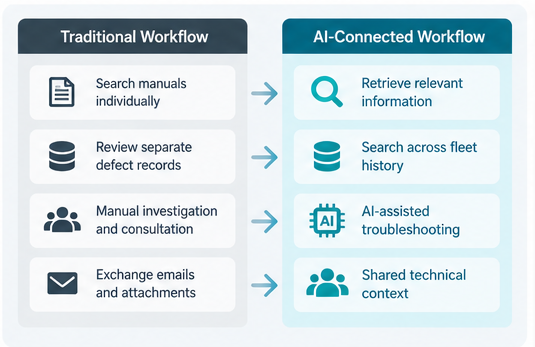
The main advantage is not that AI replaces existing ship management software.
It is that connected systems can make existing operational information easier to access and use.
Suggested supporting visual: Marine engineer investigating a machinery issue using digital technical information.
A vessel reports that its main engine is not starting as expected.
The engineering team needs to investigate relevant alarms, starting-air conditions, interlocks and equipment-specific instructions.
An AI-connected system can help locate the appropriate manual sections, previous defect reports and relevant troubleshooting procedures.
This can reduce time spent gathering information while allowing the engineer to focus on inspection, testing and fault identification.
A fleet manager notices repeated failures involving similar auxiliary pumps across several vessels.
The individual defects may have been closed, but their combined history could indicate a recurring technical problem.
Connected maritime software can help retrieve related defect reports and compare documented corrective actions.
The technical department can then assess whether further investigation, maintenance changes or OEM consultation is necessary.
A superintendent receives several machinery reports from vessels under their responsibility.
Instead of manually opening separate applications for every issue, a connected platform can help retrieve relevant documentation and previous cases.
This improves access to technical context and supports more informed discussions with onboard engineers.
These examples illustrate possible workflows, not guaranteed outcomes. Results depend on data quality, system integration and the specific operating environment.
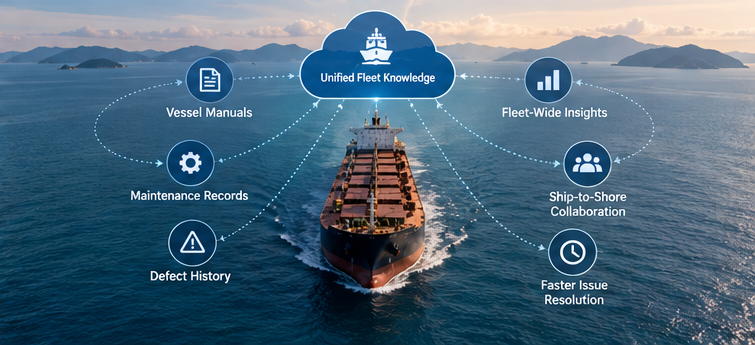
Many shipping companies already have maintenance systems, technical documentation repositories and defect reporting processes.
The challenge is making that information easier to use when a technical problem occurs.
This is where SmartSeas.AI becomes relevant.
SmartSeas.AI is an AI-powered maritime platform designed to help fleet teams access and use technical knowledge from connected sources.
It supports practical maritime workflows such as:
Rather than focusing only on another dashboard, SmartSeas.AI emphasizes making existing fleet knowledge more accessible for everyday technical decisions.
The objective is to help marine engineers and shore teams investigate problems efficiently while maintaining human oversight.
Suggested supporting visual: Shore-based technical team evaluating vessel information and operational priorities.
Selecting maritime fleet management software should begin with actual operational requirements rather than a long list of advertised features.
Identify where teams are losing time or facing recurring difficulties.
This could involve machinery troubleshooting, manual searches, maintenance planning or ship-to-shore communication.
A clearly defined problem makes it easier to evaluate whether a software solution provides measurable value.
Determine whether the platform can work with existing manuals, maintenance systems, defect records and document repositories.
Integration requirements should be confirmed before implementation.
Ask vendors to demonstrate their systems using representative vessel data.
A useful test might involve a recurring generator trip, a previous steering gear defect or a machinery issue requiring information from multiple sources.
The demonstration should show how the software retrieves evidence and supports the investigation.
For AI-powered systems, ask whether users can inspect the documents supporting an answer.
The platform should also handle missing or conflicting information appropriately rather than presenting unsupported conclusions.
Evaluate whether the software improves information retrieval, defect assessment, communication and issue resolution.
Useful metrics include:
Baseline measurements are important. Without them, it becomes difficult to determine whether a new software solution has improved operations.
Maritime digital transformation is not simply about introducing more applications.
Fleet operators should also consider the limitations of new technology.
Poor data quality: Incomplete defect descriptions, outdated manuals and inconsistent equipment identifiers can reduce the usefulness of connected information.
Integration complexity: Older software platforms may have limited interfaces or incompatible data structures.
Cybersecurity: Maritime software must follow appropriate access controls, data protection practices and cybersecurity requirements.
Crew adoption: A technically capable platform may deliver limited value if workflows are difficult to use or require excessive additional reporting.
AI reliability: AI-generated information may be incomplete or incorrect. Technical recommendations must remain subject to verification and human approval.
The IMO's maritime cyber risk management guidance provides a useful framework for considering cybersecurity within operational safety management.
Shipping companies do not need to replace every existing system to improve their digital workflows.
A more practical approach is to begin with one operational challenge.
For example, a fleet could start by improving access to technical manuals and historical defect records for a selected vessel group.
The implementation team can then evaluate whether engineers find relevant information faster and whether shore-based technical support becomes more efficient.
Once the workflow is established, the company can consider connecting additional maintenance records, procedures or operational systems.
Successful maritime digital transformation depends on clear objectives, reliable information, crew involvement and continuous evaluation.
Maritime software solutions have become essential to managing complex vessel operations.
However, the value of software should not be measured by the number of applications installed or dashboards available.
Modern fleet teams need reliable access to technical information, better visibility into recurring problems, efficient troubleshooting and stronger ship-to-shore coordination.
AI-connected platforms can help bridge the gap between stored operational data and practical technical decision-making.
For shipowners and managers, the priority should be selecting software that supports real operational workflows, integrates with existing systems and helps engineers make informed decisions.
Explore AI-powered maritime troubleshooting with SmartSeas.AI.
Discover how SmartSeas.AI helps fleet teams connect vessel manuals, defect history and technical knowledge to support faster issue resolution and more effective ship-to-shore collaboration.
Maritime software solutions are digital systems that help shipping companies manage vessel maintenance, fleet operations, technical defects, compliance, reporting and ship-to-shore coordination.
Connected software helps fleet teams access information across different systems, reduce manual searches and improve coordination between vessels and shore offices.
Maritime AI can help retrieve technical information, identify similar historical defects and support troubleshooting and operational decision-making.
Ship management software primarily manages operational records and workflows. Maritime AI software can help users retrieve, connect and interpret information from those records.
They can support downtime reduction by improving maintenance visibility, technical information retrieval, troubleshooting and access to previous corrective actions.
Fleet managers should prioritize integration capabilities, usability, technical reliability, cybersecurity, source traceability and measurable operational benefits.
SmartSeas.AI helps fleet teams access connected manuals, defect histories and technical knowledge to support machinery investigations and ship-to-shore decisions.

Get Started Today
Transform the way you troubleshoot and manage maritime operations. Join the next wave of Maritime Digital Transformation with SmartSeas AI.