.jpg)
September 30, 2026
How to Reduce Vessel Downtime from Repeated Machinery Failures

September 30, 2026
A generator trips during cargo operations. The engineering team investigates, replaces a component, tests the system and returns it to service.
Two weeks later, the same alarm appears.
The immediate repair may have worked, but the underlying problem was never fully resolved.
For fleet teams trying to reduce vessel downtime, repeated machinery failures are one of the most important problems to address. Every recurrence can create another cycle of troubleshooting, maintenance, testing, technical communication and operational uncertainty.
For critical machinery, recurring defects can also affect departure schedules, cargo operations and vessel reliability.
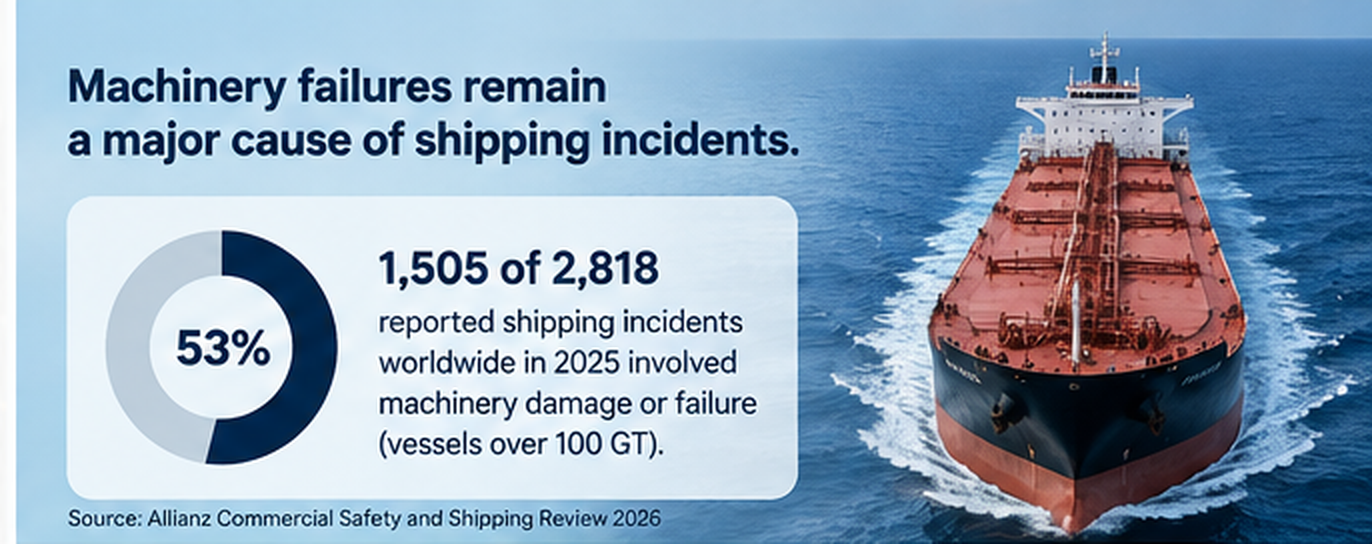
Allianz Commercial reported in its 2026 Safety and Shipping Review that machinery damage or failure accounted for 1,505 of 2,818 reported shipping incidents worldwide in 2025 involving vessels over 100 GT.
Reducing downtime therefore requires more than repairing equipment quickly. The real objective is understanding why failures occur, preventing them from returning and making previous technical knowledge easier to use across the fleet.
A machinery fault does not always stop a vessel immediately.
A standby pump might take over. A generator may restart. A temporary repair may allow operations to continue.
But recurring failures gradually reduce operational resilience.
Consider a vessel experiencing repeated cooling-water pump failures. Each time, the pump is repaired and returned to service. If the real problem is misalignment, poor suction conditions or another unresolved issue, replacing seals or bearings may only temporarily restore operation.
Eventually, the failure could happen when the standby equipment is unavailable or the vessel is operating under demanding conditions.
Repeated failures create several operational problems.
Every recurrence requires engineers to investigate the problem again.
They may have to check alarms, readings, manuals, maintenance history, previous defect reports and communication with shore teams before determining what happened.
If information from the previous incident is difficult to locate, much of the same investigation may be repeated.
Recurring defects consume engineering hours that could otherwise be used for planned maintenance and inspections.
Shore teams may also spend additional time reviewing the same problem, contacting manufacturers, sourcing parts and coordinating technical assistance.
The failed component may not be the actual cause of the problem.
For example, repeated bearing failure could be related to alignment, lubrication, vibration or operating conditions.
Replacing the bearing without correcting the underlying issue may allow the problem to continue and potentially damage other components.
Recurring problems affecting propulsion, steering, electrical generation, cooling or cargo systems can create serious operational disruption.
The concern is therefore not simply:
“How quickly can we repair this equipment?”
The better question is:
“Why did this happen, and what prevents it from happening again?”
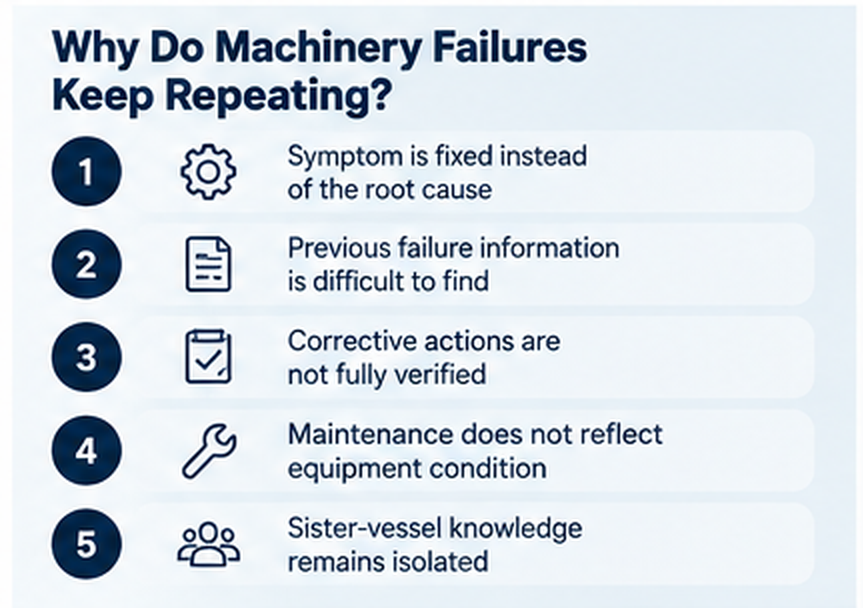
Repeated machinery failures rarely have one universal cause. They can result from equipment condition, maintenance practices, troubleshooting gaps, spare quality, operating conditions or poor access to previous technical information.
Several problems appear repeatedly across maritime operations.
One of the biggest troubleshooting risks is treating the visible failure as the entire problem.
Imagine a generator repeatedly tripping because of high temperature.
The crew may:
The generator then returns to service.
But the real cause might be restricted seawater flow, insufficient ventilation, incorrect operating conditions or another unresolved fault.
When troubleshooting stops as soon as equipment starts working again, the same failure can return.
Root-cause analysis is therefore particularly important for recurring technical problems.
Ships already generate large amounts of technical information.
Relevant information may exist in:
The problem is that these records are often stored separately.
During a fault, an engineer may need to search several systems before discovering that the same equipment experienced a similar issue six months earlier.
If previous corrective actions are buried in emails or incomplete defect reports, valuable troubleshooting knowledge can easily be missed.
A recurring problem can therefore look like a completely new failure.
Returning equipment to service does not necessarily prove that the problem has been solved.
A repaired pump might operate successfully during a short test but fail again after several hours under normal load.
For repeated machinery failures, technical teams need to verify whether the suspected root cause has actually been addressed.
Depending on the equipment, this may involve:
Without this follow-up, a temporary recovery can easily be mistaken for a permanent solution.
Planned maintenance remains fundamental to vessel reliability.
However, maintenance based only on calendar intervals or running hours may not identify every developing problem.
Equipment deterioration can also be influenced by:
Where appropriate, condition monitoring can provide additional evidence about machinery health.
For critical equipment with repeated failures, fleet teams should review whether existing maintenance intervals and inspection methods are still appropriate.
A fleet may operate several vessels with similar engines, generators, pumps or automation systems.
One vessel might spend hours investigating a difficult machinery problem and eventually identify the correct cause.
Months later, another vessel experiences the same symptoms.
If the earlier investigation remains buried in a defect report or email chain, the second engineering team may start the troubleshooting process from the beginning.
That creates avoidable downtime.
Fleet reliability improves when technical lessons from one vessel become searchable knowledge for other relevant vessels.
The UK Marine Accident Investigation Branch investigated repeated catastrophic main engine failures aboard the ro-ro passenger ferry Wight Sky.
The vessel experienced its second catastrophic main engine failure in less than a year in August 2018. A third engine failure occurred in December 2018 involving a newly built engine that had operated for only 389 hours.
Following the third failure, the operator withdrew its Wight Class ferries from service.
The investigation considered a history of engine problems across the fleet dating back several years and identified issues relating to technical oversight, maintenance management, quality control and machinery condition monitoring.
The case illustrates an important reliability principle:
Repeated failures should be investigated as a pattern, not simply treated as isolated repair events.
When the same or similar problem keeps appearing, the investigation should expand beyond the individual failed component.
The downtime associated with a recurring fault is not limited to the physical repair.
A recurring machinery problem often creates a wider operational cycle:
Fault occurs → Investigation → Information search → Diagnosis → Repair → Testing → Return to service
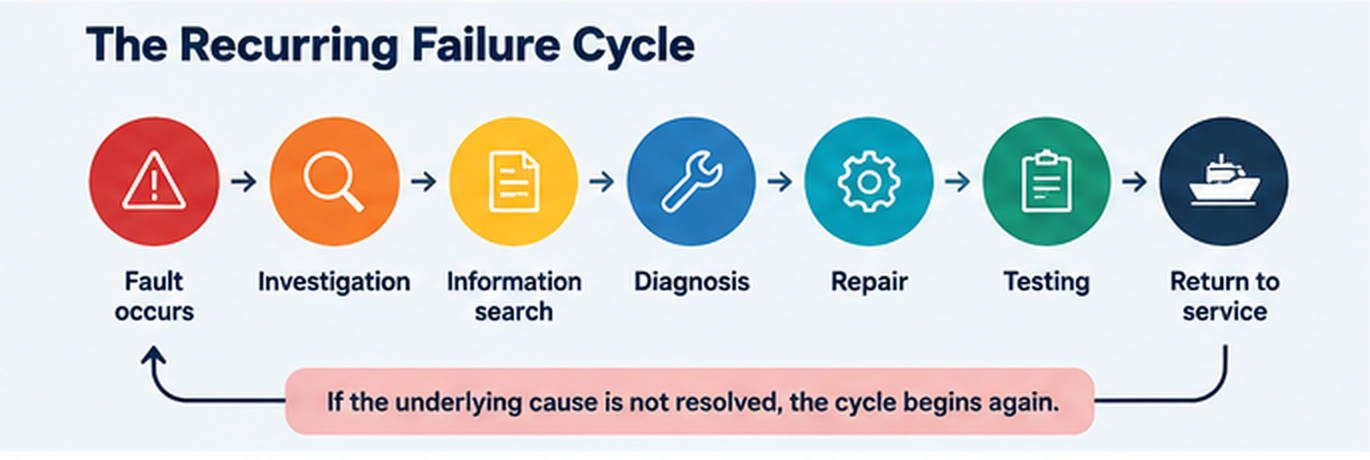
If the underlying cause remains unresolved, the same cycle begins again.
Additional delays can come from:
For fleet managers, reducing downtime therefore requires improving the entire troubleshooting process, not only reducing repair time.
The objective is not to replace engineering judgement.
It is to reduce unnecessary searching and give engineers better technical context before they make decisions.
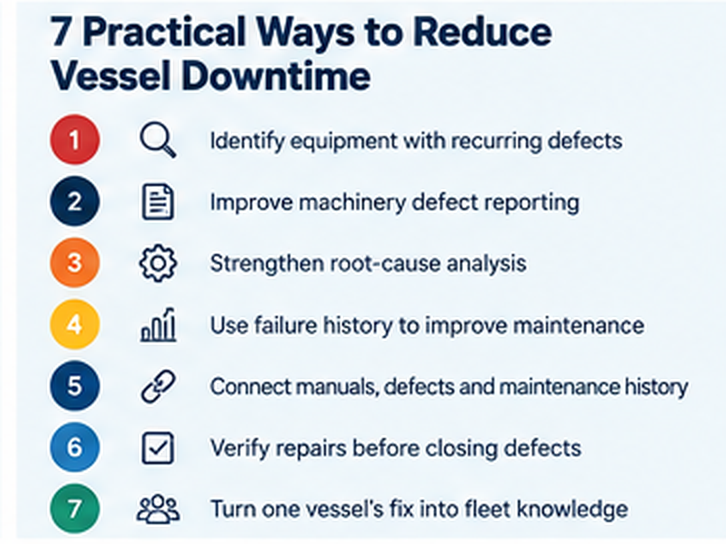
Start by identifying machinery that repeatedly appears in defect reports.
Look particularly at equipment affecting:
Do not evaluate failures only by frequency.
A fault occurring twice on critical equipment may deserve more attention than a minor issue occurring several times on non-critical machinery.
Combine failure frequency with operational consequence and equipment criticality.
A useful defect report should help the next engineer or superintendent understand what happened without reconstructing the entire incident.
Where relevant, capture:
If the fault has happened before, link the current case with the previous incident.
Better reporting makes recurring patterns easier to identify.
Repeated faults deserve deeper investigation.
Instead of asking only which component failed, ask:
Techniques such as cause-and-effect analysis, failure history review and fault-tree analysis can help structure the investigation.
For complex failures, OEMs, specialist technicians or classification societies may also need to be involved.
Historical defect information should influence future maintenance decisions.
If a component repeatedly fails before its scheduled inspection, review whether the existing maintenance interval is appropriate.
For suitable machinery, condition monitoring may help identify deterioration through parameters such as:
The objective is not to replace planned maintenance.
It is to make maintenance decisions more responsive to actual equipment behaviour.
During troubleshooting, engineers often need information from several sources.
They may need to compare:
Manual instructions + Previous defect + PMS history + OEM recommendation + Previous repair
Finding these records individually takes time.
Connecting technical information around the equipment makes previous experience easier to reuse and reduces unnecessary searching.
This becomes especially valuable when crews rotate and individual engineers may not know the vessel’s full defect history.
Recurring defects should not be considered resolved simply because the machinery restarted.
The repair should be verified under appropriate operating conditions.
Depending on the equipment, this might involve:
Technical teams should also review whether the replacement component and spare quality were appropriate.
Closing a defect too early can hide an unresolved reliability problem.
A successful troubleshooting investigation becomes more valuable when other vessels can learn from it.
Where applicable, record:
Then identify sister vessels operating similar equipment.
A recurring problem discovered on one vessel can become an early warning for the rest of the fleet.
That is how troubleshooting moves from reactive repair to fleet-wide reliability improvement.
AI can be particularly useful when technical teams need to work across large amounts of vessel information.
Consider a superintendent investigating another generator trip.
Relevant evidence may exist in:
Traditionally, these sources must be searched separately.
AI-powered maritime troubleshooting can help retrieve relevant information and present related technical records around the current issue.
For example, it can help engineers ask:
“Has this fault occurred before on this vessel?”
“What corrective action was previously taken?”
“Have sister vessels experienced similar failures?”
“Which manual sections are relevant to this alarm?”
This can reduce the time spent searching for technical context.
However, AI should support engineering judgement rather than replace it.
Engineers must still inspect machinery, verify physical conditions and confirm that technical recommendations are appropriate for the vessel and equipment involved.
This is where SmartSeas.AI becomes relevant.
SmartSeas.AI helps maritime teams connect technical information such as manuals, defect history, incident records and operational knowledge to support faster troubleshooting and better ship-to-shore decision-making.
For recurring machinery failures, this can help technical teams retrieve previous defect information, locate relevant documentation and understand whether similar problems have already occurred elsewhere in the fleet.
Instead of treating every fault as an isolated event, fleet teams can use previous operational knowledge as part of the current investigation.
The objective is practical: give engineers and superintendents faster access to relevant technical evidence while keeping qualified maritime professionals in control of the decision.
Repeated machinery failures increase vessel downtime because every recurrence creates another cycle of investigation, repair, testing and coordination.
The bigger problem is often not the individual failed component.
It is the failure to capture the lesson from the previous incident.
Fleet teams can reduce recurring defects by improving root-cause analysis, strengthening defect reporting, connecting maintenance and failure history, verifying repairs and sharing technical knowledge across sister vessels.
Condition monitoring and AI-powered maritime troubleshooting can further improve this process by helping technical teams identify patterns and access relevant information faster.
The goal is not simply to repair machinery more quickly.
It is to prevent the same problem from repeatedly consuming engineering time, increasing operational risk and taking vessels out of normal service.
If your fleet spends too much time searching manuals, reconstructing previous repairs or investigating familiar machinery faults, SmartSeas.AI can help connect technical information and make previous fleet knowledge easier to use.
Explore how SmartSeas.AI supports AI-powered maritime troubleshooting, operational clarity and faster technical decision-making.
Common causes include unresolved root causes, equipment deterioration, poor maintenance, unsuitable components, operating conditions and incomplete troubleshooting.
Each recurrence creates additional troubleshooting, repair, testing and ship-to-shore coordination, increasing the total time equipment remains unavailable.
Improve root-cause analysis, defect reporting, condition monitoring, maintenance planning, repair verification and fleet-wide knowledge sharing.
Preventive maintenance follows planned intervals. Predictive maintenance uses equipment condition and operational data to identify developing problems.
It helps identify why a failure occurred so the corrective action addresses the underlying problem rather than only the visible symptom.
Yes. AI can help retrieve previous defects, manuals and similar fleet cases faster, supporting engineers during troubleshooting.
Similar vessels may use the same machinery. A failure discovered on one vessel can provide an early warning or useful troubleshooting evidence for others.

Get Started Today
Transform the way you troubleshoot and manage maritime operations. Join the next wave of Maritime Digital Transformation with SmartSeas AI.




.svg)


.png)