November 23, 2026
What Happens to a Vessel's Troubleshooting Knowledge When an Experienced Engineer Signs Off?
November 23, 2026
A Chief Engineer signs off after a four-month contract. During that time, they resolved several machinery problems, spotted recurring equipment faults and learned which troubleshooting approaches work best on that particular vessel.
The planned maintenance system holds the service records. The defect management system holds the reports. The handover notes describe outstanding technical issues.
But how much of the engineer's actual troubleshooting experience stays accessible to the next crew?
This is one of the most overlooked gaps in managing vessel troubleshooting knowledge. Shipping companies invest heavily in technical documentation, vessel maintenance software and crew training. Yet valuable operational experience can stay with individual engineers rather than becoming reusable knowledge for the vessel and the wider fleet.
When that experience isn't captured, the next engineer may spend hours investigating a problem someone on board has already solved. The challenge isn't only retaining experienced people. It's making sure their technical knowledge keeps supporting vessel operations after they sign off.
Consider an illustrative engineering situation.
An auxiliary engine experiences intermittent starting difficulties. The Chief Engineer reviews the manufacturer's manual, checks several components and eventually traces the fault to the starting-air control arrangement.
The problem is corrected, the equipment is tested and the vessel returns to normal operation. The engineer records the repair in the defect management system.
However, the report may contain only a short description:
"Starting failure investigated. Faulty control component replaced. Equipment tested satisfactory."
What the report may not explain is equally important:
These details are practical troubleshooting knowledge. They explain not only what was repaired, but how the engineer reached the right conclusion.
When this reasoning isn't documented, future crews can see the repair record without understanding the investigation behind it.
Experienced marine engineers build familiarity with equipment behaviour through repeated exposure to operating conditions, failures and repairs. They may recognise unusual vibration patterns, intermittent alarms or behaviour that is hard to interpret from a manual alone.
That experience helps them separate symptoms from root causes. Structured ship system diagnostics records show what was found; they rarely show the instinct that pointed the engineer there.
Such knowledge is usually shared through conversations, personal notes and informal discussions rather than structured technical records. When an engineer signs off, the vessel keeps its maintenance history but can lose part of the practical reasoning built up during that contract.
Crew rotation is a normal and essential part of maritime operations. Engineers regularly join and leave vessels, while technical superintendents may oversee several ships with different equipment and maintenance histories.
The challenge arises when important technical knowledge is tied to the person who discovered it rather than to the equipment or vessel.
A handover has a lot to cover:
In that limited time, a detailed account of every past machinery fault isn't practical. Resolved problems naturally get less attention than open ones.
Two experienced engineers may troubleshoot the same fault in different ways. One remembers a similar failure from an earlier vessel; another starts with the OEM troubleshooting procedure.
Both approaches are valuable. But when earlier diagnostic findings aren't accessible, each engineer may repeat investigations that have already been done.
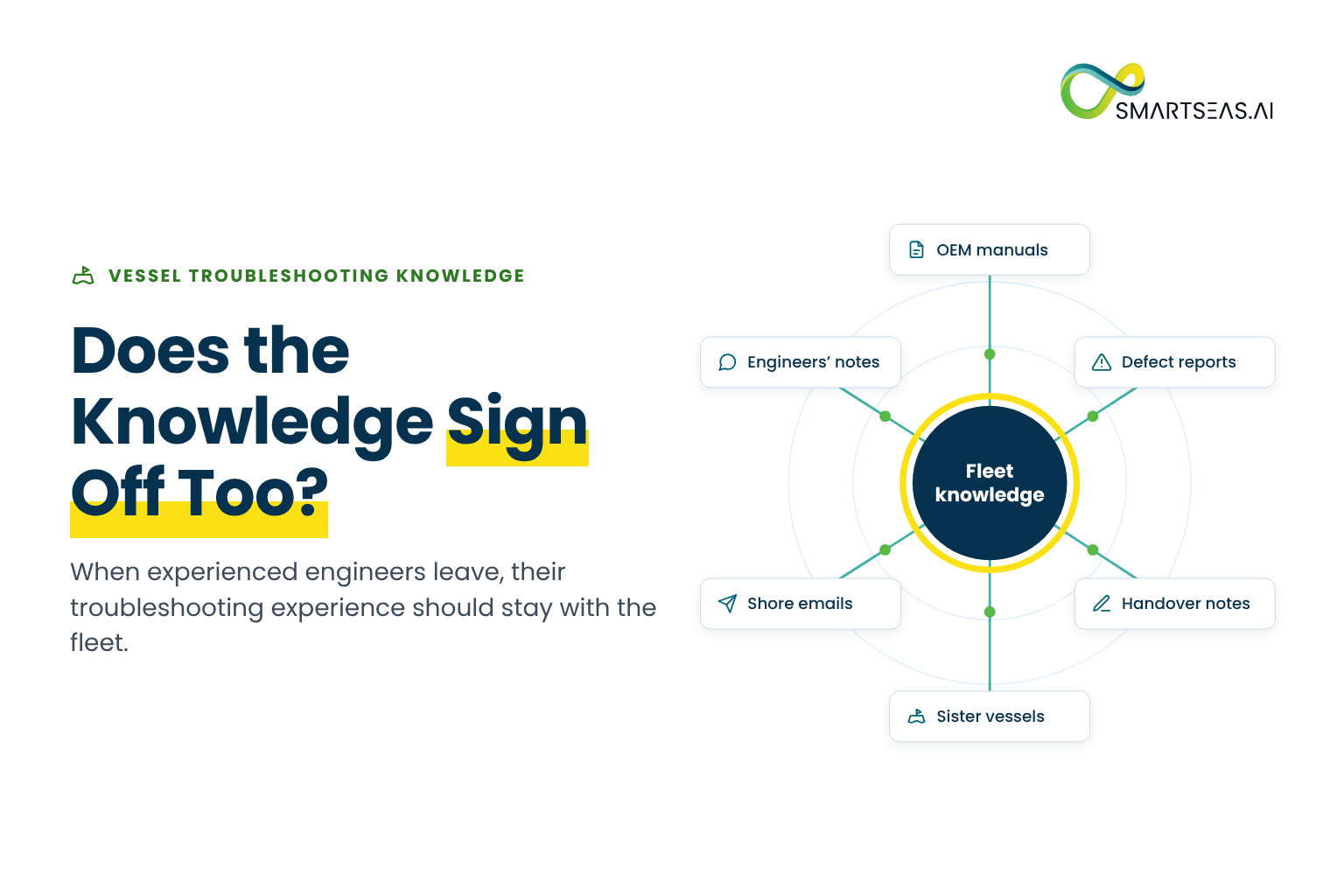
Useful troubleshooting information often sits in several places at once:
The information usually exists somewhere in the organisation. The problem is making it accessible when the next engineer needs it.
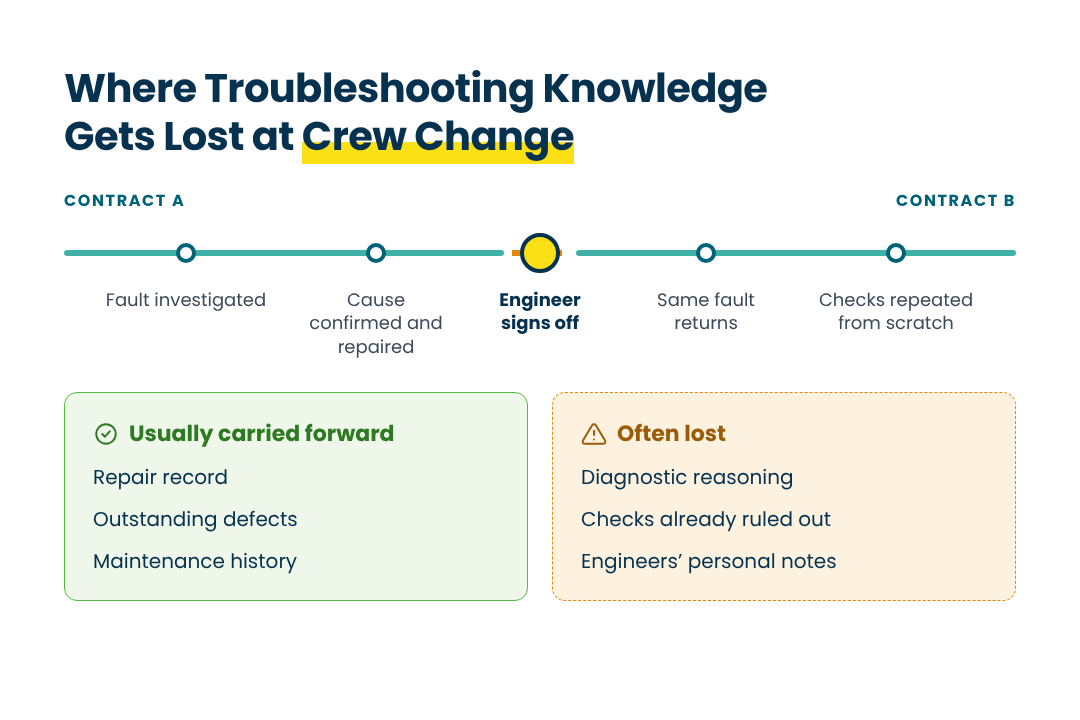
Where troubleshooting knowledge gets lost at crew change.
Imagine a vessel with repeated low-pressure alarms on an auxiliary cooling-water system. This example is illustrative.
During an earlier voyage, the previous engineering team traced the issue to a partially obstructed sensing line. They corrected it, and the vessel operated normally.
Several months later, the same alarm returns. The new team checks the pump, filters, valves and instrumentation. These checks are reasonable, but the team doesn't know about the earlier sensing-line finding.
The previous solution is recorded somewhere in the vessel's technical history. It just isn't immediately available, so the engineers spend extra time investigating a familiar problem.
A repeated machinery fault doesn't always need new technical knowledge. Sometimes it needs better access to knowledge the fleet already has.
When past troubleshooting experience is hard to retrieve, fleet teams can face longer fault investigations, repeated diagnostic work, extra ship-to-shore communication and slower recognition of recurring failure patterns. Each of these chips away at maritime operational efficiency.
The effect grows when similar equipment is installed across several vessels. A problem resolved on one ship could give useful diagnostic context to another. Without a way to share that experience, each vessel keeps its own isolated troubleshooting history.
For a deeper look at recurring faults, see our guide to reducing vessel downtime from repeated machinery failures.
Most shipping companies already run maritime fleet management software, planned maintenance systems, defect databases and document repositories. These are essential for structured records.
But storing information and making it useful for the next investigation are different requirements.
A maintenance record can confirm that a component was replaced. A useful troubleshooting record also explains why the component was suspected, what evidence supported the diagnosis and whether the fix resolved the original symptoms.
Without that context, future engineers struggle to judge whether a previous repair is relevant to their fault.
Suppose one engineer reports "auxiliary engine starting failure". Another records a similar event as "starting-air control malfunction". A third writes "engine fails to turn during start sequence".
The cases may be technically related, but a conventional keyword search may not return all three. The gap widens across fleets with different equipment models, terminology and reporting habits.
A technical superintendent may know another vessel had a similar failure. Finding the report can still mean searching several systems or calling colleagues.
That creates unnecessary dependence on individual memory and personal networks. The next stage of maritime digital transformation should focus not only on recording operational information, but on connecting it to the technical decisions crews make.
Machinery remains shipping's most common source of reported incidents. According to Allianz Commercial's Safety and Shipping Review 2026, machinery damage or failure accounted for 1,505 of the 2,818 incidents reported in 2025 on vessels over 100 GT. That is 53%, far ahead of collisions (260) and fires or explosions (218).
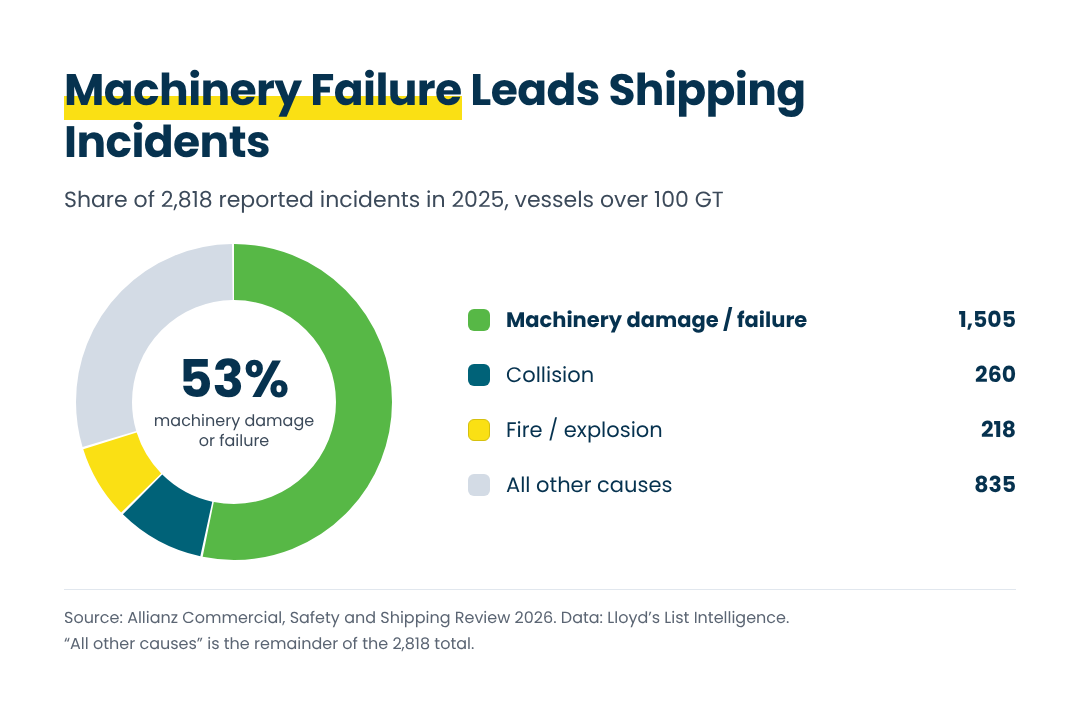
Source: Allianz Commercial, Safety and Shipping Review 2026; data from Lloyd's List Intelligence. Vessels over 100 GT.
These figures don't show that crew changes cause machinery incidents. They show why reliable technical knowledge and effective troubleshooting remain operational priorities.
Safety management requirements also stress systematic learning. Section 9 of the ISM Code covers reporting and analysis of non-conformities, accidents and hazardous occurrences, including corrective action to prevent recurrence. Section 10 covers maintenance of the ship and equipment, and Section 11 covers documentation.
Preserving useful troubleshooting experience supports these objectives. A digital knowledge platform does not, on its own, establish regulatory compliance.
For ship managers, the practical question is becoming more pressing: how can a fleet make sure technical experience gained during one contract stays useful across future crew rotations?
Artificial intelligence offers a practical way to improve how maritime organisations retrieve and reuse technical experience. The aim isn't to replace an engineer's judgement. It's to make relevant history easier to find, understand and verify.
AI-powered maritime troubleshooting can help teams search across sources that would otherwise need separate investigations. Depending on the data available and how systems are integrated, this can include OEM manuals, technical defect records, incident reports, maintenance history and earlier troubleshooting discussions.
An engineer investigating repeated pump pressure fluctuations, for example, could search by that symptom instead of guessing the exact wording used in an old defect report. A suitable system can return relevant historical cases alongside the applicable technical documentation.
The benefit is clearest when experienced engineers leave a vessel. Incoming crew no longer depend entirely on the outgoing engineer's memory; they can consult documented earlier investigations.
The knowledge stays attached to the vessel, the equipment and its technical history, not to one individual.
AI-assisted search can also help technical superintendents find similar issues across sister vessels, where records and permissions allow. Sharing troubleshooting lessons across sister vessels turns one ship's solution into a starting point for another with comparable machinery.
The engineer must still verify equipment configuration, operating conditions and applicability before using an earlier solution. AI can make experience more accessible. It cannot make incomplete or incorrect records reliable.
The difference is not that AI does the engineer's work. It's that the engineer spends less time searching and more time evaluating the technical problem.
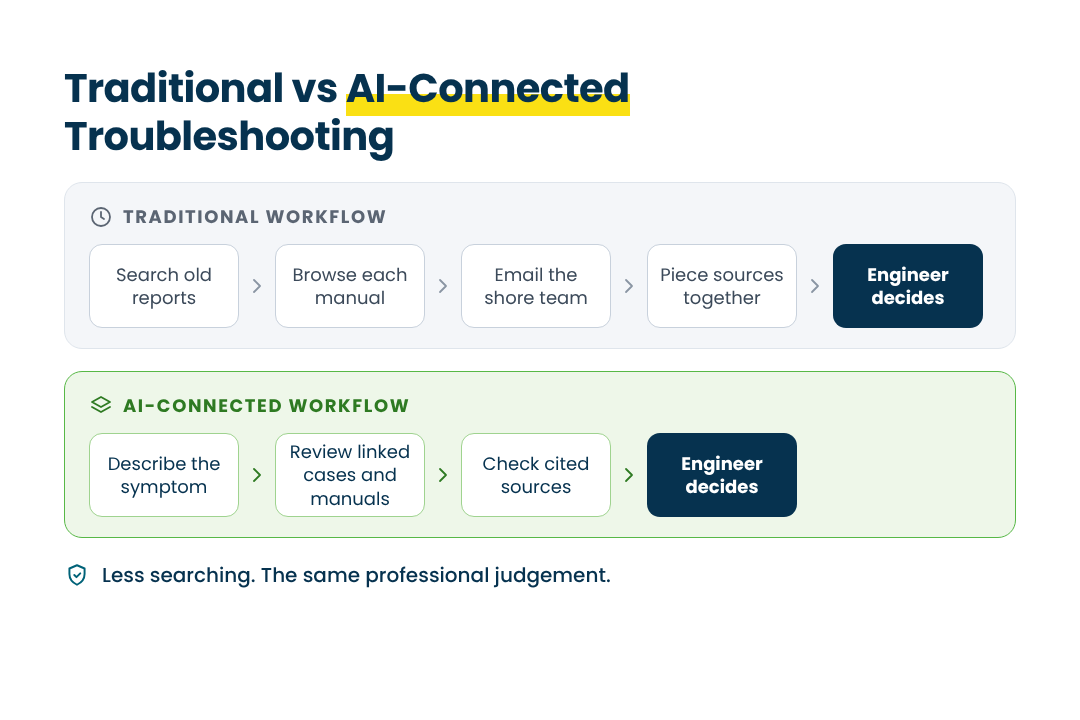
Traditional vs AI-connected troubleshooting: in both workflows, the engineer decides.
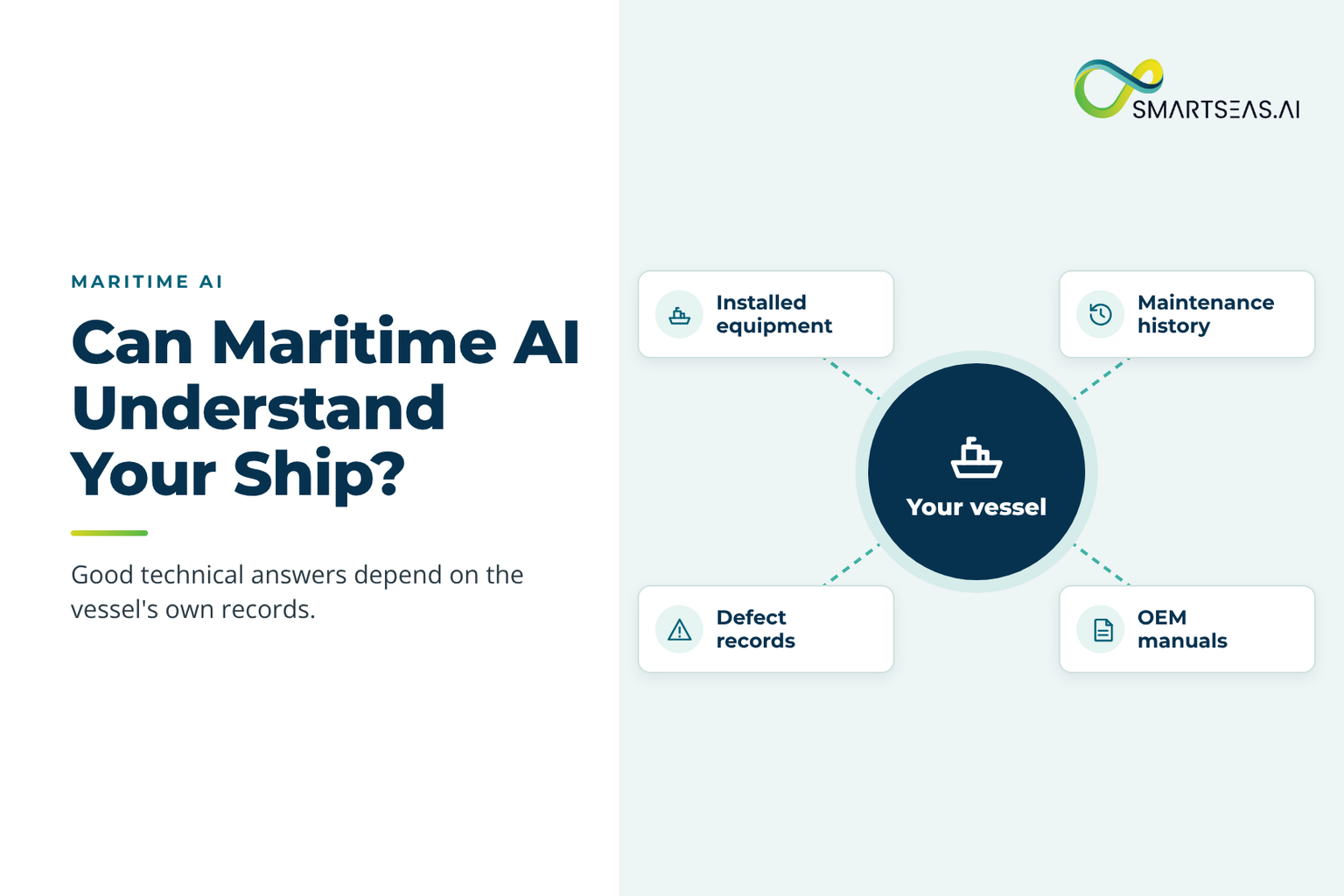
SmartSeas.AI is a Maritime AI platform that helps ship and shore technical teams reach relevant operational knowledge during troubleshooting. It connects technical manuals, previous defects and historical fleet knowledge so engineers and superintendents can investigate with better context.
When an incoming engineer meets a machinery fault, SmartSeas.AI can help retrieve the relevant equipment documentation and available previous defect cases, including similar sister-vessel experience where those records are accessible. Instead of running several separate searches, the engineer reviews related information together and checks its sources.
This supports three operational needs:
The platform supports technical decision-making. Responsibility for diagnosis, safety checks and corrective actions stays with qualified personnel.
Technology improves access, but retention also depends on operational discipline. Fleet managers can build a simple process around five habits.
IACS Recommendation 74, a guide to managing maintenance under the ISM Code, likewise encourages feeding lessons learned back into the maintenance system. For more on the downtime side, see these practical ways to reduce vessel downtime across the fleet.
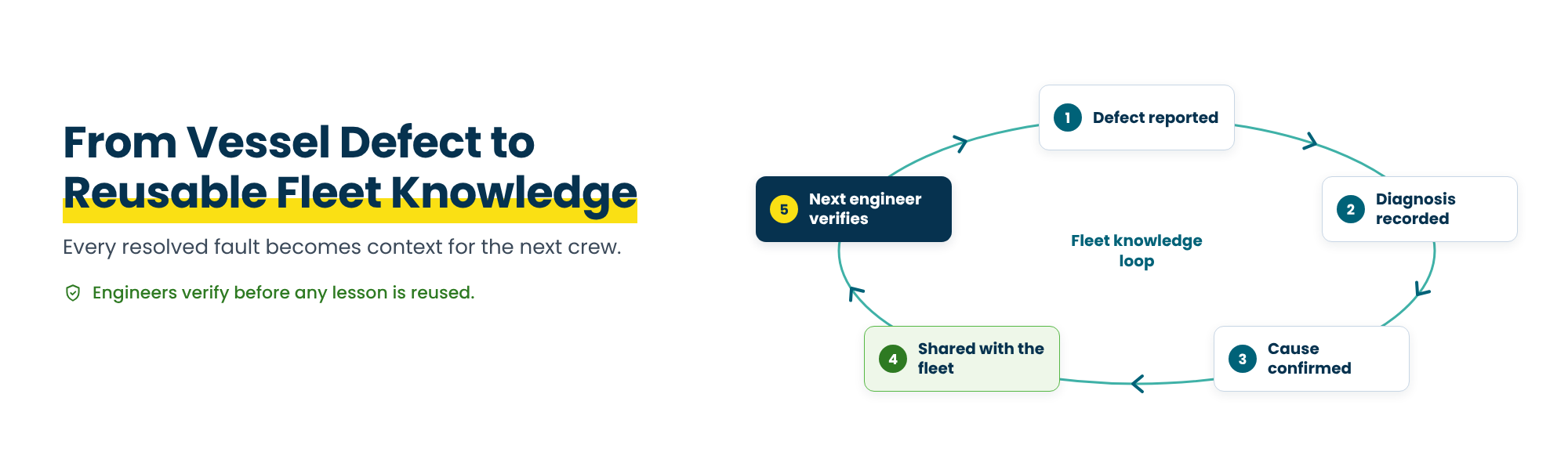
From vessel defect to reusable fleet knowledge.
Preserving troubleshooting knowledge doesn't mean treating every past repair as a recommended solution. A fault that looks similar may have a different root cause. Equipment modifications, operating conditions, maintenance history and OEM updates can all change the right approach.
AI systems can also retrieve irrelevant information, misread technical context or produce unsupported conclusions. Fleet teams should require source references, confirm equipment applicability and separate verified findings from possible causes. Our guide on how ship engineers verify AI technical answers covers this in detail.
Critical corrective actions must remain subject to the applicable OEM instructions, the vessel's safety management system and qualified engineering judgement. When evaluating platforms, it also helps to know what to look for in AI-driven maritime solutions.
The goal is to preserve experience without turning yesterday's assumptions into tomorrow's mistakes.
Every experienced marine engineer carries practical knowledge built over years of troubleshooting, maintenance and operating machinery at sea.
Crew changes are inevitable. Losing access to that experience doesn't have to be.
When shipping companies capture diagnostic reasoning, connect historical records and make earlier investigations searchable, future crews avoid unnecessary repetition. That is how vessel troubleshooting knowledge keeps growing with every resolved problem, whoever is on board.
The next engineer should inherit more than a maintenance record. They should inherit the lessons behind it.
It is the practical knowledge built from earlier fault investigations: equipment symptoms, diagnostic checks, corrective actions, OEM guidance and lessons from machinery failures.
Diagnostic reasoning often stays in personal notes, informal conversations or brief defect reports instead of structured fleet records. When the engineer leaves, that reasoning becomes hard to reach.
Beyond outstanding defects and machinery condition, it should cover recently resolved recurring faults, the checks already ruled out and where the related investigation records are stored.
Standardise defect reporting, document diagnostic findings, strengthen technical handovers and make historical troubleshooting information accessible to authorised fleet teams.
Yes. AI-assisted systems can retrieve relevant historical defects, technical manuals and earlier investigations, helping incoming engineers understand documented equipment problems faster.
Manual searches usually depend on exact keywords and separate repositories. AI-powered search can find related records across connected sources using natural-language questions and technical context.
Yes, when equipment specifications and operating conditions are comparable. Engineers must verify that earlier findings apply before using them.
No. AI supports information retrieval and analysis. Qualified engineers remain responsible for evaluating evidence, diagnosing faults and approving corrective actions.
Explore how SmartSeas.AI helps fleet teams connect technical knowledge and operational experience.

Get Started Today
Transform the way you troubleshoot and manage maritime operations. Join the next wave of Maritime Digital Transformation with SmartSeas AI.