October 21, 2026
Marine Operations Software: How AI Connects Vessel Knowledge and Shore Teams


October 21, 2026
A machinery fault occurs onboard a vessel. The engineering team checks the equipment, reviews technical manuals, searches maintenance records, and contacts the shore office for guidance.
The technical superintendent may then need to examine emails, previous defects, and service reports before recommending the next action.
Often, the problem is not a lack of technical knowledge. The information already exists within the fleet but is difficult to access when needed.
Marine operations software helps solve this challenge by connecting vessel information, technical records, and shore-based teams. With artificial intelligence, these platforms can make troubleshooting knowledge easier to retrieve, improve operational visibility, and support faster technical decisions.
Marine operations software helps shipping companies manage and coordinate vessel operations, including maintenance, technical management, defect reporting, and ship-to-shore communication.
Traditional systems primarily organize data and operational workflows. AI-enabled solutions extend these capabilities by connecting information from multiple sources and helping users find relevant technical knowledge.
For example, investigating a recurring generator failure may require:
When this information is stored separately, engineers spend valuable time searching different systems.
AI-supported vessel knowledge management makes relevant information easier to locate while keeping technical decisions under human supervision.
Shipping companies face increasing pressure to maintain vessel reliability, improve operational efficiency, and manage technical risks.
According to Allianz Commercial's Safety and Shipping Review 2026, machinery damage and failure remained a leading category of reported shipping incidents during 2025.
Even when a failure does not result in a major casualty, it can disrupt operations, increase repair costs, and affect vessel schedules.
Modern vessels generate maintenance records, inspection findings, defect reports, equipment alarms, and technical communications.
However, having more information does not automatically improve decision-making.
When records are disconnected, engineers and superintendents may struggle to find the information needed to resolve a problem.
The International Maritime Organization (IMO) has also emphasized the importance of interoperability, system standardization, and data sharing through its 2026 Maritime Digitalization Strategy, highlighting the need for more connected information systems across the shipping industry.
Onboard engineers understand the immediate machinery condition, while shore teams may have access to previous defects and wider fleet experience.
Effective ship-to-shore communication requires combining both perspectives.
Connected marine operations software helps teams work with more consistent technical information instead of relying entirely on repeated emails and clarification requests.
The IMO's International Safety Management (ISM) Code establishes an international framework for safe ship operations and effective safety management, reinforcing the importance of coordination between onboard personnel and shore-based management.
Most shipping companies already possess valuable technical information. The challenge is making that knowledge accessible and reusable.
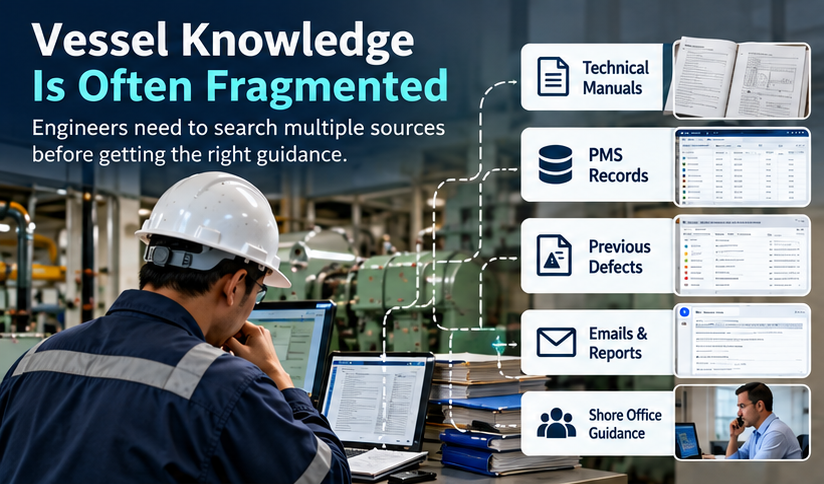
Equipment manuals contain operating limits, maintenance instructions, and troubleshooting procedures.
However, finding the correct section can be time-consuming, particularly when vessels use different machinery models or manual revisions.
A machinery failure may already have been resolved on another vessel.
If the earlier solution remains buried in a defect report or service record, engineers may repeat the same investigation.
Technical discussions often include fault observations, repair recommendations, photographs, and confirmations.
When these details remain inside individual email threads, they become difficult to retrieve and share across the fleet.
Technical superintendents manage several vessels, often with different reporting structures and documentation systems.
Disconnected records make it harder to compare recurring failures, monitor technical issues, and identify fleet-wide reliability concerns.
AI in maritime operations helps engineers and superintendents retrieve, interpret, and reuse technical information across connected systems.
Rather than searching multiple repositories separately, users can access relevant information through a unified knowledge layer.
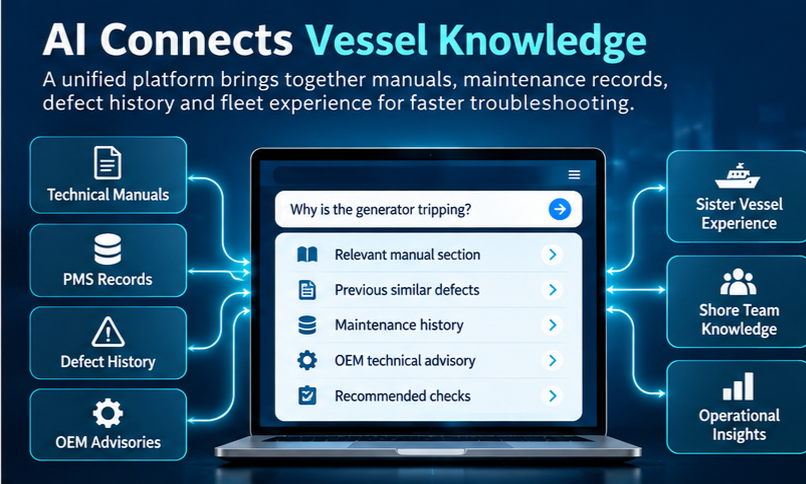
An AI-enabled platform can connect equipment manuals, PMS records, defect reports, and approved technical procedures.
For example, an engineer investigating low lubricating oil pressure could retrieve relevant instructions, historical defects, and maintenance findings from connected sources.
This reduces manual searching without necessarily replacing existing fleet management systems.
AI-powered maritime troubleshooting can identify previous incidents involving similar equipment, symptoms, and corrective actions.
Engineers can compare current observations against historical findings to support root-cause investigations.
Previous fixes must still be verified against the current equipment condition.
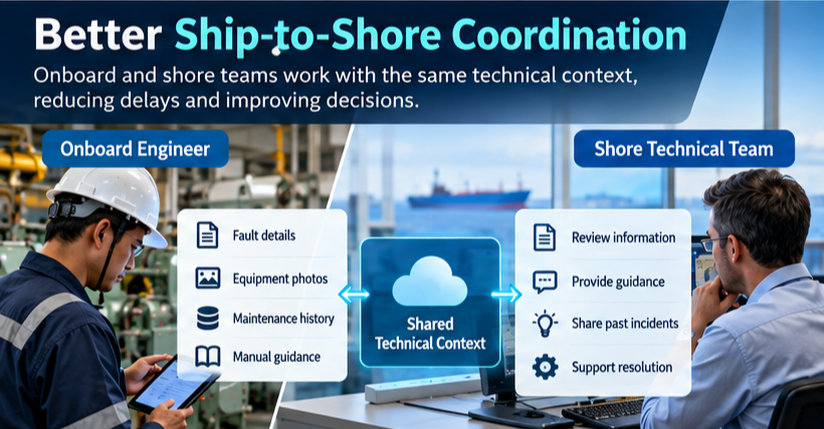
A useful technical report includes machinery identification, alarms, operating conditions, maintenance history, and actions already taken.
Connected marine operations software helps organize this information so shore-based teams can evaluate issues with better context.
A successful repair on one vessel may help another vessel operating similar equipment.
Making verified repair history searchable allows technical teams to reuse experience and develop more consistent troubleshooting practices.
The objective is not to replace engineering expertise but to make relevant technical information easier to access and use.
A vessel experiences difficulty starting its main engine.
Engineers investigate the starting air system, control logic, interlocks, and applicable alarms.
With connected vessel knowledge management, they can retrieve relevant troubleshooting procedures, previous starting failures, maintenance records, and OEM instructions.
This helps structure the investigation while engineers verify the actual machinery condition and follow approved procedures.
An auxiliary generator experiences repeated trips.
Previous repair records indicate that similar symptoms occurred several months earlier.
AI-assisted retrieval can help identify the historical defect, suspected causes, previous corrective actions, and follow-up findings.
This information supports more effective root-cause analysis and reduces unnecessary repetition of earlier investigations.
A technical superintendent manages vessels experiencing pump failures, electrical faults, and maintenance-related issues.
Without connected information, reviewing separate systems and emails can take considerable time.
AI-supported maritime fleet management software helps organize relevant records, allowing the superintendent to focus on technical priorities and corrective actions.
These are illustrative operational examples, not independently measured performance results.
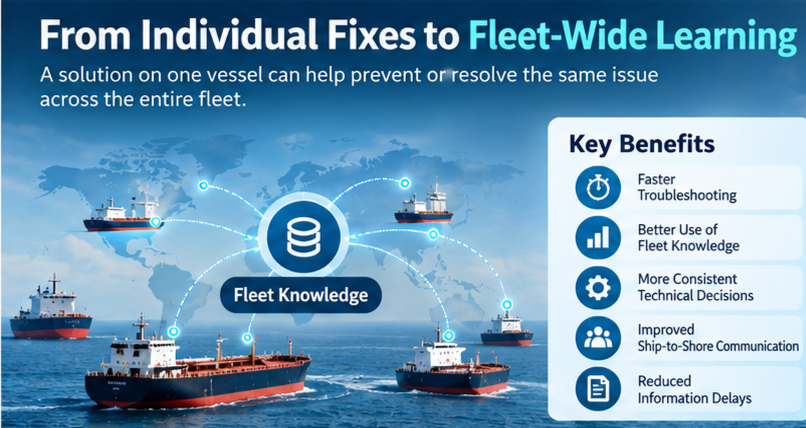
Marine operations software can improve maritime operational efficiency by reducing information delays and supporting better technical coordination.
Engineers can retrieve relevant manual sections, defect history, and technical guidance without repeatedly searching disconnected records.
Previous repairs and troubleshooting experience become more valuable when engineers across the fleet can access them.
This also helps preserve knowledge during crew changes and personnel rotations.
Access to approved procedures and historical findings supports structured investigations and more consistent corrective-action planning.
When vessel and shore teams use the same technical context, communication becomes clearer and unnecessary clarification requests may decrease.
Faster access to relevant information can help reduce troubleshooting delays.
However, actual downtime reduction also depends on equipment condition, spare-parts availability, crew competence, and repair effectiveness.
This is where SmartSeas.AI becomes relevant.
SmartSeas.AI is an AI-powered maritime platform that helps vessel crews and shore-based technical teams access and use technical knowledge more effectively.
By connecting equipment manuals, technical defects, incident reports, and previous troubleshooting experience, SmartSeas.AI supports practical maritime decision-making.
Engineers can use natural-language questions to search relevant manuals, historical defects, and troubleshooting information.
This helps reduce the effort required to locate supporting technical knowledge.
Equipment manuals explain how machinery should operate, while defect records document previous failures and corrective actions.
SmartSeas.AI helps connect these information sources, providing engineers with more useful technical context.
Shared access to technical information helps onboard personnel and superintendents understand equipment problems and coordinate appropriate responses.
SmartSeas.AI helps make historical troubleshooting experience easier to retrieve, allowing teams to learn from previous machinery problems instead of repeatedly starting investigations from the beginning.
The platform supports engineering judgment rather than replacing established technical and safety procedures.
Shipowners should evaluate marine operations software based on actual operational requirements rather than the number of advertised features.
Look for compatibility with existing maintenance systems, technical documents, defect databases, and operational reporting platforms.
AI-generated technical information should be supported by identifiable manuals, historical records, or approved procedures.
Users must be able to verify information before acting on it.
Consider offline capabilities, synchronization, and information availability when internet connectivity is limited.
Software should simplify existing workflows without creating additional reporting work for engineers or superintendents.
A phased approach helps shipping companies evaluate AI capabilities without unnecessarily disrupting existing operations.
AI effectiveness depends on the accuracy and quality of connected information.
Outdated manuals, incomplete defect reports, and incorrect equipment identification can produce misleading results.
AI may also generate technical explanations that appear reliable but are inaccurate.
Shipping companies should maintain source verification, document version control, cybersecurity safeguards, and human oversight for safety-critical decisions.
AI should strengthen existing safety management processes, not bypass them.
The IMO's Guidelines on Maritime Cyber Risk Management also recommend identifying, assessing, and managing cybersecurity risks to strengthen the safety and operational resilience of maritime systems.
Marine operations software is becoming increasingly valuable as shipping companies seek better access to technical information and stronger coordination between vessels and shore teams.
AI helps connect manuals, historical defects, previous repairs, and operational records, making relevant information easier to retrieve and apply.
For fleet managers and technical superintendents, this supports more efficient troubleshooting, better fleet visibility, and improved use of existing maritime knowledge.
SmartSeas.AI supports this approach by connecting technical knowledge and helping maritime teams make more informed operational decisions.
Explore AI-Powered Maritime Troubleshooting with SmartSeas.AI.
Discover how connected manuals, defect history, and fleet knowledge can support your technical teams.
Visit SmartSeas.AI
Marine operations software helps shipping companies manage vessel maintenance, technical records, operational reporting, and ship-to-shore coordination.
AI connects technical information, historical defects, and troubleshooting knowledge to support faster information retrieval and better decisions.
Marine operations software focuses on operational workflows, while ship management software may also include crewing, finance, procurement, and compliance.
It provides shared access to technical information, reducing unnecessary clarification and improving coordination between onboard and shore teams.
AI can reduce information-related troubleshooting delays by helping engineers find relevant manuals, previous defects, and repair history.
Many solutions support integrations with maintenance systems, document repositories, and technical databases, depending on compatibility.
SmartSeas.AI connects technical manuals, defect history, and troubleshooting knowledge to support vessel crews and shore-based teams.
Key considerations include technical accuracy, system integration, source traceability, cybersecurity, onboard connectivity, and ease of use.

Get Started Today
Transform the way you troubleshoot and manage maritime operations. Join the next wave of Maritime Digital Transformation with SmartSeas AI.