.jpg)
September 22, 2026
7 Practical Ways to Reduce Vessel Downtime Across the Fleet


September 22, 2026
A generator trips during cargo operations. A cooling-water pump starts losing pressure. A purifier fault that appeared on one vessel six months ago suddenly appears on another.
The immediate challenge is fixing the equipment. The larger challenge is preventing the fault from becoming hours or days of operational disruption.
To reduce vessel downtime, shipowners and managers need more than scheduled maintenance. They need better fault reporting, earlier visibility of machinery deterioration, faster access to technical knowledge, stronger spare-parts readiness and a way to reuse lessons from previous failures across the fleet.
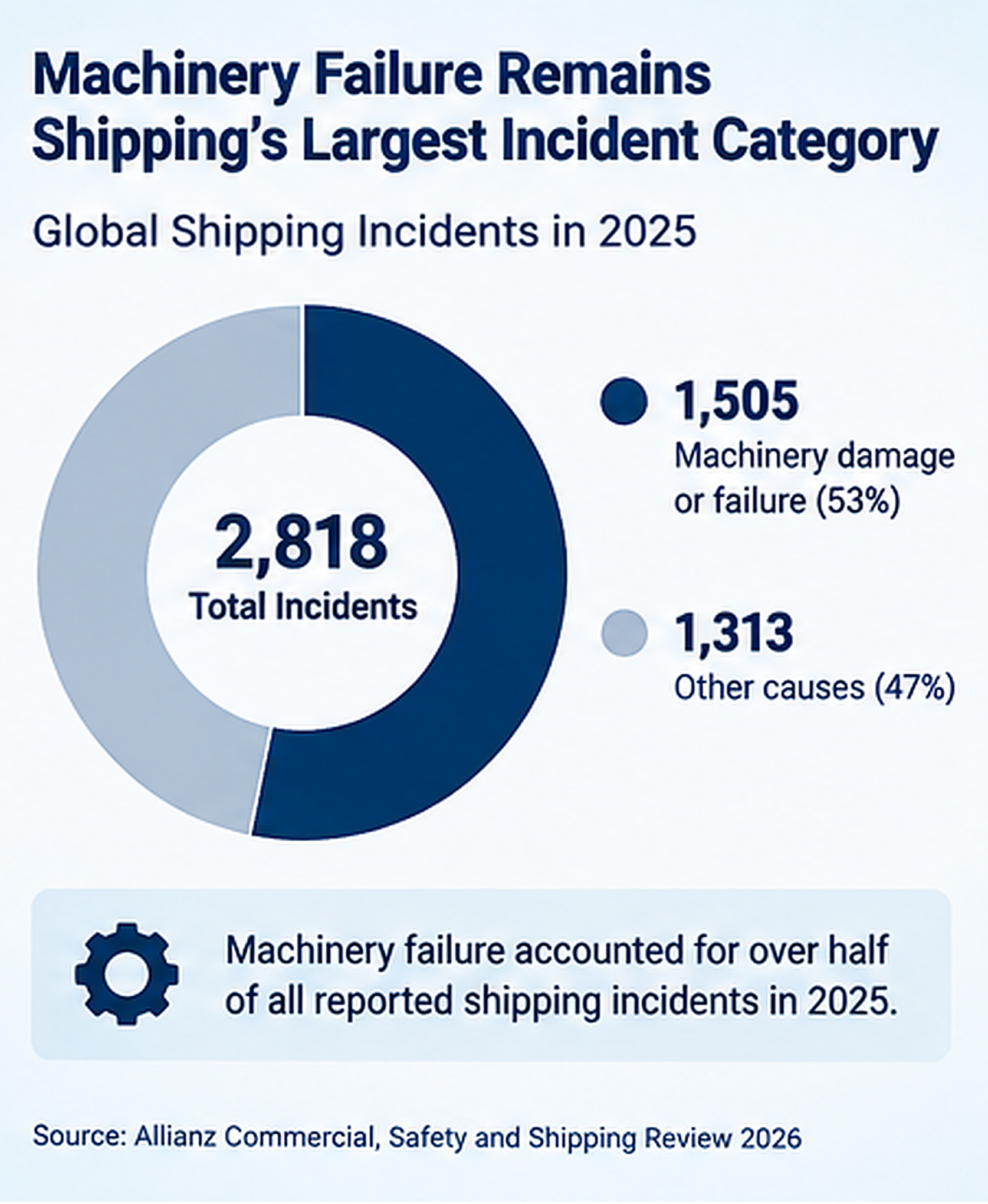
The scale of the problem remains significant. Allianz Commercial’s Safety and Shipping Review 2026 recorded 2,818 shipping incidents globally during 2025, of which 1,505 involved machinery damage or failure. Machinery failure remained the largest incident category.
Even smaller technical issues can lead to delayed departures, repeated troubleshooting, emergency spare-part requirements and added workload for ship and shore teams. The objective is therefore not only to repair failures faster, but to identify developing problems earlier and reduce the operational disruption around them.
Reducing downtime requires a fleet-wide reliability approach that improves how technical information is captured, connected and used during maintenance and troubleshooting.
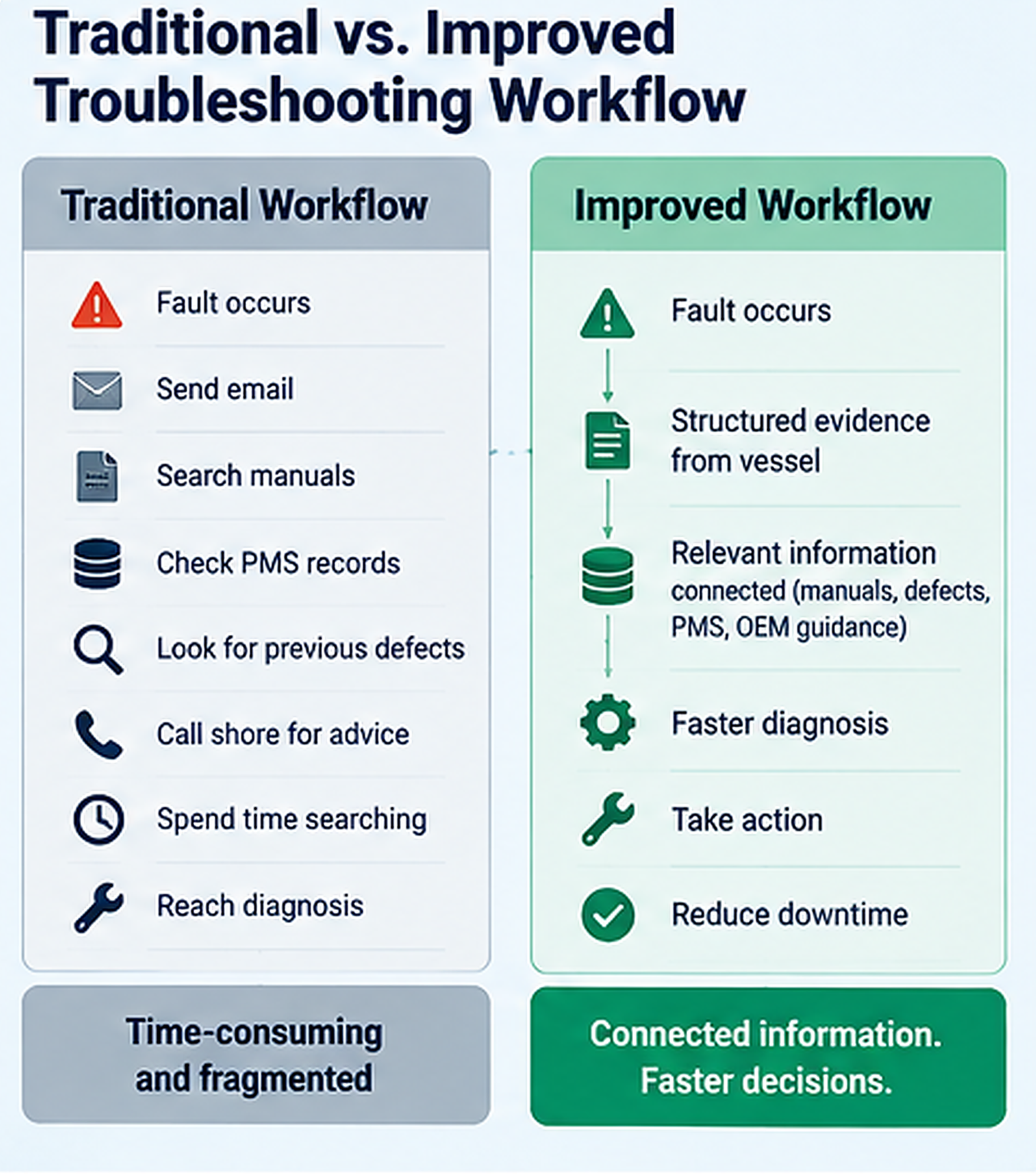
Most fleets already have maintenance systems, manuals and defect-reporting processes. The challenge is that the information is often fragmented.
During a machinery problem, engineers may need to check:
When these sources are disconnected, valuable time is spent searching before troubleshooting can properly begin.
For example, a recurring generator-temperature problem may require information from the manual, recent maintenance history, previous defects and similar sister-vessel cases.
If those records cannot be accessed quickly, the team may end up investigating the same problem again.
Reducing downtime therefore means reducing both repair time and time-to-context.
Every maintenance task matters, but every failure does not have the same operational consequence.
Fleet teams should identify systems where failure could directly affect:
Critical equipment should receive greater attention when planning inspections, maintenance windows, spare holdings and monitoring.
This is consistent with IMO's safety-management approach, which specifically calls for companies to identify equipment and technical systems whose sudden failure could result in hazardous situations.
A practical fleet approach can categorize machinery according to:
Failure probability × Operational consequence × Detectability
This helps technical managers decide where limited maintenance resources should be concentrated.
A repeated standby pump defect, for example, may deserve greater attention than its maintenance cost suggests because failure of the operating pump would then leave the vessel without redundancy.
The aim is not more maintenance.
It is better-prioritized maintenance.
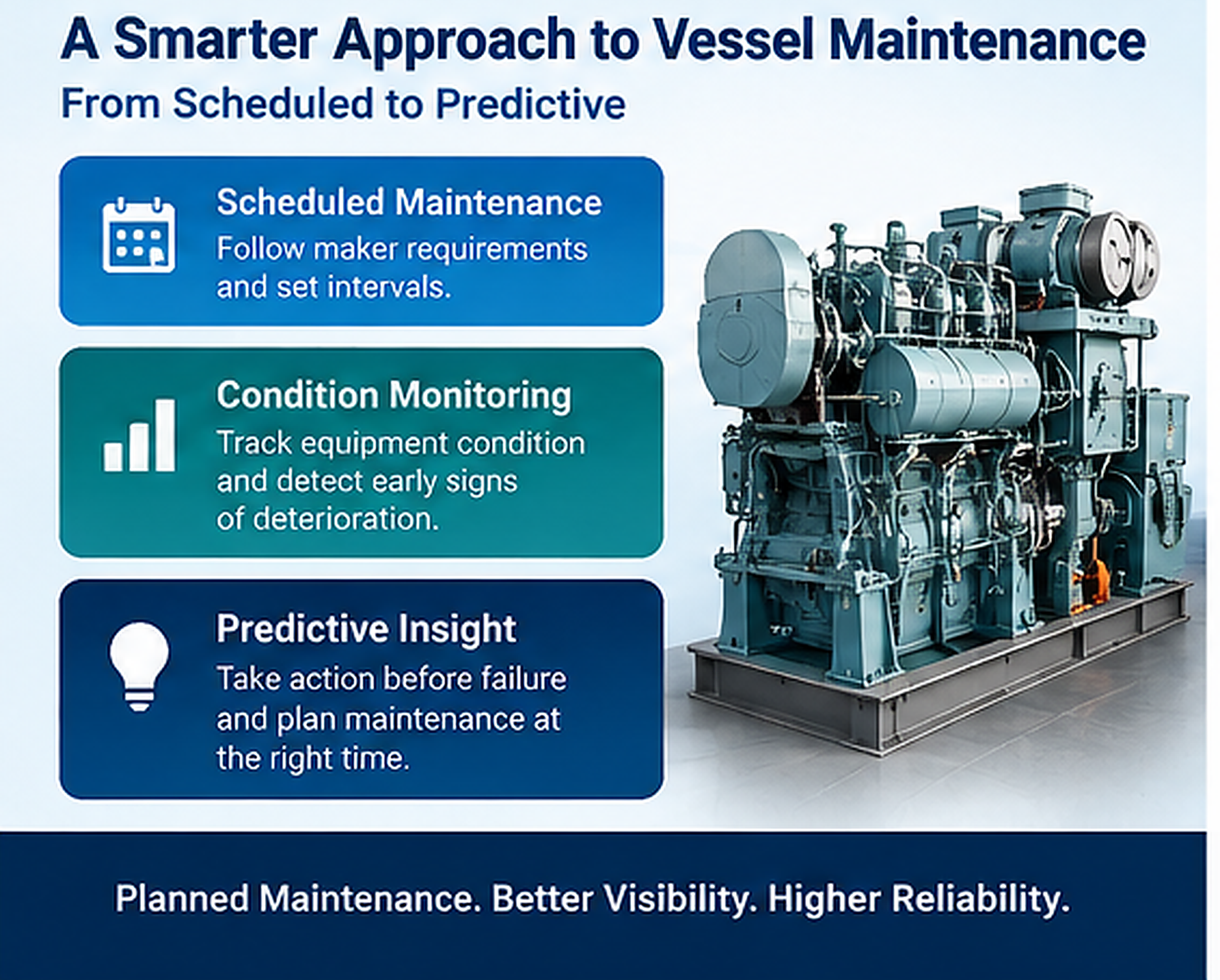
Preventive maintenance based on operating hours and calendar intervals remains fundamental to shipping.
But an interval alone cannot always show how equipment is actually deteriorating.
Condition information such as:
can help technical teams detect changes before they become failures.
Lloyd's Register describes data-driven condition-based maintenance as a way to use equipment information to provide earlier warning of developing problems and allow intervention before minor issues escalate.
DNV similarly notes that relying only on predetermined maintenance intervals can sometimes result in unnecessary maintenance and that predictive approaches can help schedule work according to equipment condition.
Consider a pump that normally operates at stable suction and discharge pressures.
A slow deterioration in discharge pressure may not justify immediate shutdown. But when the trend is combined with vibration, motor current, maintenance history and previous faults, the team can investigate during an appropriate operational window.
That is much better than discovering the issue only after the pump fails.
Importantly, predictive techniques should complement, not automatically replace, maker requirements, PMS obligations, class rules and engineering judgement.
Downtime can increase before troubleshooting even begins.
A vessel report might simply say:
“No. 2 generator tripped again. Please advise.”
The shore team then needs to request:
Several messages may be exchanged before the superintendent has enough information to evaluate the problem.
A stronger workflow structures the initial report around the equipment and symptom involved.
For example, a pump-pressure problem could automatically request:
The purpose is not to create more paperwork.
It is to ensure that useful technical evidence reaches shore earlier.
That can shorten the gap between identifying a problem and beginning meaningful troubleshooting.
Engineers rarely diagnose a complicated fault from one document.
The answer may be distributed across:
Traditional workflows require engineers or superintendents to search these sources independently.
Modern maritime software and AI can instead retrieve information around the equipment and technical problem being investigated.
Suppose a vessel reports recurring low lubricating-oil pressure.
Rather than searching a 1,000-page manual from the beginning, the technical team could retrieve:
The engineer remains responsible for interpreting the evidence and deciding what action is appropriate.
Technology simply reduces the searching and information fragmentation surrounding that decision.
This is where AI-powered maritime troubleshooting becomes especially useful: not as an autonomous replacement for marine engineers, but as a faster way to bring relevant technical evidence together.
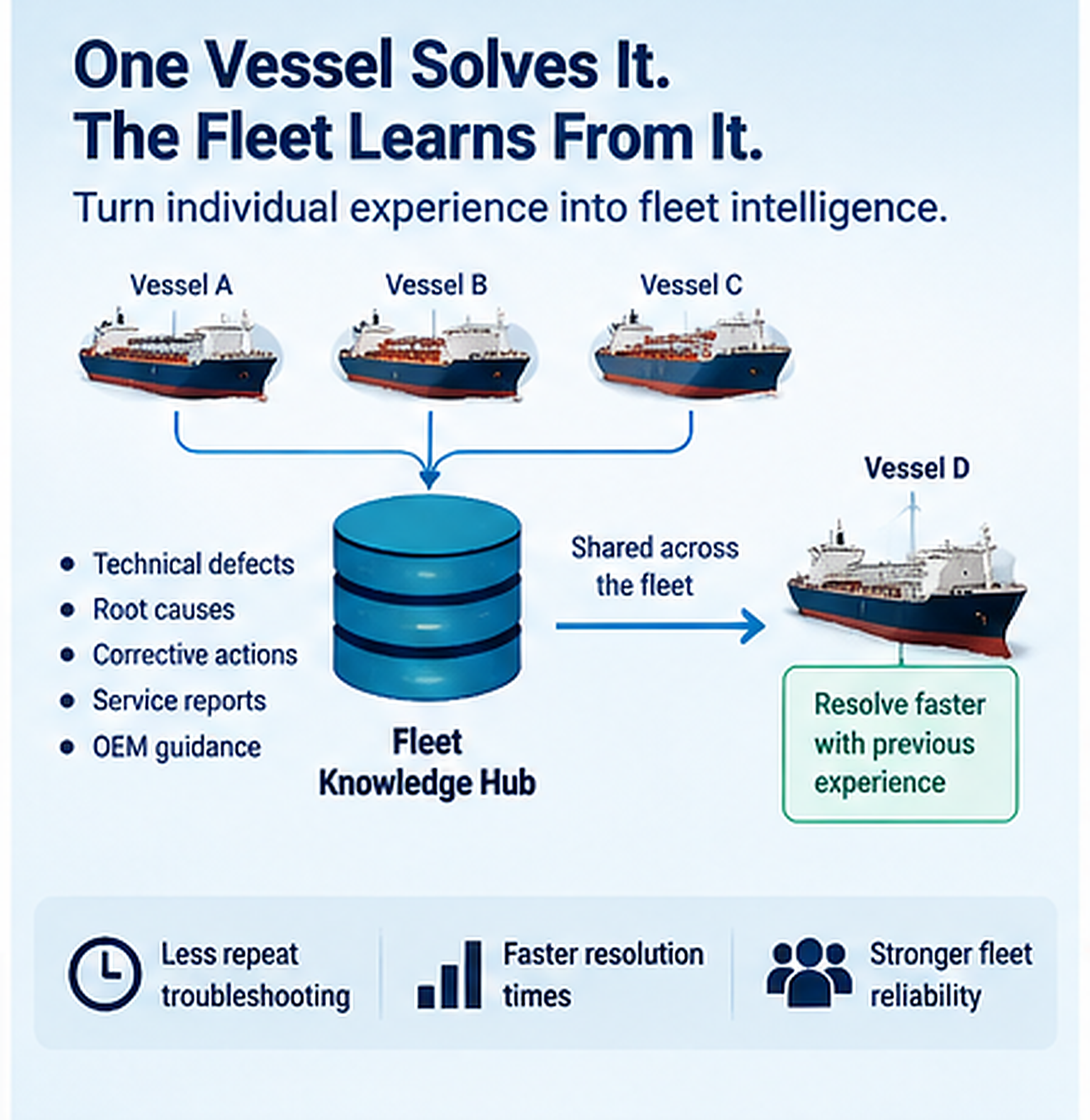
One vessel solving a difficult technical problem should make the next occurrence easier to handle.
Unfortunately, valuable troubleshooting knowledge often remains trapped inside:
That creates a common fleet problem:
The organization has already solved the fault, but the person currently troubleshooting it cannot find the solution.
A better process records every significant defect using consistent information:
Equipment → Symptom → Evidence → Root cause → Action → Result
For example:
Equipment: Main engine fuel-oil booster pump
Symptom: Repeated low-discharge-pressure alarm
Investigation: Suction restriction identified
Root cause: Contaminated strainer
Action: Strainer cleaned and upstream contamination investigated
Result: Pressure restored and monitored
If a similar problem appears elsewhere, that previous experience becomes searchable fleet knowledge.
Over time, fleet managers can also identify patterns such as:
Downtime reduction then becomes a fleet-learning process instead of a collection of isolated repairs.
Correct diagnosis does not eliminate downtime if the required component is unavailable.
Spare-parts planning should therefore be connected to equipment criticality and historical failure patterns.
IACS maintains recommended minimum spare-part guidance for essential auxiliary machinery for ships in unrestricted service, demonstrating the continuing importance of spare readiness to machinery reliability.
Fleet teams should periodically review:
Failure history adds another useful dimension.
If several vessels repeatedly require the same solenoid valve, seal kit, sensor or control component, purchasing decisions should reflect the actual fleet experience rather than only theoretical consumption.
Technical information should also be available before a breakdown occurs.
For critical equipment, teams should know:
What fails? What spare is required? Is it onboard? Where can it be sourced? How long will delivery take?
Those questions are far easier to answer before the ship is waiting for a component.
Tracking total downtime is useful.
Tracking why the downtime lasted as long as it did is more useful.
Two identical failures can produce very different operational outcomes.
One vessel may resolve the problem in three hours because the Chief Engineer immediately recognizes it.
Another may take ten hours because:
The machinery failure may be identical.
The information workflow is not.
Fleet managers should therefore consider metrics such as:
This turns downtime management from a retrospective KPI into a continuous reliability-improvement process.
The goal is not to automate marine engineering expertise.
It is to remove avoidable delays surrounding it.
This is where SmartSeas.AI becomes relevant.
SmartSeas.AI helps fleet teams bring technical information such as manuals, technical defects, incident reports, procedures and OEM guidance into a more unified troubleshooting workflow.
Instead of asking engineers to search multiple sources separately, an AI-supported workflow can surface relevant technical context around the machinery problem being investigated.
For example, when investigating a recurring generator trip, the technical team can review:
This supports faster ship-to-shore understanding while keeping the marine engineer and technical superintendent responsible for the final technical decision.
The broader objective is straightforward:
Make the fleet's existing technical knowledge easier to find, verify and reuse when it matters.
Reducing downtime does not require transforming every fleet process simultaneously.
Start with one recurring operational problem.
For example:
Then review the complete workflow.
Ask:
Once that workflow improves, expand the approach to other equipment classes.
Digital tools alone will not eliminate vessel downtime.
Sensor information can be incomplete or inaccurate.
Maintenance records may contain inconsistent equipment names.
Previous corrective actions may not have addressed the real root cause.
AI systems can also produce incorrect interpretations if technical information is incomplete, outdated or poorly controlled.
Fleet teams should therefore maintain several safeguards:
Reliable engineering decisions still depend on sound evidence and professional judgement.
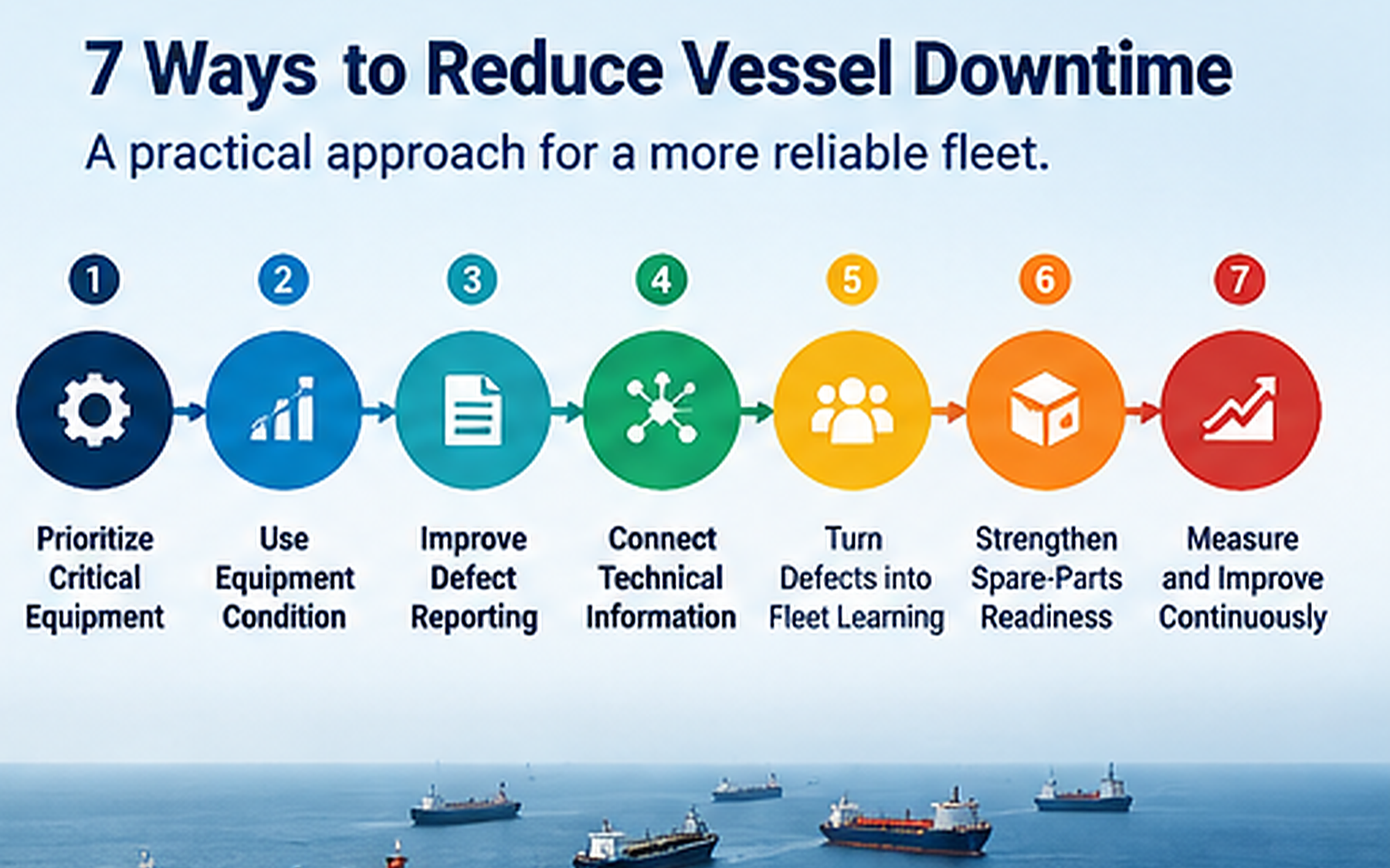
The most effective way to reduce vessel downtime is not simply repairing machinery faster after it fails.
It is reducing the delays throughout the entire technical workflow.
That means:
Machinery problems will never disappear completely.
But the same problem should not require the fleet to rediscover the same information repeatedly.
Better maintenance data, stronger technical reporting, connected fleet knowledge and practical AI support can help ship and shore teams understand problems earlier and respond with greater operational clarity.
If your technical teams spend too much time searching manuals, tracing previous defects or recreating troubleshooting knowledge already available somewhere in the fleet, SmartSeas.AI can help bring that information together.
Explore how SmartSeas.AI supports AI-powered maritime troubleshooting and faster ship-to-shore technical decision-making.
Vessel downtime is the period when a ship or critical system cannot operate as intended because of failures, maintenance, repairs or technical issues.
By improving maintenance planning, condition monitoring, troubleshooting, defect reporting, spare-parts readiness and fleet knowledge sharing.
Preventive maintenance helps identify and address equipment deterioration before it develops into a larger failure.
Preventive maintenance follows scheduled intervals, while predictive maintenance uses equipment condition and operating data to determine when attention is needed.
AI can help technical teams find relevant manuals, previous defects, procedures and similar fleet cases faster.
Repeated defects can reveal unresolved root causes and help fleets identify reliability problems across similar equipment.

Get Started Today
Transform the way you troubleshoot and manage maritime operations. Join the next wave of Maritime Digital Transformation with SmartSeas AI.



.svg)


.png)