.jpg)

A machinery fault at sea can quickly disrupt operations. Engineers may need to check maintenance history, manuals, previous defects, spare availability and communicate findings to shore before deciding the next step.
Vessel maintenance software helps organize this information in a structured digital workflow, giving ship and shore teams faster access to maintenance records and technical history.
The need is significant. Allianz Commercial reported that machinery damage or failure accounted for 1,505 of 2,818 shipping incidents worldwide in 2025.
For maritime operators, effective maintenance management is therefore not just about scheduling tasks. It supports vessel reliability, reduces avoidable downtime and improves technical decision-making.
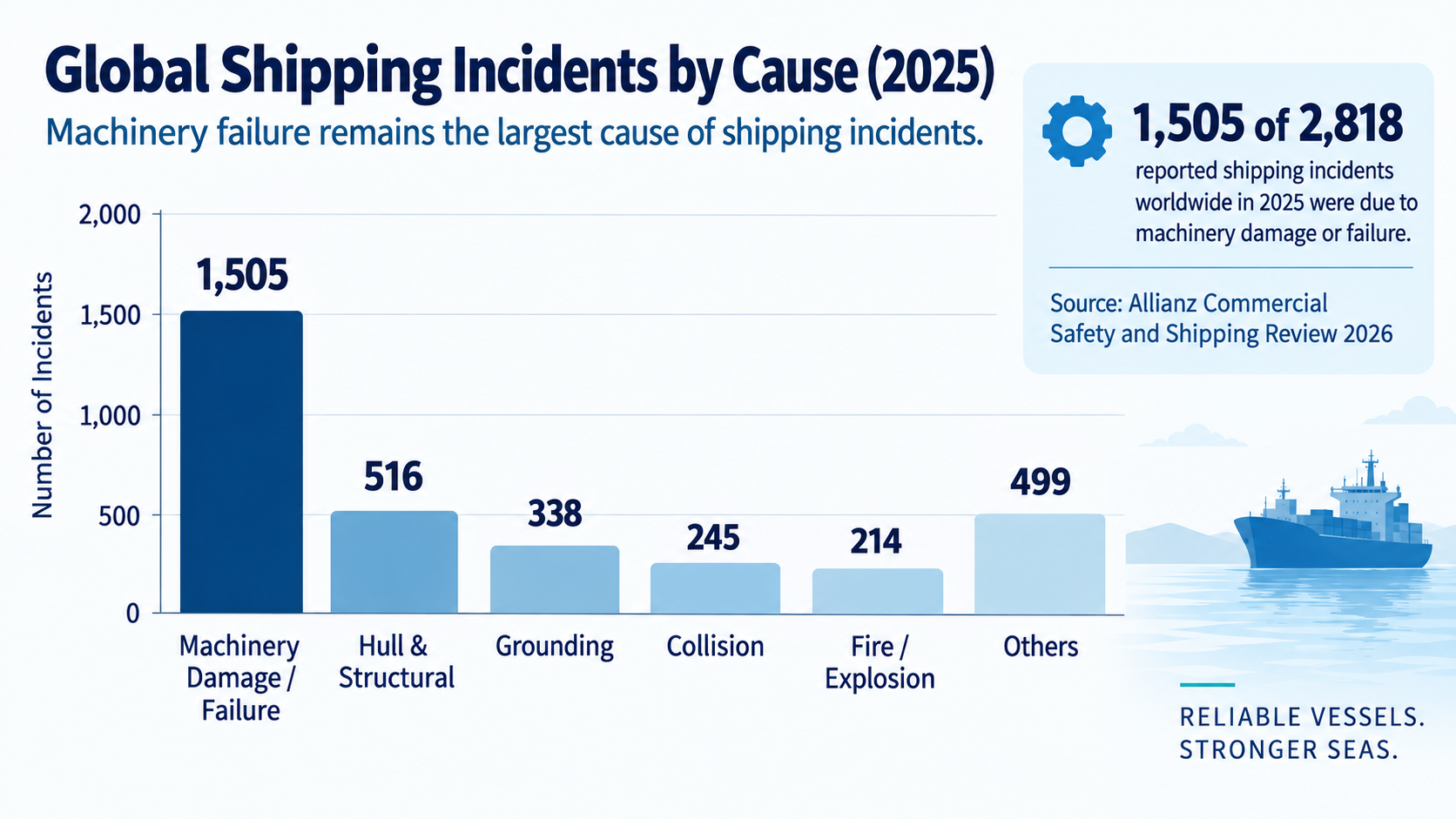
Shipping operates with little tolerance for unexpected machinery downtime.
A failure involving a main engine, generator, steering system, cargo equipment or auxiliary machinery can affect schedules, port operations, safety and repair costs.
Repair economics are also changing. Allianz Commercial notes that machinery claims continue to be affected by factors including skilled-labour shortages, long repair and spare-parts lead times, higher material costs and limited shipyard capacity.
At the same time, the technical complexity of vessels continues to increase.
Modern ships may combine conventional machinery with:
This makes structured maintenance information more important.
The IMO's International Safety Management Code requires companies to establish procedures to ensure ships are properly maintained in accordance with relevant rules, regulations and company requirements.
Maintenance is therefore simultaneously an operational, safety, compliance and commercial requirement.
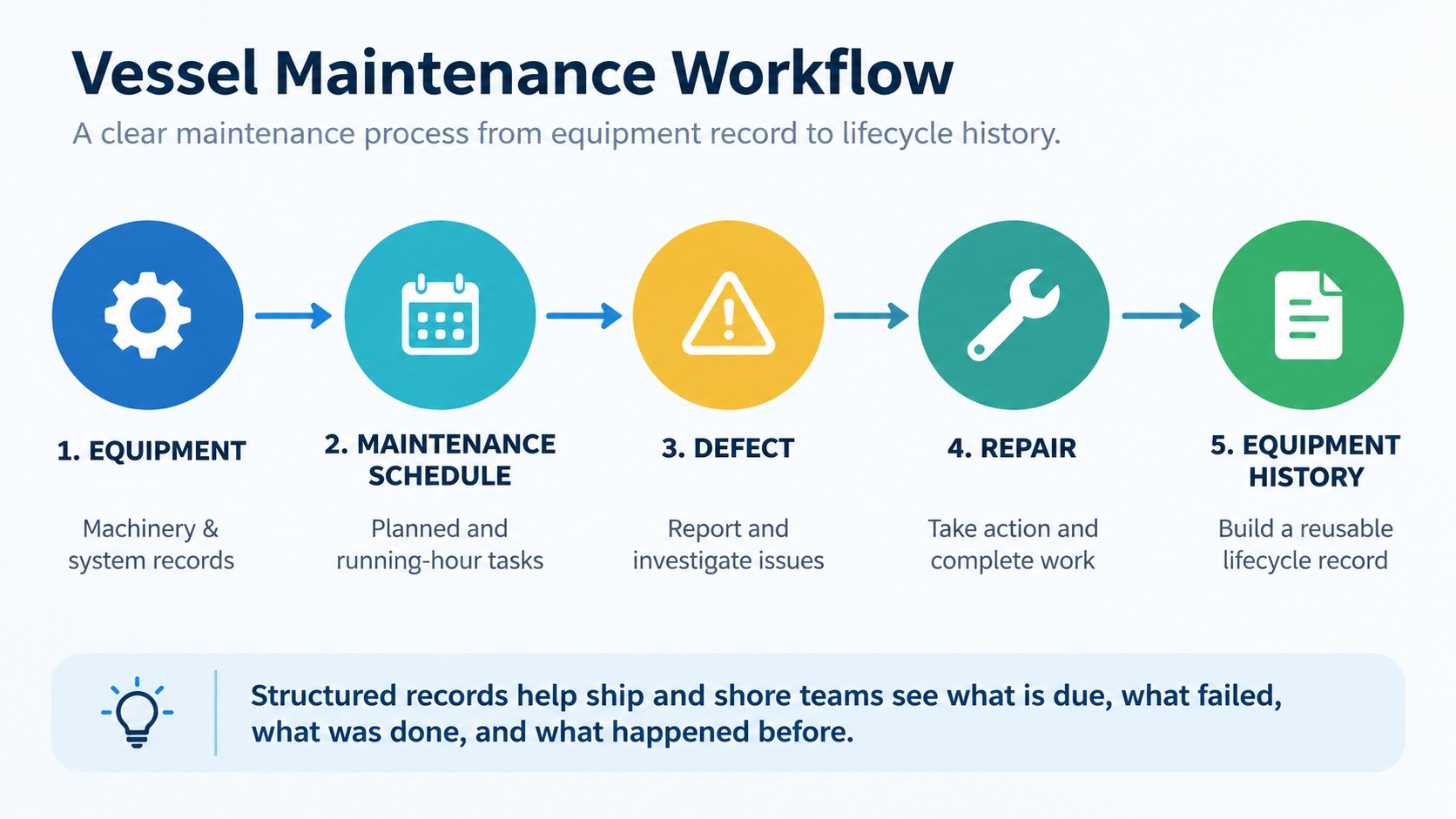
Vessel maintenance software is a digital system used to plan, monitor, perform and document maintenance activities across ships and fleets.
Depending on the platform, it can support scheduled and unscheduled maintenance, machinery databases, running-hour records, defect reporting, spare-parts management, inspection records and maintenance histories.
A Planned Maintenance System, or PMS, is one of the most established forms.
DNV describes a planned maintenance system as a way for owners and operators to plan, perform and document vessel maintenance at intervals that comply with class and manufacturer requirements.
But modern maintenance management is moving beyond simply asking:
“When is this maintenance job due?”
Fleet teams increasingly need to answer:
“What is happening to this equipment, what happened previously, and what should we do next?”
That distinction is important.
A traditional PMS primarily manages maintenance execution and records.
Condition-monitoring systems help determine equipment condition.
Troubleshooting and AI-supported platforms can help teams understand technical context and possible actions.
These systems may complement one another rather than replace one another.
Without a structured system, teams may rely heavily on spreadsheets, manual records, email reminders and individual experience.
This becomes difficult across a fleet containing thousands of machinery components and maintenance activities.
Vessel maintenance software can organize tasks according to factors such as:
The system can then show upcoming, overdue and completed work.
The practical benefit is visibility.
Chief Engineers know what requires attention onboard, while technical superintendents can monitor maintenance status across multiple vessels.
Every maintenance activity creates useful technical information.
Consider a purifier that experiences repeated vibration.
Over several months, the vessel may have:
When these records exist in different folders, emails or handwritten notes, identifying the pattern becomes difficult.
A well-managed vessel maintenance system creates a lifecycle history around the equipment.
Instead of seeing only today's fault, engineers can see what has already happened.
That history can help distinguish an isolated failure from a recurring problem.
Maintenance tasks and technical defects are closely connected.
A defect may create a new maintenance requirement. A maintenance activity may reveal another defect. A closed defect may later recur.
The problem appears when these records are managed separately.
A structured system can connect:
Equipment → Defect → Investigation → Maintenance → Spare Parts → Resolution
This gives fleet teams a more useful technical record.
It also reduces dependence on individual memory.
When a superintendent changes vessels or an engineer signs off, historical knowledge does not have to leave with that person.
Software does not make the maintenance decision by itself.
Its main value is making the necessary information easier to organize, retrieve and act upon.
No maintenance platform can guarantee that equipment will never fail.
But it can help eliminate some of the operational delays surrounding failure.
For example, imagine an auxiliary engine experiencing high exhaust temperature.
A traditional workflow may require someone to separately search:
The machinery problem may take minutes to describe but hours to fully investigate.
Better-connected maintenance information allows teams to establish technical context earlier.
DNV identifies condition-based and predictive maintenance, better docking timing and improved data-driven business processes among the potential benefits of maritime digital transformation.
Reducing downtime is therefore not simply about performing more maintenance.
It is about performing the right maintenance with better information.
One persistent fleet-management challenge is maintaining the same operational picture onboard and ashore.
The vessel may understand the immediate machinery condition.
The superintendent may understand the vessel's longer maintenance history.
Procurement may understand spare-parts availability.
Management may see only the final defect report.
Maintenance platforms can bring these perspectives closer together.
Shore teams can monitor overdue tasks, recurring defects, equipment status and maintenance workload without waiting for manually prepared reports.
This improves conversations between Chief Engineers, superintendents and fleet managers because decisions are based on a shared record.
Maintenance documentation becomes especially important during class surveys, audits and inspections.
Teams may need to demonstrate:
A structured digital record makes this evidence easier to retrieve.
IACS maintains Unified Requirement Z20 covering planned maintenance schemes for machinery, while classification societies also provide specific arrangements for machinery planned maintenance and condition monitoring.
The objective should not be maintaining records merely for an inspection.
The same records should also support day-to-day reliability decisions.
Traditional planned maintenance usually follows predetermined intervals.
For example:
Inspect every 3,000 running hours.
That approach remains important and may be required by manufacturers or class.
But operating conditions differ.
Two identical pumps installed on sister vessels may experience different loads, temperatures, vibration levels and operating environments.
This is where condition-based maintenance becomes valuable.
DNV defines condition-based maintenance as a predictive approach intended to identify upcoming equipment failure so maintenance can be scheduled when required. DNV also notes that maintenance based only on predetermined intervals can sometimes lead to unnecessary work or even introduce failures through maintenance intervention.
Lloyd's Register similarly highlights how data-driven condition-based maintenance can use real-time information to optimize maintenance schedules and reduce operational disruption.
It is important not to confuse maintenance software with the source of predictive information.
For machinery such as engines, pumps, compressors, bearings and generators, predictive maintenance may rely on data from IoT sensors and monitoring systems, including:
Sensors help indicate what is happening physically.
Maintenance software provides the surrounding history and maintenance context.
Combining the two produces a stronger picture than either can provide independently.
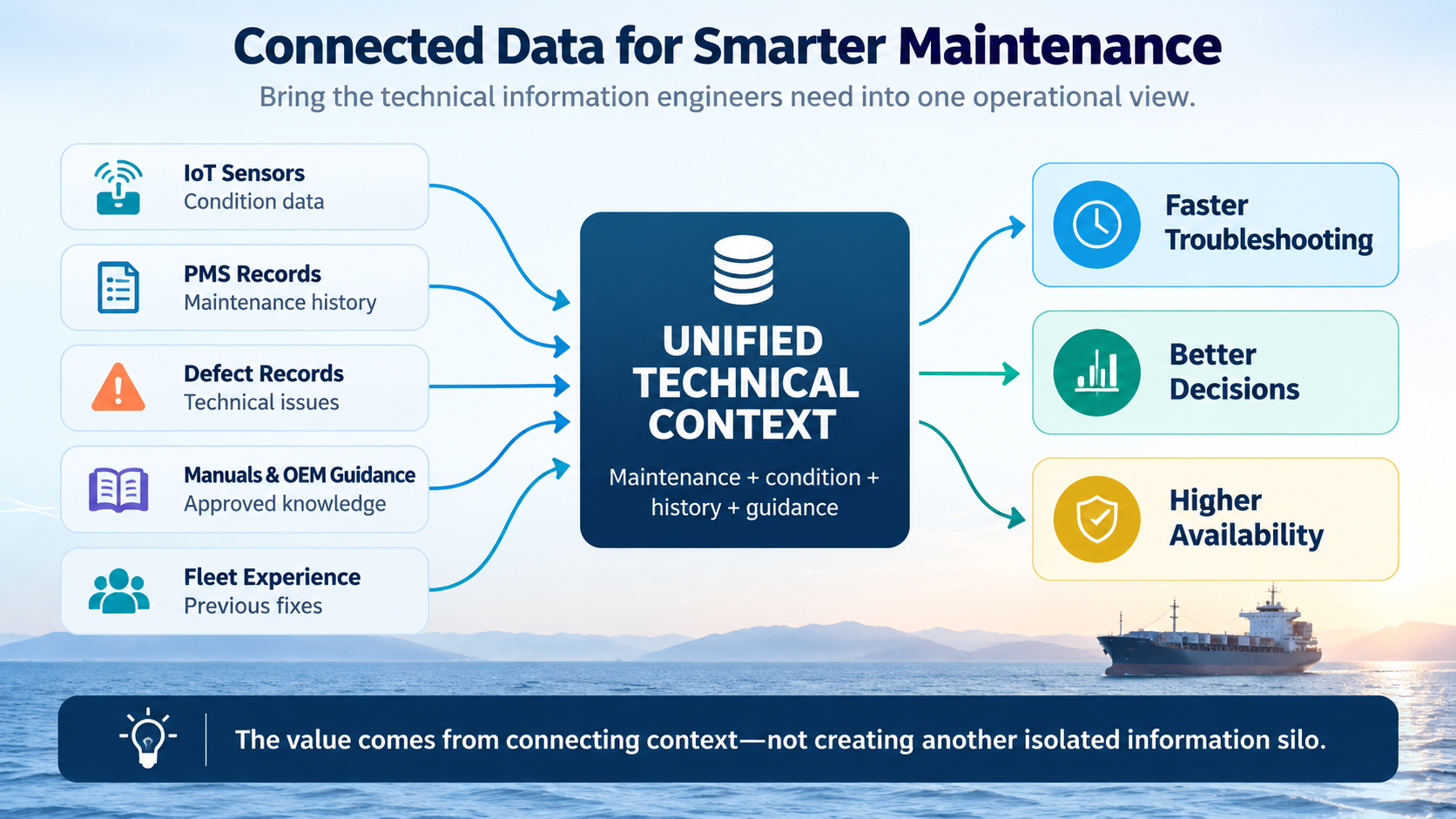
Knowing that equipment condition is deteriorating does not automatically tell an engineer what action to take.
Suppose vibration monitoring detects an abnormal bearing trend.
The maintenance team still needs to determine:
What equipment is affected?
What does the manufacturer recommend?
Has this occurred previously?
What repairs were performed last time?
Is a suitable spare onboard?
Could alignment, lubrication or foundation condition be contributing?
That moves the workflow from prediction toward prescriptive maintenance and troubleshooting.
This is where AI-powered maritime systems are becoming relevant.
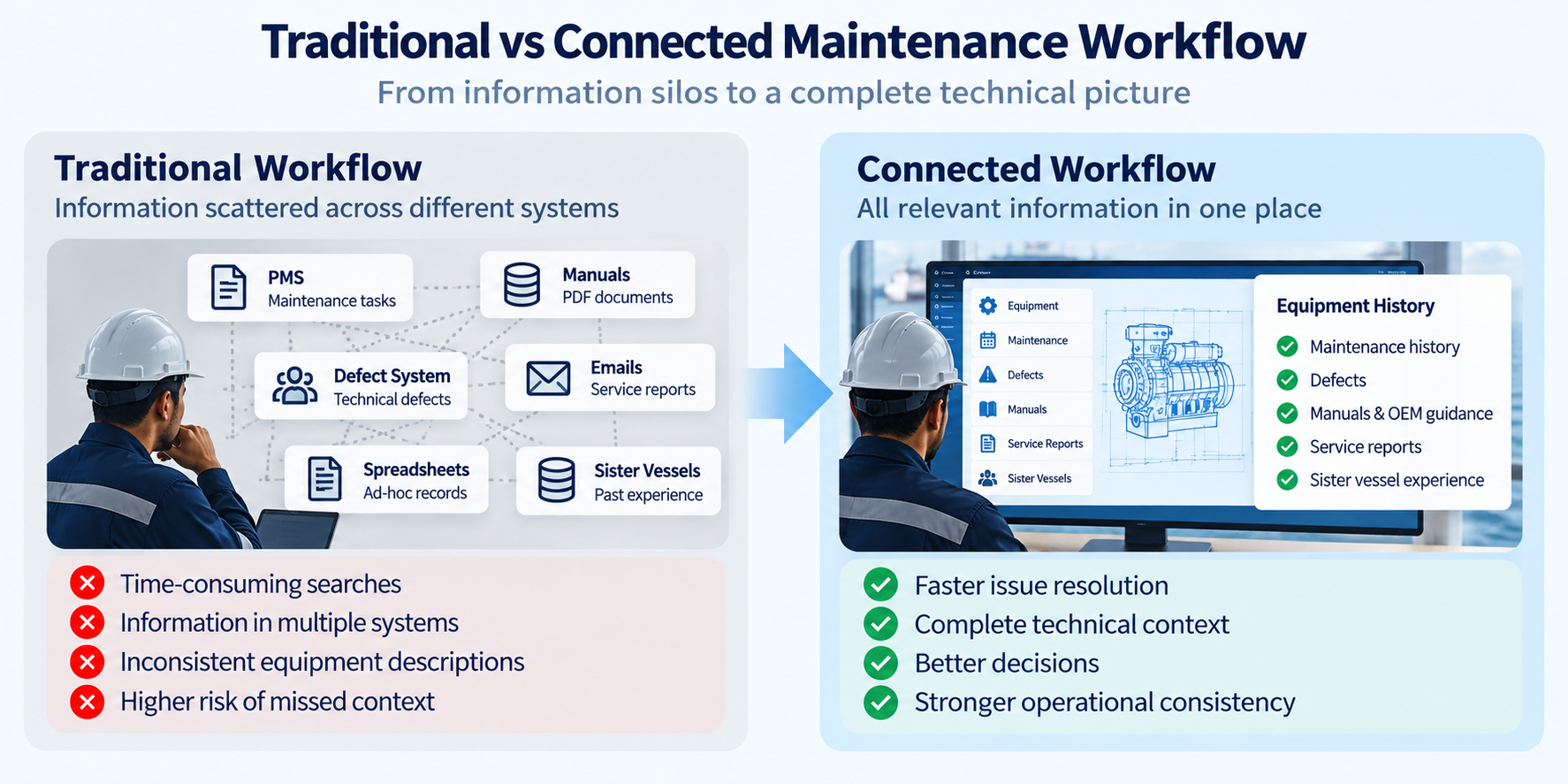
Conventional maintenance systems are effective at recording what work needs to be completed and when.
However, technical knowledge often remains fragmented across:
When a fault occurs, engineers may still have to search each source independently.
AI can provide another layer above these information systems.
Instead of searching several databases manually, a technical team could ask:
“This generator has experienced three similar trips during the last six months. What previous defects, maintenance work and maker guidance are relevant?”
The system could then bring related information together around the machinery problem.
The objective is not to replace marine engineers.
It is to reduce the amount of time engineers spend searching for information before they can apply their expertise.
This is where SmartSeas.AI becomes relevant.
Traditional vessel maintenance software remains important for planned maintenance, running-hour jobs and maintenance documentation.
SmartSeas.AI complements these workflows by helping fleet teams connect technical knowledge needed during troubleshooting and decision-making.
SmartSeas.AI can bring together information such as:
manuals + technical defects + incident reports + OEM guidance + procedures + previous fleet experience
around the equipment or fault being investigated.
For example, when a recurring machinery issue appears, the technical team does not have to depend only on the latest PMS entry.
They can investigate the problem using previous defects, approved technical documentation and relevant fleet knowledge.
This helps move fleet operations from simply recording maintenance toward using maintenance and defect intelligence for faster technical decisions.
It also supports SmartSeas.AI's broader mission of transforming maritime operations through AI-powered decision-making while keeping maritime professionals in control.
Technology selection should begin with operational requirements rather than feature count.
Operators should evaluate whether the system provides:
Most importantly, test the software using real scenarios.
Ask a Chief Engineer and superintendent to complete the same workflow they manage today.
A system that looks impressive during a demonstration but creates additional administrative work onboard will struggle to deliver operational value.
Digital maintenance is not automatically better maintenance.
Poor data can simply create a faster version of a poor process.
The same machinery may be described differently across vessels, defect systems and manuals.
Standardized equipment hierarchies and tags are therefore important.
Migrating old PMS data does not guarantee that valuable technical history has been captured.
Predictive maintenance depends on reliable input data. Faulty sensors or poorly configured thresholds can create misleading alerts.
Maintenance, procurement, defect, document and monitoring systems should exchange useful information rather than creating additional silos.
Shipboard systems must account for real maritime connectivity conditions and should not assume uninterrupted shore-style internet access.
Maintenance software and AI provide information and recommendations.
The Chief Engineer, superintendent and other qualified maritime professionals remain responsible for evaluating machinery condition and determining appropriate action.
Start with the maintenance problems causing the most operational friction rather than attempting to digitalize everything immediately.
Choose a vessel series or equipment group and examine how the current workflow handles scheduled maintenance, defects, spare parts and troubleshooting.
Next, clean the equipment hierarchy and connect the information engineers actually use: PMS records, manuals, defect histories, OEM information and condition data.
Finally, measure operational outcomes.
Useful indicators include overdue critical maintenance, recurring defects, unplanned machinery downtime, time spent retrieving technical information and the time between defect reporting and resolution.
Technology should make these workflows simpler, not create another screen for engineers to manage.
Vessel maintenance software helps ship operators plan, track and document maintenance, defects, running hours, equipment history and spare parts.
It improves maintenance planning, provides faster access to equipment history and helps teams identify recurring defects before they cause longer disruptions.
No. A PMS schedules maintenance based on time or running hours, while predictive maintenance uses machinery-condition data to detect possible failures earlier.
IoT sensors monitor parameters such as vibration, temperature, pressure and electrical load, providing data for condition-based and predictive maintenance.
No. Maintenance software manages tasks and records, while AI can help connect and interpret manuals, defects, maintenance history and other technical information.
AI can surface relevant manuals, previous defects, OEM guidance and maintenance history faster, supporting troubleshooting and technical decision-making.
Key factors include usability, defect management, equipment history, reporting, integrations, ship-to-shore synchronization and condition-monitoring support.
SmartSeas.AI helps fleet teams connect manuals, defect history, OEM guidance, procedures and technical experience to support faster troubleshooting and better-informed decisions.
Vessel maintenance is becoming more data-driven, but engineers remain at the center of technical decisions.
Vessel maintenance software helps organize planned work, equipment history, defects, and documentation, while sensors and OEM guidance add important operational context.
The real value comes from connecting these sources so ship and shore teams can identify recurring issues faster, reduce information gaps, and make better-informed maintenance decisions.
Want to connect your vessel manuals, defect history and technical knowledge to troubleshooting workflows?
See how SmartSeas.AI helps maritime teams bring trusted fleet information together for faster, more informed technical decision-making.
Explore SmartSeas.AI or book a demo to discuss your fleet's troubleshooting workflow.

Get Started Today
Transform the way you troubleshoot and manage maritime operations. Join the next wave of Maritime Digital Transformation with SmartSeas AI.



.svg)

.png)