.jpg)
September 11, 2026
What Should Ship Operators Look for in AI-Driven Maritime Solutions?

September 11, 2026
A vessel reports a recurring machinery problem. The chief engineer checks manuals, maintenance records and previous defects. The superintendent searches emails and sister-vessel experience. Several messages move between ship and shore before enough information is available to understand what is actually happening.
This is exactly the type of workflow that AI-driven maritime solutions are expected to improve.
But choosing an AI platform for shipping should involve much more than asking whether it can generate quick answers.
Ship operators need to know where those answers come from, how the platform handles maritime data, whether it understands vessel context, how securely it connects to existing systems and—most importantly—whether it helps technical teams make better operational decisions.
The question is therefore not simply:
“Does this platform use AI?”
A better question is:
“Can this AI system be trusted and used practically within real ship-to-shore operations?”
That distinction matters as maritime digitalization accelerates.
Shipping companies already operate with significant amounts of digital information.
A single fleet may have:
The problem is often not the absence of information.
The problem is finding the right information when an operational decision has to be made.
The International Maritime Organization's Strategy on Maritime Digitalization, approved by the Facilitation Committee in March 2026, specifically emphasizes interoperability, system standardization, data sharing, effective data governance and human-centred digital systems resilient to cyber threats.
At the same time, operational reliability remains an important challenge.
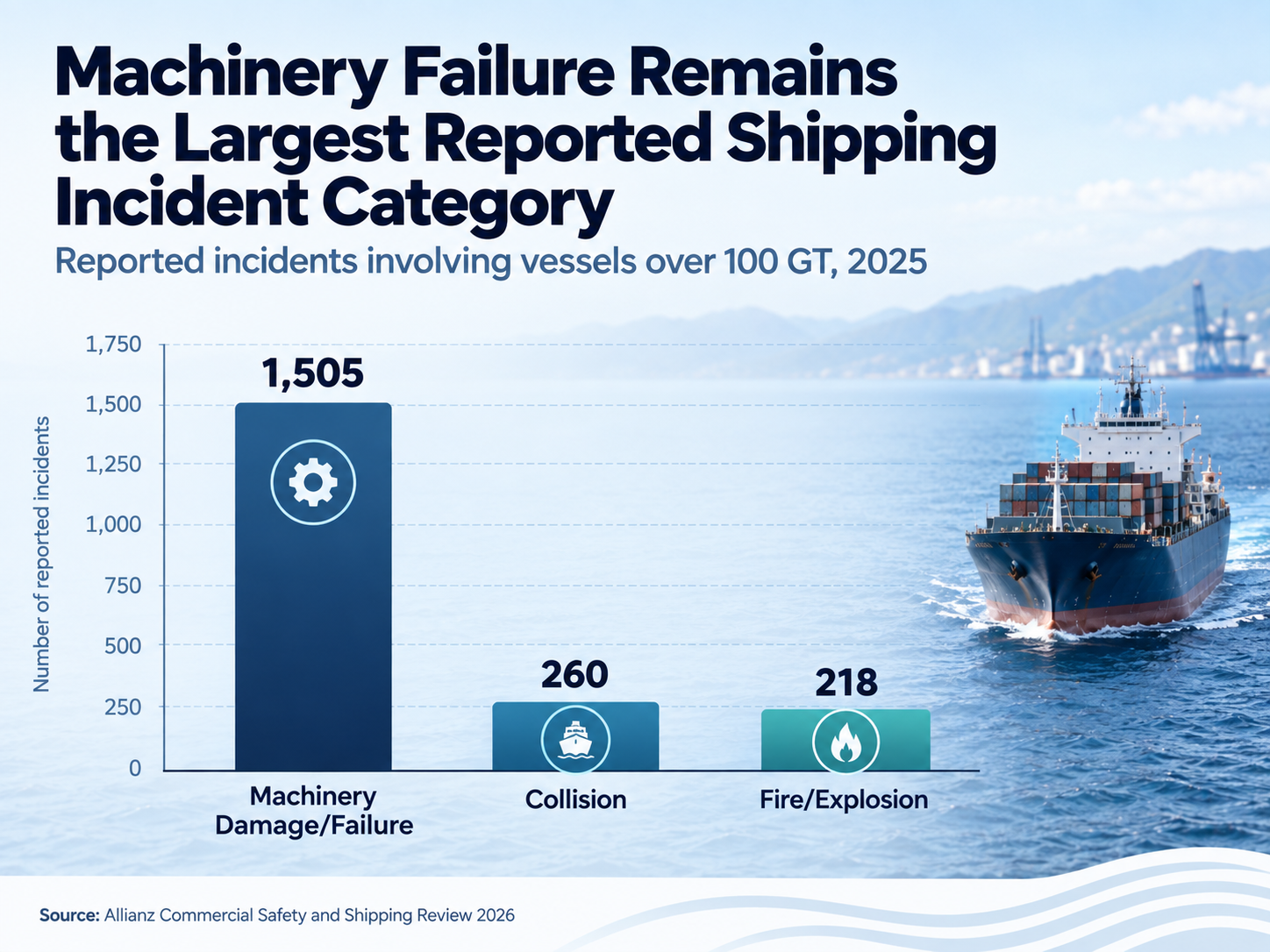
Allianz Commercial's 2026 Safety and Shipping Review recorded 2,818 reported shipping incidents involving vessels over 100 GT during 2025. Machinery damage or failure accounted for more than half of those incidents, with 1,505 cases reported.
AI cannot eliminate machinery failures.
It can, however, help fleets use technical knowledge, operational data and historical experience more effectively when failures occur.
That makes the quality of the AI platform important.
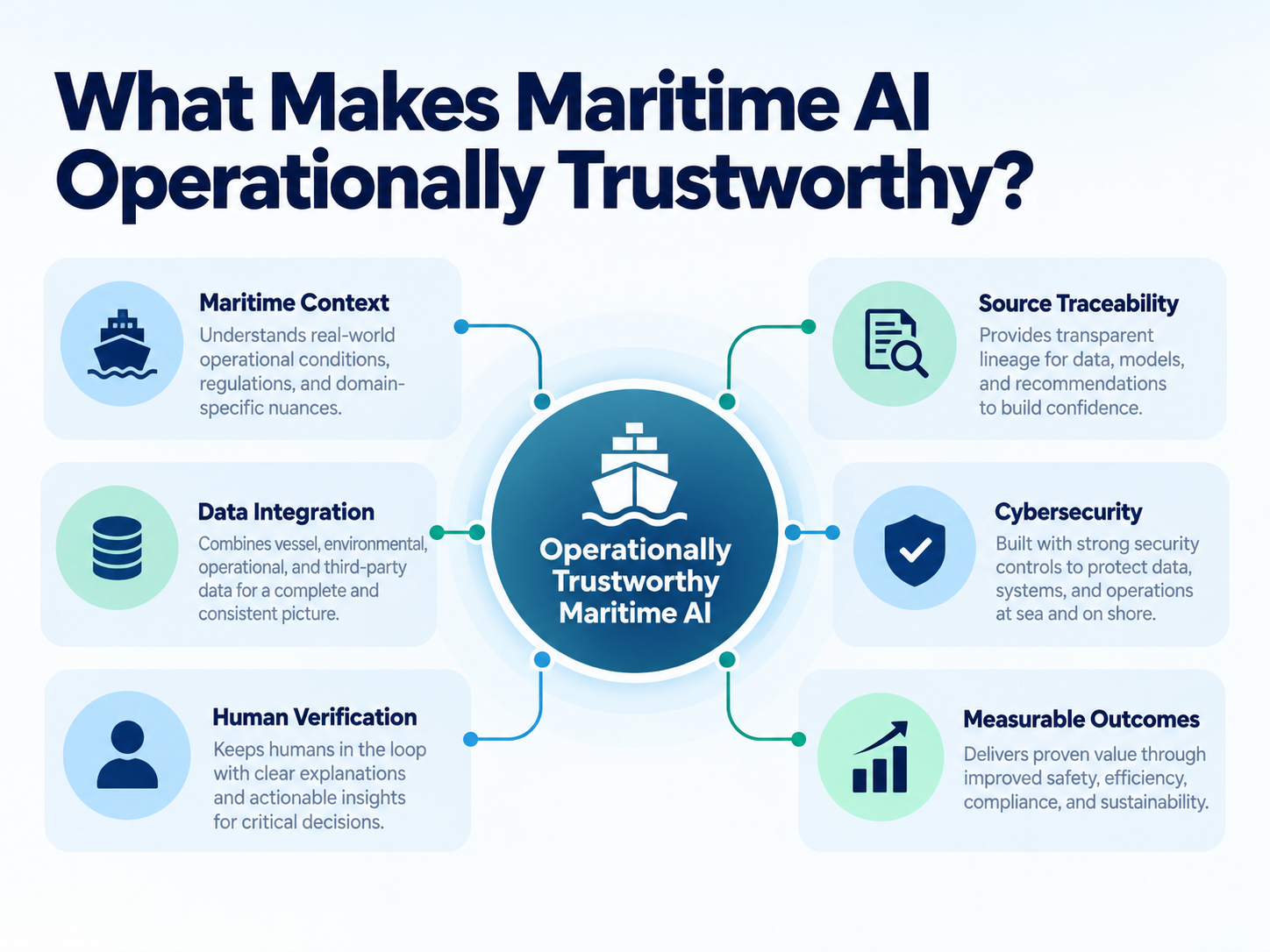
There is no single feature that makes a maritime AI platform useful.
Operators should evaluate several capabilities together.
General-purpose AI can explain machinery or list common causes of faults, but vessel troubleshooting requires more specific context.
A useful maritime platform should understand:
Two vessels may both report “Fuel oil pressure is low,” but have different equipment, control systems and maintenance histories.
Maritime AI becomes valuable when it provides equipment-specific and vessel-specific decision support, rather than generic technical answers.

One of the most important questions operators should ask is:
“Where did this answer come from?”
Technical teams should be able to distinguish between:
For example, an answer about repeated high exhaust temperature could connect engine guidance, alarm limits, maintenance history and previous similar defects.
Users should be able to inspect those sources.
DNV's DNV-RP-0671 emphasizes evidence and transparency when establishing trust in AI systems.
AI recommendations should be verifiable.

Fleet information often exists across different systems.
A strong fleet intelligence platform should connect these sources around the technical problem being investigated.
The goal is not necessarily to replace existing systems, but to create an intelligence layer that brings relevant evidence into one workflow.
Search can locate documents. Troubleshooting requires more.
Suppose a vessel reports:
“No. 2 generator tripped. Please advise.”
An AI-powered maritime troubleshooting platform should help identify missing information such as:
Troubleshooting often slows because shore teams first need to collect basic information.
AI should therefore improve the quality of the initial vessel report, not simply search documents after the report arrives.
AI should support maritime expertise, not replace professional responsibility.
Chief engineers still inspect machinery, technical superintendents assess operational conditions, and masters remain responsible for vessel safety.
IMO's 2026 MASS Code also emphasizes continued human oversight in increasingly autonomous systems.
A good AI workflow should be:
Find → Understand → Verify → Decide
Not:
Ask AI → Accept answer → Act
Operators should ensure AI interpretation remains clearly separated from technical evidence and that experienced personnel stay in control.
Ship operators rarely need another isolated dashboard.
A maritime AI solution should work with existing systems such as:
If engineers must manually transfer information between systems, much of the expected efficiency is lost.
Operators should choose solutions that fit existing workflows rather than forcing teams to redesign them.
AI quality depends on data quality, but maritime information is rarely fully standardized.
Common issues include:
For example, FO Booster Pump No. 1, Fuel Booster Pump, and Booster Pump A may refer to the same equipment.
Operators should assess how the platform handles equipment mapping, metadata, document versions and inconsistent terminology.
AI cannot automatically solve poor data structure.
Connecting fleet information also increases cybersecurity requirements.
Operators should ask:
IACS Unified Requirements E26 and E27 address cyber resilience for ships and onboard systems, while IMO also recognizes cyber risk as an operational and safety concern.
Cybersecurity should therefore be evaluated alongside functionality, not after deployment.
Even capable software creates little value if crews do not use it.
Shipboard conditions can include:
Useful features may include:
Operators should test the solution onboard, not only during a shore-office demonstration.
Historical fleet experience is often underused.
If Vessel A experiences a machinery problem that Vessel B solved six months earlier, teams may repeat the same investigation if those records remain isolated.
AI can connect similar defects using:
This helps fleets turn vessel-specific experience into reusable organisational knowledge.
AI should not assume that similar symptoms always have the same cause. It should help engineers find relevant previous experience and use it as supporting evidence.
A polished demonstration is not enough. Operators should test the platform using realistic operational scenarios.
Choose a vessel series or equipment group and test the platform with representative data such as:
Then use realistic engineering questions to assess its performance.
Do not test only simple questions answered on a single manual page.
Use scenarios that require information from multiple sources.
For example:
“This generator has experienced three similar trips in six months. What previous defects, maintenance activities and maker instructions are relevant?”
This better reflects real maritime troubleshooting.
A trustworthy system should be able to say:
“There is insufficient information to reach a reliable conclusion.”
Operators should test incomplete and ambiguous cases to see whether the AI avoids unsupported conclusions.
Ask the vendor to show where each technical statement comes from.
If users cannot inspect the underlying source, the response should not be treated as authoritative technical guidance.
AI should be measured by operational improvements, not simply:
Better indicators include:
This is where SmartSeas.AI becomes relevant.
SmartSeas.AI is an AI-powered maritime platform that helps fleet teams bring technical information together around operational problems. Instead of treating manuals, defects and previous fleet experience as separate sources, it helps teams access relevant knowledge within a troubleshooting workflow.
The focus is practical:
The objective is not to replace chief engineers, superintendents or fleet managers, but to make the information they need easier to find, compare and use.
This supports SmartSeas.AI's mission of transforming maritime operations through AI-powered decision-making.
AI adoption still requires careful evaluation.
Generative AI can produce inaccurate or incomplete answers. Technical evidence and human verification remain essential.
Previous defect reports may contain incomplete or incorrect conclusions. Historical experience should support decisions, not determine them automatically.
Missing manuals, incorrect equipment metadata and poorly structured records can reduce AI performance.
Similar machinery symptoms may have different root causes. AI should provide relevant evidence and possibilities rather than assume the same diagnosis.
Technology alone cannot improve fleet performance. Reporting practices, data ownership, crew familiarisation and workflows also matter.
Before purchasing an AI maritime platform, ask:
A vendor that answers these questions clearly is more valuable than one simply offering more AI features.
The maritime industry does not need AI simply because the technology is advancing. It needs tools that solve real operational problems.
The strongest AI-driven maritime solutions will help operators use fleet knowledge more effectively while preserving human judgement, technical evidence and accountability.
Ship operators should therefore look beyond impressive demonstrations and assess whether a solution understands maritime context, connects fragmented data, shows its sources, integrates with existing workflows and improves operational outcomes.
The real value of maritime AI is not replacing maritime expertise. It is giving professionals faster access to the information and evidence they need to apply that expertise effectively.
This helps determine whether the software is creating practical maritime operational efficiency.
Want to see how AI-powered maritime troubleshooting can work with your fleet's manuals, defect history and technical knowledge?
Explore SmartSeas.AI or book a demonstration to discuss a practical fleet use case.
AI-driven maritime solutions use AI to support troubleshooting, maintenance, fleet monitoring, document search, and technical decision-making.
AI can help operators find technical information faster, improve defect reporting, connect maintenance history, and support better ship-to-shore decisions.
No. AI should support decision-making, while engineers and superintendents verify information and make the final operational decision.
It helps users verify whether guidance comes from manuals, procedures, defect records, or AI interpretation.
They can use manuals, maintenance records, defects, service reports, OEM guidance, procedures, and operational data.
Test it with real vessel data, technical documents, historical defects, and realistic troubleshooting scenarios.
Look for encryption, access controls, audit logs, secure integrations, strong data policies, and resilience during connectivity loss.

Get Started Today
Transform the way you troubleshoot and manage maritime operations. Join the next wave of Maritime Digital Transformation with SmartSeas AI.




.svg)