October 21, 2026
Fleet Management SaaS for Maritime Operations: What Fleet Teams Should Look For


October 21, 2026
Managing a fleet requires coordination between shipboard crews, technical superintendents and shore teams. However, maintenance records, defect reports and technical manuals are often scattered across different systems, delaying troubleshooting and making previous solutions difficult to find.
Fleet management SaaS for maritime operations helps shipping companies streamline maintenance, manage defects, improve fleet visibility and connect ship-to-shore workflows. The right platform should address real operational challenges, integrate with existing systems and deliver measurable value.
Maritime operations depend on the timely exchange of accurate information. A chief engineer may report an equipment defect, a superintendent may review the technical records, and a shore-based specialist may need additional readings or documentation before recommending the next step.
When these activities take place across disconnected systems, information gathering can delay troubleshooting and create unnecessary administrative work.
Common challenges include:
These challenges become more significant as fleets grow and equipment histories accumulate.
A connected platform should help teams find information faster, track actions consistently and make better use of existing fleet knowledge. Its value comes from improving everyday workflows rather than simply digitising paperwork.
Fleet management SaaS is cloud-based software delivered through a subscription service. Depending on its scope, it may support planned maintenance, defect management, technical documentation, compliance workflows, reporting, vessel monitoring and other fleet activities.
Some platforms concentrate on technical ship management, while others focus on vessel performance, commercial operations or specialised operational needs. Not every solution provides every capability.
When evaluating maritime fleet management software, distinguish between three broad functions:
A fleet may already have a capable maintenance system but still struggle with technical knowledge retrieval. In that case, adding a complementary information or AI-assisted troubleshooting capability may be more practical than replacing the entire system.
DNV's overview of DNV marine fleet management software explains how integrated systems can connect technical management, procurement, safety and operational information across fleets.
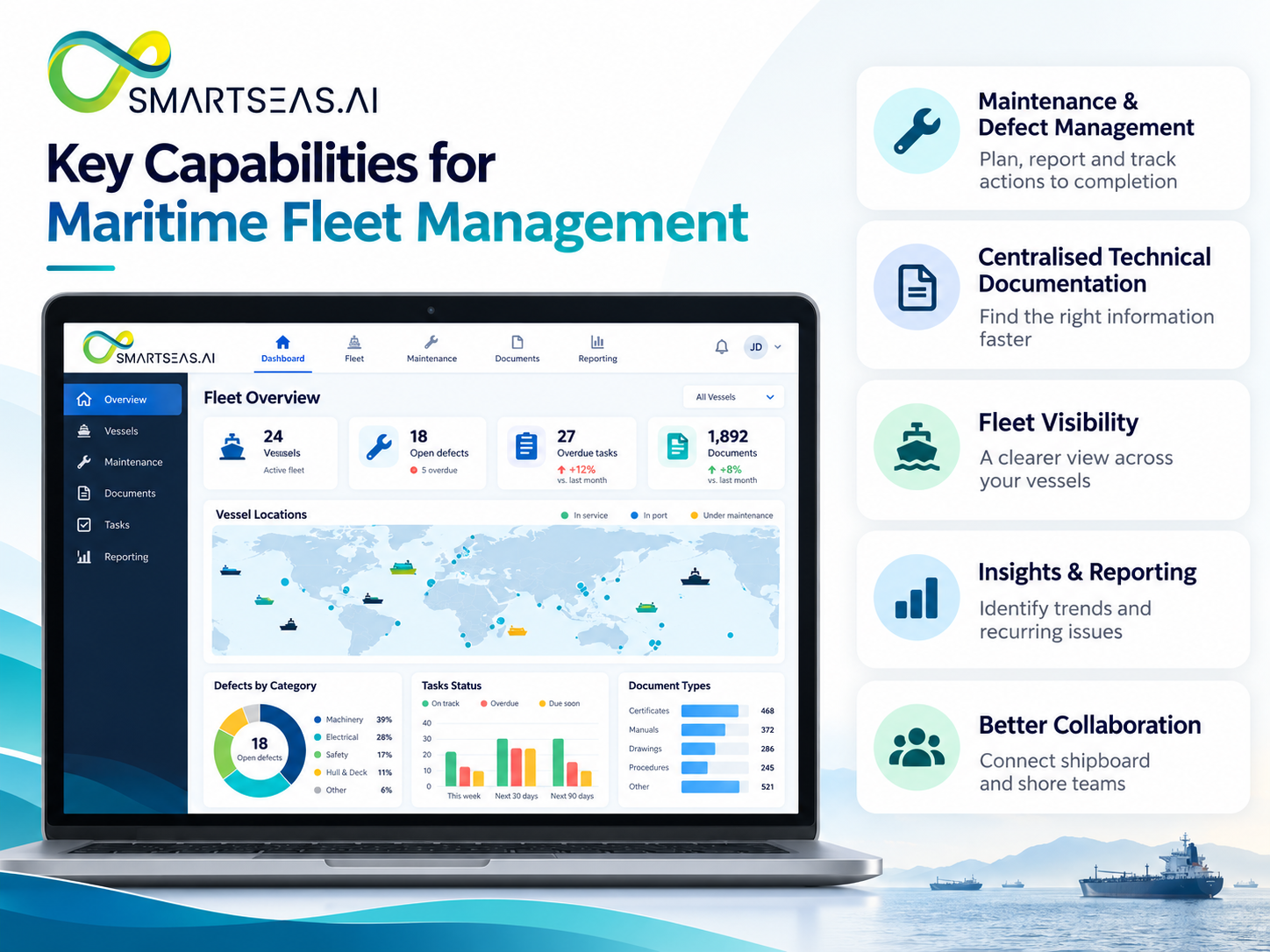
Maintenance and defect management are fundamental to technical fleet operations. Software should help teams schedule maintenance, report defects, assign responsibilities and monitor corrective actions through completion.
Look for equipment-specific maintenance histories, overdue-task visibility, defect prioritisation, repair records and verification of completed work.
For example, when an auxiliary engine develops a recurring fault, the platform should make it possible to review the defect, check earlier interventions and document the repair outcome. This creates a useful record for future investigations.
The objective is not only to track whether a task has been completed, but also to understand whether the corrective action addressed the problem.
According to DNV's guidance on planned maintenance systems, structured maintenance processes support vessel reliability, technical asset management and defect reporting.
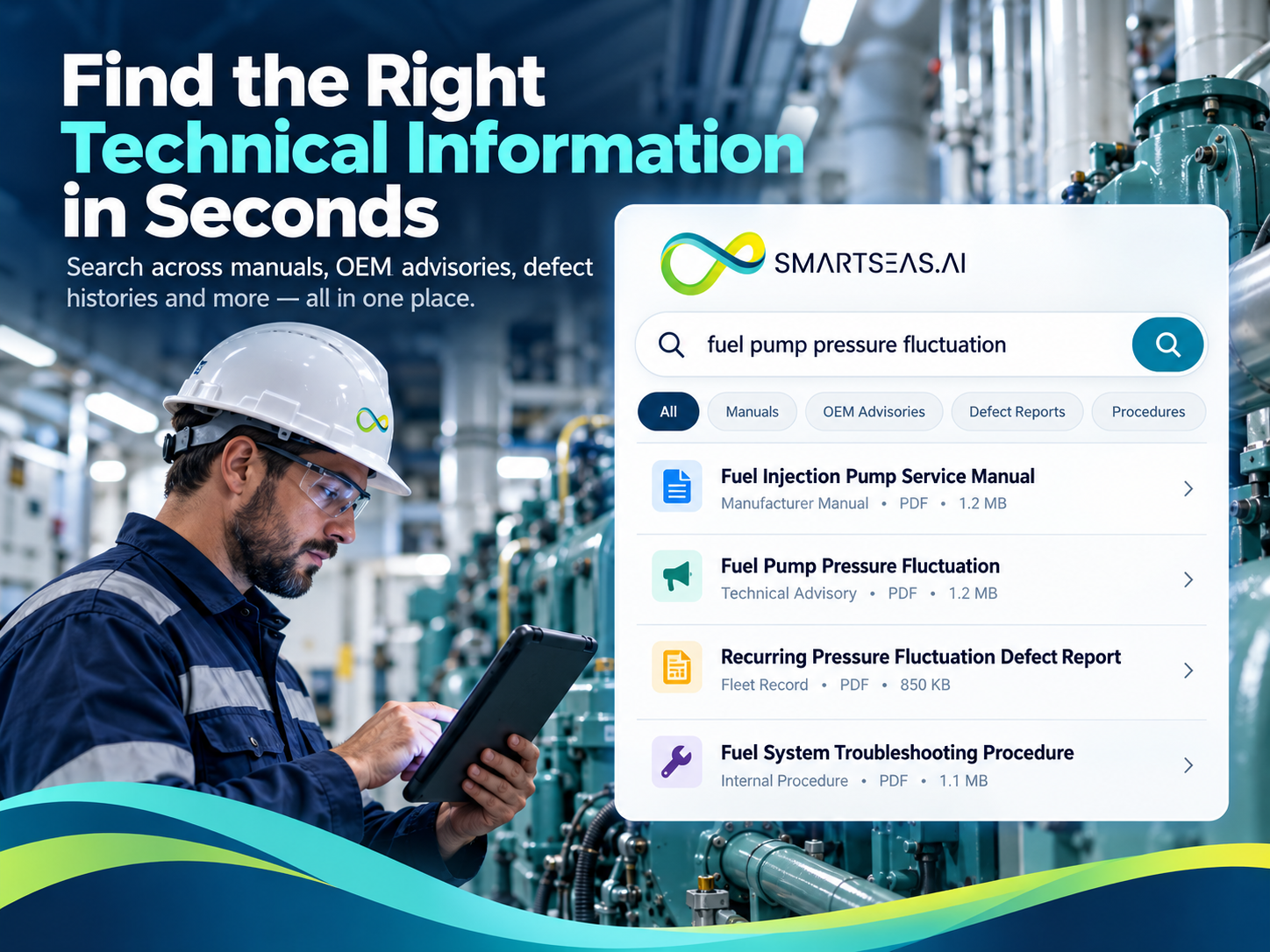
Technical teams regularly use equipment manuals, manufacturer advisories, operating procedures, safety instructions and internal technical reports. When these resources are scattered across folders, emails and applications, retrieving the correct information can take time.
A suitable platform should support:
Document control is especially important when equipment configurations differ between vessels. A document should not be treated as applicable simply because it mentions the same machinery type.
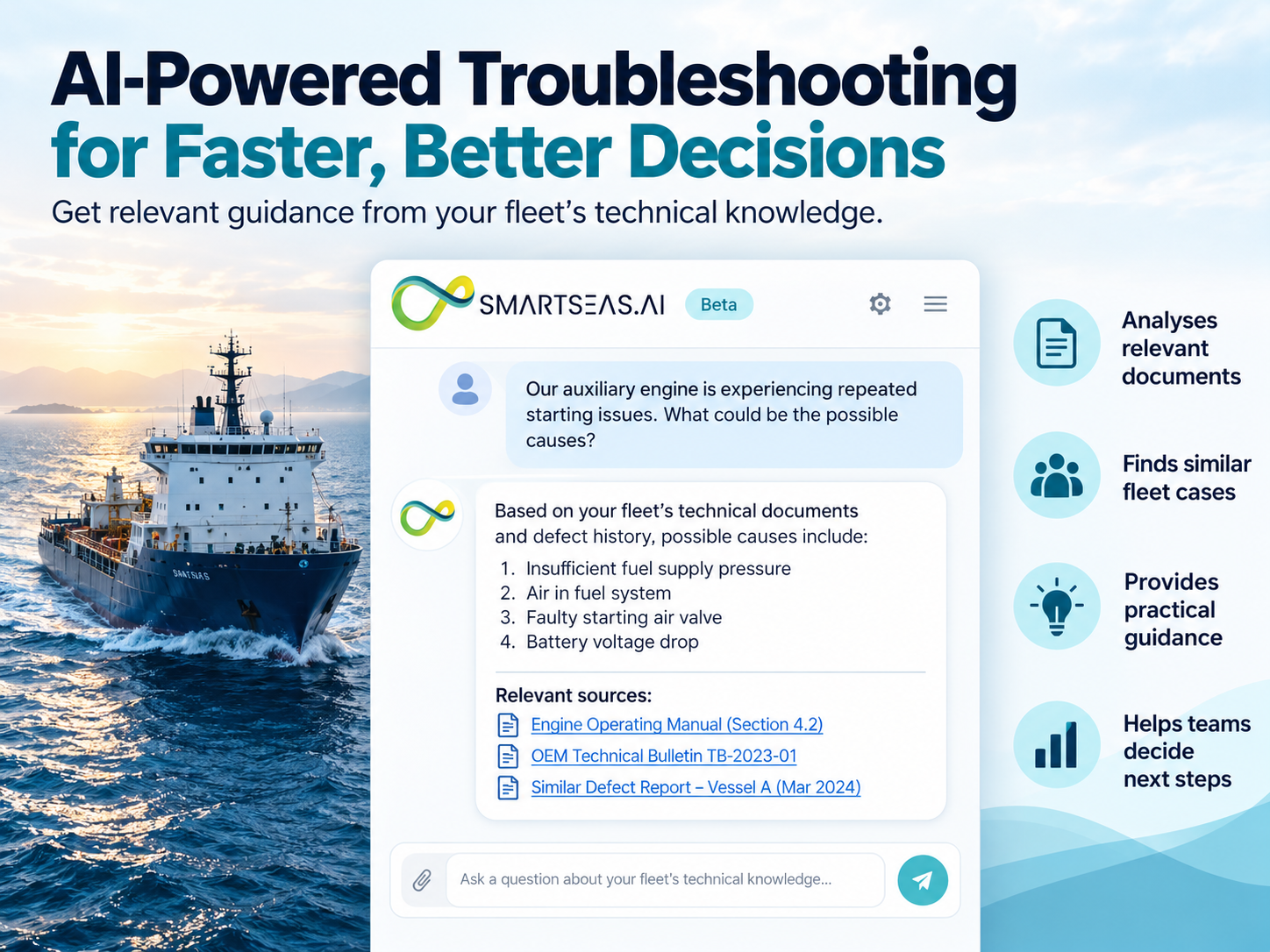
Conventional fleet software helps teams record information and manage workflows. AI-assisted tools can add value by helping users retrieve and interpret relevant information from connected knowledge sources.
Consider a pump experiencing repeated pressure fluctuations. Instead of searching several manuals and old defect reports independently, a crew member could use an AI assistant to find relevant manual sections, review documented corrective actions and identify potentially related incidents.
When evaluating this capability, ask whether the system:
A confident answer is not necessarily a reliable answer. In maritime operations, unsupported technical guidance can create additional risks. AI should support qualified personnel, not replace engineering judgement, approved procedures or equipment safety requirements.
A problem identified on one vessel may provide useful information for another vessel operating similar equipment. However, the value of this experience depends on whether previous defects and their outcomes can be retrieved.
Fleet-wide defect intelligence helps technical teams compare incident descriptions, equipment types, symptoms and documented corrective actions across vessels.
This can support the investigation of repeated failures, help preserve institutional knowledge and reduce unnecessary duplication of work.
For instance, if several vessels report similar cooling-water temperature fluctuations, a superintendent could compare their equipment histories and previous interventions before deciding what to investigate.
These similarities should guide investigation rather than automatically establish a common root cause. Technical conclusions must be based on the evidence available for each vessel.
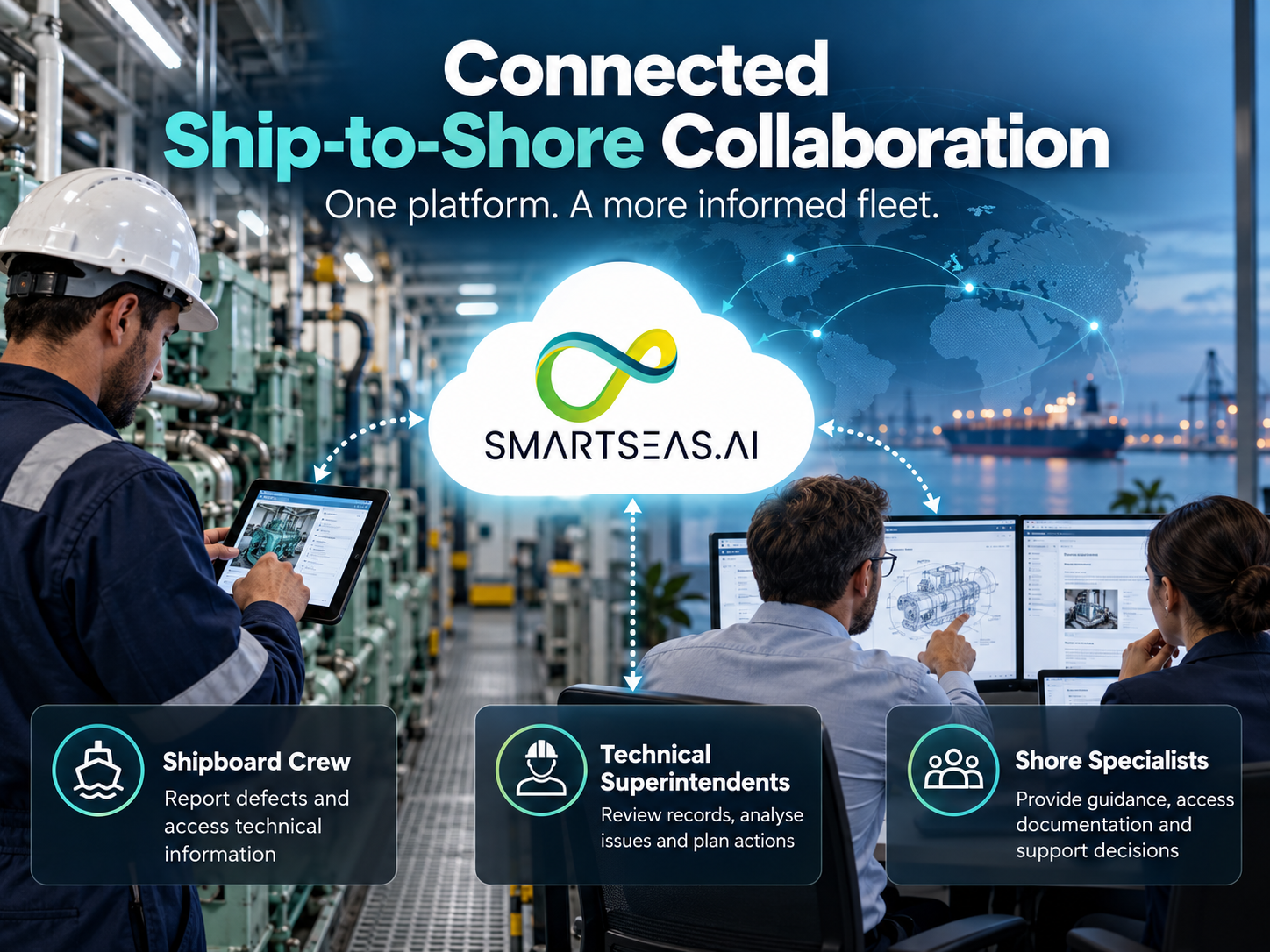
Fleet managers need to understand which defects require attention, what information remains outstanding and who is responsible for the next action.
A useful platform should provide shared updates, clear responsibility assignments, escalation workflows and access to supporting photographs, readings and documents.
This helps reduce repeated clarification between vessels and shore teams. It also makes technical decisions easier to trace, particularly when several departments contribute to an investigation.
Look for fleet-level views that help authorised users prioritise unresolved issues without losing the details of individual vessel incidents.
Reporting should help teams identify operational problems and determine where attention is needed.
Useful reporting capabilities include overdue maintenance, recurring defects, unresolved high-priority issues and equipment that repeatedly requires intervention.
Fleet teams should ask whether the platform can answer practical questions:
The reliability of these insights depends on data quality. Inconsistent defect descriptions, missing information and outdated records can reduce the usefulness of analytics.
Different platforms solve different problems. The following comparison can help fleet teams understand what each approach may offer.
These approaches can overlap. An integrated platform may already include AI capabilities, while an AI assistant may complement an existing ship management system.
The correct choice depends on the fleet's current systems, the gaps that need to be addressed and the operational outcomes the organisation wants to improve.
Introducing new software should not automatically mean replacing every existing application. A fleet may already use separate systems for maintenance, procurement, compliance and document management.
The challenge is ensuring that the information required for daily operations can be accessed without unnecessary duplication.
The International Maritime Organization has highlighted the importance of maritime digitalisation, interoperability and effective data-sharing. These considerations are relevant when assessing how new platforms fit into a fleet's existing technology environment.
Before selecting a provider, ask:
Data ownership should also be clear. The organisation needs to understand how uploaded documents and operational records are stored, retained, exported and deleted.
A platform should strengthen the existing technology environment rather than become another isolated information store.
In March 2026, the International Maritime Organization approved its IMO Strategy on Maritime Digitalization, emphasising interoperability, data-sharing, standardisation and effective data governance.
Maritime software may contain sensitive technical documents, equipment records and operational information. A security incident could affect both data confidentiality and the availability of essential workflows.
The IMO's maritime cyber risk guidance emphasises identifying, assessing and managing cyber risks that could affect safety, security or operations.
Fleet teams should review several areas before adopting a SaaS solution:
Cloud-based software does not automatically guarantee security or continuous availability. Providers should demonstrate how their controls meet the organisation's requirements.
The International Association of Classification Societies has introduced UR E26 and UR E27 cyber resilience requirements for ships and onboard systems, reinforcing the importance of cybersecurity in increasingly connected maritime environments
A platform may offer extensive functionality but still deliver limited value if shipboard personnel find it difficult to use.
Crews operate under time pressure and may have limited connectivity. Shore-based teams also need interfaces that make technical information easy to review and act upon.
During a demonstration, test a realistic workflow: report a machinery defect, attach readings, locate the relevant manual, review a previous incident and share the information with the superintendent.
Observe whether the process is straightforward, whether duplicate data entry is required and whether users can understand the results.
Prioritise intuitive navigation, practical training, responsive support and minimal disruption to existing work.
User adoption should be treated as a key implementation measure because the quality of the information available to a platform often depends on how consistently people use it.
Even when a fleet has established maintenance software, technical teams may still need to search multiple documents and historical records before finding useful troubleshooting information.
This is where SmartSeas.AI becomes relevant.
SmartSeas.AI is an AI-powered maritime platform designed to improve access to technical knowledge, support troubleshooting and strengthen ship-to-shore visibility.
When a crew reports a recurring equipment fault, an AI-assisted workflow can help retrieve relevant technical documentation and previous defect information from connected sources, where available.
This approach can help address common operational challenges:
SmartSeas.AI can complement existing fleet management systems rather than replace every maintenance or compliance application. Its suitability depends on the fleet's operational requirements, source quality and integration environment.
The objective is to help maritime professionals find relevant information faster and make better-informed decisions while keeping qualified personnel responsible for technical actions.
Software selection should focus on measurable operational value, not subscription cost alone.
Before implementation, establish a baseline using current performance data. After deployment, compare the results against the same measures.
Include implementation, integration, training and ongoing support in the cost assessment. Also consider factors outside the software, such as spare-part availability, equipment condition and crew experience.
A pilot provides a practical way to determine whether the expected benefits are being achieved before committing to a broader rollout.
A structured evaluation process helps avoid choosing software based on feature lists alone.
Step 1: Identify operational gaps. Document the main issues affecting maintenance, troubleshooting, reporting or communication.
Step 2: Define requirements. Separate essential capabilities from optional features and involve both shipboard and shore-based users.
Step 3: Test real scenarios. Use actual representative workflows, manuals and defect records during demonstrations.
Step 4: Review integration and security. Assess compatibility, data ownership, access controls and implementation requirements.
Step 5: Run a measurable pilot. Set a clear timeframe, assign responsibilities and evaluate performance against agreed KPIs.
The pilot should include user feedback and a documented review of what worked, what did not and what needs to change before wider deployment.
Avoid committing to a platform based solely on impressive demonstrations or unverified claims about AI performance and downtime reduction.
Fleet management SaaS for maritime operations should help shipping companies manage maintenance, improve defect visibility, connect technical information and support better decisions across vessels and shore teams.
The most useful platforms combine practical usability, reliable data, integration, cybersecurity and actionable reporting. AI can strengthen these capabilities by making technical knowledge easier to retrieve, provided its outputs are grounded in trustworthy sources and appropriately reviewed.
SmartSeas.AI supports this approach by helping maritime teams access connected technical knowledge and improve AI-assisted troubleshooting within existing fleet workflows.
Explore SmartSeas.AI to learn how AI-powered maritime support can complement your fleet's operational processes.
Cloud-based software that helps shipping companies manage maintenance, defects, records and fleet workflows.
Maintenance tracking, defect management, technical documentation, reporting, integration and security.
It improves information access, collaboration and consistency across fleet operations.
Yes. AI can retrieve technical knowledge and surface relevant historical defects, subject to source quality and human verification.
Not necessarily. Integrating new capabilities may be more practical than replacing effective systems.
Track information retrieval time, defect-resolution time, repeat failures, administrative effort and user adoption.
Security depends on the provider's access controls, data protection and recovery arrangements.
It helps users access connected maritime technical knowledge and supports AI-assisted troubleshooting.

Get Started Today
Transform the way you troubleshoot and manage maritime operations. Join the next wave of Maritime Digital Transformation with SmartSeas AI.