November 12, 2026
Your Fleet Has Years of Technical Data. Why Is Every New Fault Still a Search Mission?


November 12, 2026
A vessel reports a recurring fuel oil pressure problem. The Chief Engineer checks the equipment manual, reviews recent maintenance records and contacts the technical superintendent. Meanwhile, the shore team searches previous defect reports and emails to see whether another vessel has experienced the same issue.
The answer might already exist somewhere in the company's technical history. Yet finding it can take longer than expected.
This is one of the practical challenges that AI-powered maritime troubleshooting aims to address: helping engineering teams retrieve relevant technical knowledge without repeatedly searching through disconnected information sources.
Most established shipping companies have accumulated years of equipment manuals, maintenance records, technical defect reports, incident investigations and correspondence.
The information usually exists. What is missing is a fast way to retrieve it when it matters most.
As fleet operations become more data-driven, the ability to connect existing information with current machinery problems is becoming increasingly important.
Modern vessels generate substantial technical and operational information throughout their service lives.
Every maintenance activity, equipment failure, inspection and technical investigation can contribute to a vessel's operational history.
Across an entire fleet, this information may include:
These records can help engineers understand how equipment has performed, what failures have occurred previously and which corrective actions were effective.
However, accumulating information does not automatically make it accessible.
A technical superintendent may know that a similar machinery issue occurred on another vessel but still struggle to locate the relevant report.
A Chief Engineer may have the correct manual onboard but need considerable time to identify the applicable troubleshooting instructions.
This creates an important distinction between storing technical data and making technical knowledge operationally useful.
The wider industry is also under pressure to improve reliability and maritime operational efficiency. Allianz Commercial's Safety and Shipping Review 2026 highlights the continuing importance of machinery-related incidents in maritime safety and operational risk.
For fleet operators, this reinforces the value of faster access to reliable technical information.
When equipment fails onboard, troubleshooting often begins with information gathering.
Before engineers can determine the most appropriate corrective action, they may need to establish:
Each question may require searching a different system.
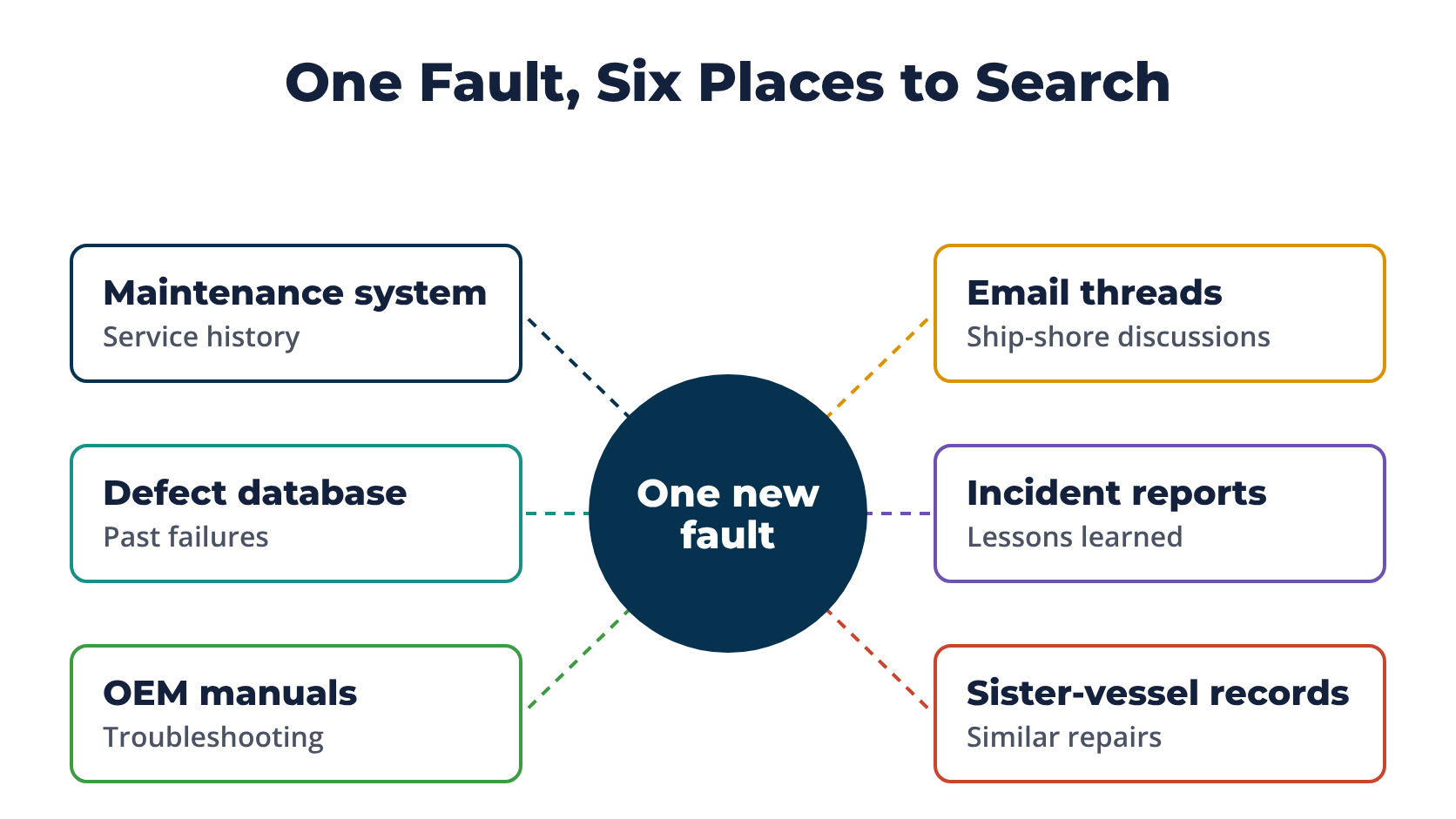
A planned maintenance system may contain the service history, while previous technical defects are stored in another application.
OEM guidance may exist in PDF manuals, and valuable troubleshooting discussions may be buried in email correspondence.
Even when all these sources are available, engineers must manually connect the information.
Consider a hypothetical auxiliary engine cooling-water temperature alarm.
The engineer may need to review the alarm history, cooling system diagrams, previous maintenance records and similar defect reports.
If this information is distributed across multiple repositories, a significant part of the initial troubleshooting effort can be spent locating and comparing documents.
The technical problem may be familiar, but the supporting information is not immediately accessible.
This is why repeated searching remains common even in fleets that have invested in digital systems. Digital records are not the same as connected technical intelligence.
Many shipping companies already use multiple digital applications to manage vessel operations.
These systems serve important purposes, but they are often designed around individual functions rather than the complete troubleshooting process.
For example:
This fragmentation creates three major operational challenges.
Different vessels may experience similar problems but investigate them independently because previous findings are not easily available.
Experienced engineers and superintendents often remember previous failures and their solutions. However, when those individuals transfer, retire or become unavailable, important knowledge can become difficult to recover.
When the vessel and office cannot access the same technical context, communication involves repeated requests for documents, clarifications and updates.
The result is additional effort before the team can make an informed technical decision.
The importance of machinery reliability is supported by recent industry reporting.
According to Allianz Commercial's Safety and Shipping Review 2026, machinery damage or failure accounted for 1,505 reported shipping incidents worldwide during 2025, involving vessels over 100 gross tons. That represented more than half of the 2,818 reported incidents.
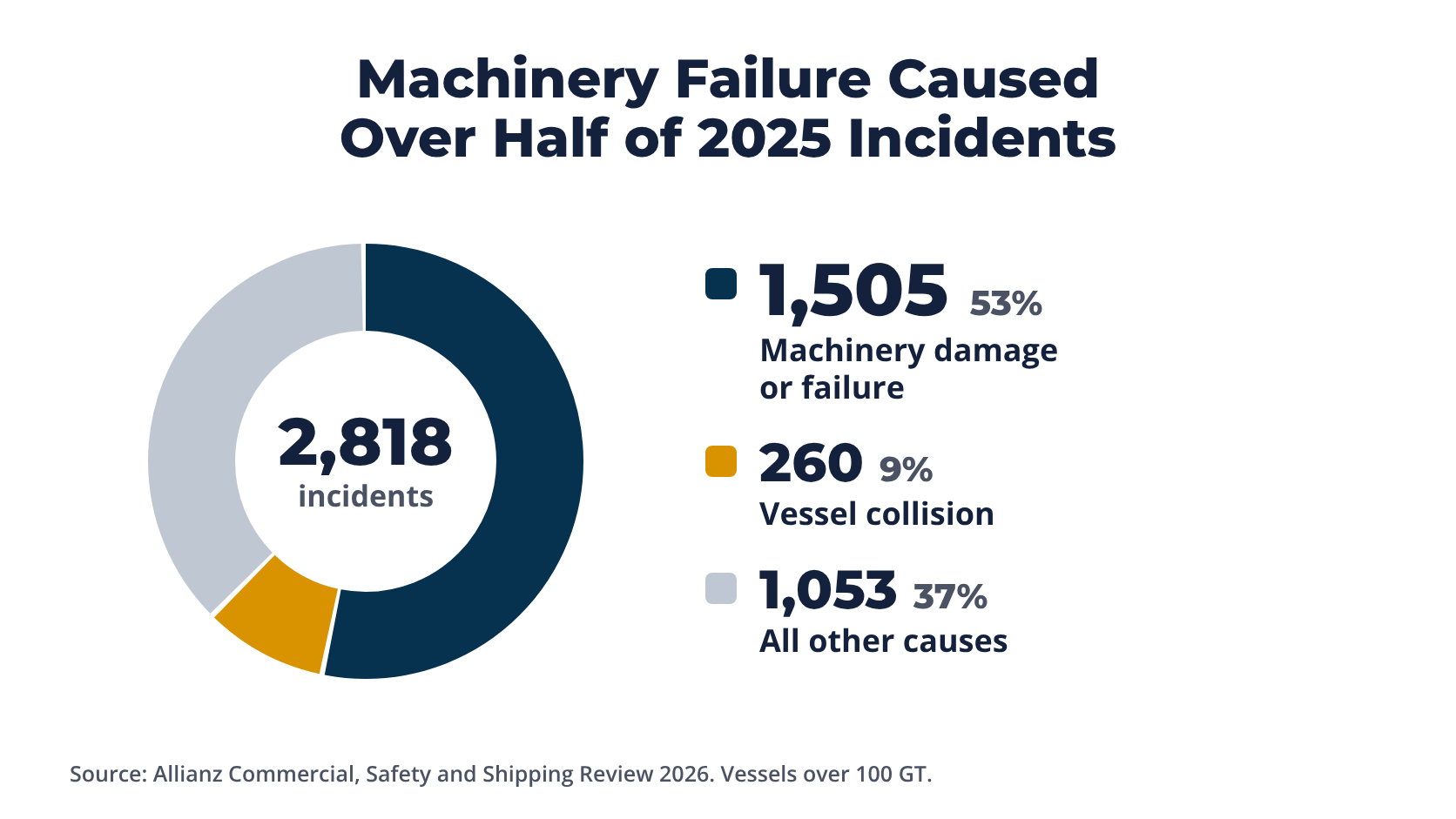
The pattern is not limited to one year. Over the past decade, machinery damage or failure accounted for 12,991 of 28,660 reported incidents, or 45% of the total.
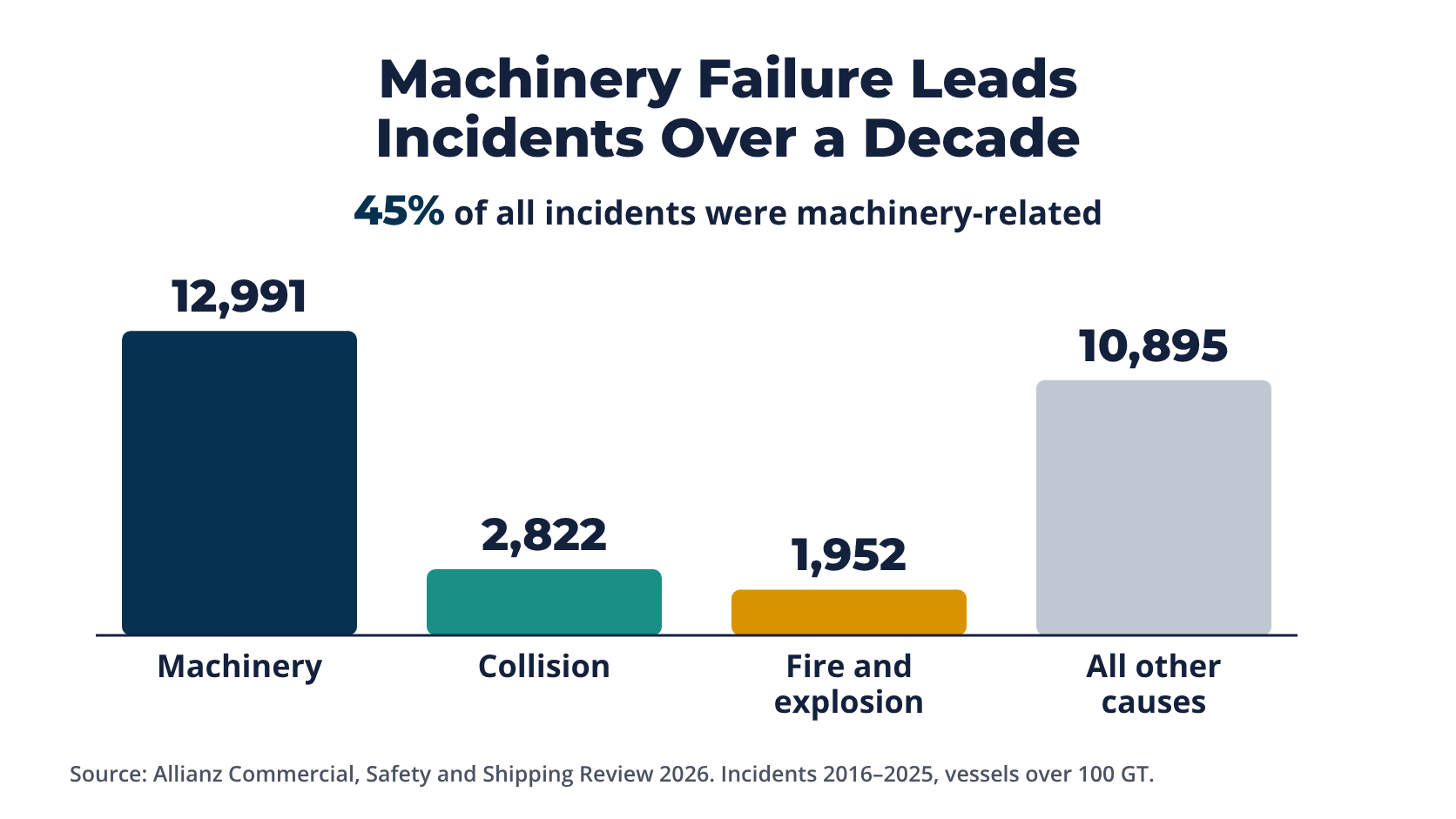
These figures represent incident categories, not the number of incidents preventable through AI. They do not establish how much downtime could be avoided through better information retrieval. They do, however, show why machinery-related operational risk deserves continued attention.
Meanwhile, UNCTAD's Review of Maritime Transport 2025 describes how shipping is navigating trade disruptions, longer routes, rising operational pressures and the need for greater digitalisation.
For shipowners and managers, improving access to existing technical knowledge is one practical way to strengthen operational decision-making without replacing every established fleet management system.
Traditional troubleshooting relies heavily on engineers identifying which documents to open and where to search.
AI-powered maritime troubleshooting can introduce a more connected approach. Instead of manually searching each source, an engineer can ask an equipment-specific question and retrieve relevant information from authorised technical records.
Consider a question such as:
Why does the auxiliary engine lubricating oil pressure drop after reaching operating temperature?
An AI-assisted system can use the equipment identity, reported symptoms and available technical context to search for relevant information.
Depending on the information made available to the system, retrieval may include OEM manuals, maintenance records, previous defect reports and technical correspondence.
Rather than displaying a long list of unrelated documents, the system can organise relevant information around the reported problem.
For example, it may retrieve the applicable OEM troubleshooting section, previous cases involving similar symptoms and corrective actions documented by other vessels.
The engineer reviews the source documents, checks whether the information applies to the installed equipment and determines the appropriate next steps.
AI should shorten the search for technical evidence, not replace engineering judgement. A source-backed answer is useful only when the retrieved information is accurate, applicable and sufficiently current.
The difference becomes clearer when comparing the two workflows.
This does not mean replacing existing ship management software or vessel maintenance software. These applications remain essential for maintaining records, scheduling activities and managing operational processes.
Instead, a connected intelligence layer can make the information held in those systems easier to use during troubleshooting.
This represents a practical direction for Maritime Fleet Management using AI: improving how existing fleet knowledge supports day-to-day decisions.
A technical defect report should be more than a record that a problem occurred. When properly documented, it can preserve knowledge that helps another engineer investigate a similar failure.
Consider a hypothetical case involving a recurring seawater cooling pump problem.
One vessel experiences reduced discharge pressure. The crew investigates and records the symptoms, inspection findings, identified cause and corrective action.
Several months later, another vessel reports similar symptoms.
If the previous investigation is searchable, the second vessel can review what was found earlier and decide whether the same failure mechanism might be relevant.
This does not mean the previous solution should be applied automatically. Different operating conditions, equipment configurations or underlying causes may require different corrective actions. However, the earlier report gives the engineering team a useful starting point.
For this approach to work, technical reports should capture more than a brief description of the problem.
Useful records include the equipment identity, operating conditions, symptoms, diagnostic checks, confirmed root cause, corrective action and evidence of successful operation after repair.
Consistent equipment naming and structured defect classifications can also improve retrieval quality.
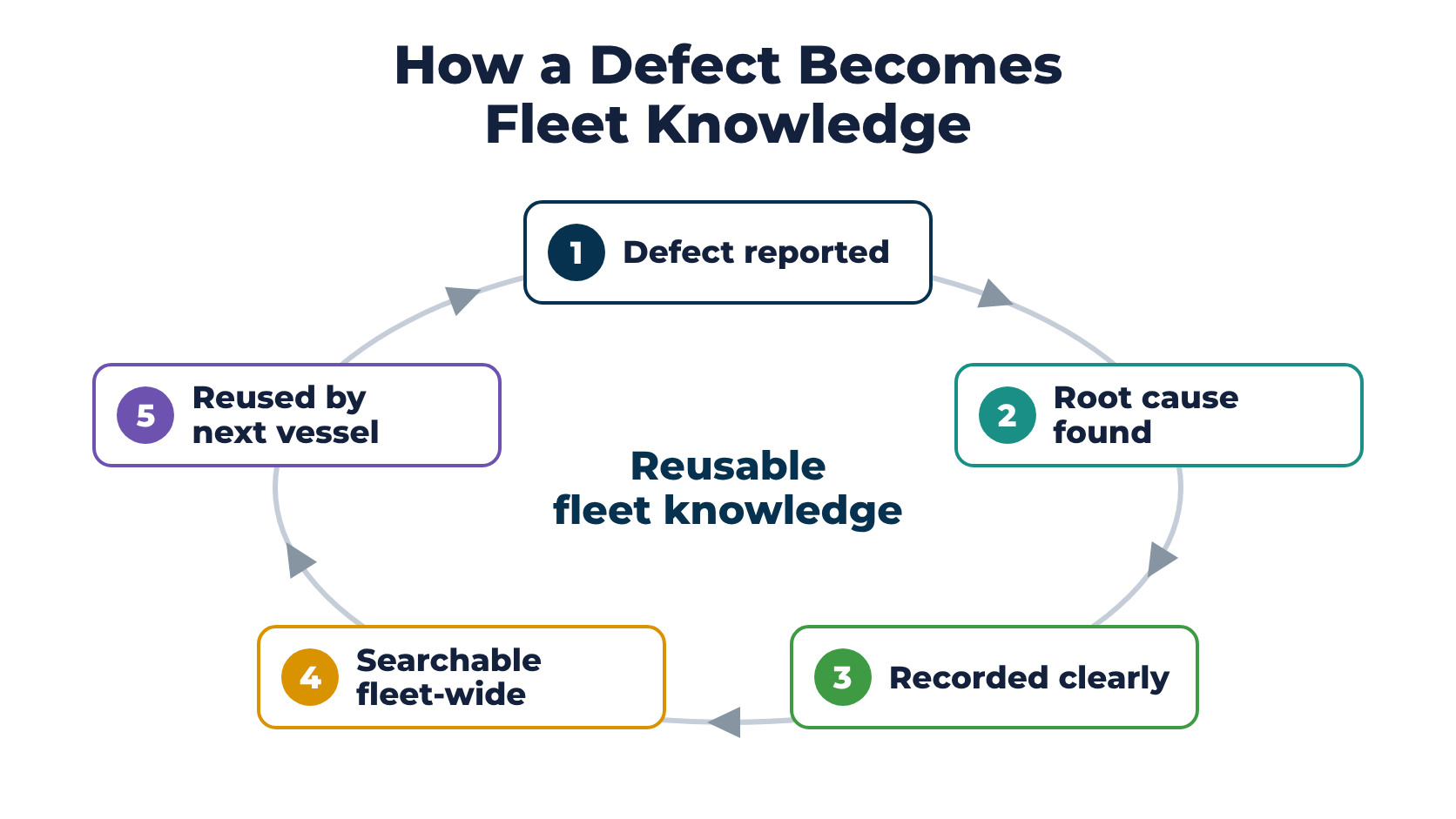
Over time, this can help transform individual vessel experiences into a searchable technical knowledge base.
That is one of the practical opportunities for a Fleet Intelligence Platform: making documented experience available beyond the vessel where it originated.
SmartSeas.AI is an AI-powered maritime platform designed to help shipboard and shore-based teams retrieve technical information and support faster troubleshooting decisions.
Rather than requiring engineers to search disconnected sources individually, SmartSeas.AI helps bring relevant technical knowledge into a more accessible workflow.
Its focus includes:
For a superintendent managing several vessels, the value lies in having relevant manuals, previous technical cases and supporting evidence available when reviewing a new defect, rather than in the AI response alone.
SmartSeas.AI supports that process while keeping technical evaluation and operational decisions with the responsible maritime professionals.
Introducing Maritime AI into technical operations should begin with the quality and accessibility of existing information.
Buying another application without understanding the underlying data challenges may simply create an additional disconnected system.
A practical implementation appr9. What Fleet Managers Should Do Before Introducing AI
oach includes the following priorities.
Map the repositories containing manuals, defect records, maintenance history, incident investigations and OEM correspondence.
Check equipment identifiers, document versions, missing corrective actions and inconsistent reporting practices.
Begin with equipment categories where previous experience is particularly useful, such as auxiliary engines, pumps, compressors, generators and control systems.
Evaluate whether retrieved information is applicable to the correct equipment model and supported by identifiable records.
Select a representative group of vessels and assess whether connected retrieval improves actual engineering workflows.
Useful indicators include:
These measurements can help distinguish genuine workflow improvements from technology adoption alone.
AI-assisted retrieval can improve access to information, but it also introduces limitations that maritime operators must manage carefully.
An AI system may retrieve an outdated manual, identify a superficially similar defect or produce an explanation that is not supported by the available evidence. Even an accurate previous repair record may not apply to a different machinery configuration.
For safety-critical troubleshooting, operators should maintain clear controls around document versioning, equipment applicability, source references, access permissions and human approval.
The IMO's maritime cyber risk management guidance also emphasises protecting shipping operations from risks associated with increasingly connected and digital systems.
AI-generated information should never override OEM instructions, approved onboard procedures, the vessel's safety management system or required isolation and permit-to-work arrangements.
The appropriate objective is AI-assisted investigation with accountable human decision-making, not autonomous technical intervention.
Shipping companies have spent years building technical records through maintenance activities, machinery investigations, inspections and operational experience.
Yet when a new defect occurs, engineers may still spend valuable time searching for information that already exists.
The next stage of Maritime Digital Transformation should therefore focus not only on collecting more data but also on making existing knowledge easier to retrieve, verify and apply.
AI-powered maritime troubleshooting offers a practical way to connect manuals, defect history and documented fleet experience.
For shipowners, fleet managers and technical superintendents, the opportunity is to reduce unnecessary searching, strengthen ship-to-shore coordination and support better-informed technical decisions.
Most fleets already have enough technical data. The real test is whether engineers can find the right information when they need it.
Discover how SmartSeas.AI helps maritime technical teams connect existing fleet knowledge and support more efficient troubleshooting workflows.
Technical information is often distributed across manuals, maintenance systems, defect databases and emails. Engineers must search multiple sources to collect the information needed for troubleshooting.
AI-powered maritime troubleshooting retrieves relevant information from connected technical sources, including OEM manuals and previous defect records, to support engineering investigations.
AI can help engineers identify previous failures, documented causes and corrective actions. This may support better investigations, although preventing recurrence still depends on correct diagnosis and effective maintenance.
Traditional ship management software primarily records and manages operational activities. Maritime AI can help retrieve, connect and interpret relevant information from those records.
Fleet managers can standardise defect reporting, improve equipment identification, maintain accurate corrective-action records and make historical cases searchable across authorised fleet systems.
No. AI can assist with technical information retrieval and evidence gathering, but engineers remain responsible for diagnosis, safety verification and operational decisions.
They should evaluate data compatibility, equipment-specific retrieval, source traceability, cybersecurity, onboard connectivity, user permissions and measurable improvements in technical workflows.

Get Started Today
Transform the way you troubleshoot and manage maritime operations. Join the next wave of Maritime Digital Transformation with SmartSeas AI.