November 20, 2026
Maritime AI Can Answer Technical Questions. But Can It Understand Your Ship?

November 20, 2026
A Chief Engineer types a question into a Maritime AI assistant: "Our auxiliary engine keeps shutting down on low lube oil pressure. What could be causing it?"
The reply arrives in seconds. Clogged filters, a faulty pressure sensor, worn bearings, a weak lube oil pump. All reasonable, and most of them were probably on the engineer's list already.
What the AI assistant doesn't know is which engine is actually installed, when the filters were last changed, whether the same alarm came up last month, or what the crew has already ruled out. Without that, it is answering a textbook question rather than the one the ship is asking.
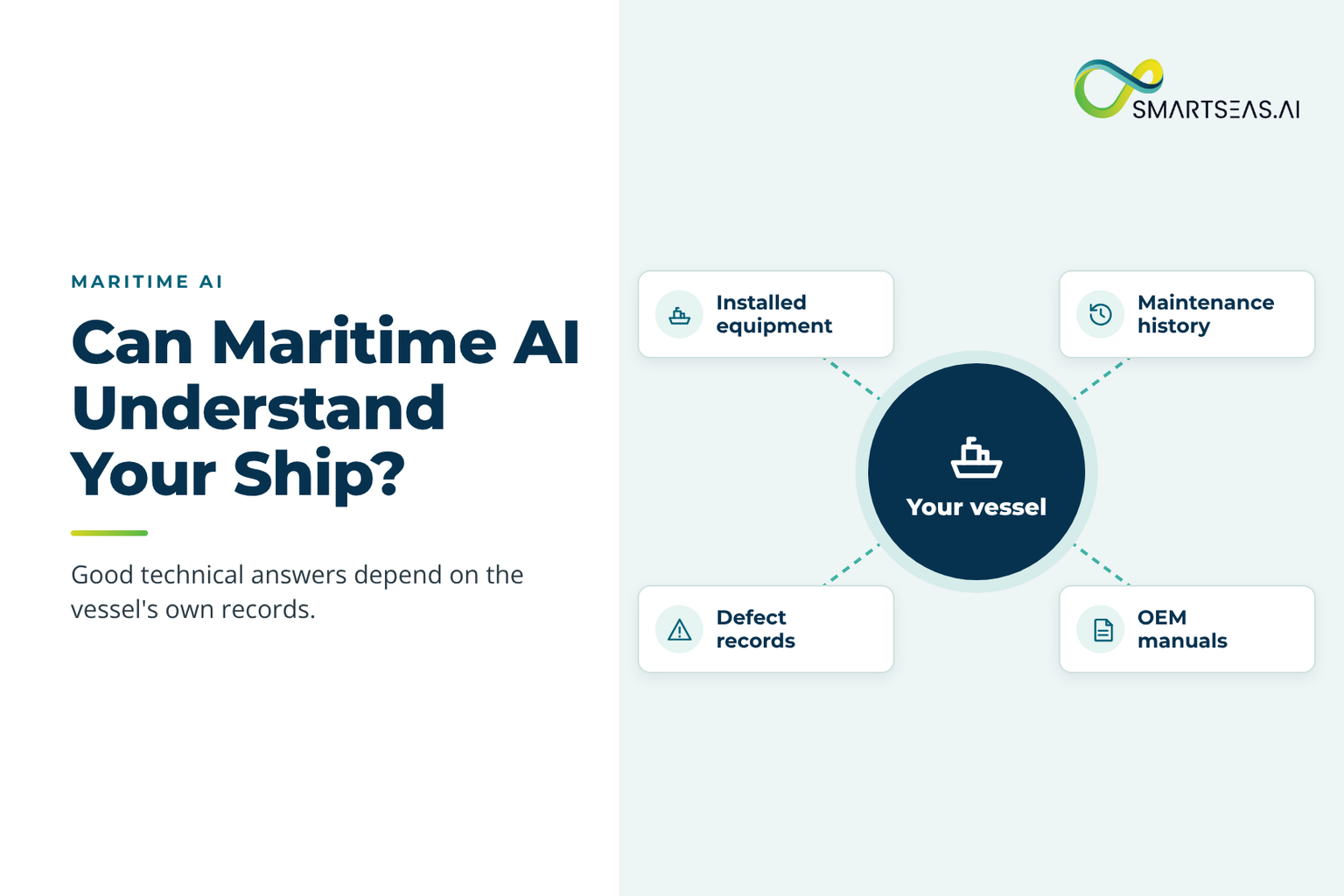
That gap is the subject of this article. AI has become good at understanding technical questions. The harder problem, and the more useful one for shipowners, marine engineers and technical superintendents, is connecting that reasoning to the vessel's own equipment records, documentation and history, so the answer is relevant, traceable and useful onboard.
Large language models (LLMs), the technology behind most AI assistants, learn from vast amounts of general text. That is why they can explain how a purifier works or list common causes of high exhaust temperature. It is useful knowledge. It just isn't vessel knowledge.
Take two ships running the same auxiliary engine model, both with the same low-pressure alarm. On one, the pressure transmitter has failed. On the other, there is a genuine lubrication problem. Ask a general AI tool and both engineers will probably get the same list. What separates the two cases sits in each ship's records and readings, not in the model's training data.
A vessel-aware system works from that context instead:
No system will have all of this every time. But each reliable piece narrows the distance between "what might be wrong with an engine like this" and "what could be happening on this ship".
Machinery is still the biggest single source of reported incidents at sea. Allianz Commercial's Safety and Shipping Review 2026 reports that machinery damage or failure accounted for 1,505 of the 2,818 shipping incidents recorded in 2025 and the years before. That is more than half the total, far ahead of collisions in second place at 260.
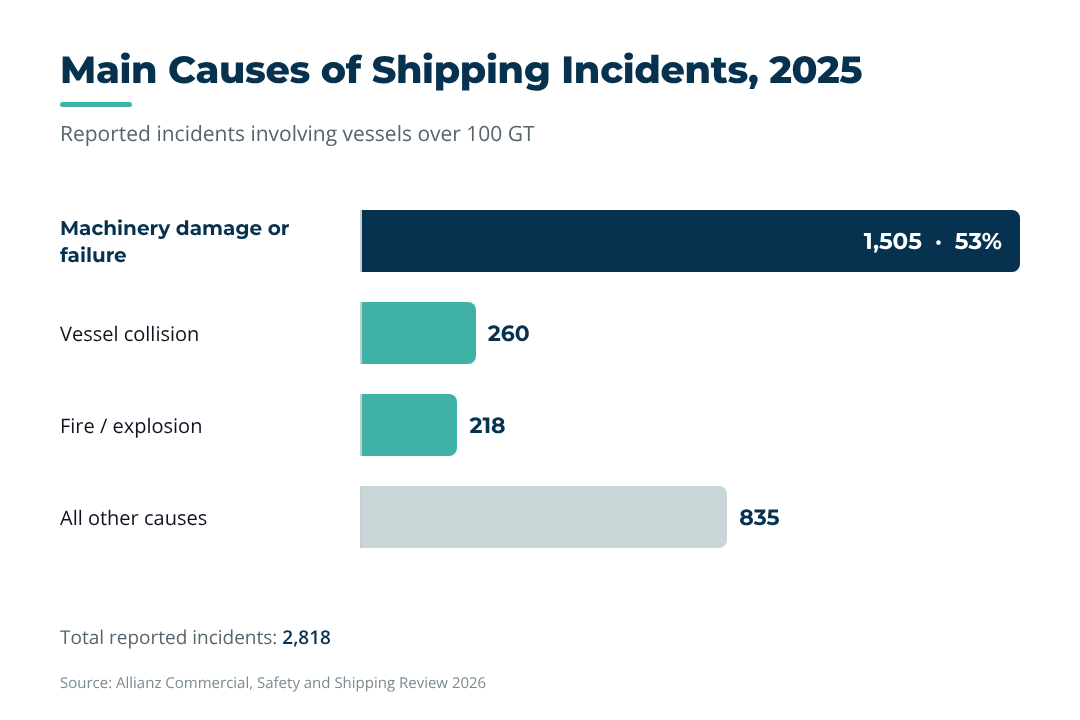
Those figures don't tell us how many failures better information could have prevented, and it would be wrong to suggest they do. What they do show is scale: technical investigations happen every day across the world fleet, and the speed and quality of each one matter.
The wider operating picture adds pressure. The UNCTAD Review of Maritime Transport 2025 describes an industry facing rising costs, longer routes driven by geopolitical tension and mounting uncertainty. Among its policy priorities, it calls for promoting digitalisation to improve efficiency and transparency "while ensuring cybersecurity".
For fleet managers, the takeaway is practical. The goal isn't more software. It is helping crews and superintendents use the technical information they already hold at the moment a fault happens.
Most shipping companies hold years of technical information: equipment manuals, planned maintenance records, defect reports, breakdown and repair histories, OEM service letters, incident investigations, superintendent correspondence and past recommendations.
Very little of it lives in one place. When a fault occurs, the engineer onboard may be scrolling through a PDF manual, opening the maintenance system and hunting for an old defect report, while the superintendent ashore digs through email or calls a sister vessel. Someone may have solved this exact problem two years ago, and still nobody finds the answer in time.
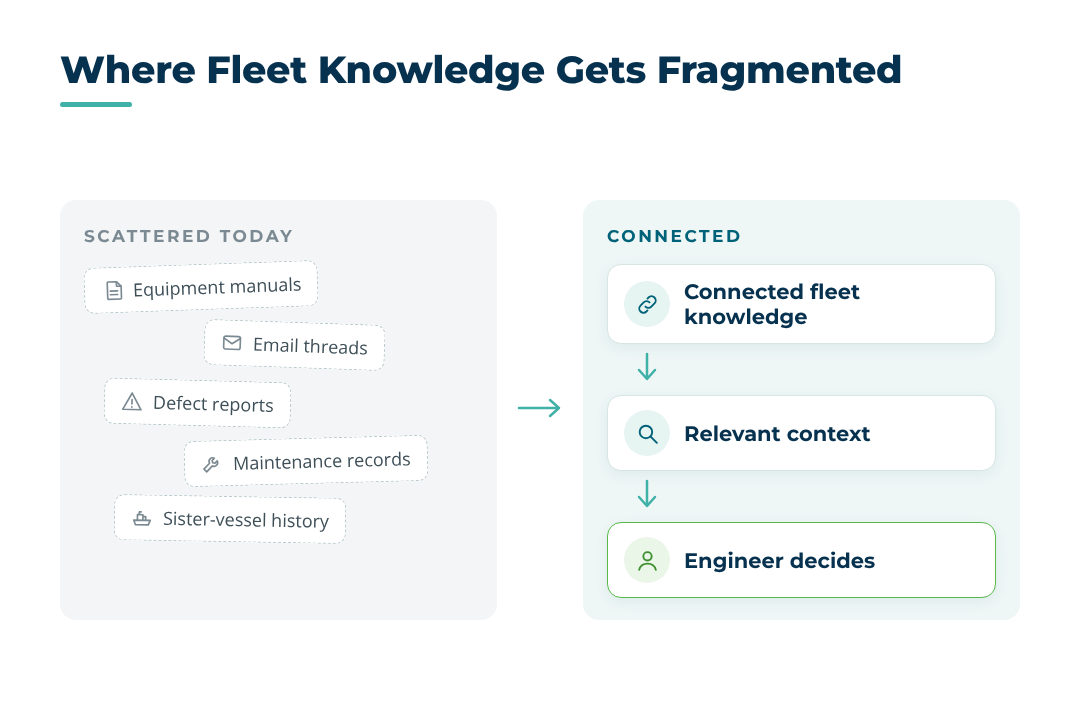
Ship management software does an important job of recording maintenance, defects and day-to-day operations. But a record that exists is not automatically a record someone can find under pressure. A defect system might hold a detailed write-up of a fuel oil pump failure, yet an engineer seeing similar symptoms on another vessel has no reason to know it is there.
That is where Maritime AI has real value. Not in producing new answers from scratch, but in surfacing the ones the fleet already has.
General-purpose AI produces answers that are plausible. Engineers need answers they can verify.
Say a seawater cooling pump starts vibrating abnormally. A general assistant will suggest checking the mechanical seal, bearings, alignment, cavitation, impeller condition and suction-side restrictions. Fair enough.
Now suppose the same pump had a cavitation problem last year, traced to a specific suction restriction, and the investigation and repair were written up in a maintenance report. A system connected to that record can put it in front of the engineer alongside the relevant OEM section. That is a far better starting point.
It is still only a starting point. Similar symptoms can have different causes, and last year's diagnosis should not be assumed to apply this time.
A useful technical answer makes clear which of three things the engineer is looking at:
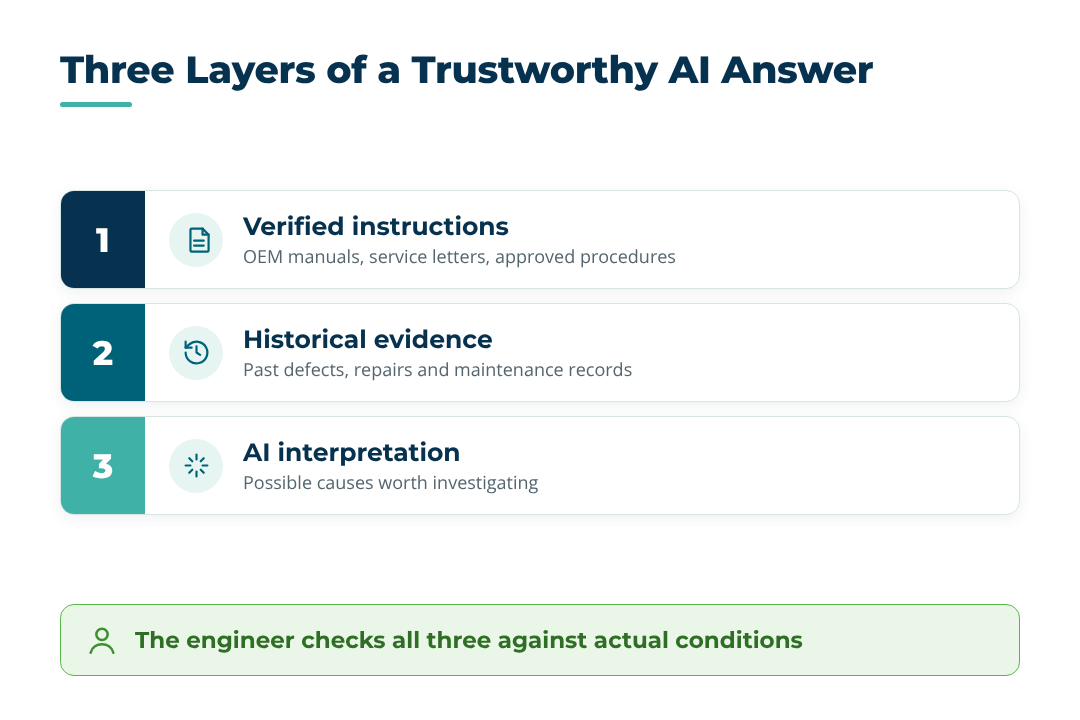
Kept apart, these show the engineer what is documented, what has happened before and what still needs investigating. A good answer makes uncertainty easier to check, rather than hiding it behind confident wording.
Understanding a vessel doesn't mean the AI knows everything happening onboard. It means being reliably connected to the technical information that belongs to that vessel. A few capabilities matter most.
Everything starts with identifying the right machinery. Guidance from the wrong manual, the wrong model or a pre-retrofit configuration can send an investigation in the wrong direction. This matters even more on ships that have had equipment replaced or control systems upgraded.
Earlier defects reveal recurring symptoms and what was done about them. A superintendent looking into an auxiliary engine starting failure gains a lot from seeing similar cases on the same ship or across sister vessels. It won't guarantee the same fix works, but it can point to the right checks and avoid repeated effort.
RAG connects a language model to external documents, so its response can draw on retrieved material rather than general training alone. In a maritime setting, that means manuals, procedures, defect reports and incident records.
RAG doesn't make wrong answers impossible. Results depend heavily on how documents are indexed, retrieved and matched to the actual equipment and question. It is, however, the foundation for answers that point back to evidence.
Technical and operational records are often confidential. Users should see only what they are authorised to see, and every important answer should link back to the documents behind it.
However capable the system, the engineer still decides whether a retrieved instruction fits the actual operating conditions. A document that mentions similar symptoms is not automatically applicable.
A chatbot answers questions. A platform built for technical work can pull from approved sources, organise the evidence and support the investigation.
Some systems go further with agentic AI: software agents that use tools and follow defined workflows to complete a task. They run inside an agent harness, which controls the tools and data they can access, how tasks are executed and how outputs are reviewed. A controlled troubleshooting workflow might retrieve the OEM manual, search defect records, compare related symptoms and draft a technical summary.
It does not diagnose or repair the machinery on its own. Qualified personnel make the call.
The difference isn't necessarily a more powerful language model. It is the operational environment around it: connections to the right records, sensible controls and workflows built around how engineering teams actually work. A well-integrated general-purpose system can provide some of this too. What matters is how reliable those connections are.
SmartSeas.AI is a Maritime AI platform that helps shipboard engineers and shore-based technical teams make better use of their technical knowledge. Rather than treating each machinery question in isolation, it connects sources such as equipment manuals, historical defects, incident records and troubleshooting documentation, so teams can ask questions conversationally and see where each answer came from.
Take a vessel reporting repeated pressure fluctuations on a fuel oil pump. The Chief Engineer needs likely causes; the superintendent wants to know whether the fleet has seen this before. Usually that means manuals, defect records and a chain of emails. With SmartSeas.AI, the engineer can simply ask:
"Has this fuel oil pump had a similar problem before, and what corrective actions were recorded?"
Where those records are in the platform, the relevant history and references come back together, with their sources attached.
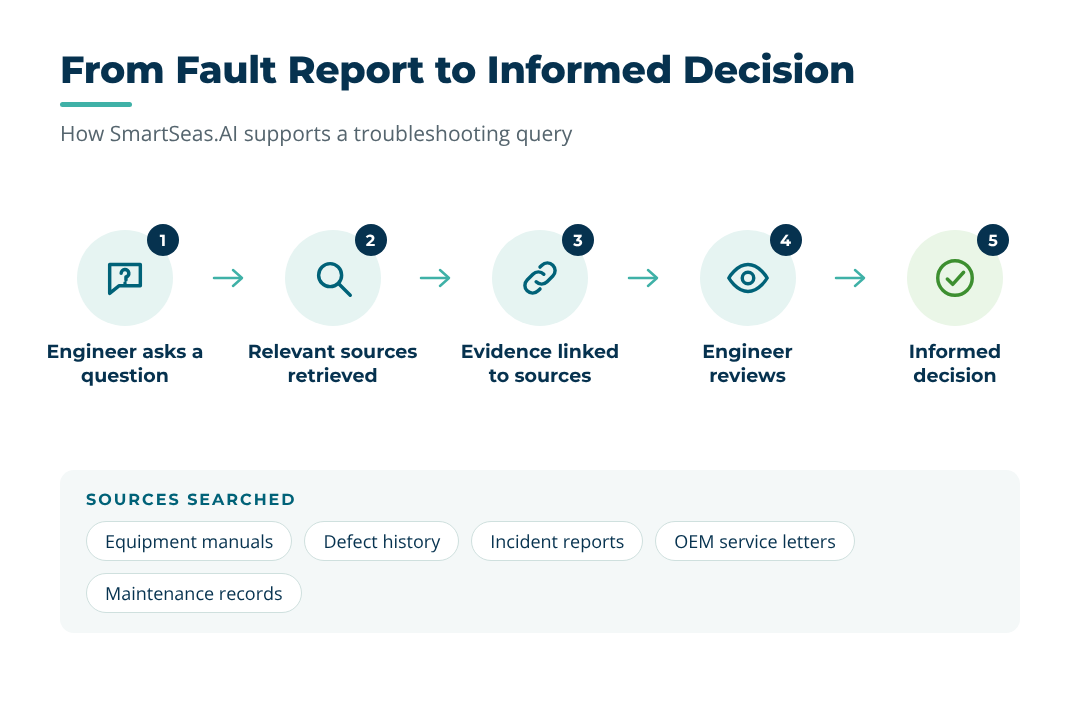
In practice, this supports three things:
SmartSeas.AI doesn't replace technical expertise. It makes the knowledge your fleet already has easier to reach, so experienced people can apply their judgement with better context.
Not every machinery failure takes a ship off-hire. Unexpected failures can still mean operating restrictions, delayed cargo work, repair costs and extra crew workload, and how quickly the ship and shore establish the technical picture affects all of them.
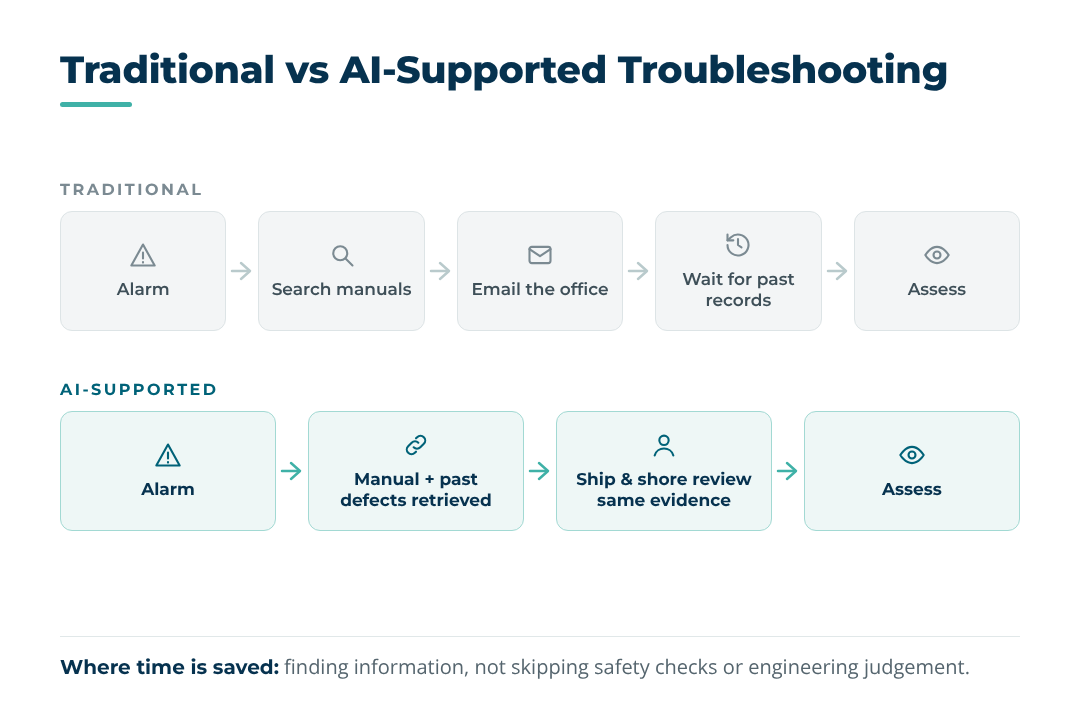
Consider an illustrative auxiliary engine starting failure.
Traditional workflow. The engineer checks the alarm history, follows procedures and searches the manual. If the cause isn't clear, the superintendent gets involved, reviews old reports or contacts the OEM. Each step may be necessary, but much of the elapsed time goes on finding information.
AI-supported workflow. The engineer follows the same safety and initial assessment procedures while the system pulls up applicable manual sections and any related failures on record. The engineer weighs this against actual readings and inspection findings, and the superintendent reviews the same evidence when deciding the next steps.
The benefit isn't automatic fault resolution. It is a shorter path to the right information, which leaves qualified people more time for the problem itself.
Measure against a baseline, and be careful about attribution. Changes in maintenance practice, staffing, equipment condition or trading pattern can move these numbers too.
Answering maritime questions is not the same as being ready for operational troubleshooting. Before committing, fleet managers should ask:
These questions matter far more than which language model sits underneath.
Language models will keep improving, and maritime software will keep becoming better connected. But a convincing explanation was never the real goal.
An engineer needs information that can be checked against the actual equipment and conditions. A superintendent needs enough context to understand earlier failures, weigh the evidence and agree a response with the vessel.
The regulatory direction points the same way. In March 2026, the IMO Facilitation Committee approved a Strategy on Maritime Digitalization that emphasises interoperability, system standardisation, data-sharing, effective data governance and human-centred systems. It is due to go to the IMO Assembly for adoption in 2027.
For shipping companies, the aim shouldn't be to put AI into every process. It should be to find where disconnected information causes delays and fix those first. A system that helps an engineer find the right manual, see the relevant defect history and check a possible cause may deliver more value than a sophisticated chatbot that knows nothing about the ship.
Maritime AI can explain how a main engine works, why a pump loses pressure or what might trigger an electrical alarm. None of that means it understands the ship in front of it.
That takes access to the right equipment information, maintenance history, defect records and verifiable references. When those are easy to reach, engineers and superintendents can investigate faults faster, coordinate better and make proper use of the experience their fleet has already built up.
Make Your Fleet's Technical Knowledge Easier to Reach
Your fleet already holds valuable troubleshooting knowledge across manuals, defect reports and technical records. SmartSeas.AI helps connect it, so crews and shore teams can investigate machinery problems with better context.
→ Explore how SmartSeas.AI helps fleet teams connect technical knowledge and operational experience
Maritime AI is the use of artificial intelligence to support shipping operations, including vessel troubleshooting, fleet management, maintenance, safety and operational decision-making.
AI can interpret technical symptoms and suggest possible causes. For vessel-specific guidance, it needs access to the relevant equipment manuals, maintenance history, defect records and operating information.
General AI gives broad technical explanations. Maritime-specific AI can be configured to retrieve vessel information and support marine engineering and fleet workflows.
The system retrieves relevant technical documentation and historical records, then helps engineers evaluate possible causes. Qualified personnel verify the information before taking action.
It can help reduce the time spent finding information and starting an investigation. Actual downtime improvements depend on equipment condition, maintenance practices, implementation quality and other operational factors.
Past defects show recurring symptoms, earlier investigations and corrective actions, so engineers don't have to start every investigation from scratch.
No. AI supports information retrieval and technical assessment, but qualified marine engineers remain responsible for evaluating equipment condition, following procedures and making technical decisions.

Get Started Today
Transform the way you troubleshoot and manage maritime operations. Join the next wave of Maritime Digital Transformation with SmartSeas AI.