November 6, 2026
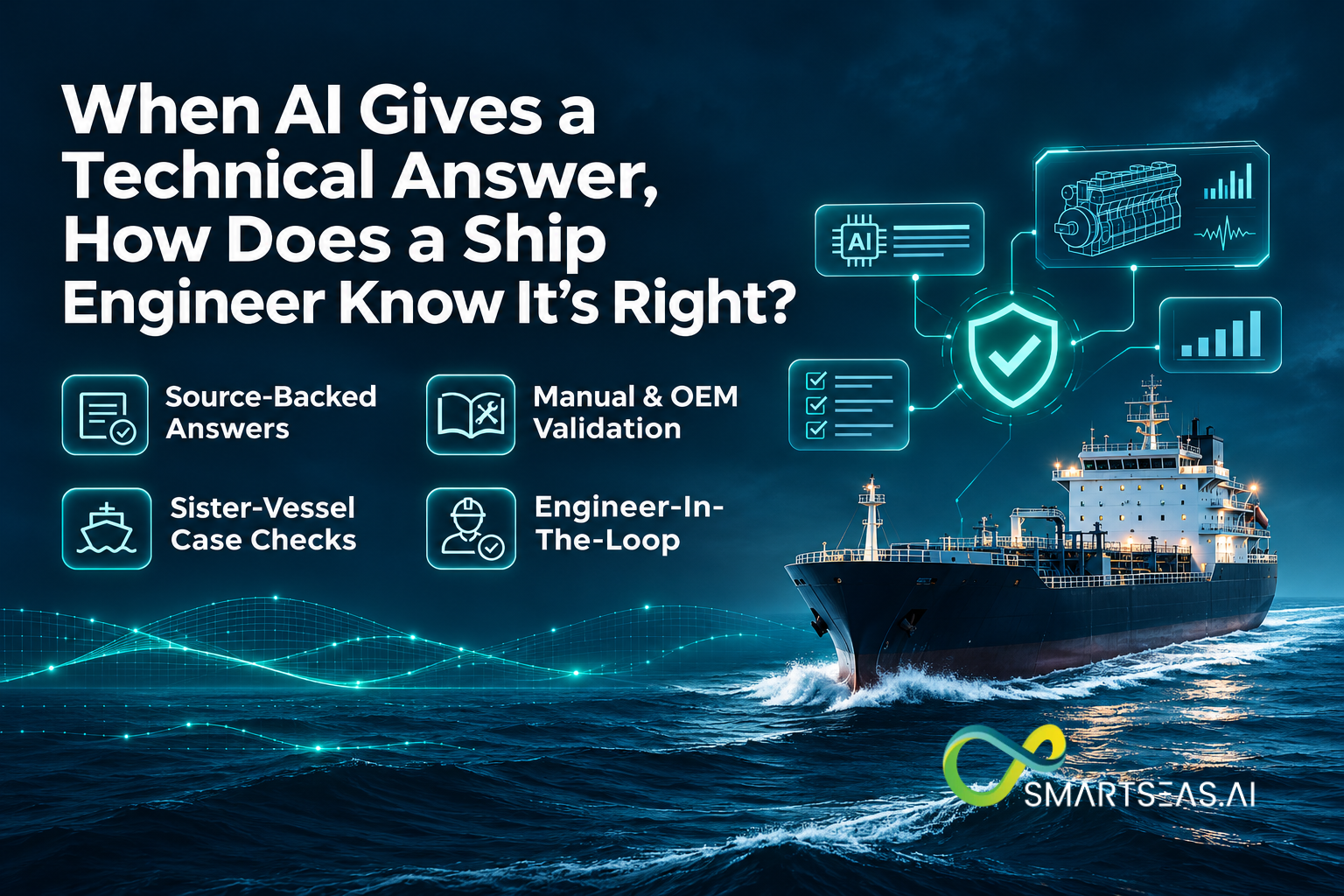
When AI Gives a Technical Answer, How Does a Ship Engineer Know It's Right?

November 6, 2026
A generator trips during cargo operations. The engineer checks the alarm history, reviews the electrical system and asks an AI assistant what might have caused the failure.
Within seconds, the system suggests possible causes and troubleshooting steps.
The answer sounds technically reasonable. But one important question remains:
How does the engineer know the answer is correct for this particular vessel and equipment?
As Maritime AI becomes part of technical troubleshooting, ship engineers and fleet managers face a new challenge: distinguishing useful AI-generated guidance from information that is incomplete, outdated or incorrect.
AI can retrieve equipment manuals, identify relevant defect history and help engineers investigate possible causes. However, a convincing technical explanation is not automatically a verified diagnosis.
For marine engineers, the real value of AI is not simply getting answers faster. It is understanding where those answers come from and whether they can be trusted before making operational decisions.
Maritime troubleshooting depends on accurate technical information.
When equipment develops a fault, engineers typically review OEM manuals, alarm histories, maintenance records, electrical drawings and previous defect reports.
These sources are essential, but information is often distributed across multiple systems and documents.
A Chief Engineer might spend considerable time locating the correct manual or contacting shore-based personnel to understand whether a similar problem occurred previously.
AI can help reduce this information-search burden.
For example, an engineer may ask:
“What could cause repeated low lubricating oil pressure alarms on this auxiliary engine?”
An AI system might identify possible causes and retrieve relevant technical references.
However, if the system uses an incorrect manual or overlooks the equipment configuration, its recommendation could be misleading.
This makes answer verification an essential part of using AI for maritime troubleshooting.
The objective should be to improve access to reliable information while keeping technical decisions under appropriate human supervision.
Generative AI can produce confident explanations even when the information supporting them is incomplete.
This problem is commonly known as AI hallucination.
In marine engineering, an AI-generated answer does not have to be entirely false to create a problem. It may contain generally correct technical information that does not apply to the installed machinery.
Suppose a main engine fails to start.
An AI assistant suggests checking:
These may all be relevant possibilities for particular engine configurations.
But they do not establish the root cause.
The actual problem could depend on the engine model, automation system, operating mode or specific alarm sequence.
If the AI system cannot identify the exact equipment and supporting references, the engineer must treat its suggestions as possibilities rather than confirmed findings.
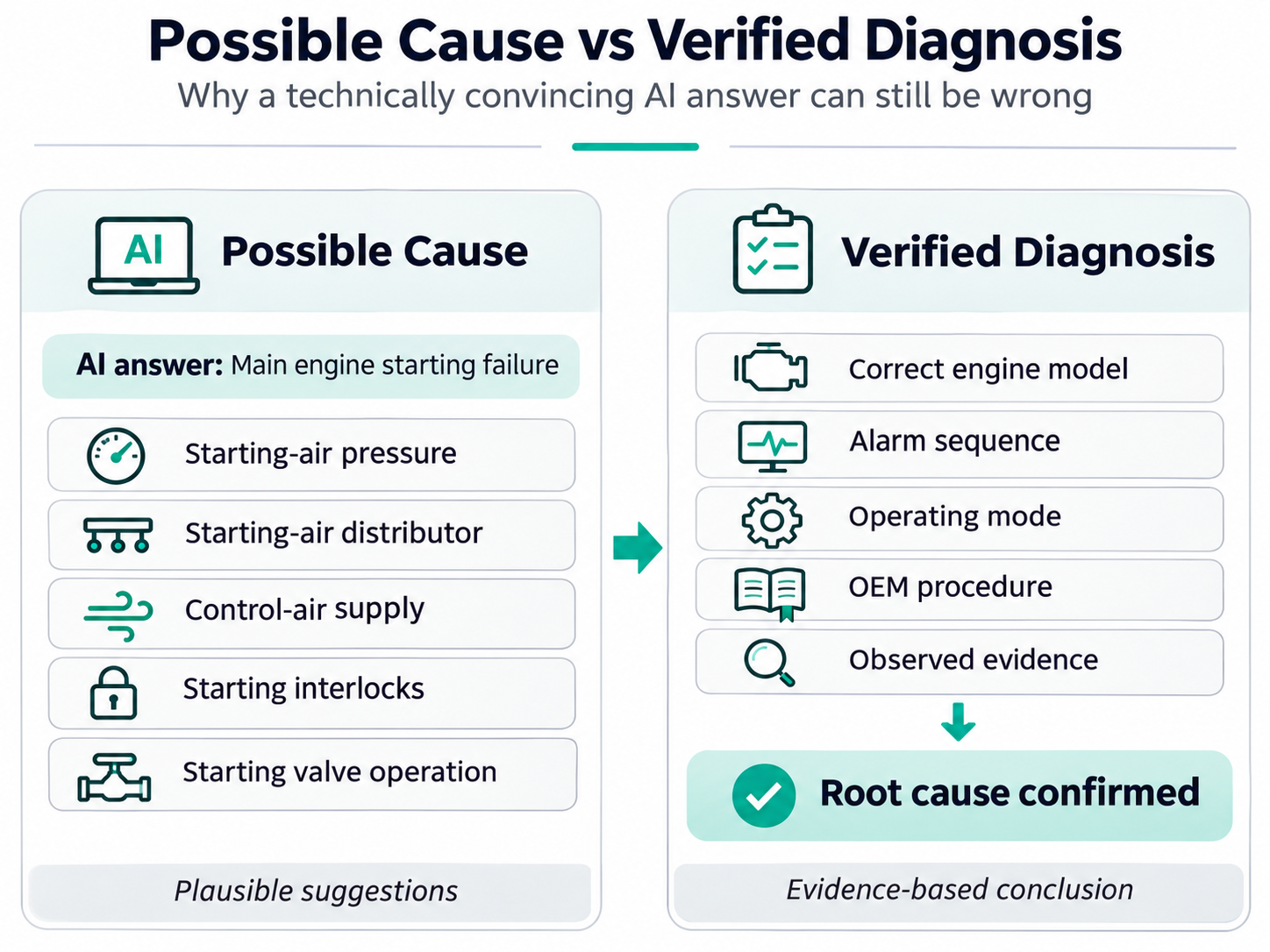
A useful AI answer explains what might be wrong. A reliable troubleshooting process verifies which explanation is supported by the evidence.
When evaluating an AI-generated technical answer, engineers should follow a structured verification process.
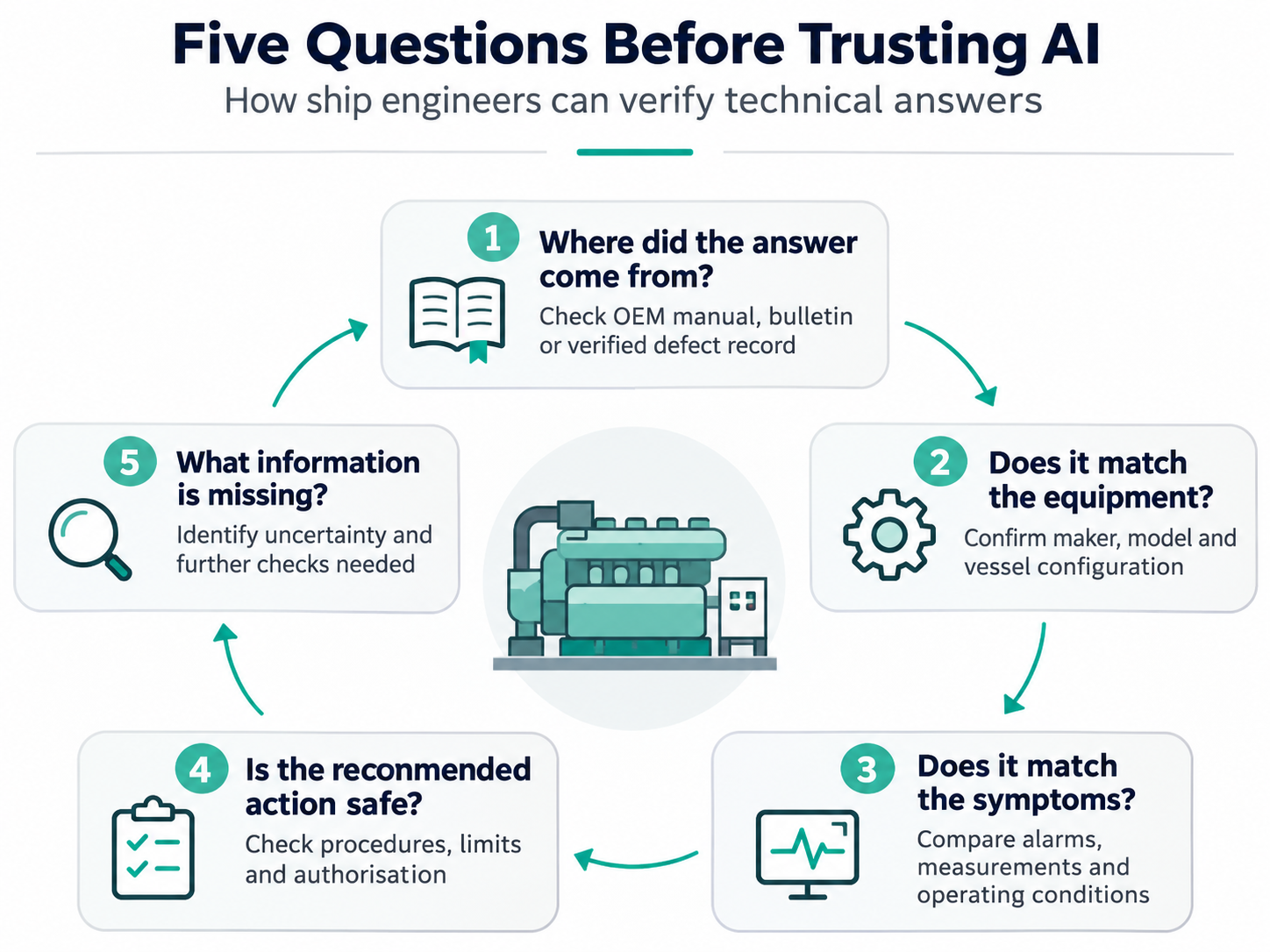
These checks help engineers distinguish a useful technical hypothesis from a recommendation supported by verified evidence.
The same approach is valuable for technical superintendents who review machinery problems remotely and need confidence in the information supplied from vessels.
A general-purpose AI model may understand how a centrifugal pump works. However, it may not know the exact pump installed onboard, its previous failures or modifications made during maintenance.
This distinction matters.
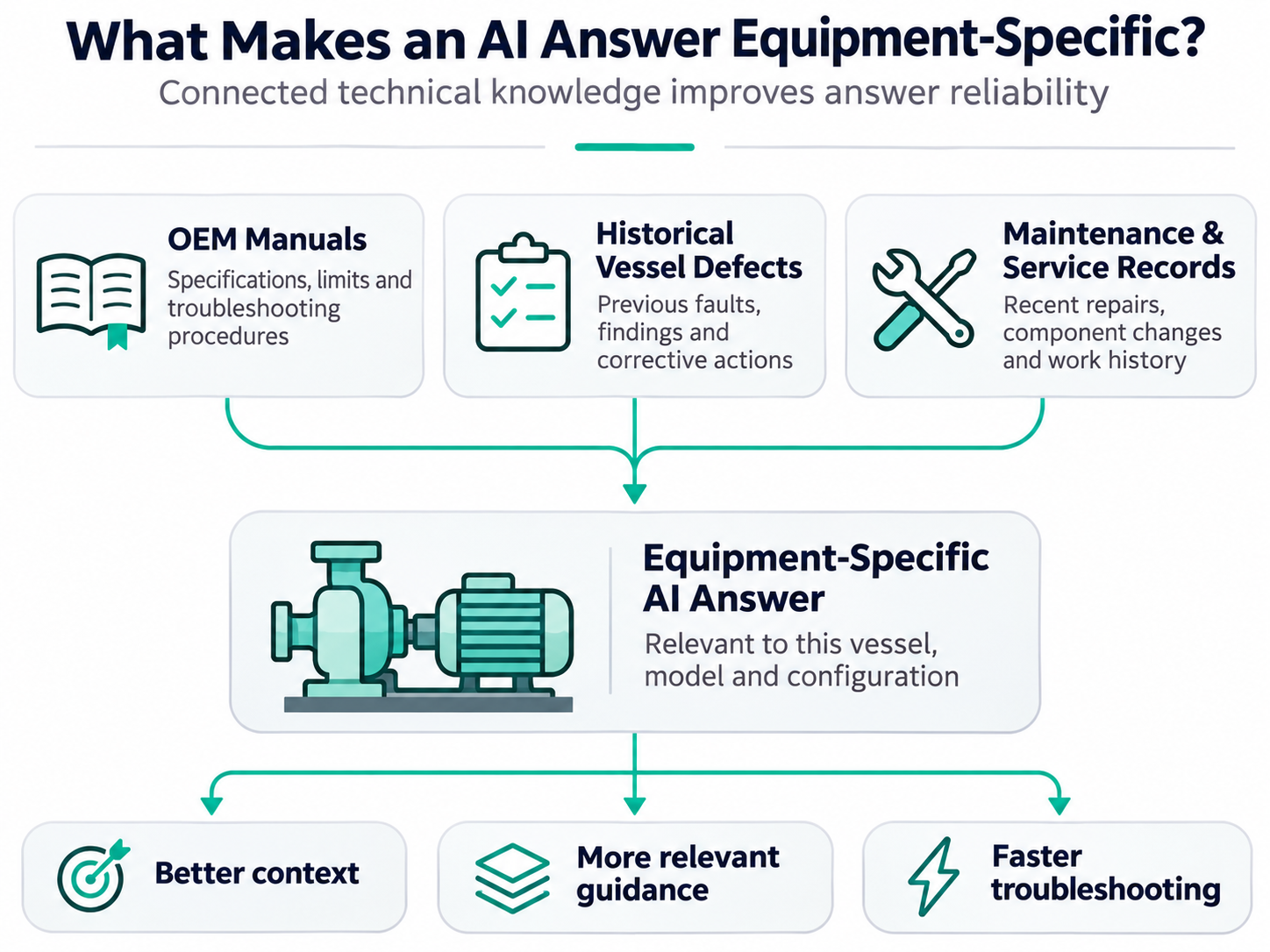
Reliable technical assistance requires access to relevant and properly maintained information.
Manufacturer documentation provides specifications, operating limits and troubleshooting procedures.
AI should retrieve the correct documentation and allow engineers to inspect the supporting information.
Previous defect reports can reveal similar faults, investigations and corrective actions.
For example, a recurring alarm may have previously been traced to a faulty transmitter or damaged electrical connection.
Although this information cannot prove the cause of the current fault, it can help narrow the investigation.
Maintenance history helps engineers understand recent repairs, component replacements and recurring equipment problems.
When manuals, defect reports and service records are connected, technical teams gain a more complete view of the machinery.
This is one practical contribution of Maritime Digital Transformation: making operational knowledge easier to retrieve and use, rather than simply storing more documents electronically.
AI does not eliminate the need for engineering investigation. Its main contribution is helping technical teams locate and organise relevant evidence.
The objective is not to automate every technical decision.
It is to reduce unnecessary information-search delays while preserving the expertise and accountability of marine engineers.
For companies exploring AI for ship management, this distinction is important. An effective system should improve the existing technical workflow rather than introduce another disconnected source of information.
Consider a vessel experiencing an unexpected air circuit breaker (ACB) trip.
The engineer notices an undervoltage-related indication and begins investigating the electrical distribution system.
An AI assistant may suggest that an undervoltage release can trip the breaker when the voltage it monitors falls below its set threshold.
The explanation sounds reasonable. But does it apply to the installed equipment?
Several questions must be answered:
A maritime-specific AI system can help retrieve the relevant circuit diagrams, OEM instructions and historical defect records.
The engineer can compare these sources with the current alarm sequence and equipment condition.
If similar failures occurred on sister vessels, those investigations may provide additional clues.
However, the final assessment must be based on verified technical evidence and approved testing procedures.
This illustrates the value of Maritime Technical Management using AI: making relevant engineering knowledge easier to access while keeping fault verification and corrective actions under qualified human control.
One of the biggest concerns surrounding AI in technical operations is whether users may become overly dependent on generated recommendations.
An AI assistant can organise information, but it cannot independently confirm every physical equipment condition onboard.
It may not know whether an alarm is intermittent, a sensor is defective or a maintenance activity has recently changed the system's configuration.
This is why engineers must remain responsible for interpreting the actual machinery condition.
The International Maritime Organization's International Safety Management (ISM) Code establishes a framework for safe ship operations, risk assessment and appropriate safeguards. AI assistance should operate within these established safety-management principles.
AI can support maritime safety by helping engineers locate relevant procedures, previous incidents and technical guidance.
However, an AI-generated recommendation must not override OEM instructions, isolation procedures, permit-to-work requirements or company safety policies.
AI should help engineers make better-informed decisions, not make safety-critical decisions on their behalf.
For many fleet teams, the challenge is not the absence of technical information.
It is that the information is scattered across manuals, maintenance records, defect reports and communication systems.
When a machinery problem occurs, engineers may spend valuable time searching different sources before developing a complete understanding of the issue.
This is where SmartSeas.AI becomes relevant.
SmartSeas.AI is an AI-powered maritime platform that helps technical teams access information from vessel manuals, historical defects and operational knowledge.
The platform supports:
Rather than relying exclusively on disconnected files or individual experience, engineers can access relevant information through a more connected workflow.
SmartSeas.AI is designed to support technical decisions, while engineers remain responsible for verifying the information and determining appropriate actions.
For organisations exploring Maritime Fleet Management using AI, this creates an opportunity to improve the accessibility and usefulness of existing fleet knowledge.
Fleet managers should evaluate AI systems on technical reliability, not only the speed of generated answers.
A fast response is useful, but it offers limited operational value if the source cannot be verified.
For shipowners evaluating AI for Fleet Managers, the following criteria provide a practical starting point.
A useful pilot should include previously resolved machinery problems and scenarios where information is incomplete.
Technical superintendents can compare AI responses against verified investigation records and applicable OEM documentation.
They should also examine whether the AI acknowledges uncertainty instead of inventing a diagnosis.
Cybersecurity is another consideration. IACS Unified Requirements E26 and E27 address cyber resilience for ships and onboard systems, and are mandatory for new ships contracted for construction on or after 1 July 2024. They reinforce the importance of secure maritime digital infrastructure.
An AI platform should therefore be assessed for both technical usefulness and appropriate information-security controls.
Trust in maritime AI should develop through consistent technical verification and operational experience.
Fleet teams can begin with a structured approach.
These practices can help shipping companies move from experimenting with AI answers towards using AI as a more dependable technical support resource.
The objective is not to remove human involvement. It is to help experienced engineers use available technical knowledge more effectively.
AI is changing how maritime technical teams access information and investigate machinery problems.
But generating an answer is only one part of effective troubleshooting.
Engineers still need to know whether the information comes from reliable sources, whether it applies to their equipment and whether the suggested action is appropriate for the current operating condition.
For shipowners and fleet managers, this should be a central consideration when evaluating maritime AI solutions.
Reliable AI-assisted troubleshooting depends on combining accessible technical knowledge, verifiable evidence and experienced engineering judgement.
The goal is not to make ship engineers trust every AI answer. It is to give them the information needed to decide which answers they can trust.
SmartSeas.AI helps maritime technical teams bring together manuals, historical defects and operational knowledge to support better-informed troubleshooting and ship-to-shore coordination.
AI can provide useful technical guidance, but engineers should verify its sources, equipment relevance and recommended actions before relying on it.
Maritime AI can help engineers retrieve relevant manuals, previous defect reports and technical information faster, supporting more informed fault investigations.
Incorrect AI guidance can lead to unnecessary investigations, inappropriate maintenance or safety risks. Engineers must verify the evidence before taking action.
No. AI supports information retrieval and troubleshooting analysis, while qualified engineers remain responsible for operational decisions.
Historical defects help engineers identify similar problems and previous corrective actions, providing useful context for current investigations.
Fleet managers should prioritise source traceability, equipment-specific information, technical reliability, security and human oversight.

Get Started Today
Transform the way you troubleshoot and manage maritime operations. Join the next wave of Maritime Digital Transformation with SmartSeas AI.