.jpg)
August 3, 2026
How Fleet Managers Can Use AI to Reduce Repeated Machinery Failures

August 3, 2026
A seawater cooling pump trips during a voyage. The crew resets the protection, completes a few checks, and returns the pump to service.
Three weeks later, it trips again.
This is where AI for fleet managers becomes valuable. A similar fault may occur on a sister vessel, but the superintendent handling that vessel may be unable to quickly find the earlier defect report, operating measurements, repair details, or lessons learned.
This is how repeated machinery failures become a fleet-level problem.
The first failure may be technical. The next may also result from incomplete reporting, disconnected records, weak root-cause analysis, or poor transfer of technical knowledge.
AI can help fleet managers connect defect history, manuals, operating data, maintenance records, and previous repair outcomes. This allows teams to identify recurring patterns, improve troubleshooting decisions, and act before the same machinery problem spreads across the fleet.
Machinery damage and failure remain major causes of shipping incidents.

The Allianz Commercial Safety and Shipping Review 2026 recorded 2,818 shipping incidents involving vessels over 100 GT during 2025. Machinery damage or failure accounted for 1,505 incidents, representing approximately 53% of the total.
Not every machinery failure can be prevented. Marine equipment operates under heat, vibration, pressure, contamination, and changing loads.
The larger concern is what happens after the first failure.
Fleet managers need to know:
Without these answers, fleets may repeatedly spend time and money resolving the same underlying weakness.
Repeated machinery failures usually come from several connected gaps.
Replacing a seal, bearing, sensor, or relay may restore operation without removing the real cause, such as misalignment, contamination, incorrect installation, excessive load, or unsuitable spares.
A note such as “pump tripped and rectified” gives little value when the fault returns. Useful reports should include readings, alarms, recent maintenance, checks completed, and repair results.
Defect reports, PMS records, manuals, emails, service reports, and spare-parts history often sit in separate systems. Without a connected view, recurring problems can appear isolated.
The same issue may be reported differently across vessels. AI can connect related symptoms, abbreviations, and technical terms.
Returning equipment to service does not confirm that the cause has been removed. Strong closure records should include the cause, repair, test results, follow-up action, and sister-vessel relevance.
Repeated machinery failures often follow this sequence:
Symptom → Quick Repair → Missing Evidence → Weak Cause Analysis → Lost Learning → Recurrence

AI can help interrupt this chain by improving defect reports, retrieving related records, identifying similar cases, and preserving the final technical lesson.
Its role is not to replace engineering judgement. Its role is to make the evidence easier to find, compare, and use.
AI can ask equipment-specific questions when a fault is reported. For a pump issue, this may include pressures, motor current, valve position, recent maintenance, photographs, and checks already completed.
Better initial evidence helps fleet managers begin troubleshooting without repeated clarification.
AI for Fleet Manager can bring together manuals, alarm limits, maintenance records, OEM guidance, operating data, and similar past defects in one issue view.
Each source should remain clearly identified so engineers can separate approved guidance from historical records and AI-generated summaries.
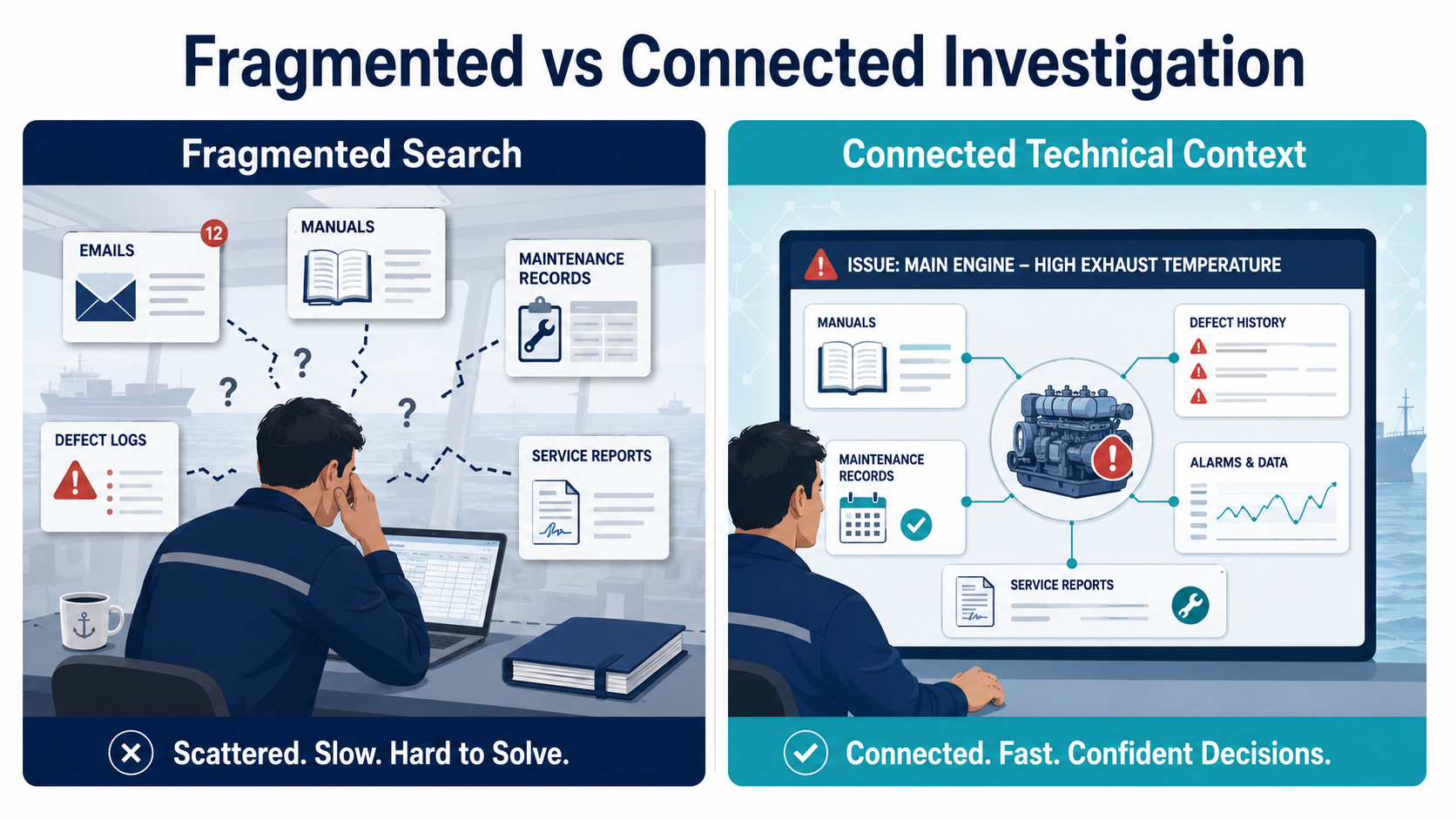
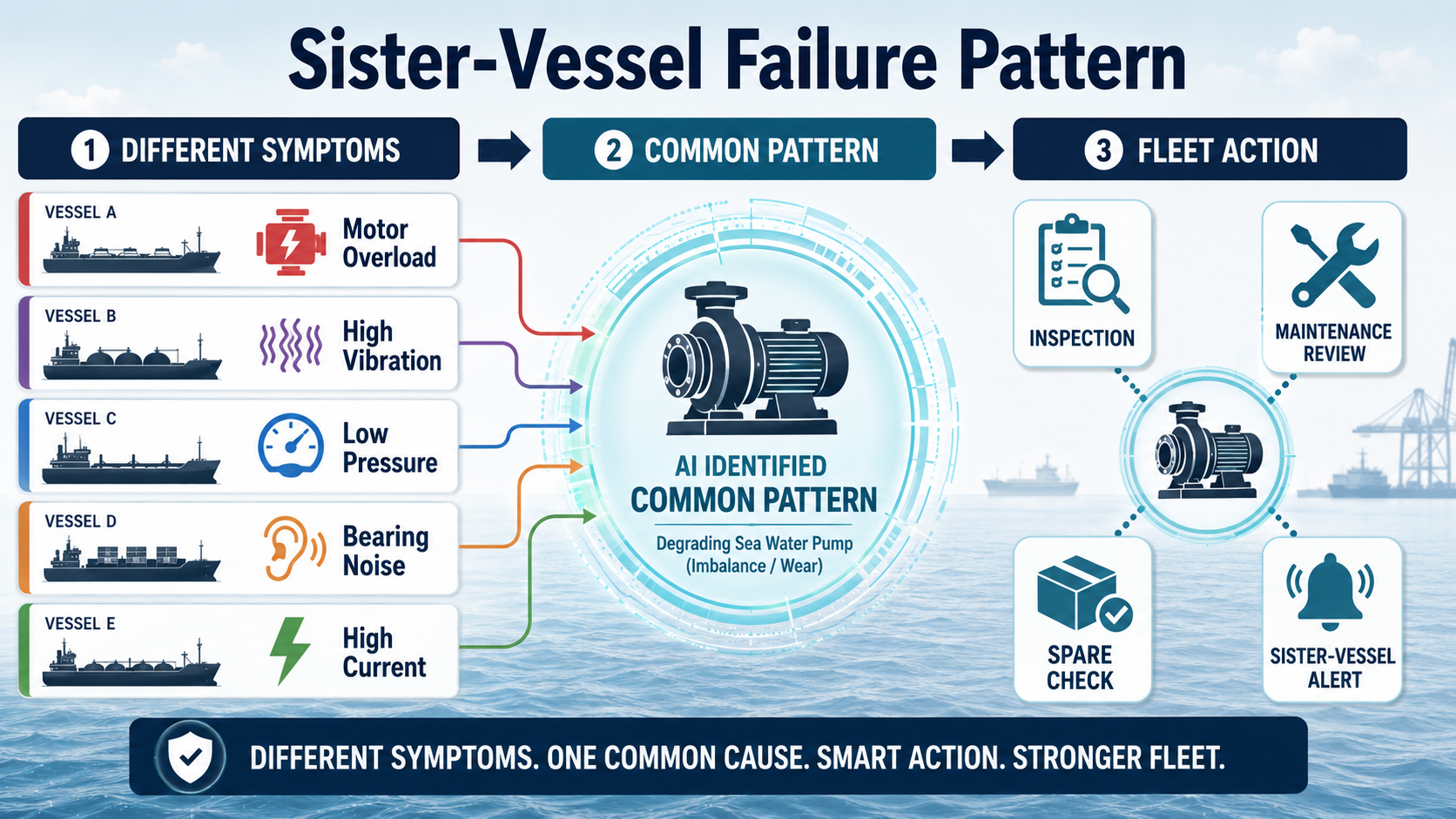
The same failure may be described differently across vessels.
AI can compare equipment models, symptoms, alarms, maintenance activity, parts replaced, and repair outcomes to reveal common failure patterns.
These patterns still require engineering review before the cause is confirmed.
AI for Fleet Managers can organise possible causes using the available evidence.
For example, a fault appearing after overhaul may make recent maintenance more relevant, while similar cases across vessels may point to a component or spare-parts issue.
This supports a focused investigation rather than a generic list of checks.
AI can identify defects that appear after overhauls, calibration, seal replacement, electrical work, or the use of a specific spare batch.
The timing does not prove the cause, but it helps fleet managers identify where further investigation is needed.
Rising vibration, temperature changes, unstable pressure, motor-current variation, and repeated alarms may indicate developing problems.
AI can compare these signals with normal behaviour and previous defects to help teams inspect equipment before failure.
Operating conditions and sensor quality must still be considered.
AI can organise the full defect timeline, including symptoms, readings, recent maintenance, checks, parts replaced, repair results, and recurrence.
This helps teams distinguish the failed component from deeper causes such as misalignment, poor lubrication, or incorrect installation.
AI for Fleet Managers can guide users to record the confirmed cause, repair completed, test results, preventive action, and sister-vessel relevance.
It can also flag vague statements such as “rectified” or “monitoring.”
A clear closure turns one repair into reusable fleet knowledge.
A 2025 IACS concentrated inspection campaign examined emergency power arrangements on 36,723 vessels. Deficiencies were found on 853 ships.
The findings included equipment problems involving quick-closing valves, control circuits, generator starting arrangements, and air circuit breakers.
The campaign also identified procedural and human-factor weaknesses, including incomplete blackout-testing procedures and crew unfamiliarity.
This shows that repeated failures may involve three connected layers:
Replacing a failed component may restore the system, but it will not correct a weak procedure or training gap.
AI can help connect equipment defects with inspection findings, procedures, and familiarisation records.
A fleet operates eight vessels with the same auxiliary cooling-water pump model.
Over nine months:
Each event is managed separately and initially appears unrelated.
AI connects the cases through equipment model, symptoms, recent maintenance, and repair history. It shows that several failures occurred after motor or bearing work and that alignment was mentioned in multiple reports.
The fleet manager can then launch a focused review covering alignment, foundations, spare specifications, motor current, vibration, and maintenance procedures.
The value is not an automatic diagnosis. The value is turning isolated repairs into one fleet-level investigation.
Include recurring symptoms, related failures with a common cause, post-maintenance defects, sister-vessel issues, repeated temporary repairs, and parts failing early.
A clear definition helps AI group events correctly.
Set minimum reporting requirements for critical machinery.
Capture readings, alarms, recent maintenance, operating conditions, checks completed, and standby-equipment status.
Reliable AI analysis begins with reliable evidence.
Use consistent equipment names across vessels and systems.
Each record should clearly identify the vessel, system, equipment, maker, model, and component.
Link defect history with Planned Maintenance System records.
Fleet managers should be able to see recent work, parts used, recorded measurements, and whether the fault returned afterward.
Begin with a manageable group such as engines, steering gear, purifiers, pumps, compressors, or emergency generators.
Group defects into failure families such as overload, leakage, vibration, low pressure, or failure to start.
AI-identified patterns should be reviewed by chief engineers, technical superintendents, and specialists.
Check whether operating conditions, equipment configurations, sensor data, and maintenance histories are comparable.
Turn analysis into inspections, maintenance changes, OEM escalation, spare-part reviews, crew familiarisation, or sister-vessel notices.
Each action should have an owner, due date, and evidence requirement.
Confirm that the failure has stopped returning.
Verification may include operating hours, load testing, follow-up condition monitoring, or comparison with sister vessels.
Fleets do not need to connect every company system immediately.
A practical starting point is to focus on records that directly support technical decisions.
More data is useful only when it improves the decision.
Measure AI through reliability outcomes, not search volume.
Track:
These indicators show whether AI is reducing recurring failures and improving technical decisions.
SmartSeas.AI makes AI for fleet managers practical by connecting technical information around a machinery problem.
For repeated machinery failures, this can include:
SmartSeas.AI helps fleets structure defect information, find relevant manual sections, surface similar past cases, compare previous fixes, and preserve technical reasoning.
The aim is not to replace chief engineers, superintendents, OEMs, or class societies.
It is to give them faster access to trusted evidence and a clearer view of what the fleet has already experienced.
This supports SmartSeas.AI’s mission of transforming maritime operations through AI-powered decision-making.
Incorrect equipment names, missing dates, and incomplete defect reports can create misleading patterns.
AI outputs should show the source records so engineers can review the result.
Two machines may show the same symptom for different reasons.
AI can find related cases, but inspection and testing are still required.
Temperature, pressure, and vibration depend on load, operating mode, ambient conditions, and equipment configuration.
These factors must be considered before comparing readings.
AI-generated explanations may be incomplete or incorrect.
Critical actions should be checked against approved manuals, company procedures, OEM guidance, and engineering expertise.
AI can support decisions, but authorised vessel and shore teams remain responsible for machinery operation and maintenance.
AI should strengthen ISM Code responsibilities, not replace them.
Repeated machinery failures should trigger a wider investigation, not another temporary fix.
AI for fleet managers helps connect manuals, defect reports, maintenance history, operating data, and previous repairs. This allows teams to identify recurring patterns, investigate causes faster, and share lessons across sister vessels.
SmartSeas.AI supports this process by turning previous machinery failures into clearer and more consistent technical decisions.
AI connects current symptoms with manuals, maintenance records, previous repairs, and sister-vessel defects. This helps fleets identify patterns and investigate underlying causes.
AI can organise evidence and suggest likely investigation areas. The root cause must still be confirmed through measurements, inspection, testing, and engineering review.
No. The PMS manages scheduled maintenance. AI complements it by connecting maintenance activity with defects, operating data, and previous repair outcomes.
Useful data includes equipment identity, load, pressure, temperature, vibration, motor current, alarms, maintenance history, parts replaced, and repair-test results.
Yes. AI can compare symptoms, equipment models, alarms, maintenance activity, and corrective actions across sister vessels.
Predictive maintenance identifies developing equipment risk. AI troubleshooting supports the investigation of an active fault using manuals, evidence, and historical cases.
The main risk is treating an AI-generated answer as confirmed technical guidance. Outputs must remain traceable and be reviewed by qualified personnel.
Start with critical equipment, standardise defect reports, clean the equipment hierarchy, and connect manuals, PMS records, and defect history.

Get Started Today
Transform the way you troubleshoot and manage maritime operations. Join the next wave of Maritime Digital Transformation with SmartSeas AI.



.svg)


.png)