.jpg)
July 7, 2026
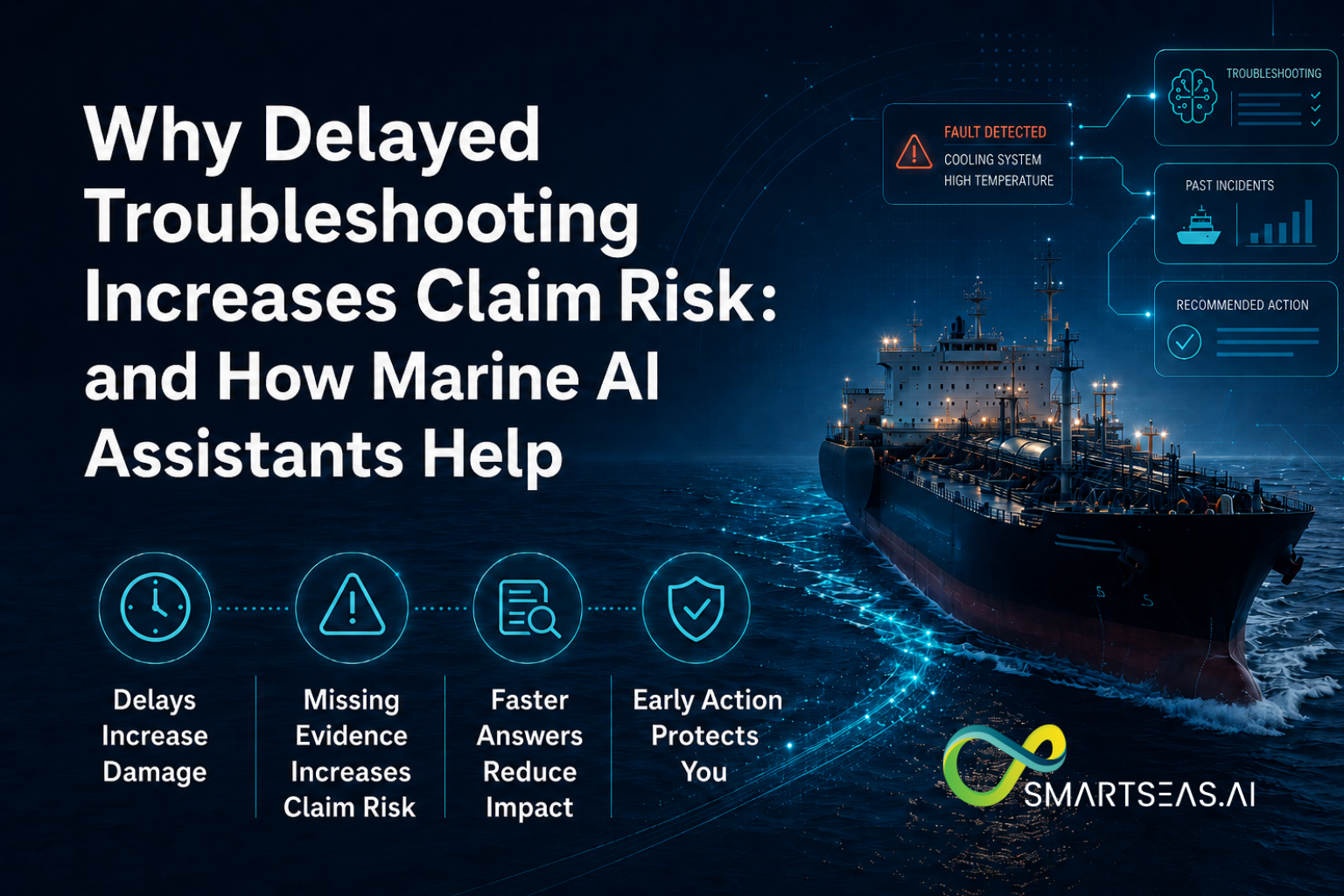
Why Delayed Troubleshooting Increases Claim Risk - and How Marine AI Assistants Help
July 7, 2026
A small machinery fault does not always become a major claim because the equipment failed.
Sometimes, it becomes a claim-sensitive problem because the response was slow, the history was missed, the evidence was incomplete, or the shore team did not get the full picture in time.
That is why a Marine AI Assistant is becoming relevant for modern fleet operations. It helps technical teams reduce troubleshooting delays, connect vessel knowledge faster, and document decisions more clearly before a defect becomes a larger operational or insurance issue.
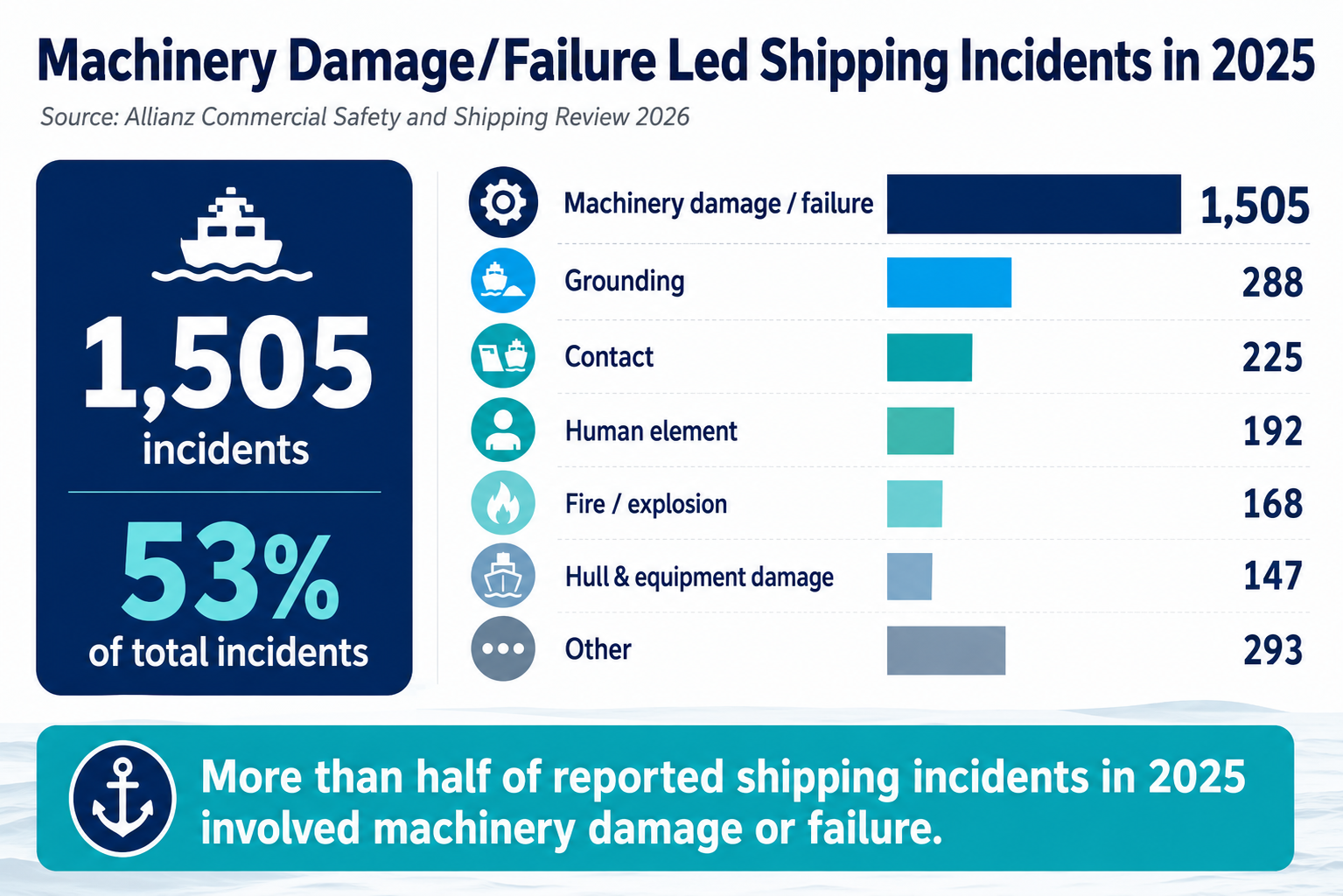
This matters because machinery damage or failure remains one of shipping’s biggest operational risk areas. Allianz Commercial’s 2026 Safety and Shipping Review reported 2,818 shipping incidents in 2025, with machinery damage or failure accounting for more than half of them at 1,505 incidents. Allianz also noted that machinery repair costs remain under pressure, with machinery claims inflation not yet back to pre-Covid-19 levels.
So the real question is not only: “Did something fail?”
It is also: “How fast did the fleet understand the fault, act on it, and record the response?”
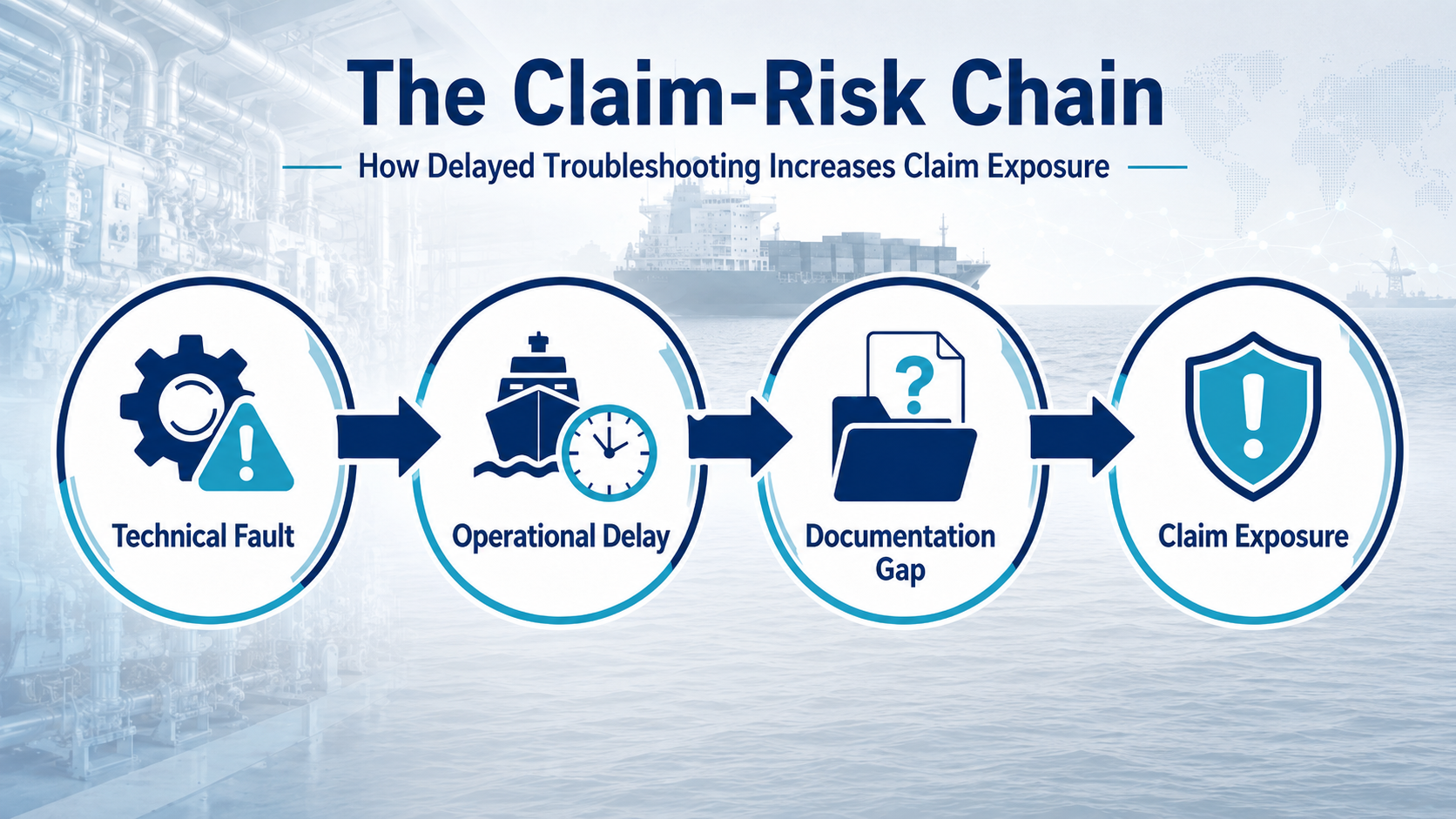
Delayed troubleshooting usually creates a chain reaction.
First, the technical fault continues.
The crew may see an alarm, abnormal pressure, vibration, overheating, repeated trip, or control issue. If the right manual section or previous fix is not found quickly, the vessel may lose valuable time.
Then, the operational impact grows.
A machinery issue can affect cargo operations, port calls, charter commitments, inspections, repair planning, or safety response. Even if the original defect is small, the delay can make the situation more expensive and harder to manage.
Finally, the documentation gap appears.
When troubleshooting happens across emails, phone calls, WhatsApp messages, PMS notes, engine logs, and screenshots, it becomes difficult to reconstruct the event later. That is where claim discussions can become complicated.
A claim-sensitive event is not only judged by the damage. It is also judged by the timeline.
In marine insurance claims, the quality of the technical story matters.
A claims handler, surveyor, class representative, charterer, lawyer, or internal management team may ask:
If the answers are scattered, the company may struggle to explain the event clearly.
The IMO’s ISM Code provides the international standard for safe ship management and pollution prevention. It also highlights the need for safe operation, risk assessment, safeguards, and proper ship-shore management responsibility.
That is why delayed troubleshooting is not just an engineering problem.
It can become a safety, compliance, commercial, and claims problem.
Imagine a vessel has a repeated cooling water pump trip.
The crew checks the pump. The office asks for alarm history, running hours, recent maintenance, vibration readings, photos, and whether the same issue happened before.
The chief engineer searches the manual. The superintendent searches previous reports. Someone remembers a similar issue on a sister vessel, but nobody is sure where that record is saved.
A few hours pass.
The vessel may still be safe, but the uncertainty is growing. The technical team is not only solving the fault now. They are also creating the record that may later explain whether the response was timely and reasonable.
This is the space where a Marine AI Assistant can help.
It can quickly connect the manual, defect history, sister-vessel cases, earlier corrective actions, and relevant procedures so the team does not start from zero.
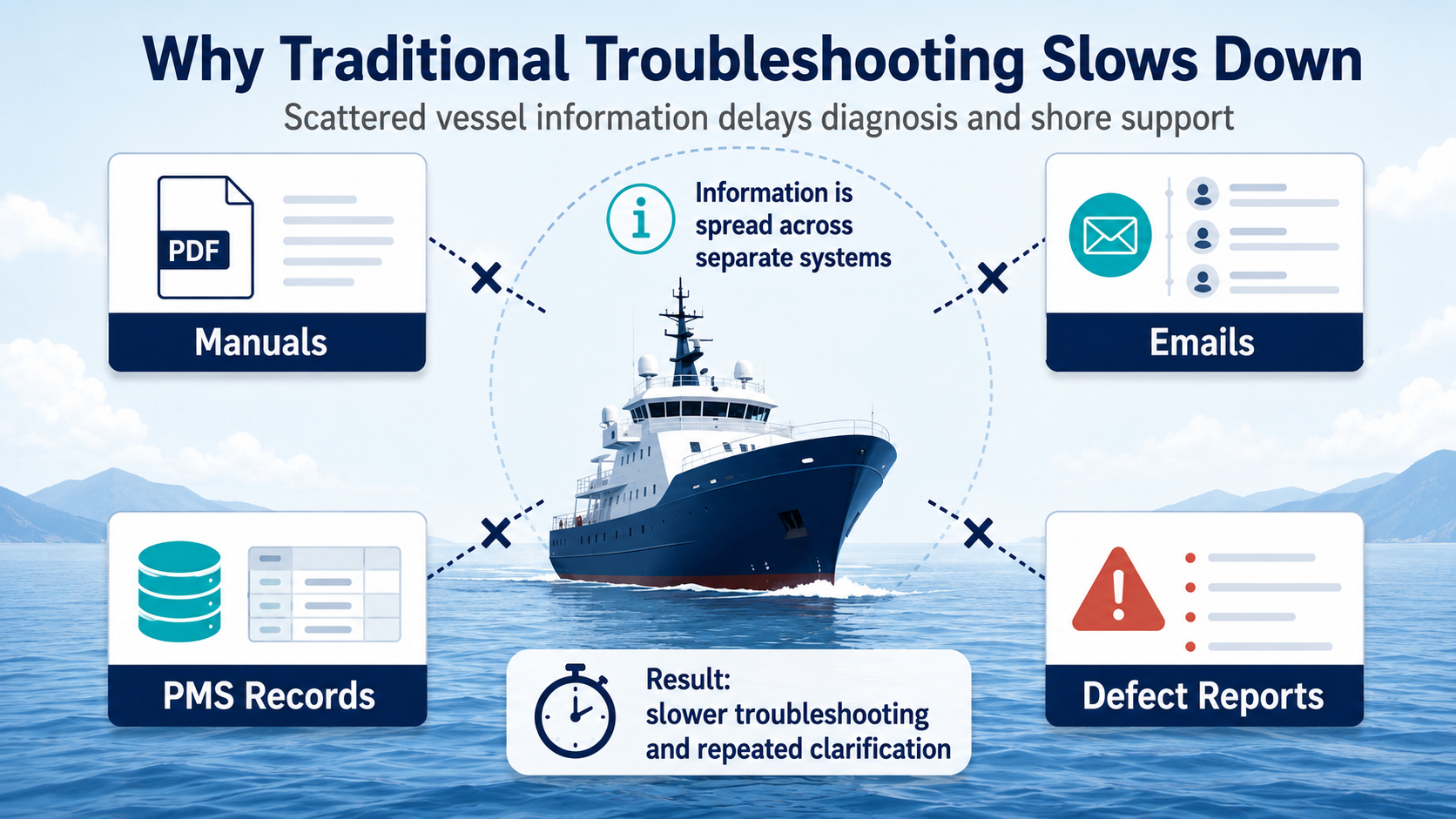
Most delays come from workflow gaps, not lack of effort.
Vessel manuals are often long, technical, and spread across folders. During a live fault, crew members may not have time to search hundreds of pages.
A similar failure may already have occurred on the same vessel or a sister vessel. But if it is buried inside a report, email, or handover note, it may not help the current team.
Superintendents often ask for more details because the first update from the vessel is incomplete. This back-and-forth is normal, but it delays decisions when information is not structured.
The best evidence is often available early: alarms, readings, photos, running conditions, first observations, and first corrective actions. If those are gathered after escalation, the timeline becomes weaker.
A senior engineer may know the vessel’s weak points, but that knowledge may not stay onboard after crew change. Repeat defects become harder to recognize when knowledge depends on people instead of systems.
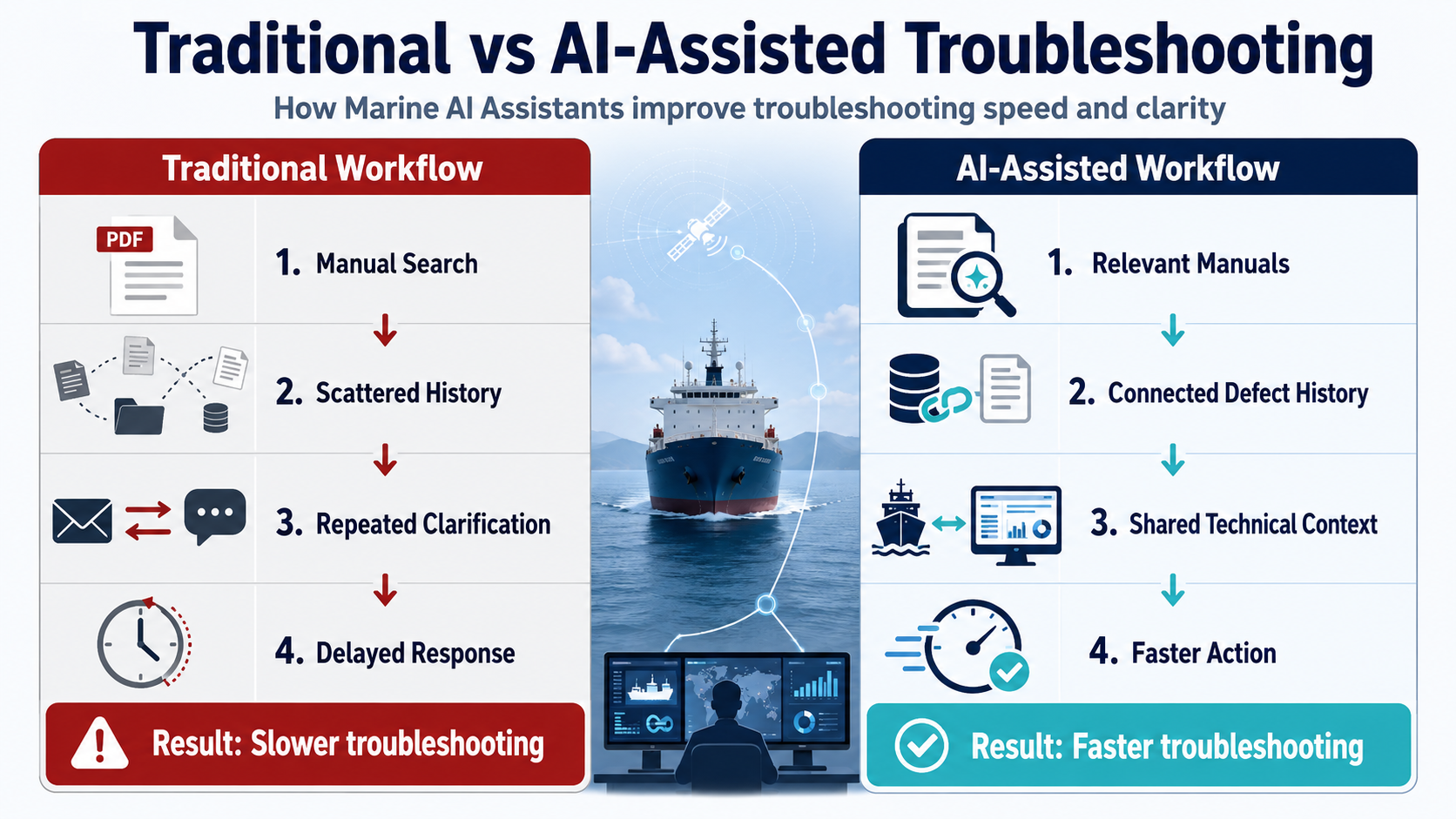
A Marine AI Assistant does not replace marine engineers, chief engineers, superintendents, OEMs, class, or insurers.
Its role is to support faster and clearer technical decision-making.
It helps teams ask practical questions such as:
This reduces the time spent searching across scattered systems.
It also helps shore teams understand the situation faster because the vessel update can be supported with structured context instead of long, fragmented messages.
Claim readiness is not only about submitting documents after an event.
It starts when the first symptom appears.
A stronger troubleshooting record can show:
This does not guarantee claim acceptance or lower premiums. Marine insurance claims depend on policy wording, causation, evidence, survey findings, exclusions, and legal context.
But better documentation gives the company a stronger operational explanation.
Gard’s P&I guidance also notes that general monetary loss or loss of time resulting from delay is not covered except where the member is legally liable to a third party and that liability is covered under the rules.
That makes it even more important for owners and managers to control delays early, not only after costs appear.
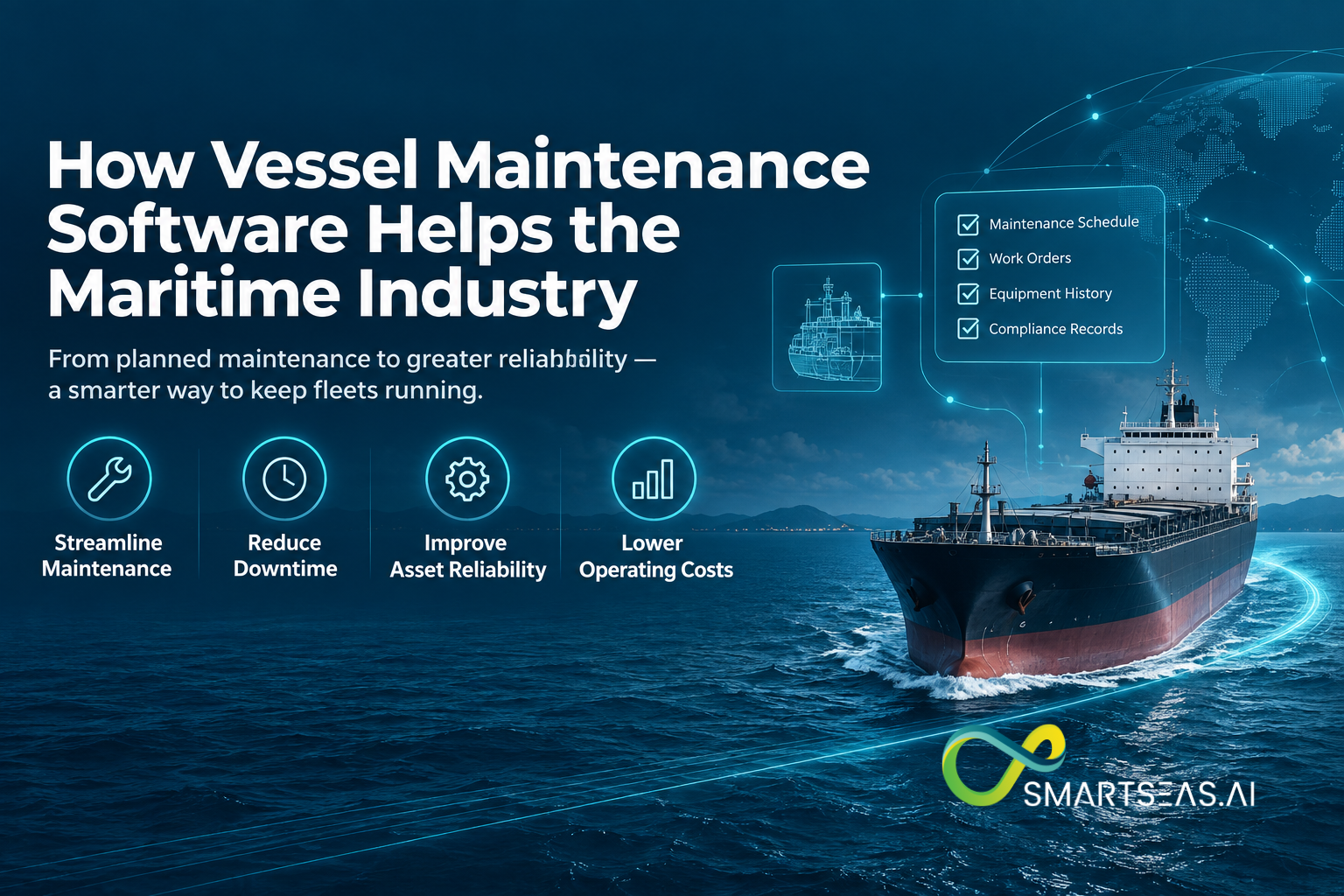
This is where SmartSeas.AI becomes relevant.
SmartSeas.AI is an AI-powered maritime platform that helps fleets improve troubleshooting, operational clarity, and ship-to-shore technical decision-making.
For fleet teams, SmartSeas.AI helps connect manuals, defect history, vessel knowledge, and corrective actions into a more accessible layer. Instead of losing time searching through scattered information, engineers and superintendents can find relevant context faster.
SmartSeas.AI supports:
The platform is not meant to make automatic approvals or replace professional judgment.
It helps maritime teams work with better information, faster.
Fleet managers can reduce troubleshooting-related claim exposure by improving five habits.
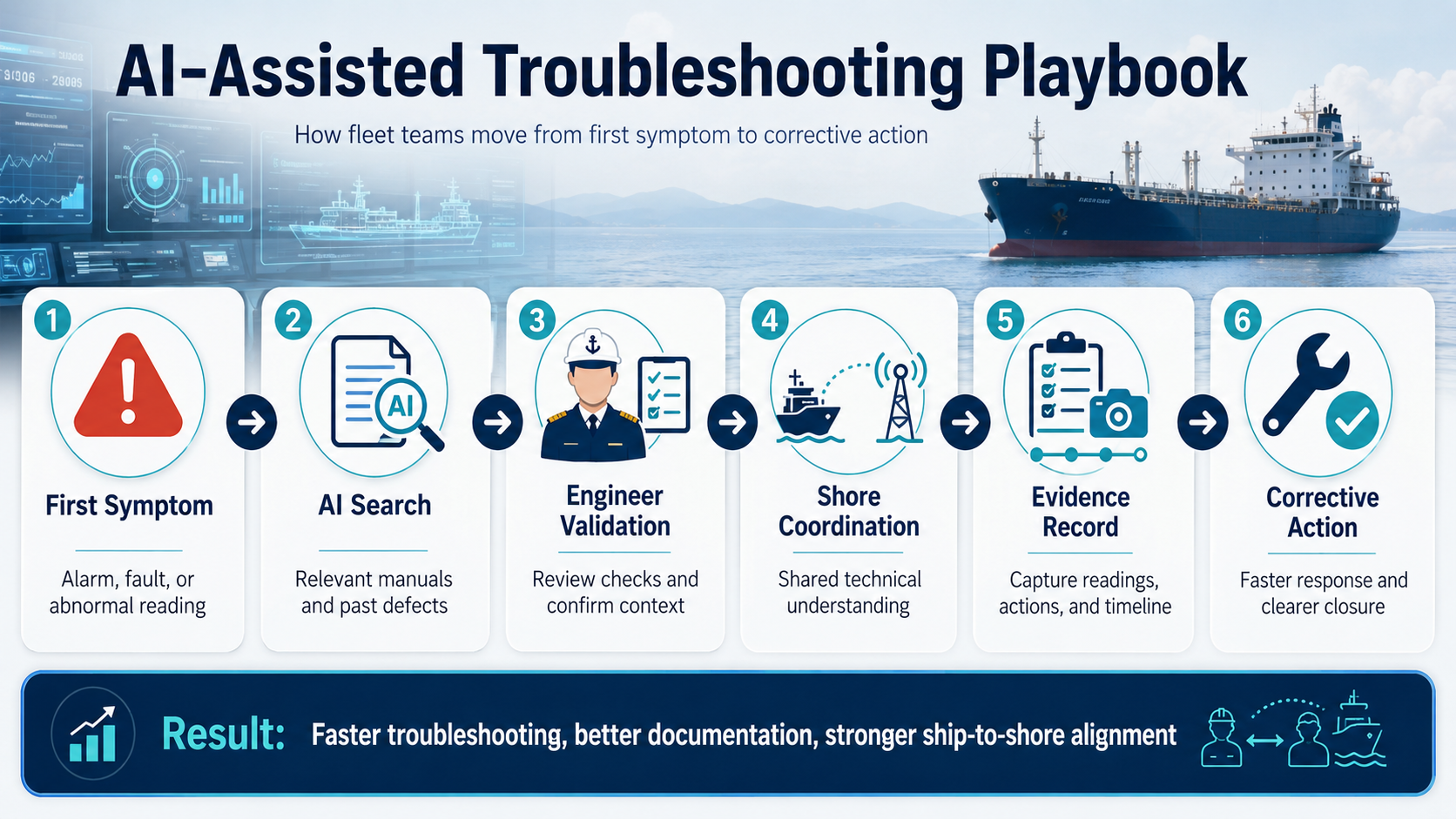
The first update should include equipment, symptom, alarm, operating condition, time, and immediate action taken.
Before starting from zero, check whether the same vessel or a sister vessel has already faced a similar issue.
Manuals explain the technical system. Defect history explains how the system has behaved in real operations. Both are needed.
Avoid long unstructured messages. Share what happened, what was checked, what is pending, and what support is needed.
Do not stop at “fault rectified.” Record what caused it, what action solved it, and what should be checked next time.
A Marine AI Assistant is useful only when it is connected to reliable data.
If manuals are missing, defect descriptions are poor, or documents are outdated, the output quality can be reduced. AI should not approve temporary repairs, safety-critical deviations, class matters, or insurance positions.
The best model is human-led and AI-assisted.
Marine engineers and superintendents should validate every recommendation against actual vessel condition, company procedures, class requirements, OEM guidance, and safety limits.
Used correctly, AI improves access to knowledge.
Used carelessly, it can create false confidence.
Delayed troubleshooting increases claim risk because time creates uncertainty.
It can allow damage to worsen, delay decisions, weaken evidence, and make the event harder to explain later.
A Marine AI Assistant helps by reducing the time between the first symptom and the right technical context. It brings manuals, defect history, vessel knowledge, and corrective actions closer to the people who need them.
For maritime teams, the value is practical.
Faster troubleshooting.
Clearer documentation.
Better ship-to-shore alignment.
Stronger operational control.
SmartSeas.AI helps fleets move from delayed, scattered troubleshooting to faster, more transparent, and more evidence-ready technical response.
It helps reduce operational factors that may increase claim risk, such as delayed response, missing history, weak documentation, and slow ship-to-shore clarification. It does not guarantee claim approval or lower premiums.
Because claims often depend on timeline, causation, actions taken, evidence quality, and whether the response was reasonable.
No. AI should support maritime professionals by retrieving relevant information faster. Final decisions must remain with qualified personnel.
It should connect manuals, defect reports, incident history, OEM advisories, PMS records, procedures, and past corrective actions.
SmartSeas.AI helps vessel and shore teams find relevant troubleshooting context faster, including manual references, similar defects, and previous corrective actions.
No. The biggest value is before escalation, when early action can prevent a small defect from becoming a bigger operational problem.

Get Started Today
Transform the way you troubleshoot and manage maritime operations. Join the next wave of Maritime Digital Transformation with SmartSeas AI.




.svg)

.png)