.jpg)
July 24, 2026
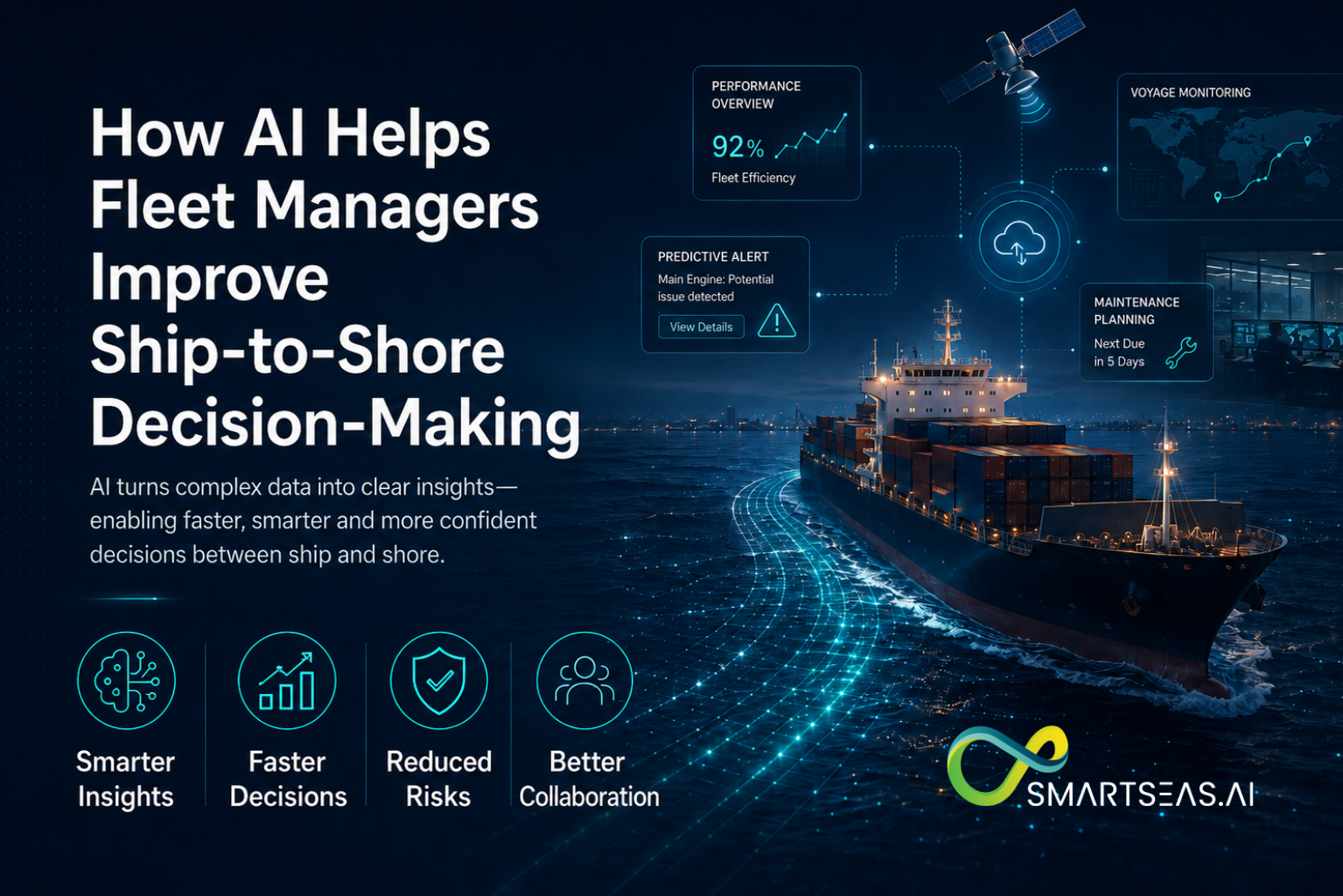
How AI Helps Fleet Managers Improve Ship-to-Shore Decision-Making

July 24, 2026
A vessel reports a sudden drop in cooling-water pressure, but the shore team still needs to search manuals, review past defects and request missing readings before giving guidance.
This is where AI for fleet managers becomes valuable. It helps vessel and shore teams connect technical reports, manuals, maintenance history and previous repairs faster.
The goal is not to replace maritime expertise. It is to reduce search time, improve the quality of available evidence and support faster, better-informed ship-to-shore decisions before the delay becomes downtime.
Ship-to-shore communication is often treated as a messaging problem.
In practice, it is usually a context problem.
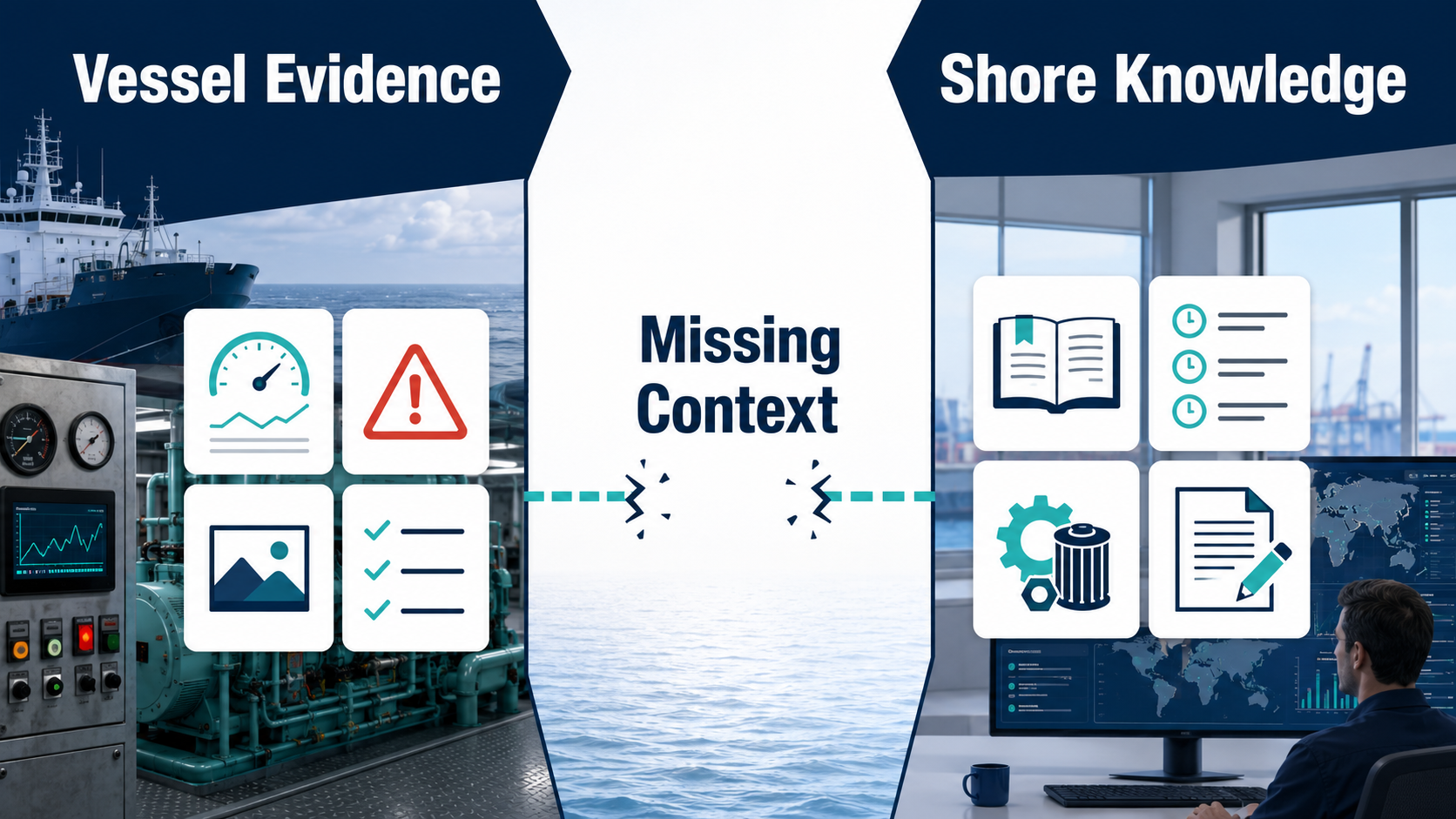
The vessel has alarms, readings, observations and recent maintenance details, while the shore team holds manuals, defect history, OEM guidance and fleet-wide experience.
Neither side has the complete picture at the start.
If the first report is missing key details, the fleet manager must request more information while shore teams search separate emails, spreadsheets and technical systems. The message may reach shore quickly, but the decision remains slow.
The ISM Code reinforces the importance of effective shipboard and shore-based coordination. Better decisions depend on accurate information reaching the right people in a clear, usable form.
Fleet managers are handling more technical information than ever before.
Modern shipping companies rely on separate systems for maintenance, defects, safety, procurement, documents, performance data and OEM communication. Each system may hold part of the answer, but few provide a complete view of one machinery issue.
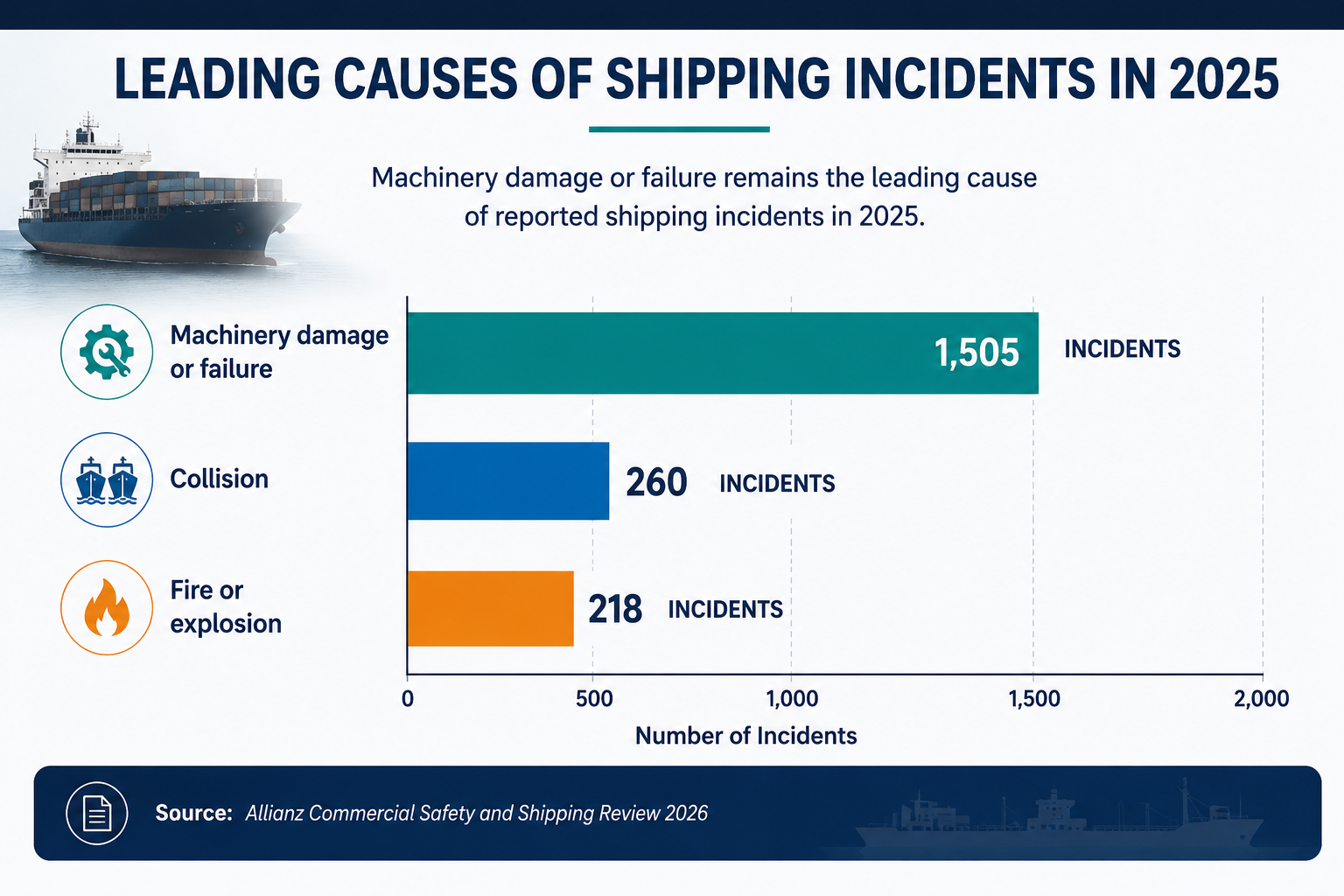
The Allianz Commercial Safety and Shipping Review 2026 recorded 2,818 shipping incidents involving vessels over 100 GT in 2025. Machinery damage or failure was the largest category, with 1,505 incidents.
AI cannot prevent every failure, but faster assessment, stronger evidence and clearer ship-to-shore coordination can reduce the impact of delayed decisions on vessel availability, repair costs, schedules, safety and crew workload.
Better ship-to-shore decision-making is therefore part of operational risk management, not just communication efficiency.

A vessel report may arrive by email, while manuals, repair history and OEM guidance are stored in separate systems. The fleet manager must connect these sources manually before deciding what to do next.
During an active machinery problem, the crew may be handling alarms, inspections and safe operation at the same time. Important details such as pressure readings, alarm history, equipment model, recent maintenance or standby status may be missing.
Several rounds of clarification may be needed before troubleshooting can begin.
Large equipment manuals may spread relevant guidance across alarm tables, operating limits, maintenance procedures and technical drawings.
The crew’s wording may also differ from the manufacturer’s terminology, making the correct section harder to find.
A similar fault may already have occurred on another vessel, but if the earlier cause and repair cannot be found quickly, the investigation starts again.
The vessel, fleet manager and purchasing team may all be working on the same issue using different systems.
This can lead to duplicate work, missed updates, unclear ownership and decisions based on incomplete information.
AI becomes useful when it connects the complete technical decision process rather than creating another separate dashboard.
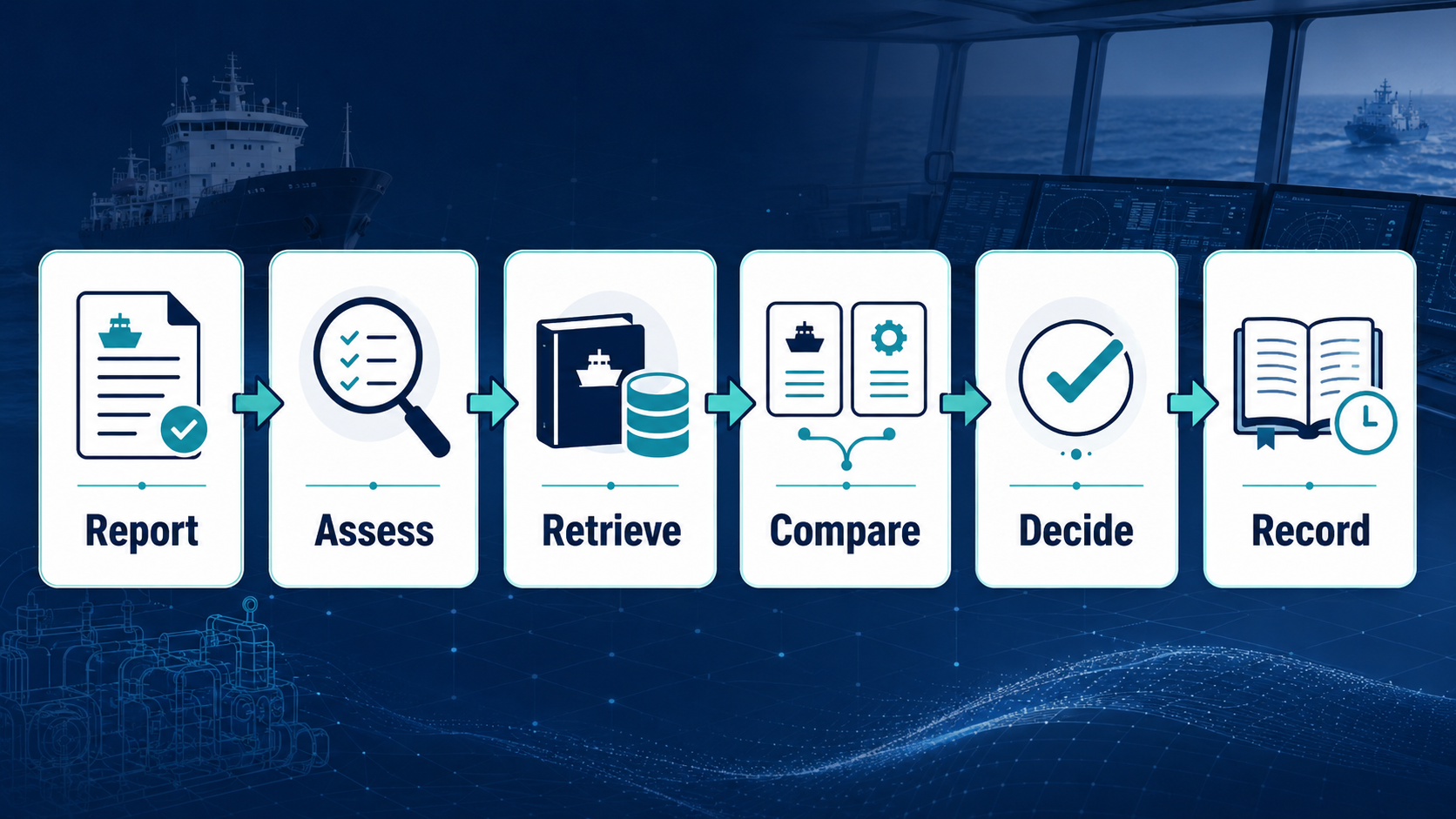
AI can guide the crew to provide equipment-specific information from the start.
For a pump-pressure problem, this may include the equipment model, pressure readings, motor current, valve position, recent maintenance, standby status and checks already completed.
The goal is not longer reporting. It is a more useful first report that allows the fleet manager to assess the fault without repeated clarification.
AI-powered maritime troubleshooting can bring together relevant manuals, alarm limits, maintenance history, OEM guidance, operating data and previous defects in one issue view.
Clear source references remain essential. Maker instructions, company procedures, historical records and AI interpretation should be clearly separated so the fleet manager can verify the information before acting.
The same technical problem may be described in different ways, such as unstable flow, pressure loss, air ingress or suspected cavitation.
AI can connect reports with similar equipment, symptoms, alarms or replaced components. This helps fleet managers review earlier causes, successful repairs, repeat failures and OEM recommendations.
Previous defects become reusable fleet knowledge instead of closed records.
Reliable AI should highlight missing information before suggesting possible causes.
This may include absent equipment details, pressure readings, alarm timing, maintenance history, sensor location or standby status.
Identifying these gaps early helps vessel and shore teams collect stronger evidence and reduces the risk of acting on incomplete information.
Instead of presenting a long list of possible causes, AI can organise the response into:
This gives the crew a clearer sequence while keeping the final decision with the chief engineer and fleet manager.
A connected issue screen can combine the vessel report, machinery readings, manuals, previous defects, photographs, recommended checks, agreed actions and follow-up responsibilities.
Both vessel and shore teams can see what is known, what remains missing, what action has been approved and who is responsible.
This creates one shared operational picture around the defect.
After resolution, AI can organise the confirmed cause, checks performed, repair, parts replaced, OEM guidance and follow-up actions into a structured history.
This supports handovers, repeated-failure reviews, inspections, claims and fleet learning.
The next vessel experiencing a similar problem can begin with the knowledge created by the earlier repair.
A vessel reports repeated high bearing temperature on a seawater pump.
The chief engineer sends a photograph of the temperature display.
The fleet manager asks for vibration, motor current, pressure readings, lubrication condition and recent overhaul history.
The vessel replies through several messages.
The superintendent searches the manual for the temperature limit and asks colleagues whether a similar problem occurred elsewhere.
After several hours, the team identifies that the abnormal temperature began after an overhaul and may be connected to misalignment.
The vessel selects the pump and reports the symptom.
The system requests the relevant readings and retrieves:
The AI identifies that vibration data is still missing.
The fleet manager reviews the evidence and instructs the vessel to check vibration and alignment before moving to more invasive work.
AI has not replaced engineering judgement.
It has reduced the time required to assemble the technical context.
This is where SmartSeas.AI becomes relevant.
SmartSeas.AI is an AI-powered maritime platform that helps vessel and shore teams connect technical information around real operational problems.
It can bring together:
For fleet managers, this creates a more connected technical decision workflow.
SmartSeas.AI can help teams:
The platform is designed to support qualified maritime professionals, not replace them.
The chief engineer, technical superintendent and fleet manager remain responsible for evaluating vessel conditions and approving actions.
SmartSeas.AI helps them spend less time searching and more time making informed decisions.
Begin with a process where delays are easy to identify, such as:
Avoid trying to digitise every fleet process at once.
Identify:
This shows where time is currently being lost.
Begin with approved information:
Users should always be able to see the source, revision and vessel applicability.
AI should retrieve, compare and organise information.
Qualified maritime personnel should continue to assess:
Useful indicators include:
The objective is not simply to increase AI usage. It is to improve technical decisions.
Incomplete readings, incorrect equipment details or unreliable sensor information can affect the quality of the output.
Similar symptoms may involve different equipment models, configurations or operating conditions.
Previous defects should support comparison, not replace verification.
The platform should display document revision, approval status and vessel applicability.
Shipboard workflows should consider offline access, delayed synchronisation and local availability of critical documents.
Access control, encryption, audit history and data ownership must be defined before vessel and shore systems are connected.
The system should clearly separate:

Ship-to-shore communication does not improve simply because vessels and shore teams exchange more messages.
It improves when both sides work from the same technical context.
Fleet managers need to understand:
AI helps connect these elements faster.
The strongest use of AI for fleet managers is not autonomous technical control. It is decision support that reduces search time, improves evidence quality and gives vessel and shore teams a clearer shared view.
SmartSeas.AI supports this approach by connecting manuals, defects, operational records and previous solutions around the machinery issue being investigated.
The result is faster issue resolution, greater operational transparency and a fleet that learns from every completed repair.
AI helps fleet managers retrieve manuals, connect previous defects, identify missing evidence and organise troubleshooting information around a specific vessel problem.
Yes. AI can create structured vessel reports and provide both vessel and shore teams with the same technical context, actions and supporting evidence.
No. AI should support qualified maritime professionals. Safety-critical technical decisions should remain under human review and approval.
Yes. Maritime AI can identify similar symptoms, alarms, equipment models, repairs and corrective actions across the fleet.
Useful inputs include equipment details, alarm history, readings, operating conditions, maintenance records, photographs, previous defects and maker manuals.
SmartSeas.AI connects manuals, defect records, incident information and previous solutions to support faster troubleshooting and clearer ship-to-shore decisions.

Get Started Today
Transform the way you troubleshoot and manage maritime operations. Join the next wave of Maritime Digital Transformation with SmartSeas AI.




.svg)