.jpg)
June 23, 2026
How a Marine AI Assistant Helps Fleets Reduce Downtime, Defects and Insurance Claim Risk


June 23, 2026
A Marine AI Assistant helps fleets reduce delays that often begin before a breakdown. When engineers cannot quickly find the right manual section, defect history is hidden in PMS or ERP systems, or past fixes remain in someone’s memory, troubleshooting slows down.
In shipping, where around 80% of global trade moves by sea, these delays affect schedules, operating costs and customer confidence. A Marine AI Assistant brings manuals, defect history, OEM guidance, internal notes and ship-to-shore communication into one decision-support layer, helping teams find the right information faster, act with confidence and reduce avoidable escalation.
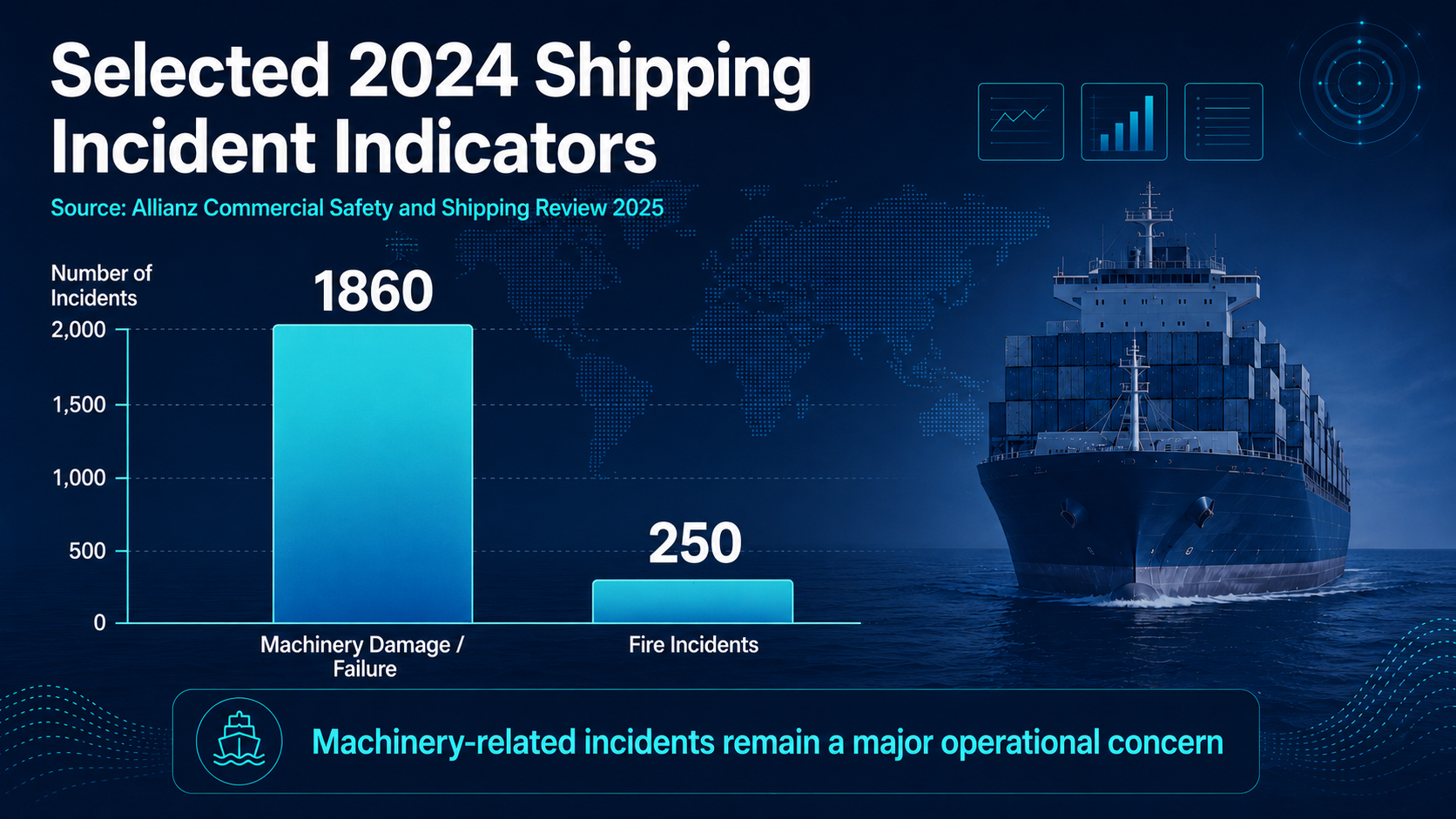
Fleet operations are facing pressure from trade uncertainty, route disruption, rising costs and technical risk. UNCTAD reported that maritime trade grew by 2.2% in 2024, but was expected to slow to 0.5% in 2025 before averaging about 2% annually from 2026 to 2030.
At the same time, machinery reliability remains a major concern. Allianz Commercial reported 1,860 machinery damage or failure incidents in 2024, making it the leading shipping incident category. IUMI also noted in 2025 that hull claims severity remained above pre-COVID levels, led by machinery failures.
This shows why downtime, repeated defects and insurance claim risk are closely connected. Slow troubleshooting, incomplete defect history, weak evidence, repeated failures and poor ship-to-shore visibility can all increase operational exposure.
A Marine AI Assistant helps reduce these weak points by making vessel knowledge easier to find, connect and act on during technical operations.
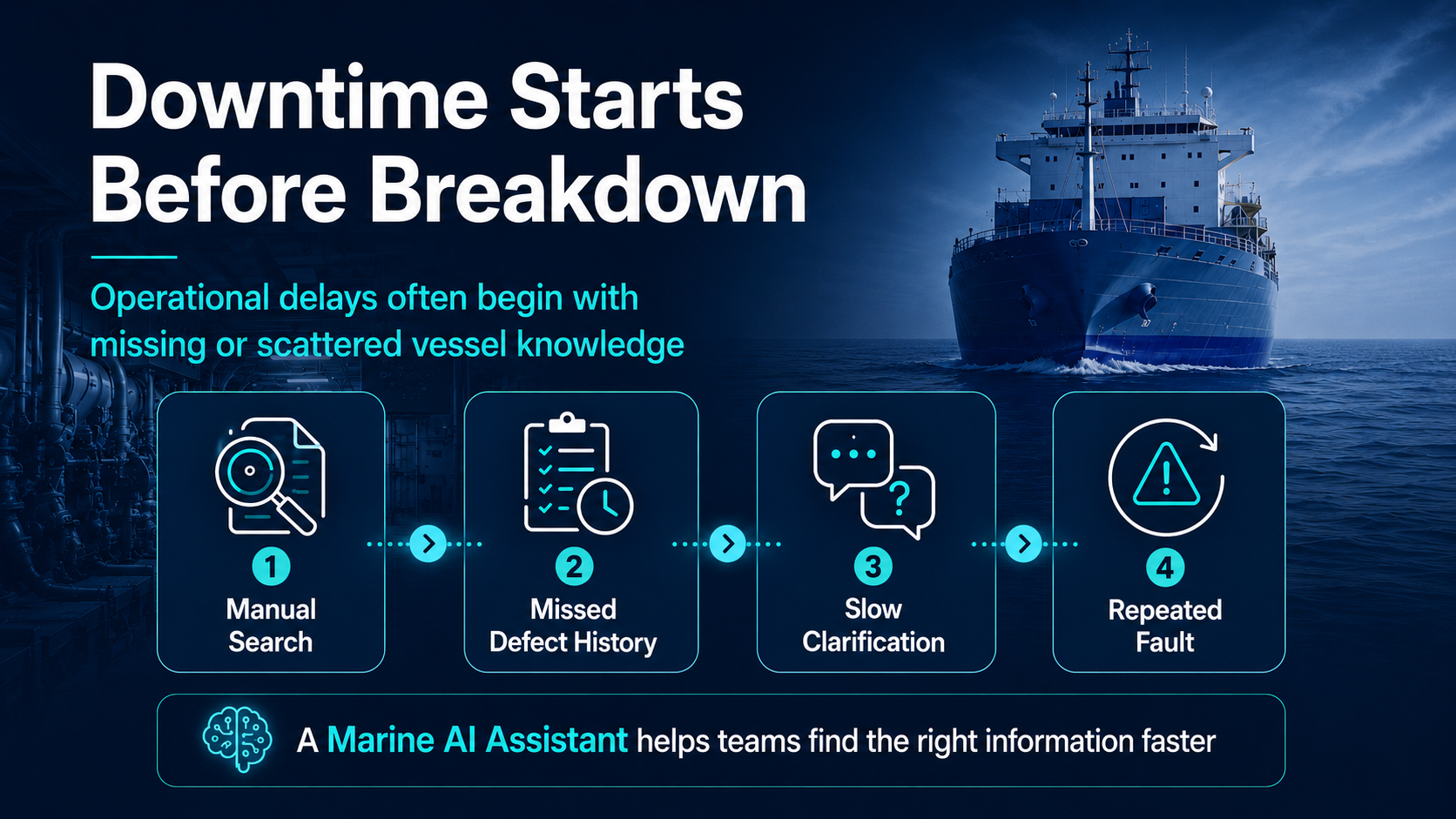
When a pump fails, an alarm repeats or a machinery system trips, teams naturally focus on the technical fault: what failed, what changed and what should be checked first.
But many delays are actually information delays.
The manual may be available, but the right troubleshooting page is buried inside a long PDF. A superintendent may remember a similar issue, but not the vessel or corrective action. An OEM advisory may exist, but may not be accessible onboard at the right moment. Defect history may be recorded, but not connected to the current symptom.
This is where downtime starts before the breakdown.
A Marine AI Assistant reduces this delay by helping teams search across vessel-specific manuals, defect records, past fixes, service letters and internal technical notes faster. The result is quicker technical clarity and a stronger first response.
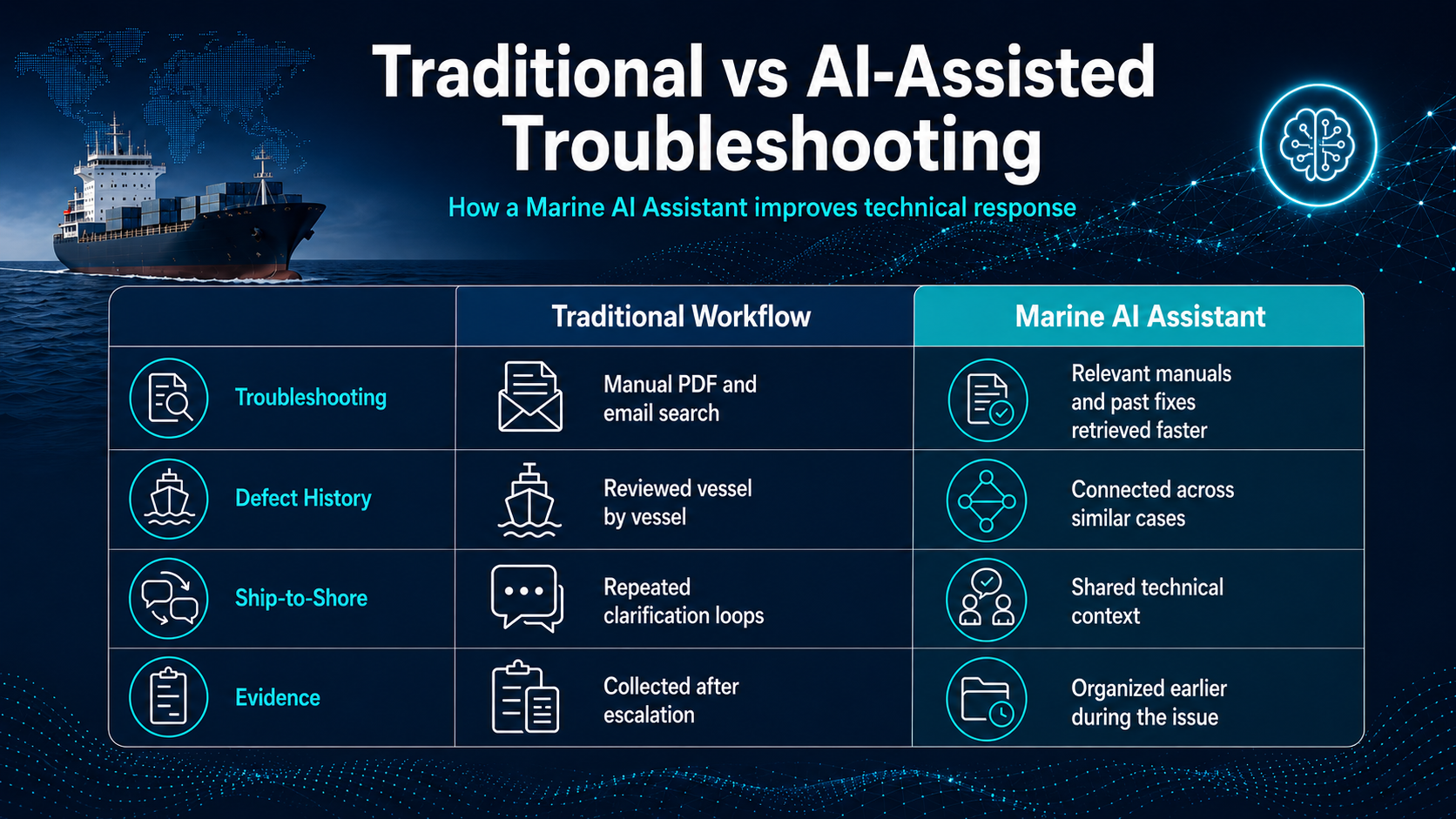
During a machinery issue, time is often lost searching across manuals, alarm logic, defect reports and superintendent guidance. If these documents are not connected, troubleshooting becomes a slow back-and-forth process.
A Marine AI Assistant retrieves relevant information based on the fault, equipment, vessel and operating context. For example, during an auxiliary engine alarm, it can surface manual sections, similar past cases, OEM advisories, related defect reports, safety procedures and suggested checks.
The crew still validates the condition onboard, and the superintendent still decides the right action. The difference is that the team starts with better information, faster.
Many downtime events become longer because the vessel and office do not share the same technical picture. The vessel explains the symptom, the office asks for logs or history, the vessel replies, and another clarification follows.
A Marine AI Assistant improves ship-to-shore visibility by organizing the issue context in one place. When a vessel reports a problem, the office can quickly see related history, supporting documents and possible past fixes.
This helps superintendents move faster from “What happened?” to “What should we check next?”
A weak first response can turn a manageable defect into a larger delay or safety issue. Teams may miss a warning sign, follow the wrong sequence or overlook a related service bulletin.
AI-powered maritime troubleshooting helps standardize the first response by guiding users toward relevant checks, past actions and source-backed information. This is especially useful for recurring faults, crew changes, complex systems and large manuals.
The value is not that AI replaces engineers. The value is that it helps engineers reach the right information faster.
Repeated defects are expensive because they show that the fleet is fixing symptoms but not always learning from patterns.
A single vessel may close a defect after a temporary repair. Another vessel may later face the same issue. A third vessel may show early warning signs, but the connection may not be noticed.
This is common when defect history is trapped in separate systems or reviewed only vessel by vessel.
A Marine AI Assistant helps fleets identify repeated patterns by connecting information across:
This makes defect intelligence more usable.
For example, if several vessels report similar purifier alarms, the fleet team can look beyond each isolated event. They can examine whether the issue is linked to operating conditions, maintenance intervals, spare quality, crew familiarity, incorrect settings or a known OEM advisory.
This helps fleets move from reactive correction to fleet-level learning.
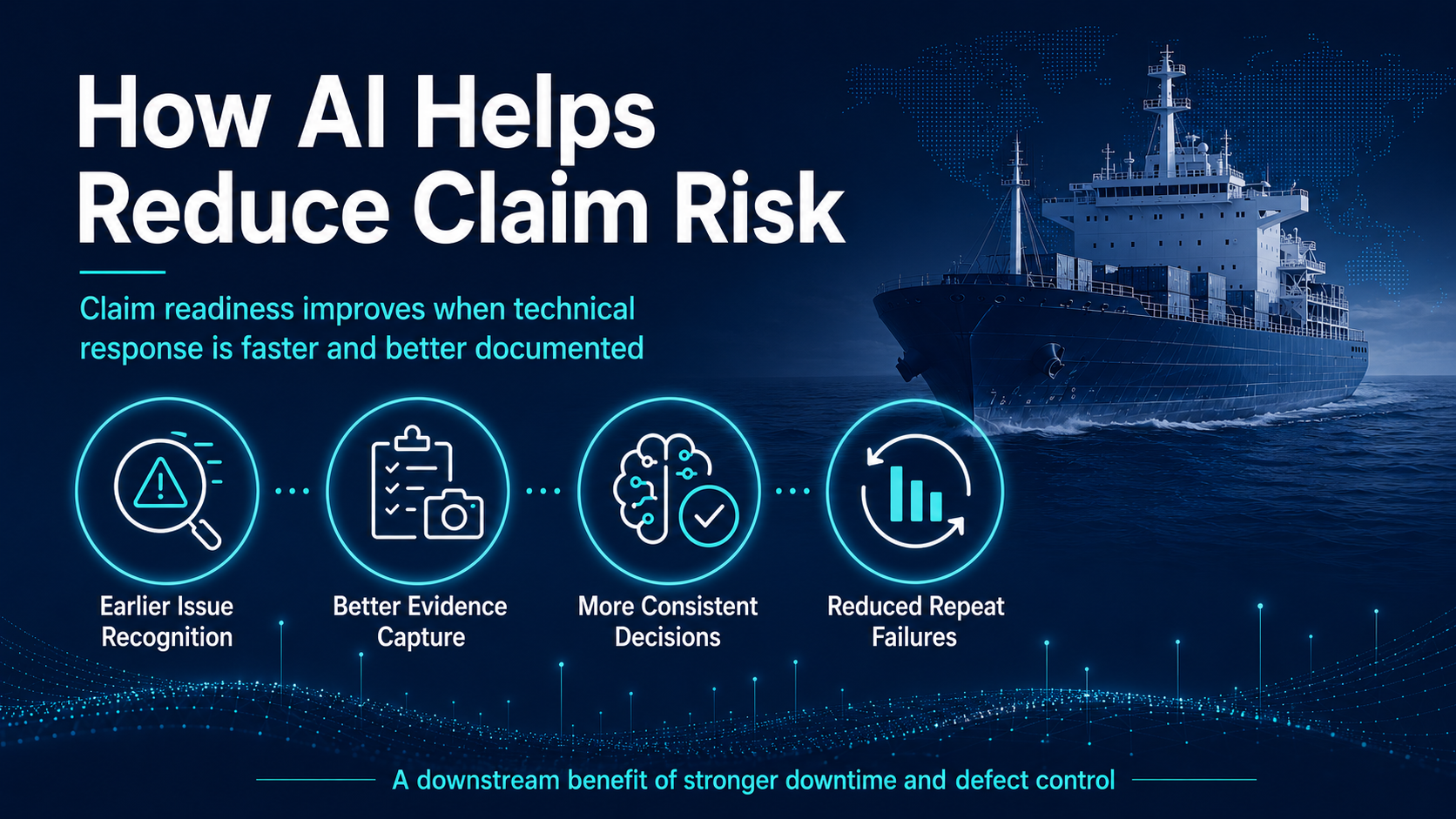
A Marine AI Assistant does not guarantee fewer claims, lower premiums or claim approval. Marine insurance depends on many factors, including vessel condition, casualty circumstances, policy terms, trading area and survey findings.
But it can help reduce claim risk operationally.
Claim exposure often increases when troubleshooting is delayed, evidence is incomplete, actions are not clearly recorded, or repeated defects are not connected to a root-cause trail.
A Marine AI Assistant helps by improving four areas:
When teams can search manuals, defect history and past fixes faster, they may identify developing problems before they become larger machinery failures. This matters because machinery failure remains a major incident and claims driver in shipping.
Claims often depend on a clear timeline: what happened, what alarms appeared, what checks were done, when the office was informed and what corrective action was taken.
A Marine AI Assistant helps preserve this context earlier by organizing defect details, manual references, troubleshooting steps and communication history around the issue.
Inconsistent technical responses can increase operational and safety risk. A Marine AI Assistant supports a more structured approach by surfacing relevant procedures, previous fixes and decision-support guidance.
It does not replace the company’s Safety Management System. It helps teams access the right knowledge faster within that system.
Repeated failures can create difficult questions if a larger incident occurs later. Was the root cause addressed? Was the earlier defect properly closed? Was the same issue seen on sister vessels?
AI-assisted defect intelligence helps fleet teams identify recurrence patterns earlier and take action before the same issue escalates.
This is where SmartSeas.AI becomes relevant.
SmartSeas.AI is an AI-powered maritime platform built to help fleet teams improve troubleshooting, operational clarity, safety response, ship-to-shore visibility and technical decision-making.
It helps fleets unify vessel knowledge across sources such as:
Instead of leaving critical knowledge scattered across PDFs, emails and systems, SmartSeas.AI helps technical teams retrieve relevant information faster and apply it in an operationally useful way.
For ship managers, the value is not just faster search. It is better for fleet learning.
SmartSeas.AI supports:
The platform supports SmartSeas.AI’s mission: transforming maritime operations through AI-powered decision-making.
Imagine a vessel reports a main engine starting problem before departure.
In a traditional workflow, the crew may search the manual, check alarms, send details to the office and wait while the superintendent reviews old reports or asks if anyone remembers a similar case. This can take hours.
With a Marine AI Assistant, the team can ask:
“Main engine not starting after command. What checks should we perform based on this vessel’s manual and past defects?”
The assistant can retrieve relevant start-air checks, control system interlock references, past similar defects, OEM guidance, earlier corrective actions, safety precautions and supporting manual pages.
The crew still performs the checks, and the superintendent still validates the action. But the team starts with stronger context, which can reduce avoidable delay.
Consider a fleet where several vessels report fuel oil pump cavitation or abnormal vibration.
Individually, each defect may look manageable. But across sister vessels, the pattern may point to a wider issue. Traditional reporting may miss this because each defect is closed separately.
A Marine AI Assistant can identify similar defect descriptions across vessels and connect them with equipment type, operating condition, maintenance history, previous corrective actions, manual guidance and superintendent notes.
This helps the fleet ask better questions:
Is the maintenance interval suitable? Is the same component failing? Is there a relevant OEM advisory? Are different crews applying different fixes?
This is how AI turns defect history into fleet intelligence.
A Marine AI Assistant should be used as a decision-support layer, not as an autonomous decision-maker.
Key limitations include:
The best approach is to use AI to support faster, better-informed technical decisions.
Do not begin with every operational problem. Start where information delays are common, such as machinery troubleshooting, repeated defects, OEM advisory search, safety procedure access, ship-to-shore support and incident learning.
A Marine AI Assistant should not rely only on generic maritime knowledge. It should connect vessel-specific and fleet-specific data, including manuals, defect history, advisories and internal technical notes.
AI should support marine professionals, not replace them. Chief engineers, superintendents and safety teams should still validate recommendations, approve actions and manage escalation.
Fleets should measure whether the assistant improves troubleshooting time, repeated defect reduction, manual search time, ship-to-shore response time, evidence completeness and defect closure quality.
Every resolved fault should improve future troubleshooting. Once a fix is validated, that learning should become easier for the fleet to find and reuse next time.
A Marine AI Assistant is an AI-powered tool that helps vessel and shore teams search, retrieve and use maritime operational knowledge. It can support troubleshooting, defect analysis, manual search, procedure access and ship-to-shore technical decision-making.
It reduces downtime by helping teams find relevant manual sections, past defects, OEM advisories and previous fixes faster. This shortens the information-search stage of troubleshooting.
It cannot prevent every machinery failure. However, it can help teams detect recurring issues, review past cases and respond earlier before a defect becomes more serious.
AI can compare similar defect descriptions, equipment types, corrective actions and historical cases across vessels. This helps fleet teams identify patterns that may be missed in vessel-by-vessel reviews.
It can help reduce operational claim risk by improving evidence capture, response consistency and defect visibility. It does not guarantee lower premiums or claim approval.
No. Vessel maintenance software usually manages planned maintenance, jobs and records. A Marine AI Assistant focuses on retrieving technical knowledge, supporting troubleshooting and connecting operational context across documents and systems.
Ship-to-shore visibility helps the office and vessel work from the same technical picture. This reduces repeated clarification, speeds up decisions and improves operational coordination.
SmartSeas.AI helps fleets unify manuals, defect intelligence, OEM advisories and technical notes into an AI-powered troubleshooting and decision-support platform for ship and shore teams.

Get Started Today
Transform the way you troubleshoot and manage maritime operations. Join the next wave of Maritime Digital Transformation with SmartSeas AI.




.svg)

.png)