.jpg)
July 3, 2026
The Future of Shipping: Predictive Analytics for Smarter Decision-Making

July 3, 2026
Shipping decisions are becoming harder to make with delayed information. A machinery fault, port delay, route disruption, weather change, or repeated vessel defect can quickly affect cost, safety, schedule reliability, and customer confidence.
This is why predictive analytics in shipping is becoming more important for modern fleet teams.
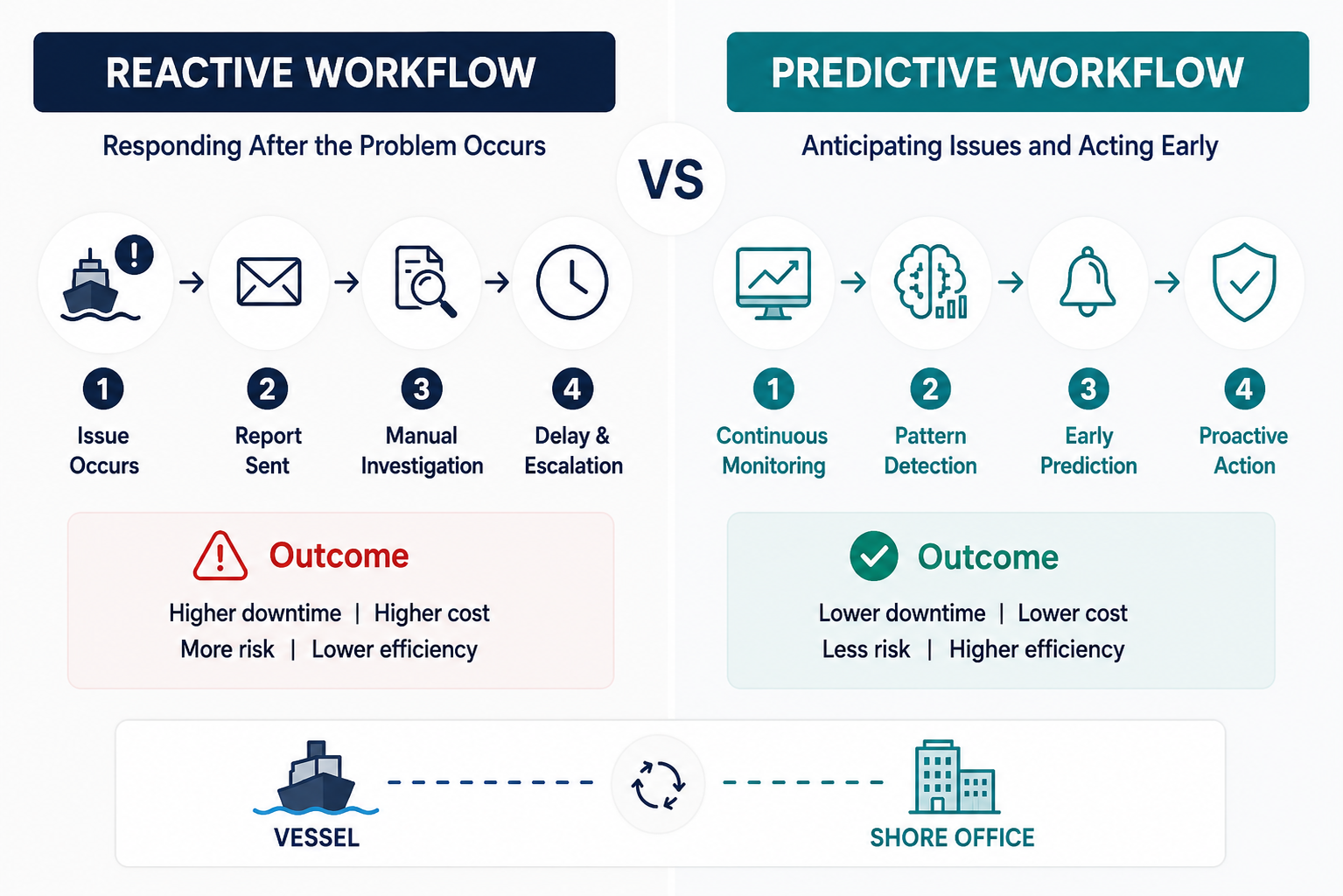
Predictive analytics helps shipping companies move from reactive decisions to proactive control. Instead of waiting for failures, missed ETAs, or repeated technical defects, fleets can use data patterns to identify early warning signs and act sooner.
The future of shipping is not only about collecting more data. It is about turning vessel data into faster, clearer, and smarter decisions.
Maritime operations are under pressure from route disruption, port congestion, emissions rules, machinery risk, and rising operational costs.
According to UNCTAD, rerouting away from the Red Sea and Panama Canal increased vessel demand and container ship demand by mid-2024. Longer routes can also increase fuel use, congestion, costs, emissions, and schedule uncertainty.
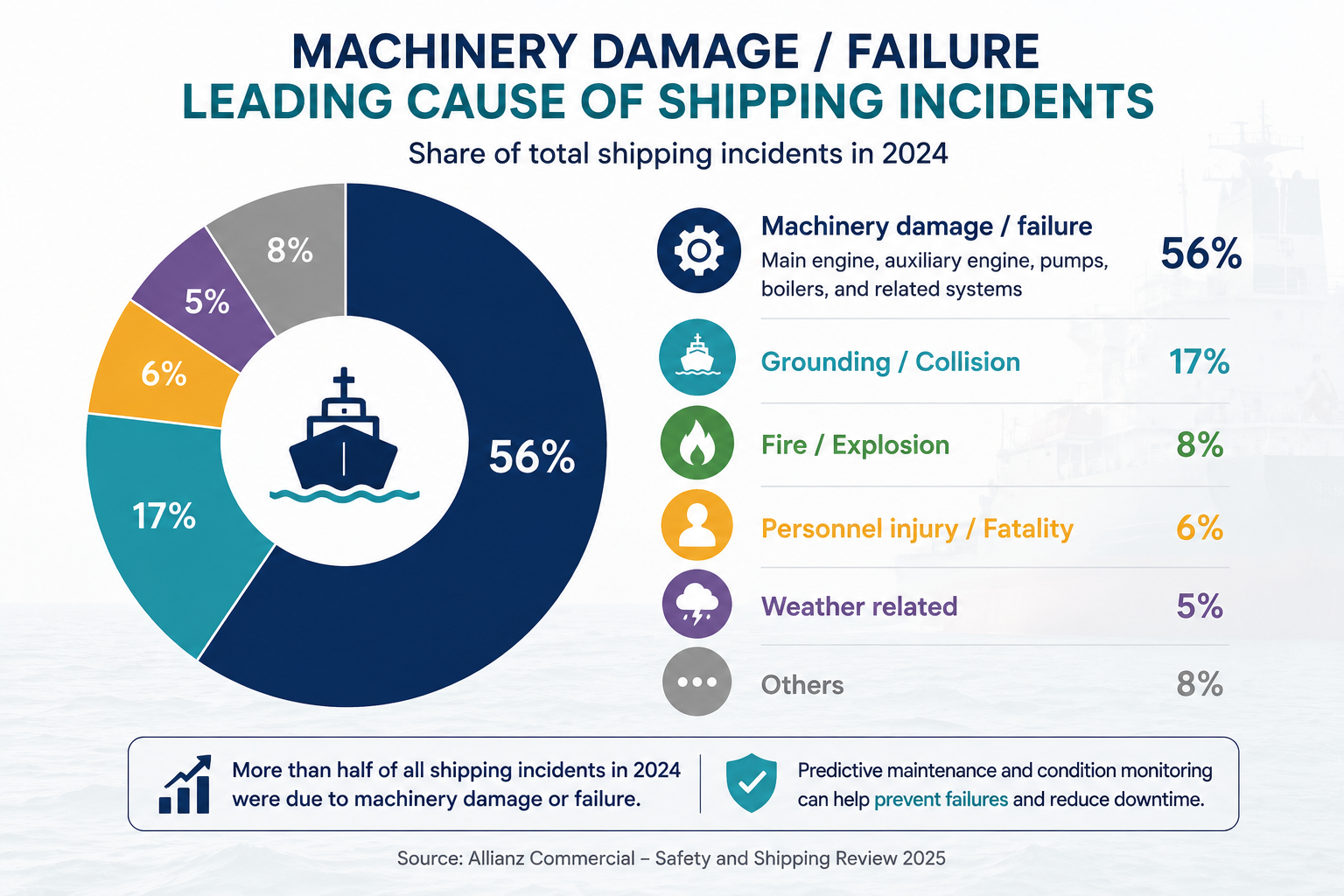
Machinery risk is also a major concern. Allianz Commercial’s Safety and Shipping Review 2025 identifies machinery damage or failure as the leading cause of shipping incidents globally.
For fleet teams, this creates a simple challenge: traditional workflows are often too slow.
Predictive analytics helps teams answer questions such as:
What equipment is showing early signs of failure?
Which vessel may need technical support soon?
Which voyage has a higher delay risk?
Which defect looks similar to a past failure?
Which issue needs shore-side attention before escalation?
Predictive analytics in shipping uses historical data, real-time data, machine learning, and operational context to forecast likely future outcomes.
It helps fleets move from:
“What happened?”
to
“What may happen next?”
to
“What should we do now?”
A predictive analytics system may use vessel sensor data, PMS records, defect reports, voyage data, weather information, fuel records, inspection findings, manuals, and shore-side technical notes.
For example, a cooling issue may look minor at first. But when the system connects rising temperature trends, past alarms, maintenance delays, and similar defect reports, it may show a higher risk of failure.
Predictive analytics does not replace engineers or superintendents. It helps them see patterns earlier and make better decisions.
Shipping is becoming more digital, connected, and data-driven.
The IMO’s e-navigation strategy focuses on harmonized maritime information to support safer and more efficient navigation.
The International Hydrographic Organization confirmed that Phase 1 S-100 product specifications entered into force in January 2026, supporting more structured digital navigation data.
Commercial documentation is also becoming digital. The DCSA electronic bill of lading standard supports digital bill of lading data exchange through open APIs.
On the regulatory side, EMSA’s 2025 digitalization update highlights work around maritime data services, EU ETS, FuelEU Maritime, and the European Maritime Single Window environment.
These changes show the same direction: maritime decisions are moving from manual reports toward connected data systems.
But data alone is not enough. Predictive analytics becomes useful only when data is organized, reliable, and connected to daily fleet workflows.
Traditional shipping decisions often happen after the problem is already visible.
A vessel reports a defect.
The superintendent asks for more details.
The crew sends photos or manual extracts.
The office checks old reports.
The team searches for spares.
This process takes time.
The same issue may have happened before on another vessel, but the past fix may be hidden in reports, emails, or PDFs.
Common gaps include:
Decisions happen after escalation.
Past repairs and corrective actions are hard to find.
Ship and shore teams may not share the same operational picture.
Manual analysis does not scale across large fleets.
Safety and compliance evidence is often collected too late.
Predictive analytics helps reduce these gaps by connecting data, history, and operational context earlier.
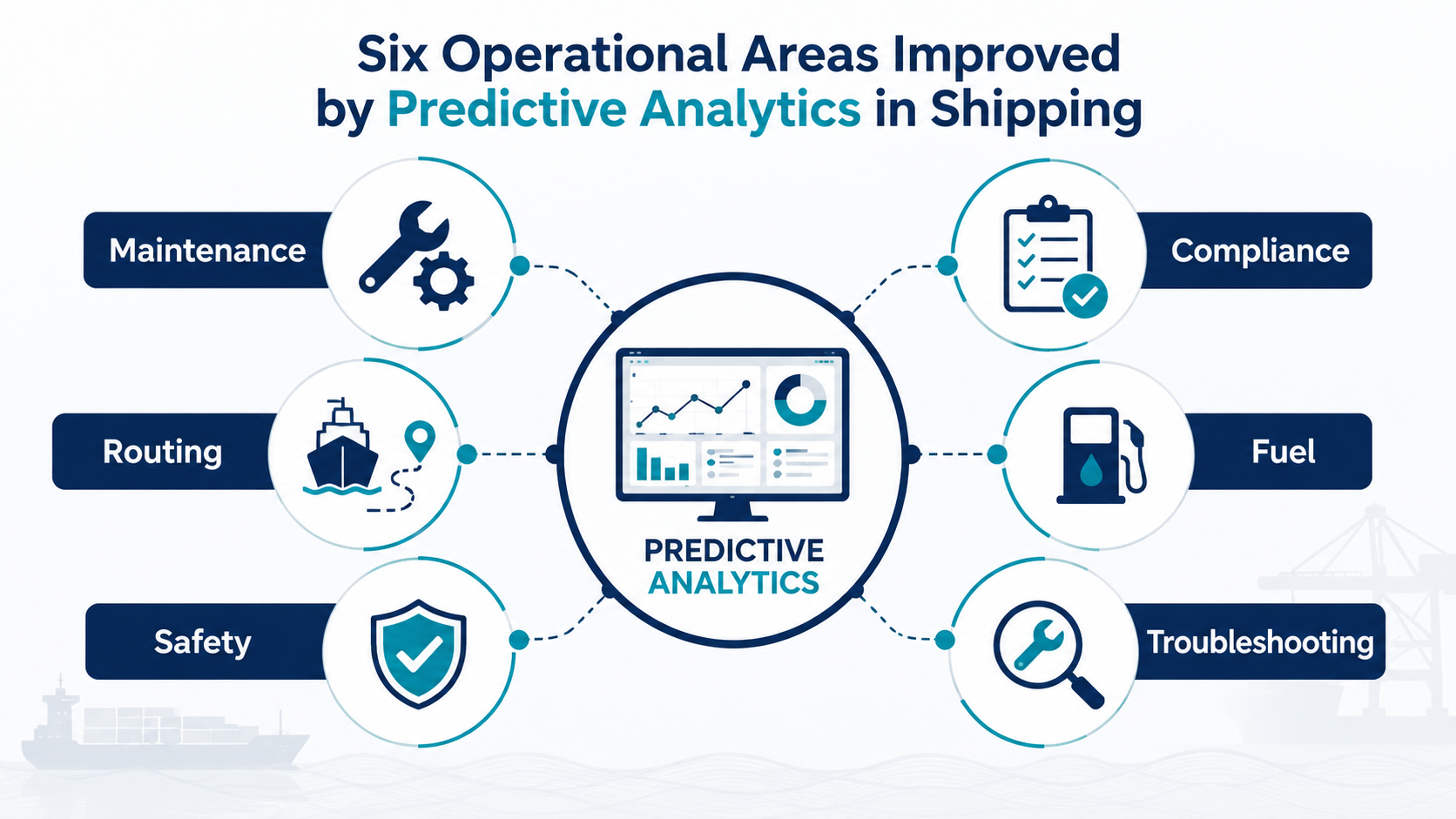
A vessel maintenance software or PMS can show what maintenance is due. Predictive analytics goes further by identifying what may fail based on condition, history, usage, and repeated symptoms.
It can help detect vibration changes, abnormal temperatures, repeated alarms, lubrication issues, pump degradation, generator anomalies, and recurring hydraulic failures.
This helps technical teams plan earlier checks and avoid avoidable downtime.
This matters because machinery damage or failure remains a major incident category in global shipping, as reported by Allianz Commercial.
Prediction alone is not enough.
If a system predicts a seawater pump issue, the team still needs to know what to check, which manual applies, whether the issue happened before, and what corrective action worked.
This is where AI-powered maritime troubleshooting becomes valuable.
SmartSeas.AI helps fleets connect manuals, defect history, past corrective actions, technical documents, and troubleshooting knowledge. This helps crew and shore teams move faster from risk signal to technical action.
The value is not only knowing that a problem may happen. The value is knowing what to do next.
Shipping schedules are affected by weather, port congestion, canal restrictions, technical delays, bunker planning, and geopolitical disruption.
Predictive analytics can improve ETA reliability by combining vessel position, speed, weather, port congestion, voyage history, and route risk.
This helps teams understand whether a vessel may miss a port window, whether a route may create delay, or whether weather may affect fuel use.
UNCTAD has highlighted how rerouting around chokepoints can increase congestion, fuel consumption, insurance exposure, costs, and emissions.
Predictive analytics can help fleets forecast fuel consumption under different operating conditions.
It can compare actual performance against expected performance based on draft, trim, weather, hull condition, engine load, speed, route, and cargo condition.
This is useful as shipping faces stronger emissions reporting and decarbonization pressure.
DNV’s Maritime Forecast to 2050 highlights the industry’s decarbonization pathway, including regulation, alternative fuels, and technology choices.
Predictive analytics helps teams make more informed decisions within this transition.
Safety decisions often need quick access to the right information.
Predictive analytics can help identify repeated safety-related defects, high-risk equipment trends, recurring inspection findings, and vessels with increasing technical risk.
It can also help compliance teams spot overdue corrective actions, incomplete maintenance evidence, repeated non-conformities, and documentation gaps before inspections.
EMSA’s maritime digitalization work shows how maritime awareness increasingly depends on reliable digital information.
For fleets, the same principle applies internally: safety and compliance improve when operational data is visible and structured.
Predictive analytics depends on connected systems. That means cyber resilience is important.
As vessels become more digital, IT and operational technology systems become more connected.
IACS Unified Requirements E26 and E27 address cyber resilience for ships and onboard systems, with revised requirements applied to new ships contracted for construction on and after July 1, 2024.
Predictive systems should therefore be implemented with clear data governance, access control, cybersecurity review, and operational boundaries.
A smarter ship also needs a safer digital foundation.
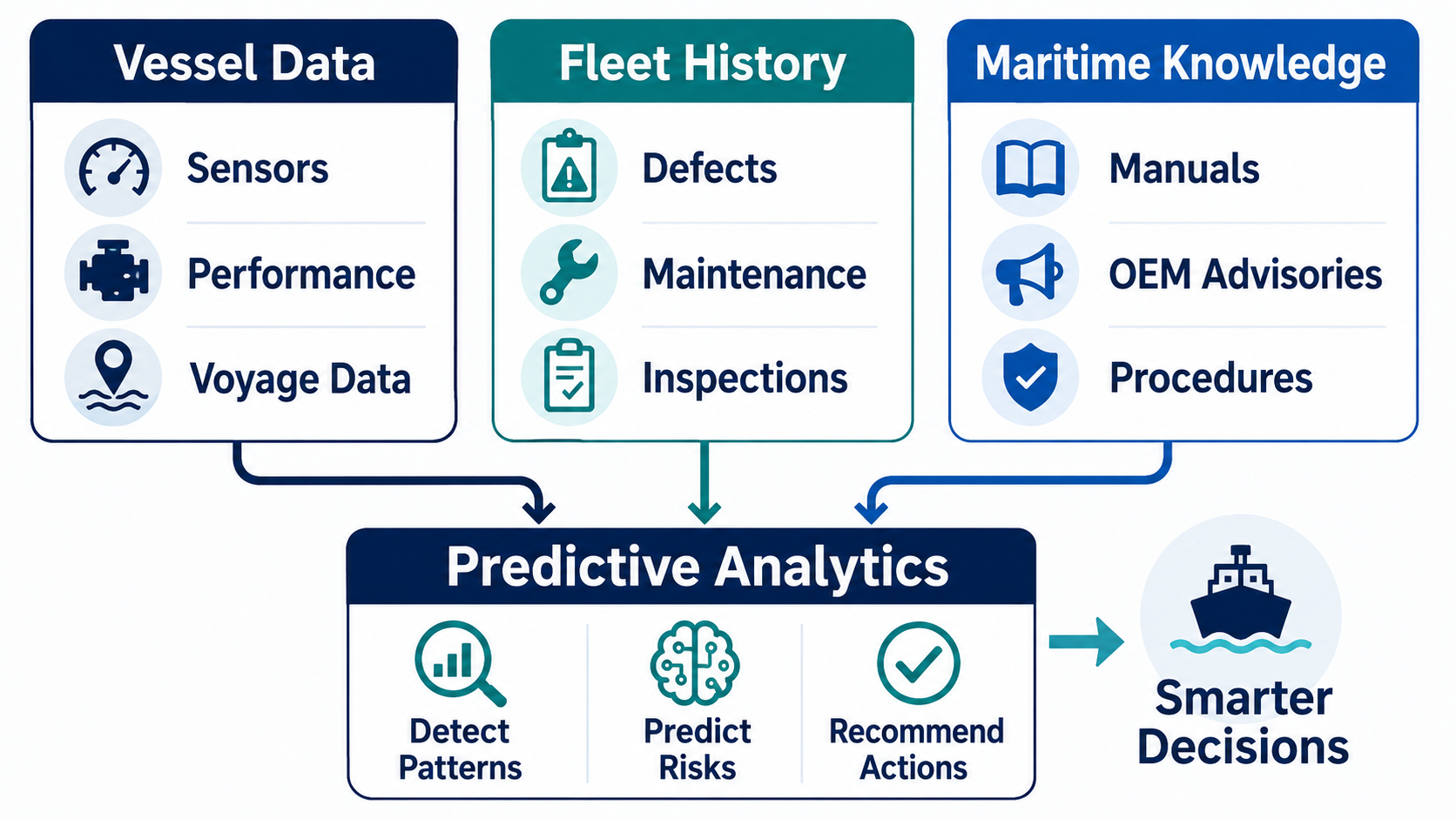
Predictive analytics needs reliable and connected data.
For maritime fleets, the most useful data usually comes from three areas.
This includes sensor readings, equipment performance, fuel consumption, speed, draft, engine load, alarms, condition monitoring data, and voyage information.
This includes past defects, breakdowns, repairs, spares used, PMS history, inspection findings, drydock reports, and corrective actions.
This includes manuals, OEM advisories, safety procedures, technical bulletins, class requirements, and vessel-specific instructions.
The best systems connect these layers into one decision workflow.
For example, if a bearing temperature rises, the system should connect past similar defects, relevant manuals, previous corrective actions, and spares history.
That is the difference between raw data and operational intelligence.
Not every predictive analytics project delivers value.
Common reasons include poor data quality, fragmented systems, unclear workflows, too many alerts, limited maritime context, and weak ship-to-shore adoption.
If defect descriptions are inconsistent, maintenance records are incomplete, or sensor data is unreliable, predictions become weaker.
If PMS data, manuals, emails, and defect reports remain separate, the system cannot see the full picture.
Most importantly, a prediction must lead to action. Otherwise, it becomes just another alert.
Predictive analytics must be practical, explainable, and connected to the way fleet teams actually work.
SmartSeas.AI helps maritime teams turn scattered vessel knowledge into faster operational decisions.
Many analytics tools show dashboards or sensor trends. These are useful, but technical teams also need the “why” and the “what next.”
SmartSeas.AI helps fleets connect manuals, technical documents, defect history, incident reports, past corrective actions, and ship-to-shore troubleshooting context.
When a vessel reports a recurring fault, SmartSeas.AI can help teams retrieve relevant manual sections, compare similar past defects, and identify previous corrective actions.
This helps fleets move from prediction to practical action faster.
Start with high-cost operational problems such as recurring machinery defects, unplanned downtime, slow troubleshooting, repeated ship-to-shore clarification, fuel performance deviations, ETA uncertainty, and inspection preparation gaps.
Clean and standardize defect data, including equipment names, failure codes, corrective actions, and closure notes.
Connect PMS data with defect history so teams can compare planned maintenance with actual failures.
Include manuals and technical knowledge so predictions can lead to practical troubleshooting steps.
Keep humans in the decision loop. Predictive analytics should support marine engineers and superintendents, not bypass them.
Start with a defined vessel group or machinery category before scaling across the fleet.
Predictive analytics is useful, but it is not perfect.
Fleet teams should not treat predictions as automatic approval for action. Crew and superintendents must validate the output against actual vessel conditions.
Limitations include data gaps, sensor faults, poor defect descriptions, incomplete source documents, alert overload, limited historical data, and cybersecurity risk.
Predictive analytics should be used as a decision-support layer.
The safest approach is human-led, AI-supported, and evidence-backed.
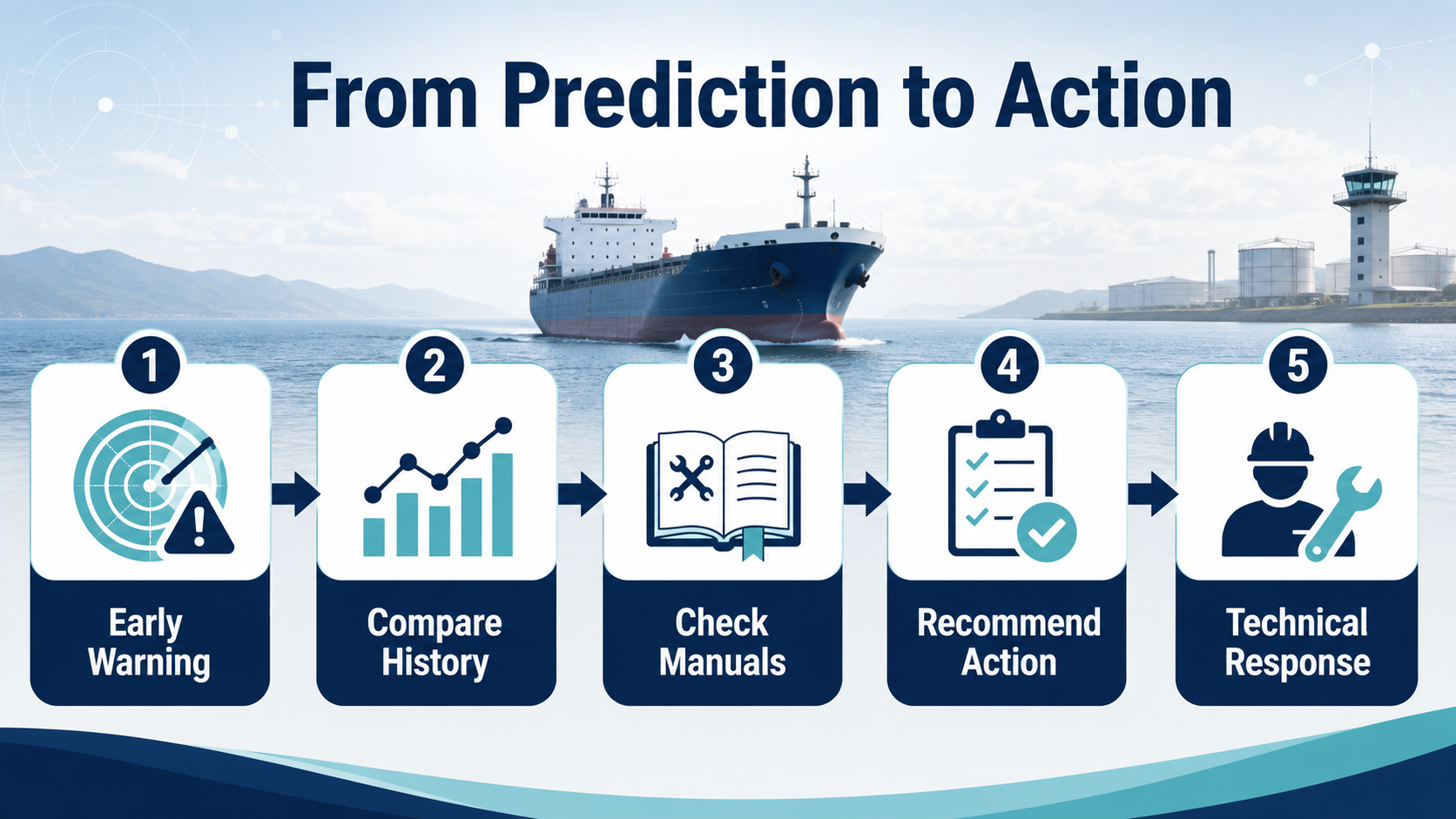
Predictive analytics in shipping is becoming an operational requirement.
Fleet teams are managing more disruption, more compliance pressure, more technical complexity, and more vessel data than ever before.
The challenge is not only collecting information. The real challenge is turning that information into faster and safer decisions.
Predictive analytics helps fleets see risk earlier. AI-powered troubleshooting helps teams act on that risk faster.
SmartSeas.AI supports this shift by helping maritime teams unify vessel knowledge, defect intelligence, manuals, and troubleshooting workflows into one practical AI-powered decision layer.
The future of shipping will be shaped by fleets that can combine maritime expertise, connected data, and practical AI to make better decisions before problems escalate.
Predictive analytics in shipping uses vessel data, historical records, and AI models to forecast likely risks or outcomes. It helps fleets identify issues before they escalate.
It detects early warning signs from condition data, maintenance history, and defect patterns. This helps teams plan checks and repairs earlier.
No. Predictive maintenance is one use case. Predictive analytics can also support voyage planning, fuel performance, ETA prediction, safety response, and compliance readiness.
Useful data includes sensor readings, PMS records, defect reports, maintenance history, alarms, voyage data, weather data, spares records, manuals, and inspection findings.
No. It supports engineers and superintendents by giving better visibility and earlier warnings. Final decisions still need human judgment.
SmartSeas.AI connects manuals, defect history, incident reports, technical knowledge, and troubleshooting workflows so teams can move faster from risk signal to action.
The biggest challenge is usually data quality and fragmentation. If vessel data is scattered, predictions become harder to trust and act on.
Shipping is facing disruption, compliance pressure, safety demands, and rising operational complexity. Predictive analytics helps fleets make faster and more informed decisions.

Get Started Today
Transform the way you troubleshoot and manage maritime operations. Join the next wave of Maritime Digital Transformation with SmartSeas AI.




.svg)


.png)