.jpg)
June 12, 2026
Can a Marine AI Assistant Reduce Insurance Claim Risk in Fleet Operations?

June 12, 2026
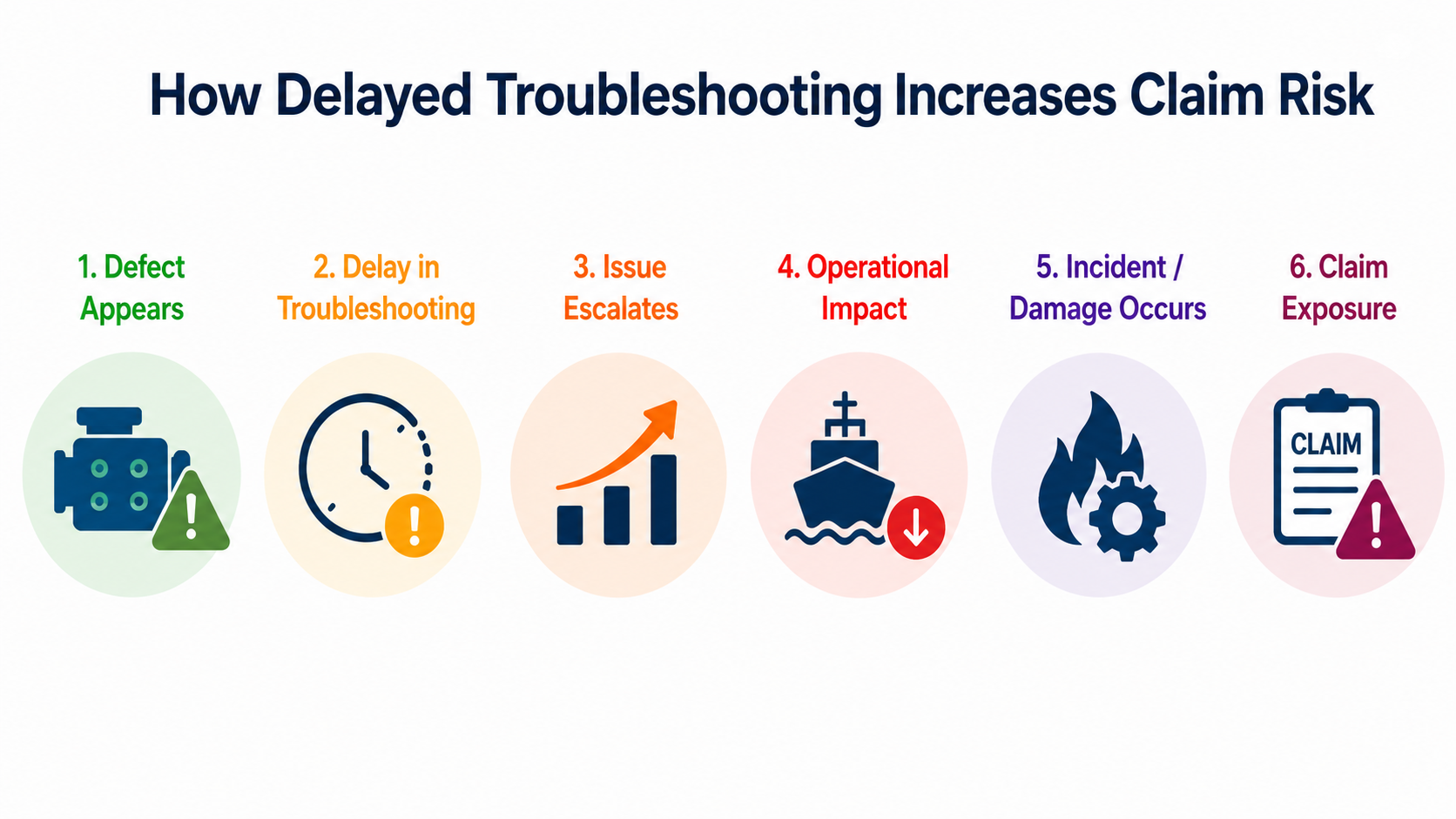
When a vessel faces a machinery fault, repeated defect or safety-critical alarm, claim risk can begin long before actual damage occurs. Delayed troubleshooting, missing evidence, weak defect history and poor ship-to-shore visibility can all increase exposure.
A Marine AI Assistant helps reduce insurance claim risk by connecting manuals, defect history, troubleshooting guidance and operational evidence, so teams can identify issues faster and act before defects escalate.
AI does not prevent every claim or guarantee lower premiums. But it can support stronger loss prevention and better claim readiness. This matters because Allianz Commercial Safety and Shipping Review 2025 reported 3,310 shipping incidents in 2024, with machinery damage/failure accounting for 1,860 incidents.
In fleet operations, many insurance conversations begin after the loss: after the machinery damage, after the delay, after the fire, after the cargo issue, after the off-hire event, or after a dispute begins.
But operational risk usually builds before that point.
A purifier abnormal vibration may be treated as a one-off issue. A main engine starting problem may be closed after a temporary fix. A generator trip may be discussed in email, but not connected with similar failures across sister vessels. A hydraulic leak may appear minor until it affects a safety-critical system.
When these signals are not connected, fleets lose the chance to act early.
Insurance claim risk increases when:
The International Maritime Organization’s ISM Code is built around safe management, safe operation and pollution prevention. IMO also notes that the ISM Code includes assessment of identified risks to ships, personnel and the environment, and the establishment of appropriate safeguards.
A Marine AI Assistant supports this principle operationally: it helps teams find the right information earlier, understand risk patterns faster and preserve context while events are still unfolding.
Marine insurance risk is becoming more complex because vessels, machinery, fuels, regulations and trading patterns are changing at the same time.
IUMI warned in 2025 that loss severity remains above pre-COVID levels, led by machinery failures. It also highlighted that fires and explosions are relatively few but costly, while collision, contact and grounding frequencies have edged up.
The same IUMI update noted that older ships are a growing concern. The average world fleet age was reported at 22.6 years, with 35% of ships more than 25 years old and 61% more than 15 years old. IUMI also stated that older ships are often harder or uneconomical to repair, increasing the risk of constructive total losses or unrepaired damage claims.
This is important for fleet managers because older vessels often carry more fragmented technical history. The knowledge may sit across manuals, planned maintenance records, email threads, superintendent notes, defect reports, incident reports and crew memory.
At the same time, digitalisation is accelerating. DNV notes that data streams from sensors and other sources can support decision-making, monitoring, control, quality assurance and verification in maritime operations.
The challenge is not simply having more data. The challenge is making that data usable during a real operational problem.
Many machinery-related incidents are not caused by one single catastrophic event. They often begin with an alarm, abnormal parameter, recurring trip, vibration, leakage, temperature rise or unclear fault code.
The first operational question is simple:
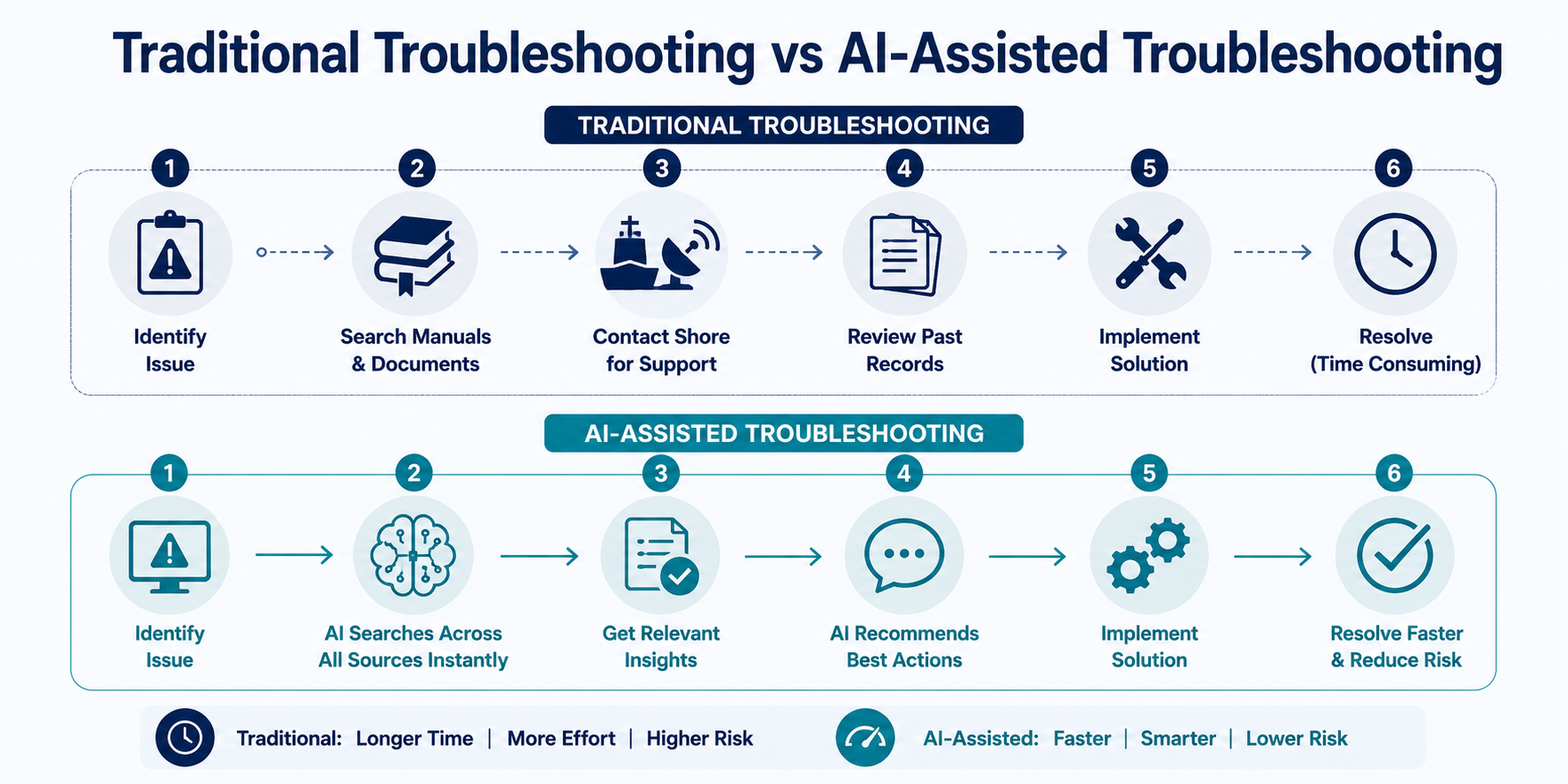
In a traditional workflow, the crew may search multiple manuals, ask shore teams, check PMS history, review previous defect reports and wait for clarification. The delay itself can become a risk.
A Marine AI Assistant shortens this loop by connecting manuals, troubleshooting procedures, previous defects, corrective actions and vessel-specific records into one search and decision-support layer.
This matters because machinery damage/failure represented the largest share of reported shipping incidents globally in Allianz Commercial’s 2025 review.
A single defect is a technical problem. A repeated defect is a management signal.
If the same purifier fault, generator alarm, boiler trip or steering gear issue appears across sister vessels, the problem may not be isolated. It may point to a maintenance practice, operating condition, component batch, training gap, system design issue or procedure weakness.
Traditional systems often store these records separately. A Marine AI Assistant helps connect them.
For example:
This is where SmartSeas.AI becomes relevant. SmartSeas.AI helps fleets unify manuals, defect reports and past vessel intelligence so ship and shore teams can move from isolated defect handling to fleet-wide learning.
Insurance claims are not only about what happened. They are also about what can be shown.
A fleet may need to demonstrate:
When this information is scattered across WhatsApp messages, emails, logbooks, PMS comments and superintendent notes, reconstruction becomes difficult.
A Marine AI Assistant can help teams preserve the operational timeline earlier. It can structure defect context, connect related records and make it easier to retrieve evidence when required.
This does not replace formal claims handling, surveyor reports or insurer requirements. But it improves the quality of operational memory before the claim conversation begins.
A common source of operational risk is not lack of effort. It is a lack of shared context.
The vessel may describe a fault one way. The superintendent may interpret it differently. The OEM manual may contain the answer, but in a section that takes time to locate. A previous vessel may already have solved the same issue, but that knowledge is buried in an old defect report.
A Marine AI Assistant helps create a common technical picture.
Instead of asking repeated clarification questions, shore teams can see the relevant fault history, manual references, previous actions and related operational context faster. This improves decision quality and reduces the chance of repeated, inconsistent or delayed instructions.
Loss prevention is not only about preventing major accidents. It is also about reducing the conditions that allow small issues to become expensive events.
NorthStandard describes its loss prevention aim as reducing the likelihood of incidents and claims occurring and helping mitigate the cost of claims.
A Marine AI Assistant supports this by turning operational records into earlier warning signals. For example, if multiple vessels report similar cooling water issues after maintenance, or repeated starting failures after a component replacement, the fleet can investigate before the pattern becomes a larger exposure.
Consider a vessel facing a main engine starting issue before departure.
In a traditional workflow, the crew may:
The risk is not only delay. The risk is incomplete context.
A Marine AI Assistant can help the crew and shore team quickly identify:
This improves the fleet’s ability to act early and document properly. If the situation later becomes a claim-sensitive matter, the operator has a clearer technical trail.
SmartSeas.AI is built for the practical reality of fleet operations: manuals are large, defect records are fragmented, vessel knowledge is spread across teams, and shore teams need clarity fast.
SmartSeas.AI helps fleets improve:
The value is not “AI replacing the marine engineer.” The value is helping marine engineers, technical superintendents and fleet teams reach the right information faster.
SmartSeas.AI supports AI-powered decision-making by turning operational data into a usable troubleshooting and fleet intelligence layer.
A Marine AI Assistant should not be treated as a final authority for safety-critical decisions. It should support competent maritime professionals, not replace them.
Fleet teams should be clear that:
This is especially important as ships become more digital and connected. IACS has emphasized that maritime digital adoption increases the need to address cyber threats that could affect operations, safety and data integrity. Revised IACS UR E26 and E27 requirements apply to new ships contracted for construction on and after July 1, 2024.
AI should strengthen operational control, not create a new uncontrolled risk.
Begin with systems where failures can create high downtime, safety or claim exposure:
Manuals alone are useful. Defect history alone is useful. But the real value comes when they are connected.
The best workflow is:
Manual guidance + past vessel history + current symptoms + corrective action + evidence
Do not wait until a claim appears. Capture:
Every repeated defect should answer three questions:
The strongest use of AI in fleet operations is not generic chatbot output. It is controlled, maritime-specific, source-backed assistance connected to vessel manuals, approved documents and operational history.
Not directly. Insurance premiums depend on claims history, vessel condition, trading area, underwriting appetite, fleet profile and market conditions. A Marine AI Assistant can support better loss prevention, evidence quality and operational control, which may strengthen risk discussions over time.
AI reduces claim risk by helping crews troubleshoot faster, connect similar past defects, preserve evidence earlier and improve ship-to-shore decision-making before a small issue escalates.
Yes. Allianz Commercial reported that machinery damage/failure accounted for 1,860 of 3,310 reported shipping incidents globally in 2024, making it the largest incident category in its 2025 review.
No. AI should support qualified maritime professionals by retrieving relevant information, structuring defect history and improving visibility. Final operational decisions must remain with competent personnel.
Evidence helps establish what happened, when it happened, what actions were taken and whether the vessel acted reasonably. Better evidence can reduce confusion and support clearer claims handling.
Useful data includes technical manuals, planned maintenance records, defect reports, incident reports, OEM letters, safety procedures, troubleshooting records and ship-shore communication history.
SmartSeas.AI helps fleets unify manuals, defect intelligence and operational data so teams can troubleshoot faster, improve ship-to-shore visibility and reduce repeated defect risk.
A Marine AI Assistant cannot remove every operational, technical or insurance risk from fleet operations. Shipping will always involve machinery complexity, weather exposure, human judgement, regulatory obligations and commercial pressure.
But it can reduce the conditions that often lead to larger losses.
It helps fleets act earlier, troubleshoot faster, connect past knowledge, document better and improve operational clarity between ship and shore. In a claims environment where machinery failures, vessel age, repair costs and evidence quality all matter, this kind of operational intelligence is increasingly valuable.
For fleet teams, the opportunity is simple:
Do not wait for the claim to organize the data.
Use the data before the claim.

Get Started Today
Transform the way you troubleshoot and manage maritime operations. Join the next wave of Maritime Digital Transformation with SmartSeas AI.




.svg)