.jpg)

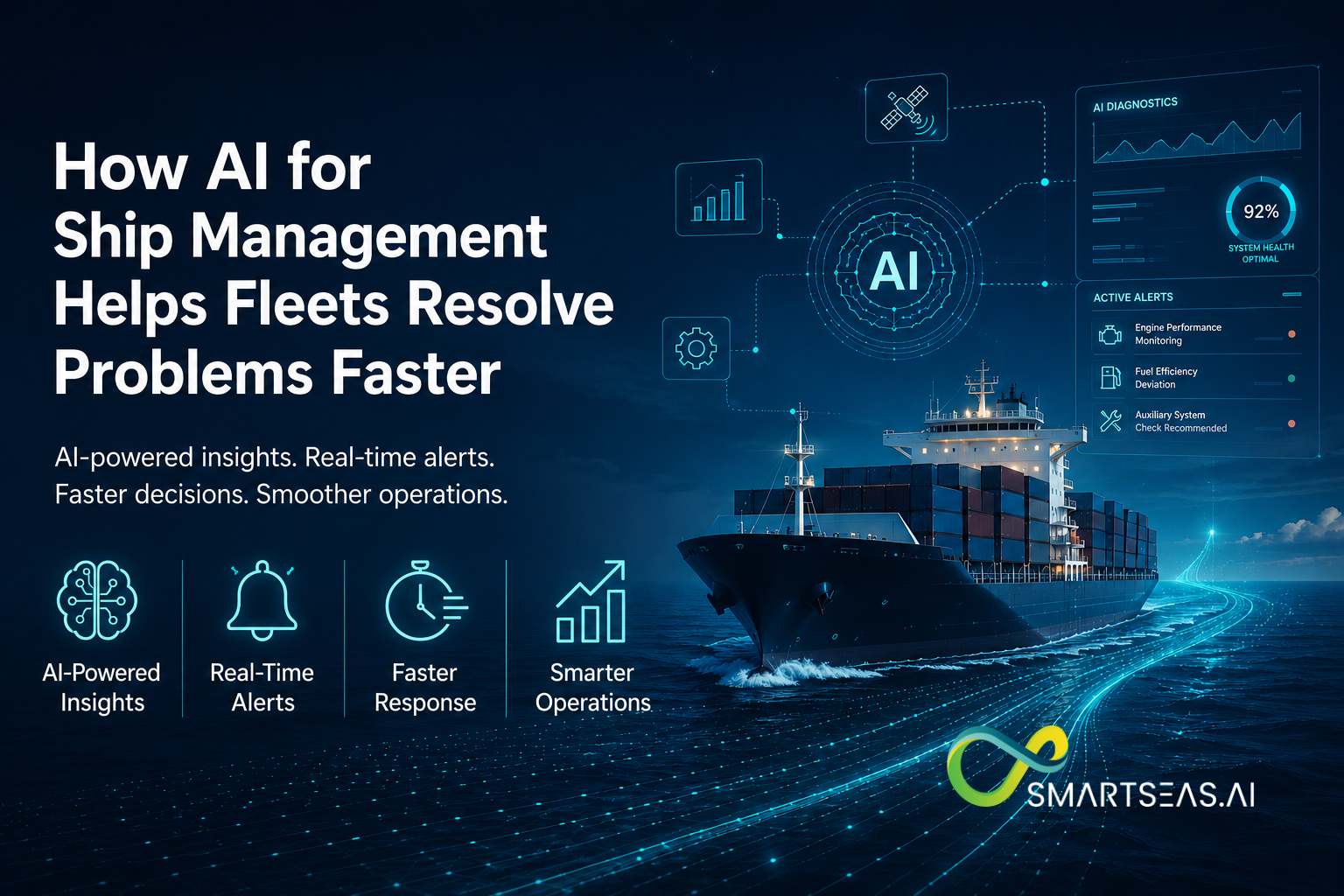
AI for ship management is helping maritime teams troubleshoot vessel problems faster, reduce downtime, and improve ship-to-shore decision-making. When machinery issues occur onboard, engineers often spend valuable time searching OEM manuals, defect reports, service letters, maintenance records, emails, and previous vessel cases before identifying the right action.
AI can connect this scattered technical knowledge and surface relevant information faster. Instead of adding another system for crews to manage, AI-supported workflows help vessel and shore teams find trusted operational context when it matters most.
This article explains how AI can improve troubleshooting, maintenance, operational visibility, and fleet coordination.
AI for ship management uses artificial intelligence to help vessel and shore teams access, analyse, and connect operational information across areas such as troubleshooting, maintenance, defect management, compliance, and fleet coordination.
Instead of searching manuals, reports, emails, and historical records separately, AI-supported systems can bring relevant technical context together and help maritime professionals make faster, better-informed decisions.
The purpose is not to replace masters, chief engineers, or superintendents. It is to give them faster access to the information needed to make operational decisions.
Ship operations have become more data-heavy than ever before.
Modern vessels generate information from:
But having more data does not automatically create faster decisions.
In many fleets, technical teams still face:
A chief engineer may know the issue has happened before, but locating the exact corrective action can still take hours.
This is where AI changes the operational workflow.
AI does not replace marine expertise.
Instead, it helps crews and shore teams access relevant operational intelligence faster.
Modern AI systems can:
The operational advantage comes from reducing the time between:
Problem detected → Correct action identified
Not every operational delay starts with a major machinery failure. Sometimes, it begins with scattered updates — a minor alarm, delayed maintenance note, crew observation, or unclear spare status.
Individually, these signals may look small. But when they sit across different systems, shore teams may not see the full picture quickly.
AI for ship management helps connect these inputs into one workflow.
A simple flow looks like this:
This helps fleets move from scattered updates to coordinated decisions across maintenance, safety, compliance, and ship-to-shore operations.


One of the biggest operational gains from AI is troubleshooting support.
When machinery alarms occur, engineers often need to:
Traditionally, this process depends heavily on manual searching and individual experience.
AI-powered troubleshooting systems can significantly reduce this delay by connecting:
Instead of searching across multiple systems, teams receive structured operational guidance faster.
This becomes especially valuable during:
Many fleets already possess years of operational knowledge.
The challenge is that this knowledge often remains:
AI becomes far more effective when maritime data is organized properly.
This includes:
Without structure, even large data volumes create operational noise.
With structure, AI can identify meaningful operational relationships faster.
One of the biggest hidden delays in ship management is communication friction between vessel and shore teams.
Often:
AI-supported workflows help create shared operational visibility.
Instead of long email chains, technical teams can access:
This reduces confusion and improves alignment during critical decisions.
Traditional maintenance planning is often:
AI helps fleets move toward condition-aware prioritization.
Instead of treating every issue equally, fleets can identify:
This helps technical teams prioritize operational attention more effectively.
Modern fleet management depends on visibility.
Technical managers increasingly need to understand:
AI-powered ship management platforms improve this visibility by connecting operational data into one searchable environment.
This helps reduce:
This is where SmartSeas.AI becomes operationally relevant.
SmartSeas.AI helps fleets reduce troubleshooting delays by connecting:
Instead of manually searching across disconnected systems, ship and shore teams can access structured intelligence through AI-powered workflows.
The platform is designed to support:
The focus is not replacing human expertise — it is helping maritime teams act faster with clearer operational context.
AI adoption alone does not automatically solve operational problems.
Fleets still need:
Poorly organized data can reduce AI effectiveness.
The strongest operational results usually happen when fleets first improve:
AI becomes much more valuable when the operational foundation is already structured.
The maritime industry is under increasing pressure from:
At the same time, vessels cannot afford long troubleshooting delays.
The competitive advantage is shifting toward fleets that can:
This is why AI for ship management is becoming less about experimentation — and more about operational efficiency.
AI for ship management refers to the use of artificial intelligence to improve vessel operations, troubleshooting, maintenance, coordination, and operational decision-making across fleets.
AI helps teams search manuals, defect history, service letters, and operational records together, reducing the time required to identify corrective actions.
No. AI supports marine engineers by improving access to operational knowledge and structured decision support. Human expertise remains essential.
Structured data helps AI identify relationships between defects, equipment history, operational conditions, and corrective actions more accurately.
AI creates shared operational visibility between vessel and shore teams by centralizing technical context, defect history, and troubleshooting information.
Common benefits include:
Yes. Even smaller fleets can benefit from centralized operational knowledge, faster troubleshooting, and improved coordination workflows.
If your vessel and shore teams are spending too much time searching manuals, reviewing previous defects, or exchanging repeated troubleshooting emails, SmartSeas.AI can help.
SmartSeas.AI connects manuals, defect histories, service letters, reports, and vessel-specific technical knowledge so teams can find relevant information faster and make better-informed troubleshooting decisions.
See how SmartSeas.AI can help your fleet reduce troubleshooting delays and improve ship-to-shore decision-making.

Get Started Today
Transform the way you troubleshoot and manage maritime operations. Join the next wave of Maritime Digital Transformation with SmartSeas AI.




.svg)