.jpg)
June 4, 2026
How a Marine AI Assistant Helps Fleets Reduce Downtime, Defects and Insurance Claim Risk


June 4, 2026
When a vessel faces a main engine alarm, steering gear fault, purifier issue, boiler trip or repeated machinery defect, a Maritime AI Assistant can help reduce the delays that often turn small technical issues into bigger operational problems.
The biggest cost is often not the fault itself.
It is the delay.
Delay in finding the right manual.
Delay in checking past defects.
Delay in ship-to-shore clarification.
Delay in deciding whether the issue is routine, urgent or claim-sensitive.
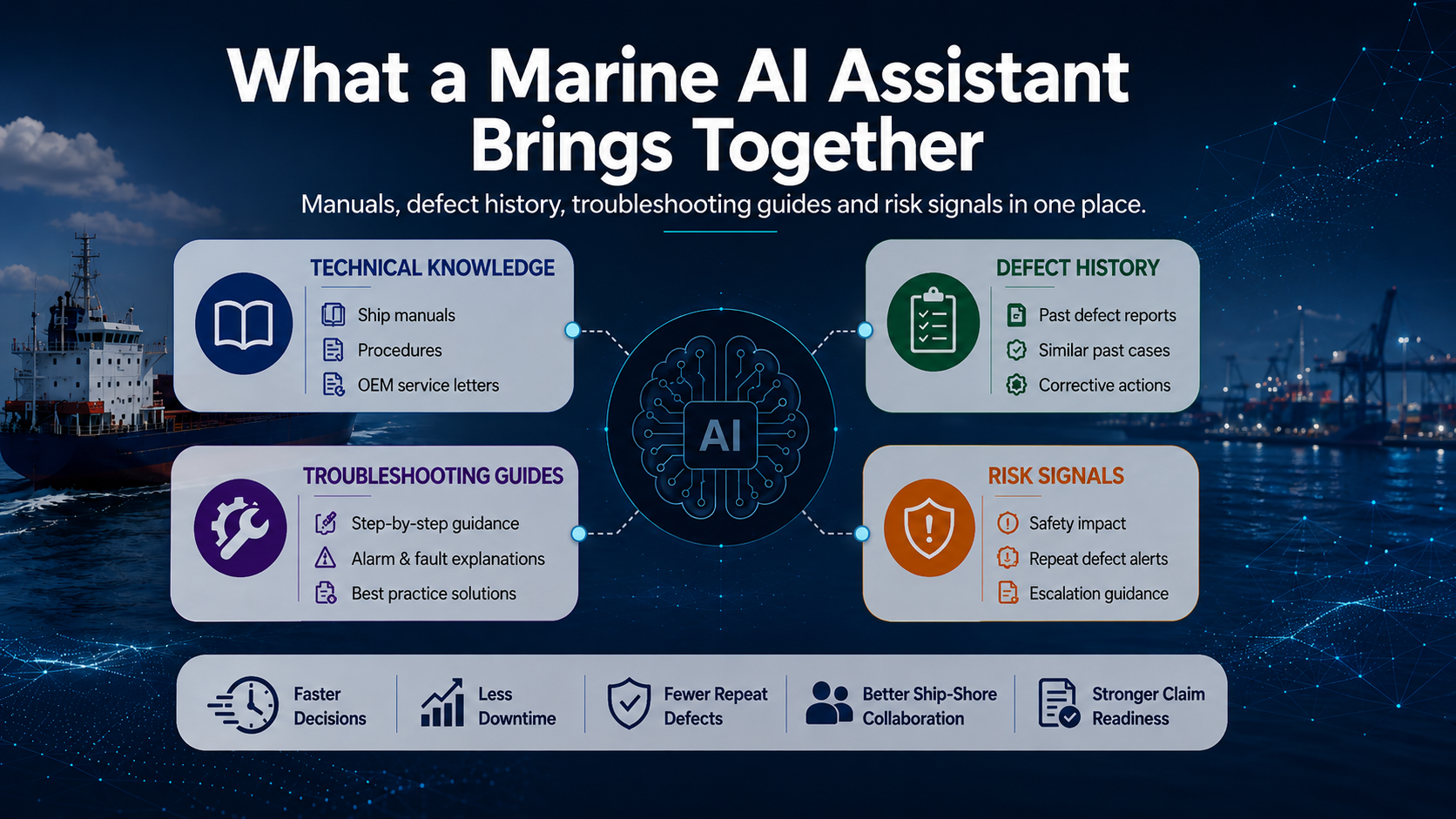
A Maritime AI Assistant helps fleets reduce these delays by connecting technical manuals, defect history, troubleshooting guides, incident records and risk signals into one decision-support layer.
This matters because machinery damage/failure remains one of shipping’s biggest operational risks. Allianz Commercial’s Safety and Shipping Review 2025 reported that machinery damage/failure accounted for 1,860 shipping incidents globally in 2024, more than half of all reported incidents.
Source: Allianz Commercial, Safety and Shipping Review 2025
A small technical defect can quickly become a bigger operational problem.
A repeated alarm may delay departure.
A temporary repair may hide a deeper root cause.
A missed pattern may cause the same failure across sister vessels.
Poor documentation may weaken follow-up after a serious incident.
That is why downtime, defect management and insurance claim risk are connected.
UNCTAD’s Review of Maritime Transport 2025 notes that shipping carries over 80% of world trade and is facing rising cost pressure, uncertainty and operational disruption. In this environment, fleets need faster and more reliable technical decision-making.
Source: UNCTAD, Review of Maritime Transport 2025
.
Most claim-risk events do not begin as claims.
They begin as small operational signals.
A Marine AI Assistant helps break this chain earlier by giving crew and shore teams faster access to the right information.
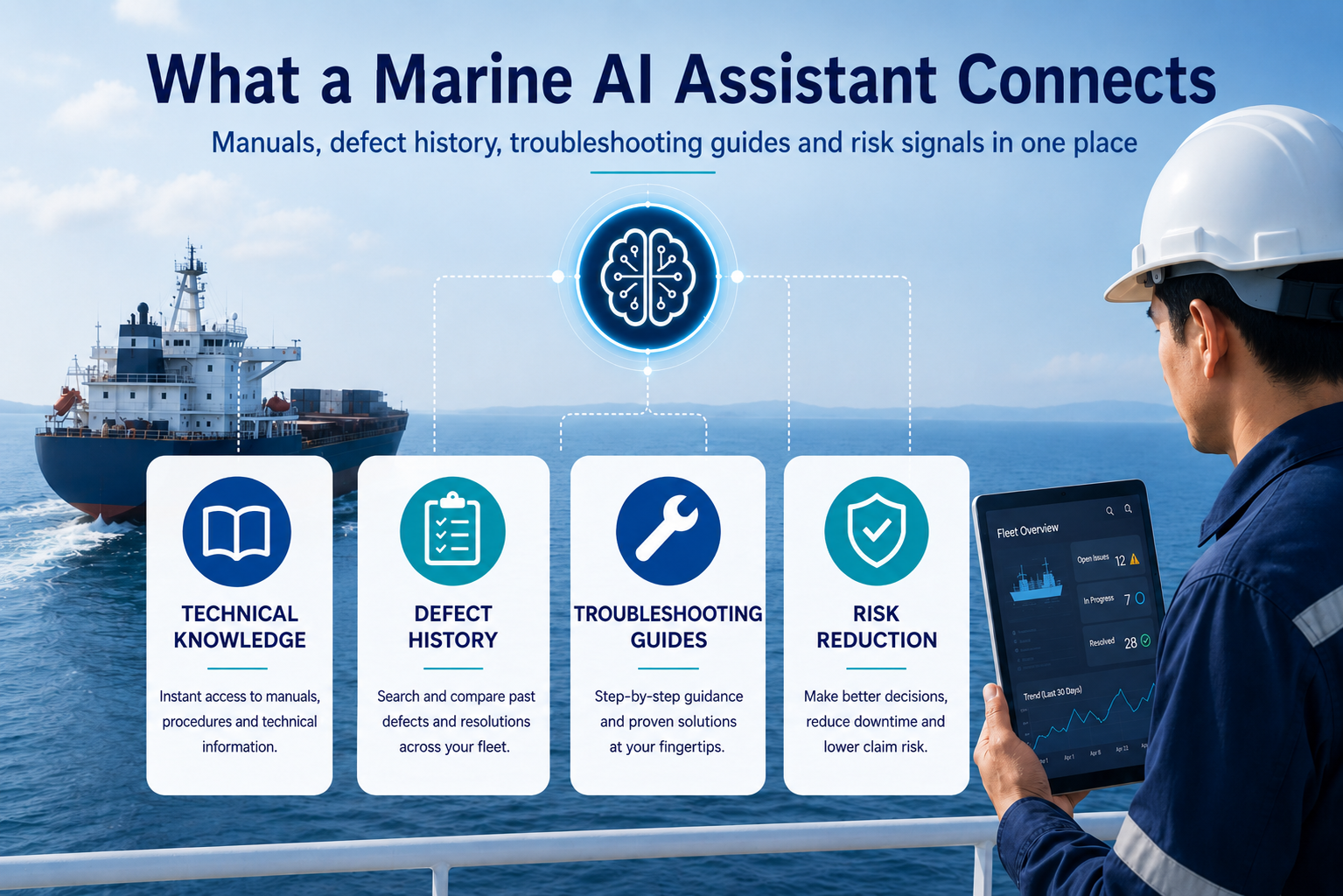
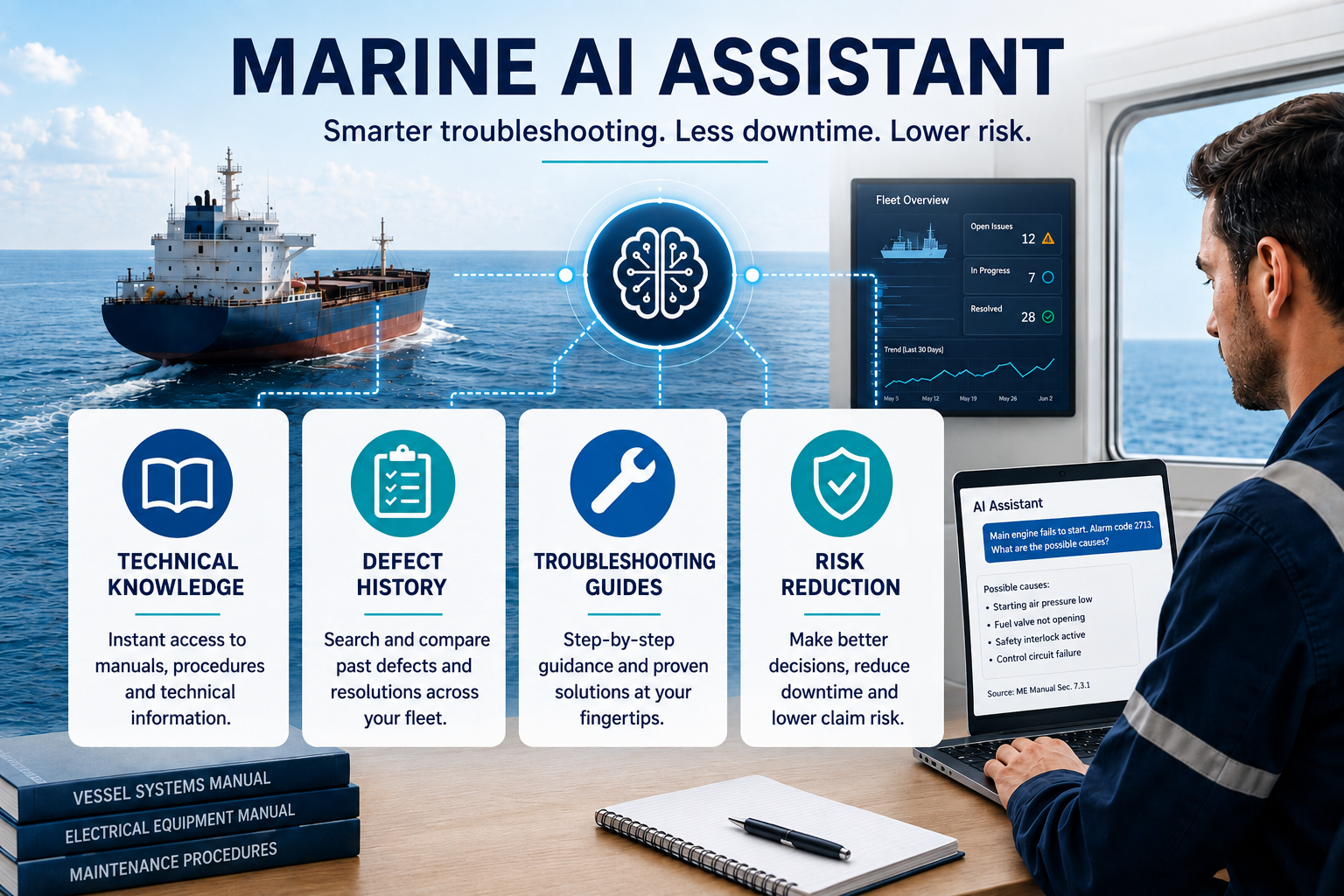
A Marine AI Assistant is not just a chatbot. It is a maritime decision-support tool that connects vessel-specific knowledge.
It can bring together:
This helps crew and shore teams ask better questions:
“What caused this alarm before?”
“What manual section applies?”
“Did a sister vessel face the same issue?”
“What evidence should we capture?”
“Is this a repeat defect or a new failure pattern?”
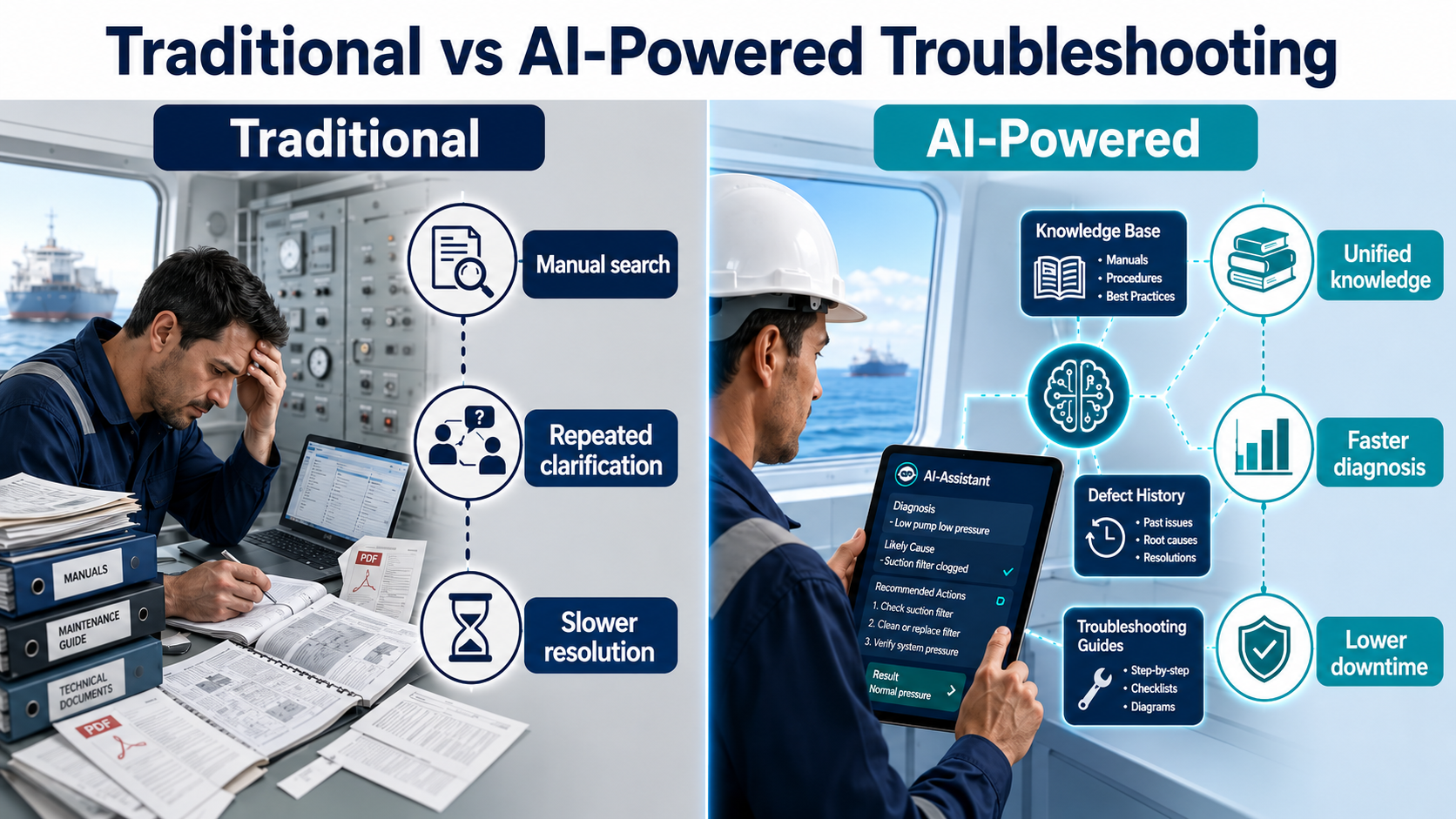
Traditional troubleshooting is often slow because information is scattered across PDFs, emails, PMS records, defect logs and personal experience.
A Marine AI Assistant improves this workflow.
DNV highlights that maritime digitalization allows data streams and information sources to support decision-making, monitoring, control and verification. A Marine AI Assistant applies this idea directly to daily troubleshooting.
Source: DNV, Digitalization in the Maritime Industry
A Marine AI Assistant reduces downtime by shortening the time between problem identification and the right technical action.
It helps by:
For example, if a vessel reports a main engine start failure, the assistant can quickly retrieve relevant manual sections, previous similar cases, possible checks, alarm logic and escalation guidance.
The crew still makes the decision.
But the time lost searching is reduced.
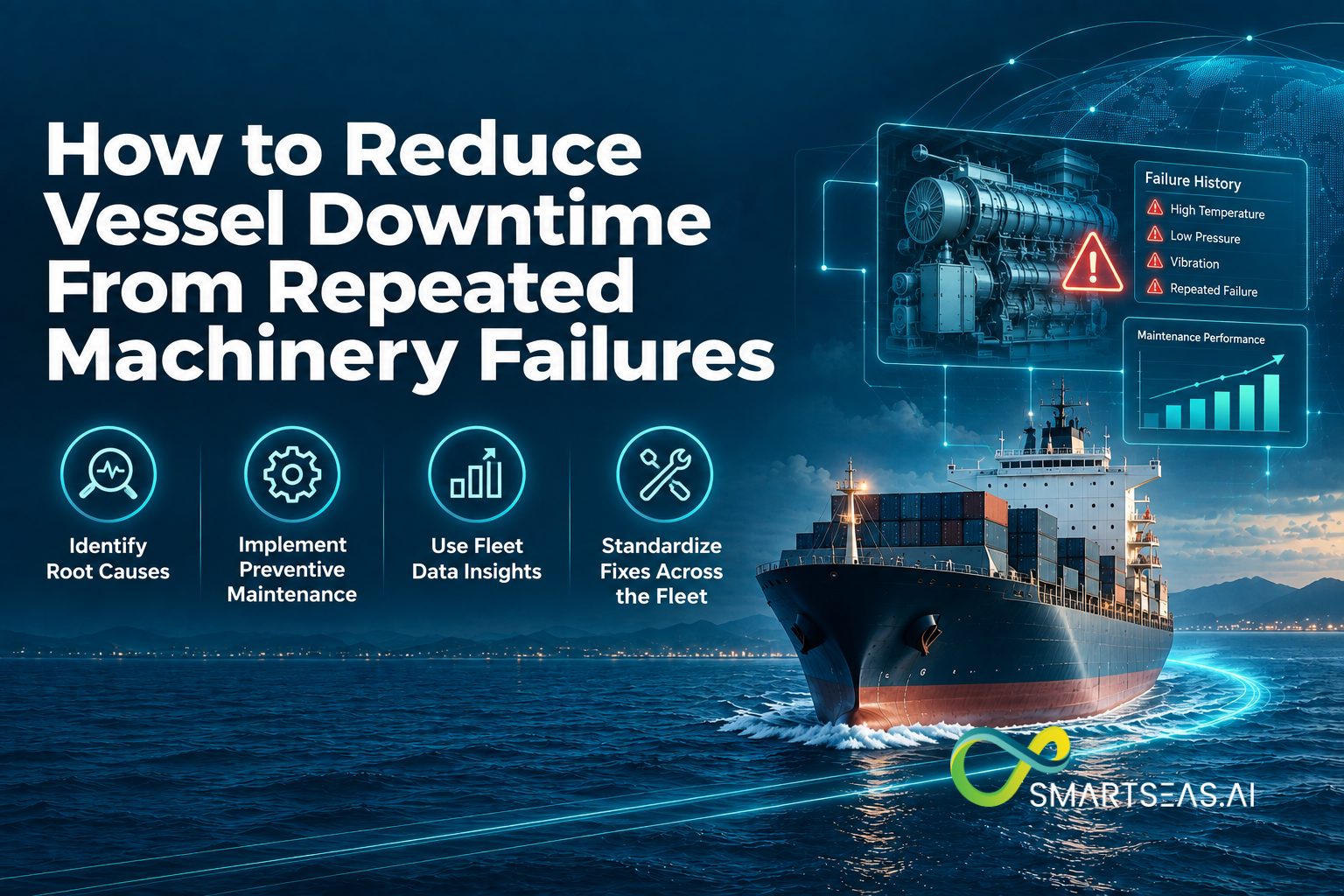
Many fleets already record defects.
But recording defects is not the same as learning from them.
A Marine AI Assistant helps convert defect logs into defect intelligence by connecting:
This helps technical teams identify repeated failures and strengthen corrective and preventive actions.
The IMO’s ISM Code provides the international standard for safe ship management and operation. Better defect intelligence supports that wider goal by improving maintenance discipline, reporting and follow-up.
Source: IMO, ISM Code overview
A Marine AI Assistant does not directly guarantee lower insurance premiums.
But it can reduce behaviours that increase claim risk.
It supports claim-risk reduction by improving:
Cefor’s 2024 hull reporting highlighted machinery claims as an increasing concern, making machinery risk control an important area for ship managers and insurers.
Source: Cefor, 2024 Hull Report
This is where AI can support loss prevention.
When teams respond earlier, document better and learn from repeated failures, they are in a stronger position to manage operational and insurance exposure.
This is where SmartSeas.AI becomes relevant.
SmartSeas.AI is an AI-powered maritime platform that helps fleets improve troubleshooting, operational clarity, ship-to-shore visibility and technical decision-making.
It helps fleet teams unify manuals, defect intelligence and troubleshooting history into one practical AI-powered workflow.
SmartSeas.AI supports:
The goal is not to replace marine engineers or superintendents.
The goal is to empower them with faster access to the right knowledge and clearer operational context.
Marine AI must be used responsibly.
A Marine AI Assistant should not override the chief engineer, bypass company SMS, replace class or flag requirements, or recommend unsupported actions.
It should provide source-backed answers and keep human review in the loop.
DCSA notes that fragmented data, processes and technology continue to affect shipping efficiency and visibility. This is why AI implementation should include data governance, access control, source citations, audit logs and cybersecurity review.
Source: DCSA, Digital Standards and Interoperability
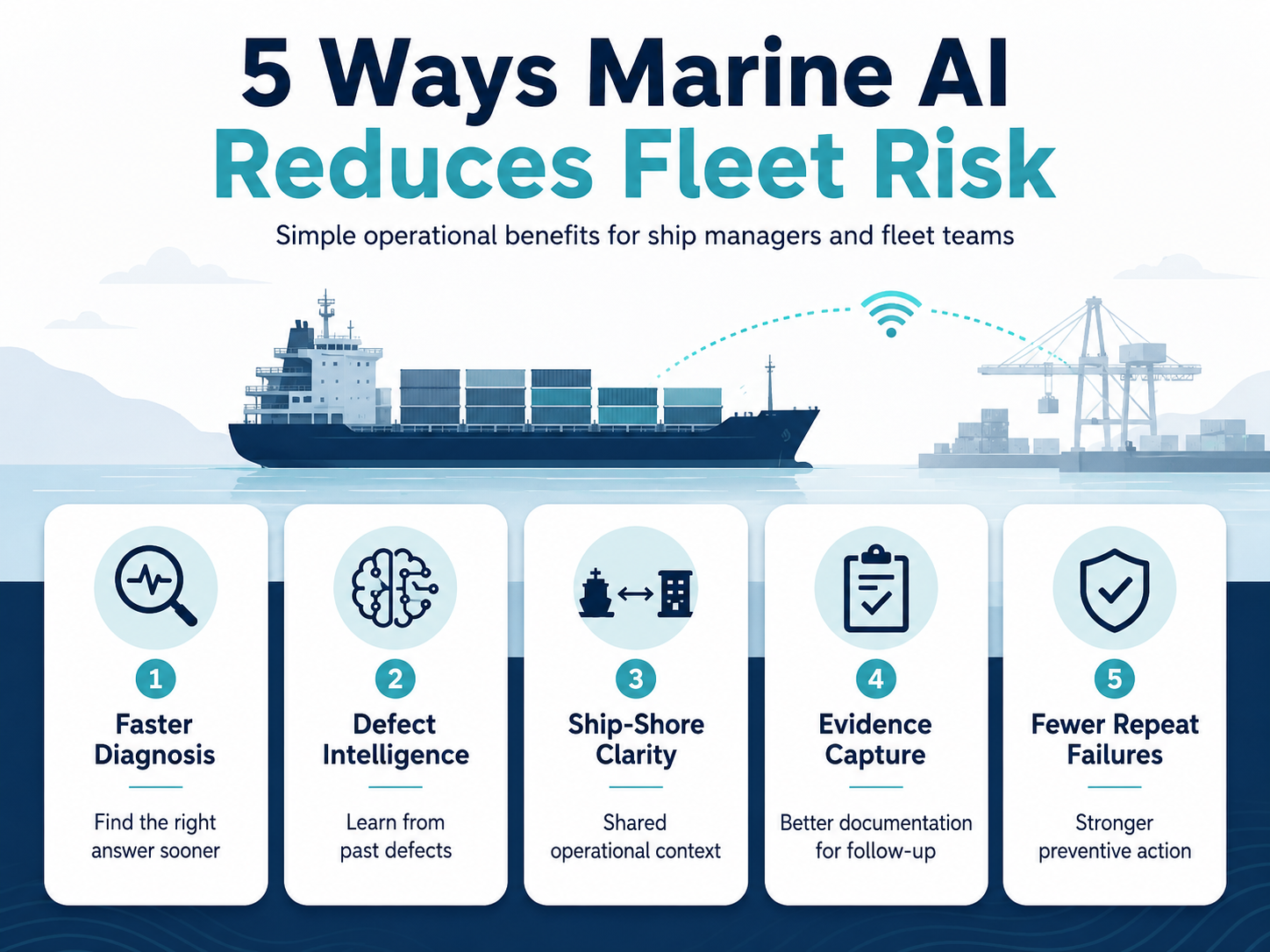
A Marine AI Assistant helps fleets reduce downtime, defects and insurance claim risk by improving how technical knowledge is found, used and shared.
It helps the crew find the right guidance faster.
It helps superintendents compare similar past defects.
It helps teams reduce repeated failures.
It improves ship-to-shore clarity.
It supports better documentation when issues escalate.
For ship managers, the value is not simply using AI.
The value is moving from reactive troubleshooting to connected operational intelligence.
SmartSeas.AI helps fleets make that shift through AI-powered maritime troubleshooting, unified defect intelligence and practical ship-to-shore decision support.
Want to see how SmartSeas.AI helps fleets reduce downtime, improve troubleshooting and strengthen operational visibility?
Book a demo with SmartSeas.AI.
A Marine AI Assistant is an AI-powered decision-support tool that helps crew and shore teams search manuals, defect history, incident reports and troubleshooting guides to resolve vessel issues faster.
It reduces downtime by finding relevant technical information faster, comparing similar past cases and reducing repeated ship-shore clarification.
Yes. It can help identify recurring patterns, compare similar failures and support stronger corrective and preventive actions.
It improves early response, documentation, evidence capture, defect traceability and loss-prevention discipline.
No. Predictive maintenance focuses mainly on sensor trends and failure prediction. A Marine AI Assistant focuses on troubleshooting, manuals, defect intelligence and operational decision support.
Crew should trust AI only when recommendations are source-backed, vessel-specific and aligned with approved manuals, SMS procedures and superintendent review.

Get Started Today
Transform the way you troubleshoot and manage maritime operations. Join the next wave of Maritime Digital Transformation with SmartSeas AI.




.svg)