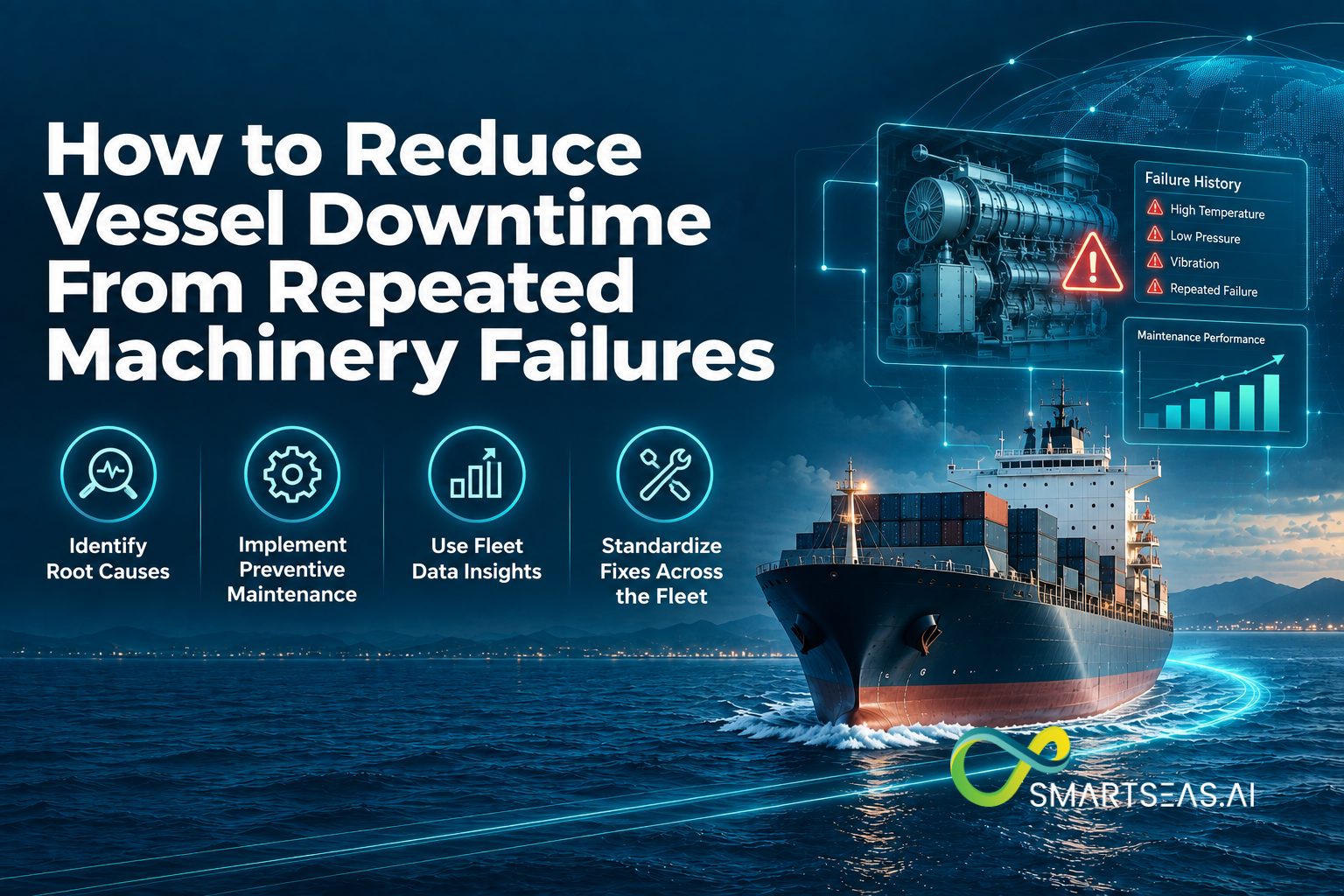
.jpg)


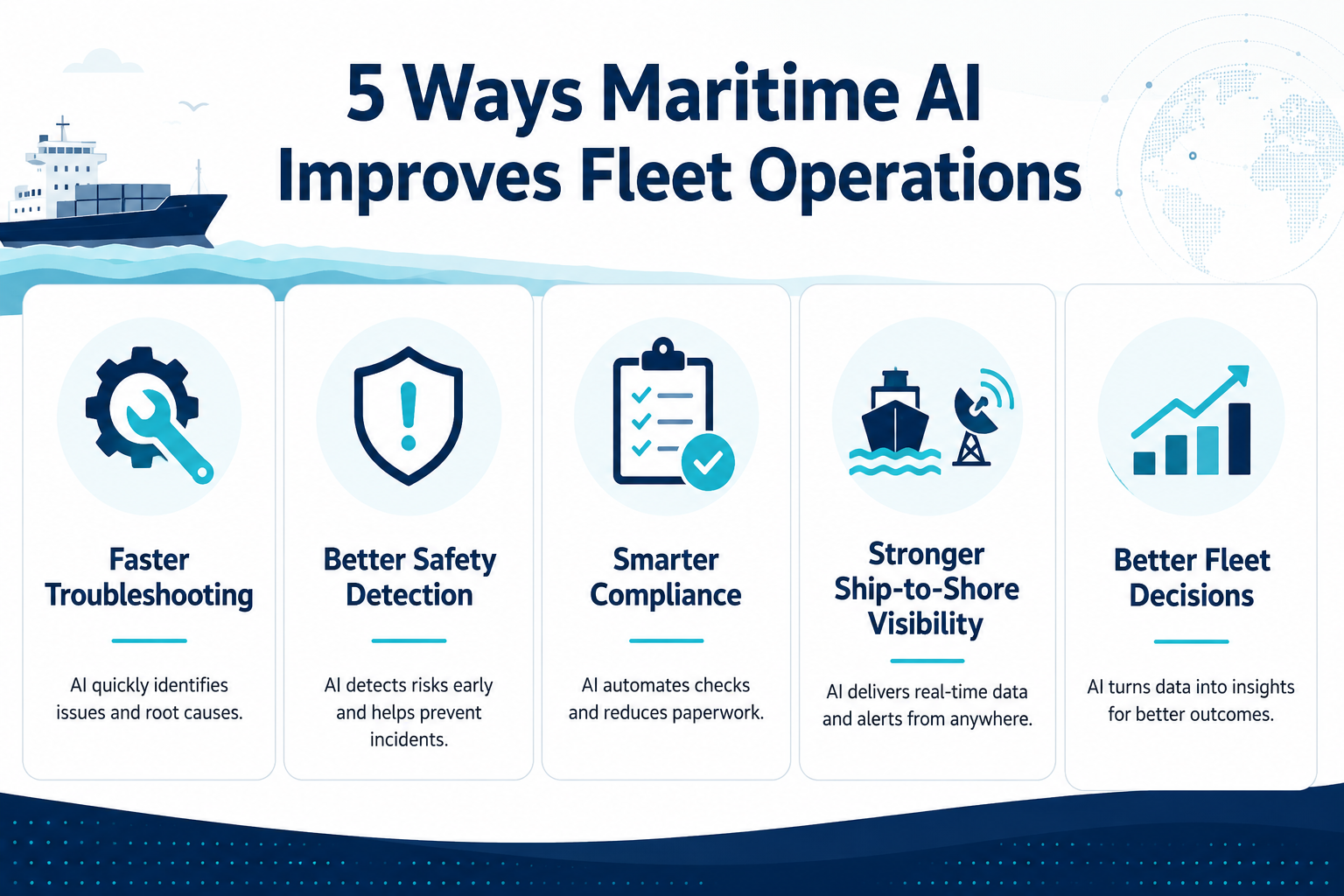
Maritime AI technology is changing how shipping companies manage vessels, troubleshoot equipment issues, improve safety, and make faster decisions across fleets.
Modern shipping is becoming too complex for scattered manuals, reports, emails, and slow manual searches. Fleet teams now need faster access to the right information at the right time.
Shipping carries around 80% of international trade in goods by volume, so even small delays can affect vessel schedules, operating costs, and supply chains.
Source: UNCTAD Review of Maritime Transport.
This is why maritime AI is becoming important. It helps convert scattered maritime data into useful decision support.
The maritime industry is under pressure from several directions.
Global shipping is facing fragile growth, route disruption, rising costs, and uncertainty. UNCTAD reported that maritime trade grew by 2.2% in 2024 but was expected to slow to only 0.5% in 2025.
Source: UNCTAD Review of Maritime Transport 2025.
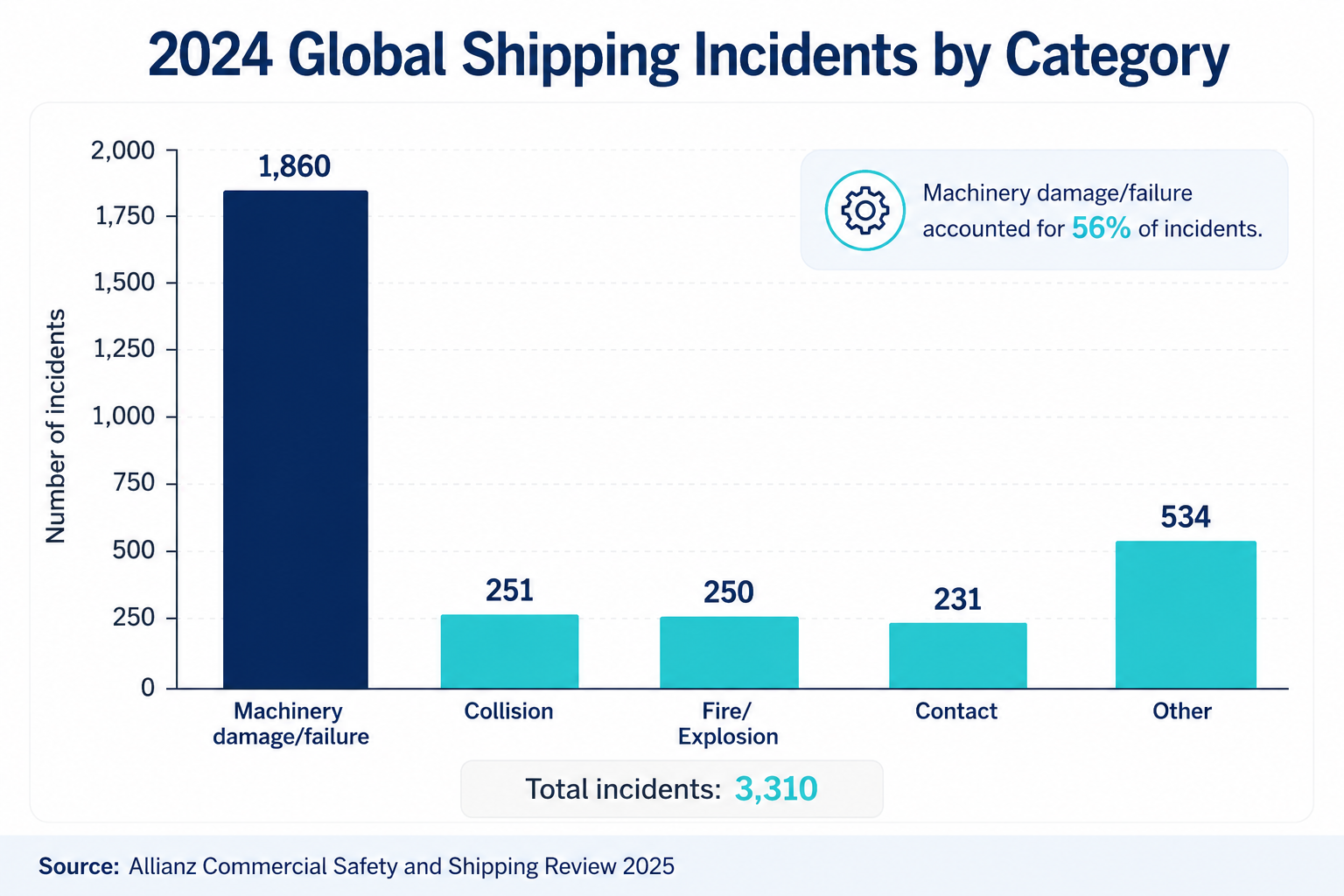
At the same time, safety and machinery risks remain a major concern. Allianz Commercial reported 3,310 shipping incidents globally in 2024. Machinery damage or failure accounted for 1,860 incidents, and fire incidents reached 250, the highest total for a decade.
Source: Allianz Commercial Safety and Shipping Review 2025.
These numbers show one clear point: shipping does not only need more data. It needs faster and clearer ways to use the data it already has.
That is where AI-powered maritime systems can help.
Most shipping companies already have huge amounts of useful information.
The problem is that this information is often scattered across different places.
A vessel team may need to check:
When a machinery alarm happens at sea, the crew may not have time to search through all these sources manually.
The right information may exist, but it may not be easy to find at the right moment.
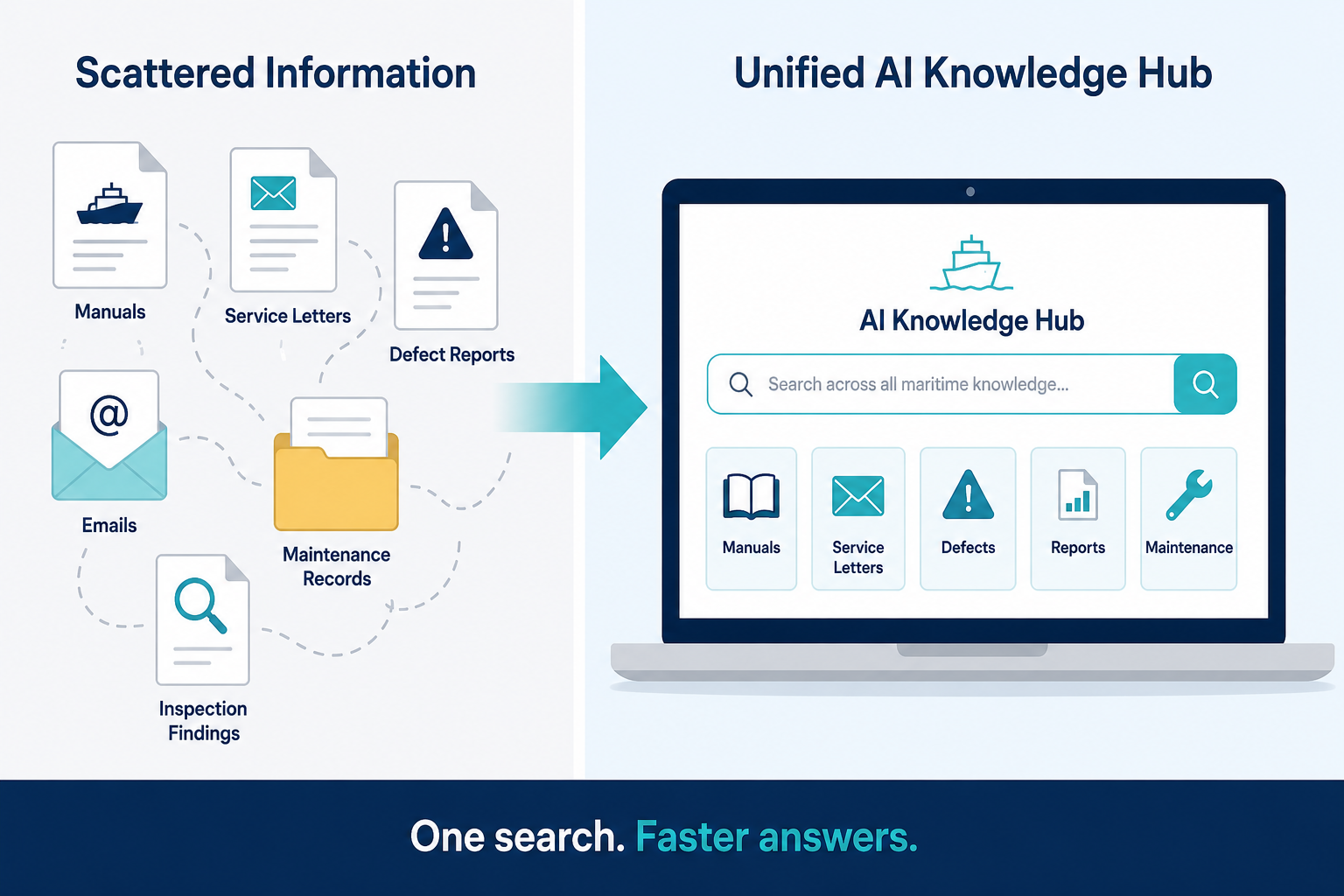
Traditional digital systems help companies store information.
But storage alone is not enough.
A manual may be available in a document folder. A previous defect may be recorded in a report. A maker service letter may be saved in an email attachment. But during a live issue, teams need the exact relevant answer quickly.
Maritime AI technology helps connect these sources.
It can search across manuals, reports, defect history, service letters, and operational records. It can identify relevant procedures, similar past cases, and possible next steps.
This moves maritime teams from document search to decision support.
One of the most practical uses of maritime AI is technical troubleshooting.
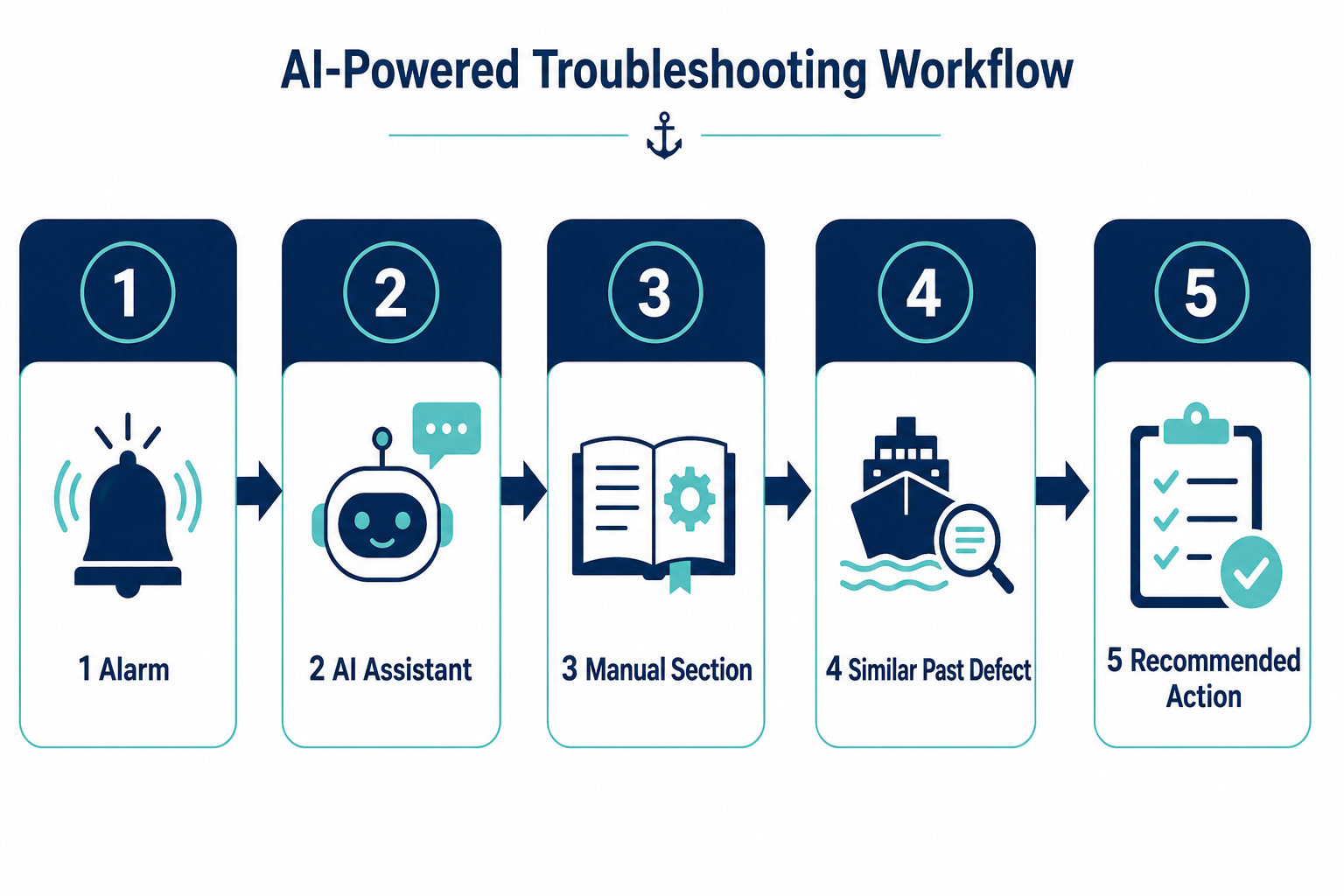
When a vessel has a machinery issue, crews often need to search manuals, service letters, defect reports, and past cases before taking the right action.
This takes time, especially when information is scattered across different systems.
AI troubleshooting in maritime can reduce this delay by finding the relevant manual section, similar past defect, and useful technical context faster.
This is where SmartSeas.AI becomes relevant.
SmartSeas.AI helps vessel and shore teams access manuals, service letters, reports, and defect histories in one place. This supports faster troubleshooting, clearer ship-to-shore coordination, and better decision-making during technical issues.
The goal is not to replace marine engineers.
The goal is to help them find the right information faster and take the first correct action with more confidence.
Every fleet has valuable knowledge hidden inside past defects.
A main engine starting issue on one vessel may be similar to an issue that happened earlier on a sister vessel. A purifier trip may have already been solved by another crew. A steering gear alarm may have a known pattern.
But this knowledge is often buried in old reports and email threads.
Maritime AI can help identify repeated failures, common root causes, and previous corrective actions.
This helps technical teams move from isolated incident handling to fleet-wide learning.
For example, if several vessels show repeated compressor failures, AI can help connect the pattern with maintenance timing, spare quality, operating conditions, or previous corrective actions.
This makes defect history useful, not just archived.
Safety risks often start as small signals.
A repeated alarm. A delayed corrective action. A recurring defect. A similar observation across multiple vessels.
Individually, these may not look serious. But together, they may show a rising risk.
Maritime AI can help detect these patterns earlier by connecting alarms, defects, inspection findings, and past incidents.
The maritime industry is already seeing AI used for safety prevention. In 2025, the World Shipping Council launched a Cargo Safety Program using AI-powered screening to identify cargo risks. At launch, carriers representing more than 70% of global TEU capacity had joined the program.
Source: World Shipping Council Cargo Safety Program.
This shows that AI is not only useful for efficiency. It can also support risk prevention.
For vessel operations, similar logic can apply to machinery faults, fire risks, repeated deficiencies, and operational weak signals.
Ship-to-shore coordination is one of the biggest challenges in technical operations.
The vessel team knows the immediate condition onboard. The shore team may know the fleet history, vendor support, spare availability, budget constraints, and upcoming commercial commitments.
But both sides may not always have the same information at the same time.
This creates delays.
Maritime AI technology can help create a shared technical view between vessel and shore teams.
If both teams can access the same manuals, defect history, reports, and technical context, they can make decisions faster.
This is especially useful for fleets with sister vessels. A superintendent can compare similar issues across vessels, while the onboard team can access relevant past cases without waiting for long email exchanges.
Compliance is becoming more digital and evidence-driven.
Port state control, class surveys, SIRE inspections, safety audits, and environmental reporting all depend on accurate records.
The challenge is not only completing the action. The challenge is proving that it was completed properly.
IMO’s Maritime Single Window became mandatory from 1 January 2024. IMO Member States are required to use a centralized digital platform to collect and exchange information with ships during port calls.
Source: IMO Maritime Single Window.
This shows the direction of the industry. Maritime data must be structured, searchable, and reusable.
AI can support compliance by helping teams find missing records, link corrective actions to defects, organize inspection evidence, and identify repeated observations.
For example, if a vessel has repeated deficiencies related to emergency equipment, fire safety, or machinery records, AI can help highlight the pattern earlier.
This improves readiness before inspections and audits.
Fuel efficiency is no longer only a cost issue.
It is now linked to emissions, CII performance, charter expectations, and long-term decarbonization.
IMO’s 2023 GHG Strategy aims for international shipping to reach net-zero GHG emissions by or around 2050. It also includes checkpoints for 2030 and 2040 and emphasizes the need for low- and zero-carbon fuels and improved efficiency.
Source: IMO 2023 GHG Strategy.
Maritime AI can support fuel and voyage decisions by analyzing weather, route performance, speed, trim, engine behavior, hull condition, and historical consumption.
But AI should not be treated as an autopilot.
Weather, safety, charter party terms, port congestion, cargo requirements, and machinery conditions still require human judgment.
The best use of AI is to give fleet teams better options, better visibility, and better decision context.
Predictive maintenance is one of the most discussed areas of maritime AI.
The goal is to detect early warning signs before equipment fails.
AI can analyze signals such as temperature, pressure, vibration, running hours, alarms, maintenance records, and defect history.
But predictive maintenance only works when the data is reliable.
If reports are incomplete or inconsistent, AI outputs may be weak.
That is why maritime AI adoption should begin with data unification.
A practical starting point is repeated technical issues such as:
Once the data is structured around equipment, system, and problem type, AI can help detect useful patterns.
Crew experience is one of the most valuable assets in shipping.
But crew members rotate. Superintendents change. Lessons learned during one incident may not reach the next vessel.
This creates knowledge loss.
A Marine AI Assistant can help preserve vessel-specific experience by capturing troubleshooting steps, root causes, corrective actions, and lessons learned.
This is especially helpful for newly joined engineers.
Instead of relying only on handover notes, they can search previous similar cases and vessel-specific history.
AI does not replace training. It supports training with real operational knowledge.
Over time, the fleet becomes smarter because experience is not lost when people move.
Ports are also becoming more digital.
The IMO Maritime Single Window requirement supports electronic exchange of information during port calls. The goal is to reduce duplication and improve arrival, stay, and departure clearance processes.
Source: IMO Maritime Single Window.
AI can help shipping companies prepare for this environment.
It can support document checking, missing data identification, port call preparation, and operational record retrieval.
In the future, AI may also help predict port delays, optimize arrival planning, and improve coordination between vessel, agent, terminal, and shore office.
This matters because port delays affect fuel consumption, emissions, crew workload, and commercial performance.
As ships become more connected, cyber risk becomes more important.
IMO Resolution MSC.428(98) encourages cyber risks to be addressed in safety management systems under the ISM Code.
Source: IMO Maritime Cyber Risk Management.
IACS has also introduced UR E26 and UR E27 for cyber resilience of ships and onboard systems and equipment. These requirements apply to new ships and connected onboard systems under the IACS framework.
Source: IACS UR E26 and UR E27.
This is important for maritime AI.
AI systems may connect manuals, vessel records, reports, operational data, and communication workflows. These systems must be secure and properly governed.
Responsible maritime AI should include:
AI should support decisions, not make safety-critical decisions without human oversight.
Maritime AI adoption should not start with a large, complicated project.
It should start with one clear operational problem.
Choose a problem that creates real operational pain.
Examples include machinery troubleshooting, repeated defects, inspection preparation, or ship-to-shore communication delays.
AI needs reliable information.
Start by connecting manuals, defect reports, service letters, maintenance history, and vessel-specific records.
Crew should not need a complicated system during a live issue.
The AI interface must be fast, clear, and easy to use.
Marine engineers, superintendents, and fleet managers should review AI outputs.
Their feedback is essential for practical accuracy.
Track improvements such as faster information retrieval, fewer repeated searches, better documentation quality, and improved coordination.
Start with one vessel, system, or vessel series.
Then expand to more vessels once the workflow proves useful.
The future of maritime AI will be vessel-specific, connected, and practical.
Generic AI will not be enough for shipping.
The real value will come from AI systems that understand each vessel’s manuals, equipment, defects, history, procedures, and operating context.
DNV’s Maritime Forecast to 2050, 2025 edition focuses on how shipping will navigate the next phase of its decarbonization journey. This reinforces the need for better data, smarter operational decisions, and more efficient fleet management.
Source: DNV Maritime Forecast to 2050, 2025 edition.
Future maritime AI will likely support:
The fleets that benefit most will be those that connect AI with real operational workflows.
Maritime AI technology is helping shipping companies turn scattered data into faster and clearer decisions.
By connecting manuals, service letters, defect history, reports, and vessel-specific knowledge, AI can support faster troubleshooting, better ship-to-shore visibility, stronger compliance readiness, and improved fleet learning.
SmartSeas.AI supports this shift by helping maritime teams access the right technical information faster and use it for practical decision-making across ships and fleets.
The future of shipping will still depend on human expertise. Maritime AI makes that expertise easier to find, share, and apply when it matters most.
Maritime AI technology is the use of artificial intelligence to support shipping operations, vessel management, troubleshooting, safety, compliance, maintenance, and fleet decision-making.
It helps crews and shore teams find the right technical information faster. AI can search manuals, service letters, defect reports, and past cases together, reducing time lost in manual searching.
No. AI should support marine engineers, not replace them. Safety-critical decisions must remain under human control.
AI troubleshooting in maritime uses artificial intelligence to help diagnose vessel equipment issues by connecting alarms, manuals, defect history, and recommended checks.
AI needs accurate and structured data. If manuals are outdated or defect reports are incomplete, AI outputs may be less reliable.
SmartSeas.AI helps fleets unify access to manuals, service letters, reports, defect histories, and technical data so vessel and shore teams can troubleshoot faster and make clearer decisions.
Yes. Maritime AI can help organize inspection evidence, find missing records, connect corrective actions to defects, and identify repeated observations.
The future will focus on vessel-specific AI assistants, predictive maintenance, fleet-wide technical intelligence, safer operations, and better ship-to-shore visibility.

Get Started Today
Transform the way you troubleshoot and manage maritime operations. Join the next wave of Maritime Digital Transformation with SmartSeas AI.




.svg)