.jpg)
August 11, 2026
What Is Ship Predictive Maintenance? Key Benefits and Implementation Strategies

August 11, 2026
Machinery rarely fails without warning. Rising vibration, changing temperatures, unstable pressure or repeated alarms can signal developing problems, but this information is often scattered across vessel systems, logs and maintenance records.
Ship predictive maintenance connects these signals with equipment history and operating context to help fleets identify deterioration earlier and plan maintenance before it leads to breakdowns or delays.
It is not simply about predicting when a component will fail. Effective predictive maintenance combines reliable data, technical guidance and engineering judgement.
This article explains how ship predictive maintenance works, its key benefits and practical implementation strategies for fleet operators.
Ship predictive maintenance uses real-time condition data from IoT sensors, together with operating trends and maintenance history, to identify machinery deterioration before failure.
It may analyse:
For example, a single high bearing-temperature reading may not indicate a fault. But rising temperature combined with increasing vibration and previous bearing issues may justify an earlier inspection.
DNV describes condition-based maintenance as a predictive approach that helps identify developing failures so maintenance can be carried out when needed.
Predictive maintenance should therefore complement the vessel’s PMS, OEM guidance, class requirements and engineering judgement—not replace them.
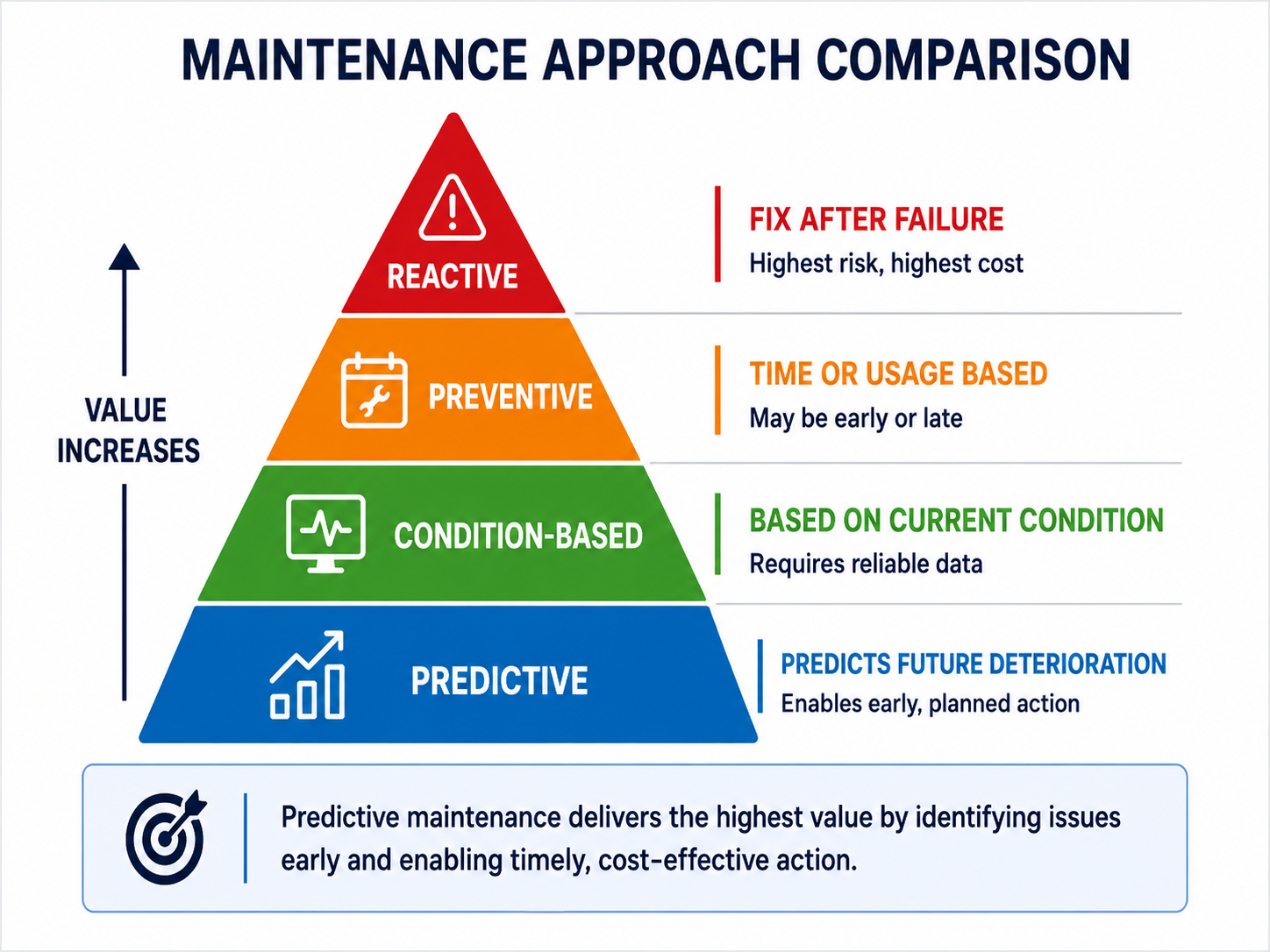
Maritime maintenance strategies differ mainly in what triggers the work.
Machinery failure continues to be one of shipping’s most common operational risks.
The Allianz Commercial Safety and Shipping Review 2026 recorded 2,818 shipping casualties and incidents involving vessels over 100 GT during 2025. Machinery damage or failure accounted for 1,505 incidents, representing 53% of the total.
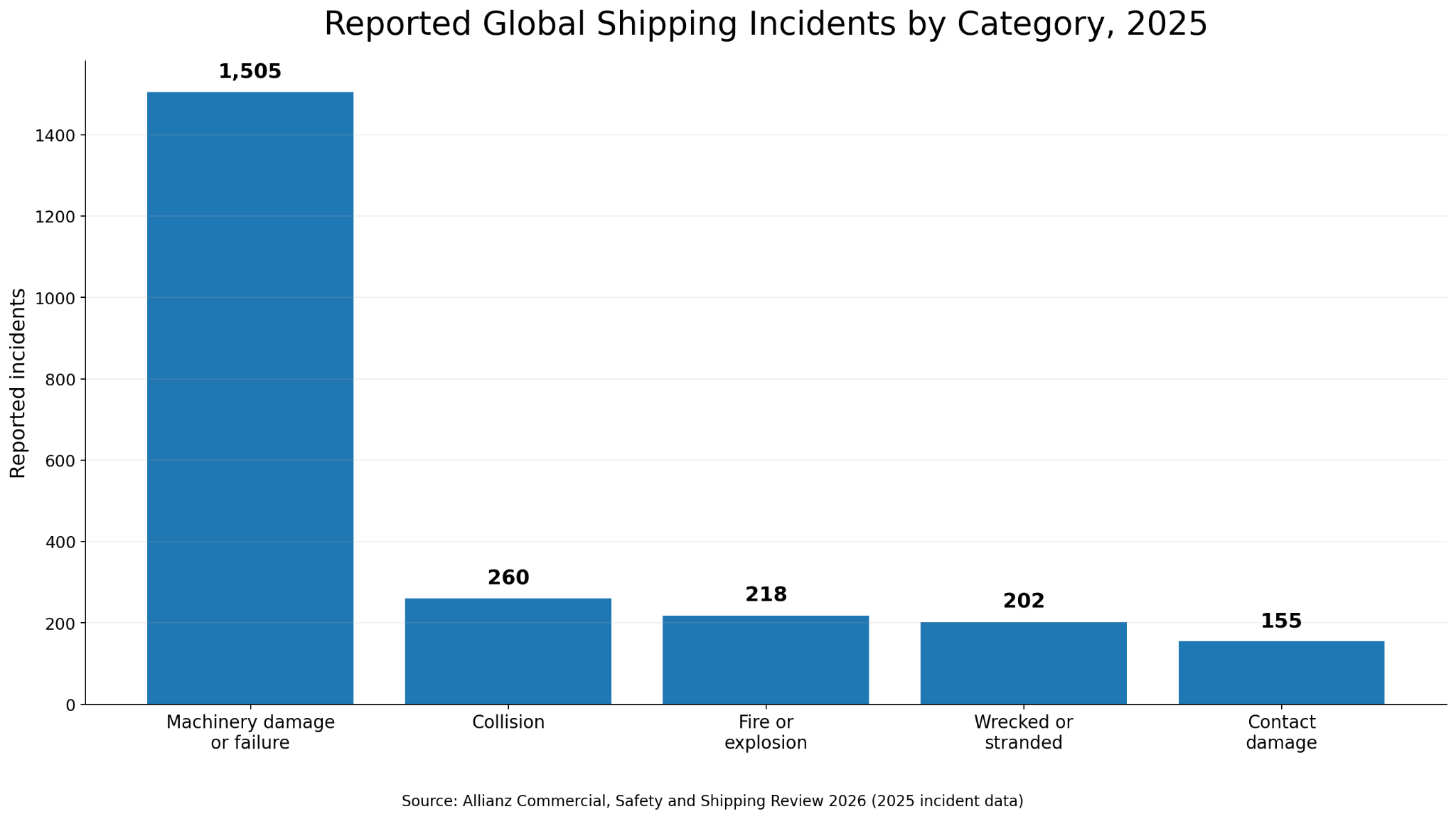
These figures do not mean that every machinery incident could have been predicted. Some failures occur suddenly or involve hidden defects.
They do show why machinery reliability remains a major concern for shipowners, ship managers, technical teams and insurers.
Several operational changes are making ship predictive maintenance increasingly relevant.
Modern vessels increasingly use IoT sensors and condition-monitoring systems to capture vibration, temperature, pressure, load and other machinery parameters in real time.
The challenge is turning these signals into useful maintenance decisions by connecting them with equipment history and operating context.
Fleet teams must coordinate repairs around voyages, cargo operations, port stays, service engineers, spare availability and dry-docking schedules.
Earlier warning gives the shore team more time to:
Condition data may be stored in one platform, PMS history in another and previous defect investigations in emails or PDFs.
A predictive alert may show that something is changing, but engineers still need technical context before deciding what to do.
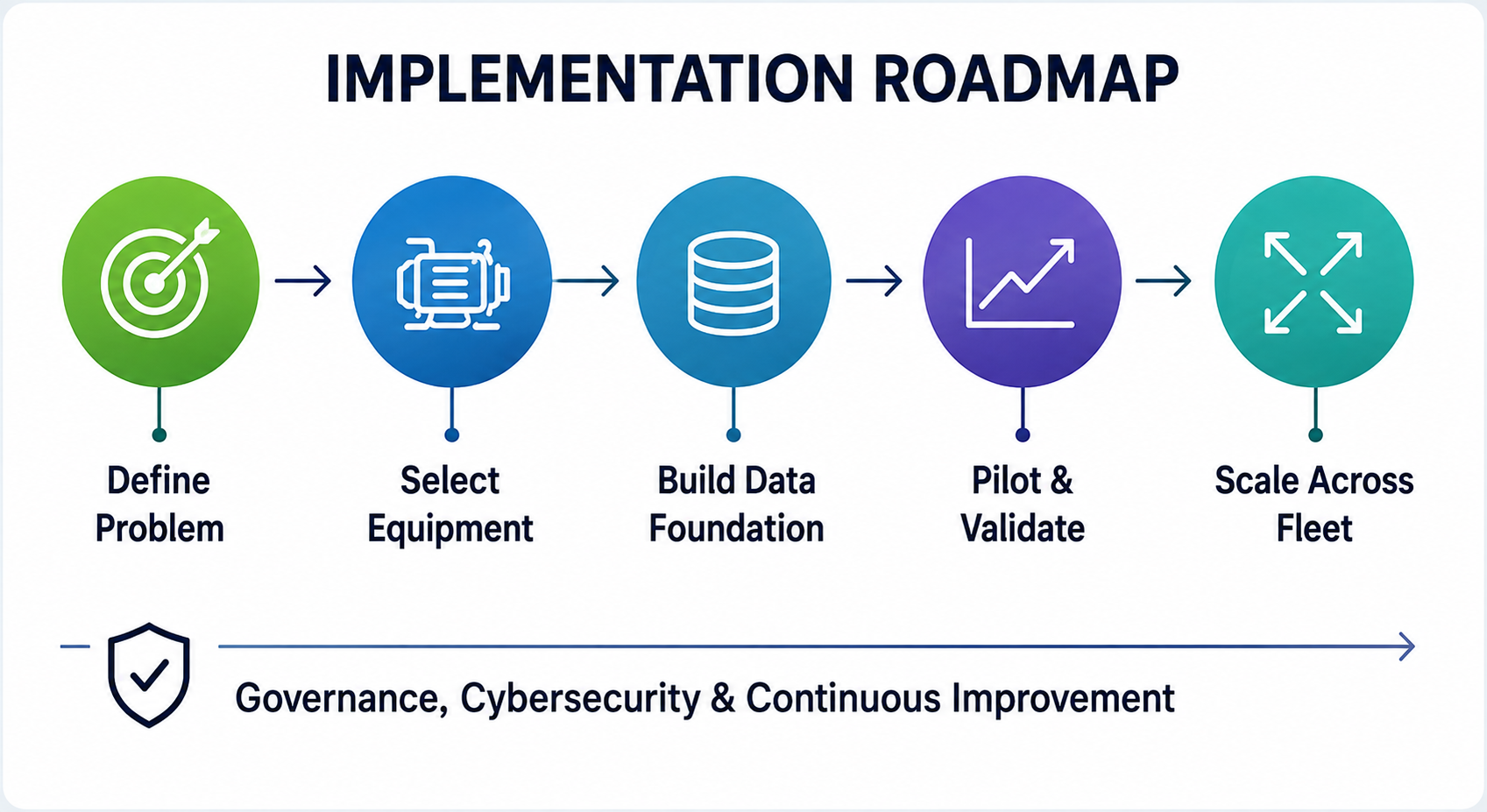
A practical predictive maintenance workflow can be divided into five stages.
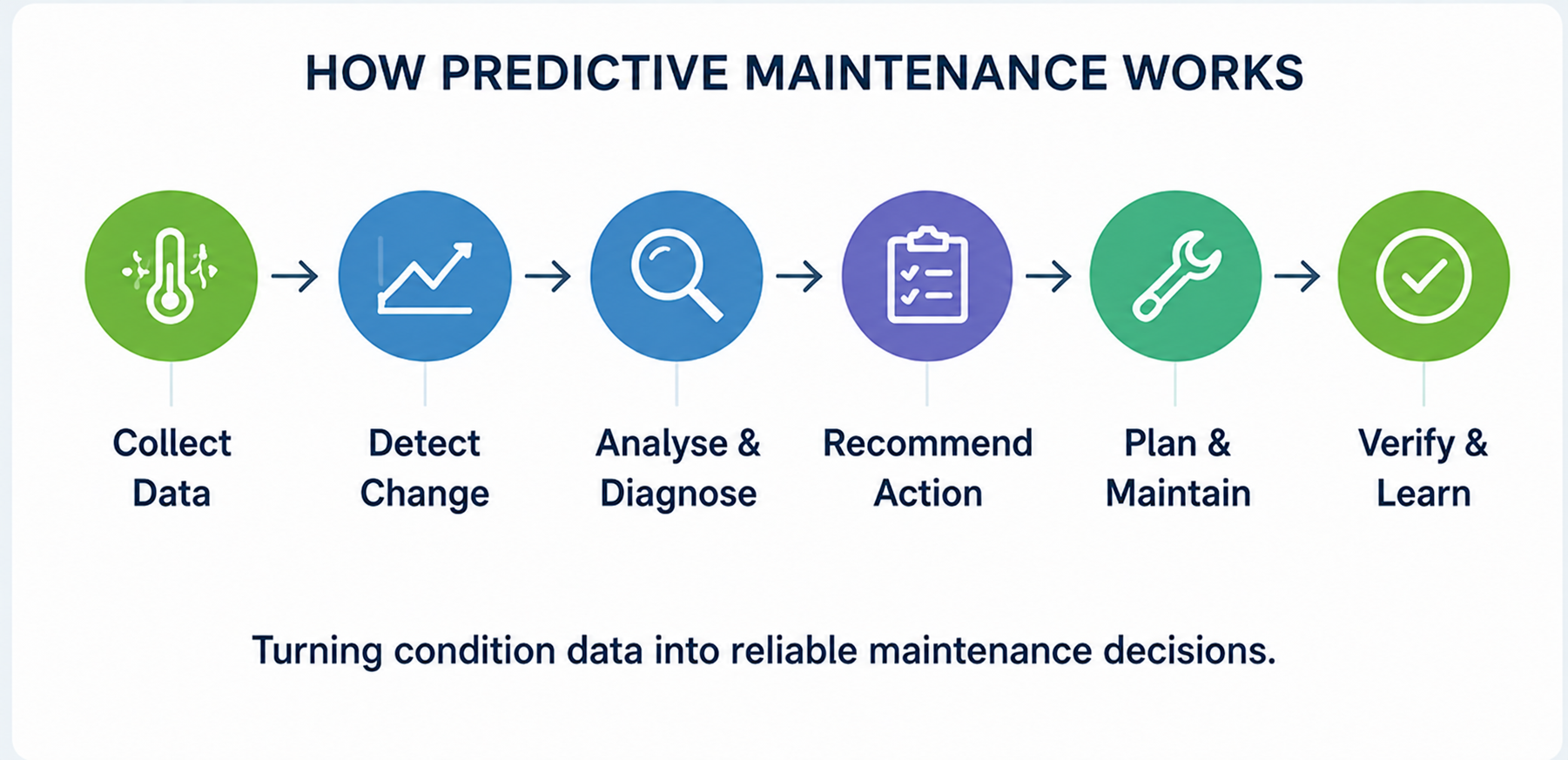
IoT sensors are a primary data source for predictive maintenance, continuously capturing machinery condition alongside logs, inspections and maintenance records.
The value does not come from collecting every available measurement. It comes from collecting reliable information linked to the correct equipment and operating condition.
Raw readings can be misleading without context.
A temperature may be acceptable at one engine load and abnormal at another. Vibration recorded during manoeuvring cannot always be compared directly with vibration during steady sea passage.
The system should understand:
Without this context, even a technically advanced model can produce an unreliable conclusion.
The fleet needs a baseline showing how the equipment performs when operating correctly.
This may be based on:
Simple thresholds may be enough for some equipment. More complex machinery may require models that consider load, speed and ambient conditions.
The analytical system looks for abnormal trends through:
The alert is only the beginning.
The ship and shore team must still determine:
The team may decide to continue monitoring, conduct an inspection, reduce load, repair the equipment or replace a component.
The final record should include:
This information strengthens future troubleshooting and improves the reliability of later predictions.
Predictive analytics can highlight gradual changes that may be difficult to recognise during routine watchkeeping.
A single unusual reading may not be important. A sustained change across several related parameters provides stronger evidence that an equipment condition is developing.
Unexpected failure during cargo operations, manoeuvring or a time-sensitive voyage can create serious operational disruption.
Earlier warning gives the fleet time to prepare spares, service support, risk assessments and a suitable repair window.
Predictive maintenance cannot eliminate downtime, but it can convert some unexpected failures into planned interventions.
Two identical pumps may experience different loads, running hours, fluid conditions and maintenance quality.
Condition information helps the technical team determine whether equipment requires earlier attention or whether a non-critical intervention can wait, subject to OEM and class requirements.
An early indication of deterioration provides more time to:
This is particularly valuable for long-lead or maker-specific components.
A predictive alert supported by trend data provides a better starting point than a short message saying that machinery is “not working properly.”
A useful issue record can include:
The fleet manager can begin assessing the problem instead of repeatedly asking for basic information.
Replacing a failed component may restore operation without correcting the underlying cause.
Repeated bearing damage, for example, may be connected to misalignment, contamination, incorrect lubrication, poor installation or unsuitable replacement parts.
Connecting equipment trends with previous repairs helps reveal these recurring patterns.
A single vessel may not experience enough examples of a particular failure to identify a pattern.
Across a fleet, similar equipment may show common alarm sequences, component life, service recommendations or spare consumption.
This allows technical managers to determine whether a problem is isolated or may also affect sister vessels.
One cylinder’s exhaust temperature gradually moves away from the others at comparable loads.
The technical team reviews:
The system does not automatically diagnose an injector fault. It guides the team towards a focused investigation.
Vibration and bearing temperature increase over several voyages. Maintenance records also show that the bearing was recently replaced.
Instead of replacing it again, the team investigates alignment, lubrication, coupling condition and foundation integrity.
Jacket-water temperature fluctuates only when the generator operates above a particular load.
The team compares cooling-water pressure, thermostatic-valve behaviour, heat-exchanger performance and recent maintenance to determine whether the issue is load-dependent.
Large volumes of sensor data are not useful if equipment names, units and operating states are inconsistent. Signals should be mapped to the correct vessel, system and equipment.
Sensor drift, missing readings and inconsistent sampling can produce unreliable alerts. Data quality should be checked before advanced analytics are introduced.
If every deviation creates an alert, crews may stop trusting the system. Alerts need clear severity levels, persistence rules and ownership.
A warning such as “high probability of pump failure” is not enough. The system should show what changed, what evidence supports the warning and what checks should follow.
Predictive models can miss failures or generate false positives. Their output should always be reviewed alongside maintenance history, OEM guidance and current operating conditions.
Predictive findings should connect with inspections, defects, work planning, spare requisitions and closure. Otherwise, the warning remains separate from the real maintenance workflow.
Start with a specific operational issue such as repeated machinery failures, pump breakdowns, cooling instability or maintenance-related off-hire.
Set a measurable goal, for example detecting deterioration early enough to arrange spares and plan repairs during a suitable port stay.
Focus on machinery with high operational impact, frequent failures, long spare lead times and measurable signs of deterioration.
Typical candidates include pumps, motors, generators, compressors, bearings, turbochargers and purifiers.
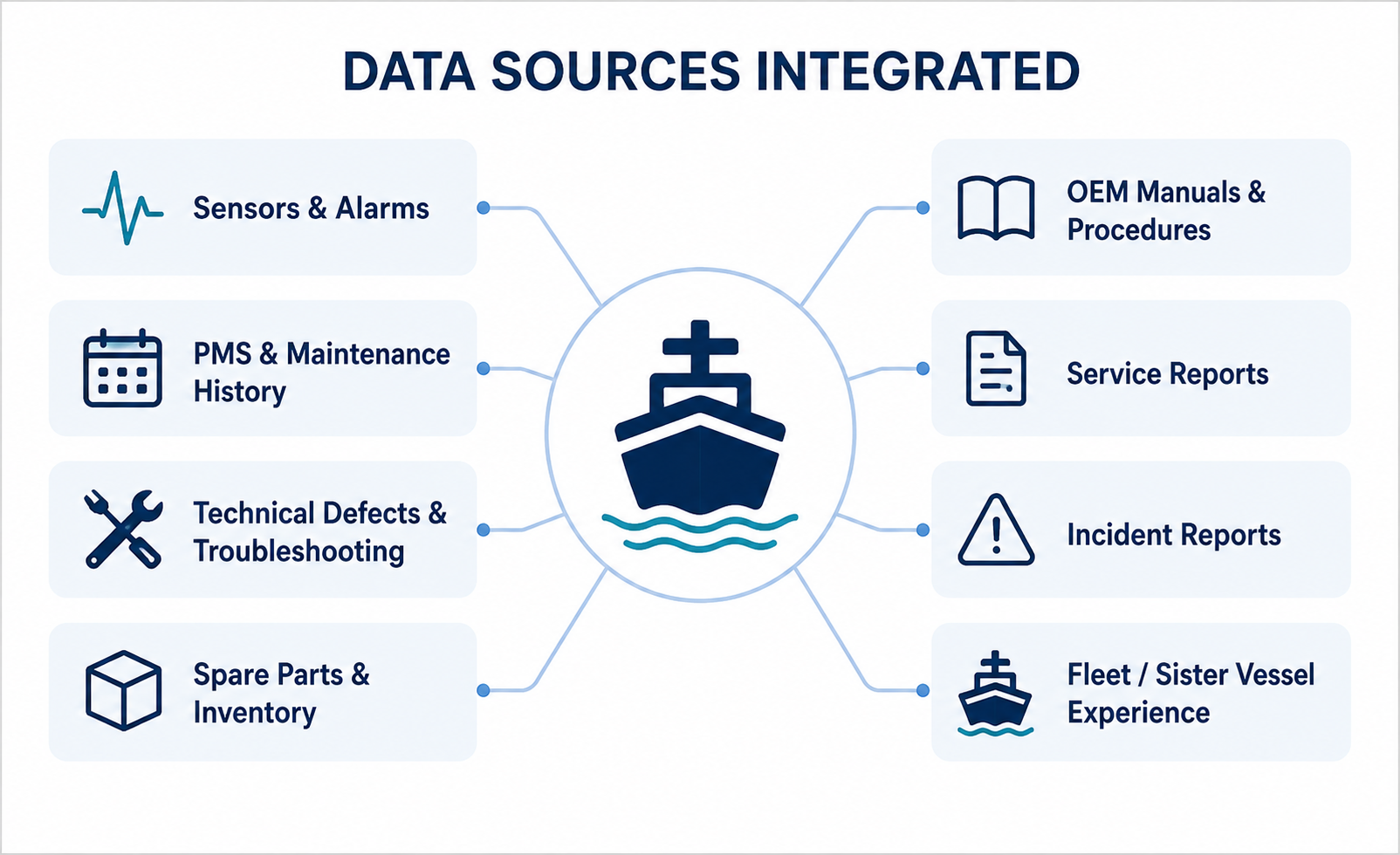
Combine sensor readings with PMS history, defect records, service reports and OEM guidance.
Consistent equipment naming across vessels is essential for accurate fleet comparisons.
Not every use case requires machine learning.
Simple threshold monitoring may detect unsafe readings, trend analysis can identify gradual deterioration, and anomaly detection or predictive models can support more complex cases.
The best method is the simplest one that produces reliable, explainable results.
Every alert should have a clear owner and next action.
Define who validates the warning, what checks the vessel performs, when shore teams or OEMs become involved, and how the final action is recorded.
Start with one equipment category or a group of sister vessels.
Test the full workflow:
Data → Alert → Investigation → Maintenance → Verification → Learning
Measure outcomes such as downtime, warning lead time, false alerts and repeat defects.
Where vessel systems connect with shore or cloud platforms, apply secure access, network controls, backups and manual fallback procedures.
Expand only after the pilot demonstrates value.
Before applying models across the fleet, account for differences in equipment maker, model, age, operating profile and sensor configuration.
IoT sensors and predictive analytics can identify that machinery condition is changing. The next challenge is deciding what action should follow.
This is where SmartSeas.AI supports prescriptive maintenance.
SmartSeas.AI connects predictive warnings with manuals, maintenance history, previous defects, OEM advisories and sister-vessel experience to help technical teams investigate the issue and identify the most relevant next steps.
For example, if IoT data shows rising vibration on a pump, SmartSeas.AI can connect that warning with previous bearing failures, alignment findings and maker guidance to support a more focused technical decision.
In simple terms:
IoT Sensors → Detect Condition → Predictive Analytics → Identify Risk → SmartSeas.AI → Support Action
SmartSeas.AI does not replace condition-monitoring systems, PMS, OEM guidance or engineering judgement. It helps fleets move from prediction to source-backed prescriptive action.
Ship predictive maintenance helps fleets identify machinery deterioration earlier, plan maintenance more effectively and reduce the risk of unexpected downtime.
Its success depends on more than sensors and analytics. Reliable data, clear workflows, engineering judgement and integration with existing maintenance systems are essential.
SmartSeas.AI supports this process by connecting machinery warnings with manuals, defect history, maintenance records and fleet experience, helping ship and shore teams make faster, better-informed technical decisions.
Explore a SmartSeas.AI pilot to see how AI-powered maritime troubleshooting can support faster issue resolution and stronger fleet learning.
Ship predictive maintenance uses equipment-condition data, operating trends and historical records to identify machinery deterioration before failure.
Planned maintenance schedules work according to fixed periods or running hours. Predictive maintenance uses evidence of changing equipment conditions to support maintenance timing.
No. Predictive maintenance normally complements the planned maintenance system, which remains essential for scheduling, documenting and controlling maintenance work.
Suitable equipment may include pumps, motors, generators, compressors, bearings, turbochargers, purifiers and other machinery with measurable signs of deterioration.
No. Thresholds, trend analysis and engineering rules may be enough for many use cases. AI becomes useful when analysing complex patterns across large volumes of data.
Useful information includes vibration, temperature, pressure, oil analysis, alarms, running hours, PMS history, defect reports and crew observations.
The biggest challenge is often creating reliable data, trusted alerts and a clear process for converting warnings into maintenance actions.
SmartSeas.AI connects machinery warnings with manuals, maintenance history, previous defects, procedures and fleet experience to support faster technical investigation.

Get Started Today
Transform the way you troubleshoot and manage maritime operations. Join the next wave of Maritime Digital Transformation with SmartSeas AI.




.svg)


.png)