.jpg)
June 4, 2026
AI and Predictive Analytics: Driving Smarter Decisions in the Shipping Industry


June 4, 2026
Shipping decisions are often delayed not because teams lack information, but because the right information is scattered across manuals, defect reports, emails, PMS records, sensor data, inspection notes, and shore-side conversations.
This is why AI and predictive analytics in shipping are becoming important. Fleet teams no longer need only historical reports. They need faster answers, earlier warnings, and clearer operational context before small issues become costly delays.
The timing matters. UNCTAD’s 2025 maritime report says maritime trade grew 2.2% in 2024 but was expected to slow to 0.5% in 2025, showing how global shipping is operating under more pressure and uncertainty.
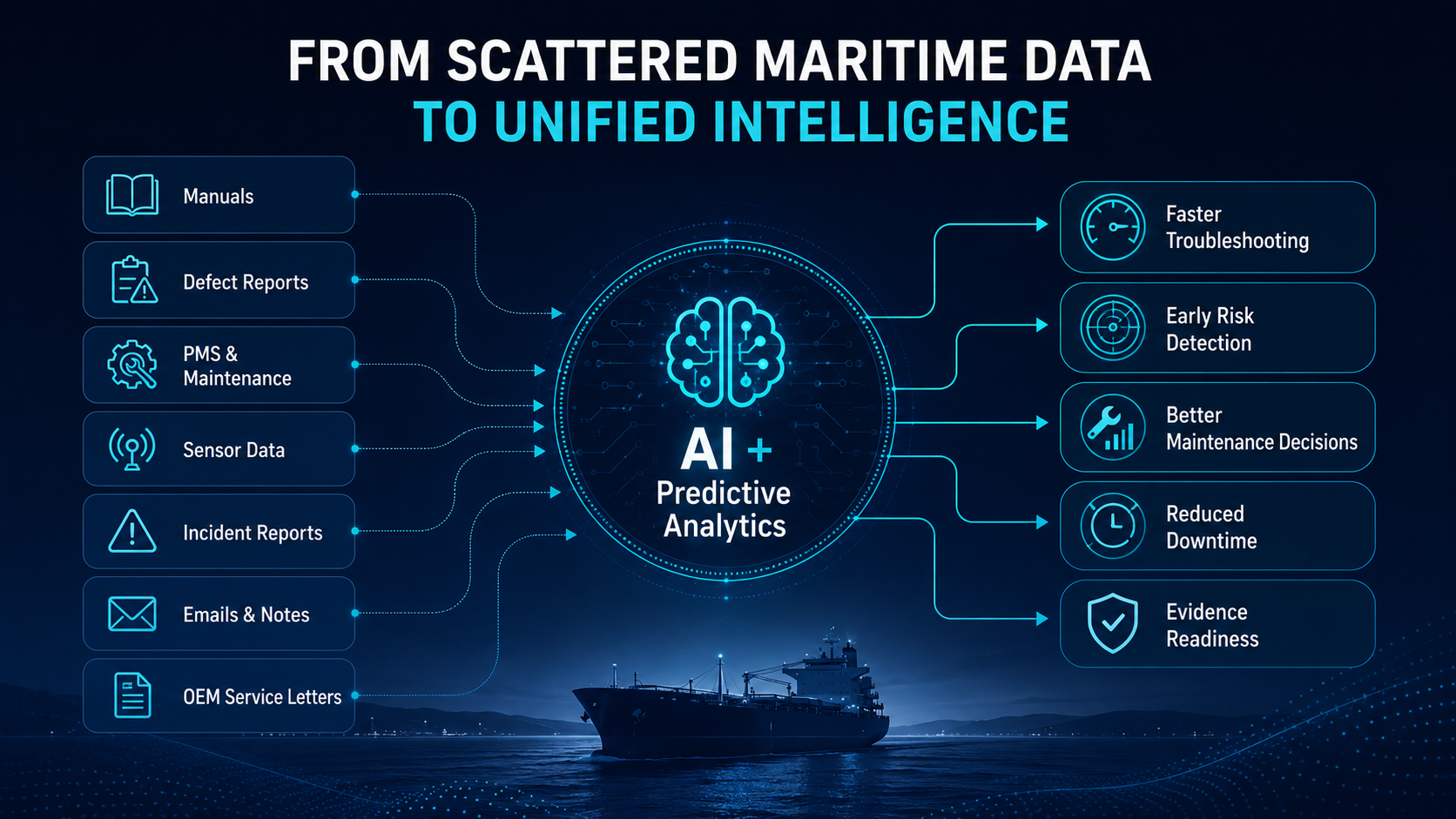
Modern vessels generate more operational data than ever before.
A single vessel may produce information from:
The challenge is not collecting data. The challenge is turning that data into decisions.
AI helps interpret unstructured information such as manuals, emails, and incident reports. Predictive analytics helps identify patterns and early warning signals from historical and operational data.
Together, they help fleets move from reactive response to earlier, evidence-backed action.
Machinery failure remains one of the biggest operational risks in shipping. Allianz Commercial’s Safety and Shipping Review 2025 reported that machinery damage or failure accounted for 1,860 shipping incidents globally in 2024, which was well over half of all reported incidents.
At the same time, compliance is becoming more data driven. IMO’s Data Collection System collects fuel oil consumption data and includes CII-related reporting from 2023 onward.
FuelEU Maritime has also increased the importance of operational data quality. The regulation applies to ships above 5,000 GT calling at European ports and sets greenhouse gas intensity reduction targets, starting with 2% in 2025 and increasing toward 80% by 2050.
For fleet teams, this means technical decisions, safety decisions, maintenance decisions, and compliance decisions are becoming more connected.
AI and predictive analytics are related, but they are not the same.
AI helps shipping teams search, understand, summarize, classify, and recommend actions from large volumes of maritime information.
For example, a marine AI assistant can help answer:
“What are the possible causes of repeated purifier low-pressure alarms on this vessel?”
Instead of manually checking multiple PDFs and reports, AI can search manuals, defect history, OEM notes, and previous corrective actions.
Predictive analytics focuses on what may happen next.
It can help detect patterns such as:
The real value comes when both work together.
Predictive analytics identifies the risk. AI explains the operational context and helps guide the response.
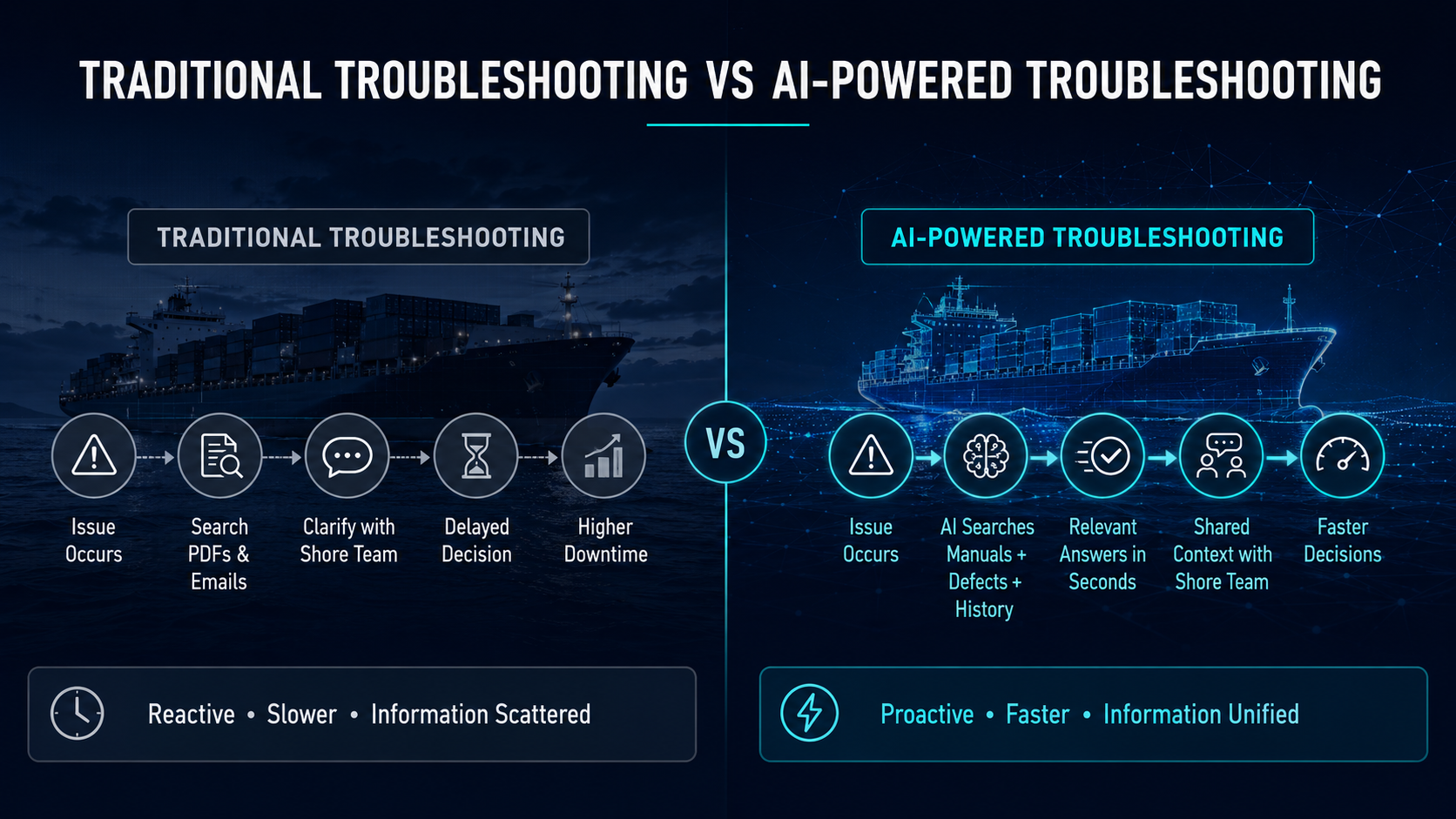
When a vessel faces a machinery alarm, the crew may need to check manuals, past defects, spare part records, and shore guidance.
This can take time.
AI-powered maritime troubleshooting reduces this delay by bringing relevant information into one place. It helps crews and superintendents quickly understand what happened before, what the manual says, and what actions were previously effective.
This does not replace marine engineers. It supports them with faster access to trusted technical knowledge.
Predictive maintenance becomes stronger when fleets combine sensor data with defect history.
A temperature trend alone may show that something is changing. But defect history can explain whether a similar pattern previously led to pump failure, heat exchanger fouling, sensor issues, or cooling restriction.
AI adds context. Predictive analytics adds early warning.
Together, they help teams decide:
This helps maintenance become more condition-informed instead of only calendar-based.
Many fleet problems are repeated.
A purifier issue, boiler trip, generator alarm, compressor fault, or steering gear defect may appear on one vessel and later appear on another.
Traditional reporting often treats these as separate cases.
AI can group similar defects by equipment, symptom, cause, corrective action, and recurrence. This helps technical teams identify patterns earlier and issue better fleet-wide guidance.
Shore teams often receive incomplete information during urgent technical issues.
The vessel may send an email, screenshots, alarm details, and manual references. The superintendent may then ask for more clarification. This creates delay.
AI improves ship-to-shore visibility by giving both sides a shared view of the issue, previous cases, vessel-specific references, and recommended next steps.
This improves response speed and reduces repeated back-and-forth communication.
Modern shipping compliance depends on data quality.
Fuel, emissions, safety, maintenance, and inspection records need to be accurate and traceable. Manual evidence collection creates risk, especially when records are scattered across systems.
AI can help organize evidence, connect records, and make technical decisions easier to review.
This is useful not only for audits and inspections, but also for insurance-related conversations when timelines, actions, and evidence matter.
AI works best when fleet data is clean, structured, and connected.
Many fleets already have useful information in manuals, defect reports, PMS records, emails, incident reports, and OEM service letters. But if these records are scattered, AI cannot deliver full value.
Fleet teams should start by standardizing:
When data is structured properly, AI can identify patterns faster and predictive analytics can give more reliable early warnings.
Better data discipline leads to better maritime AI decisions.
This is where SmartSeas.AI becomes relevant.
SmartSeas.AI helps fleets turn scattered maritime knowledge into practical decision intelligence.
The platform connects:
Instead of forcing teams to search through multiple documents and emails, SmartSeas.AI helps crews and shore teams find vessel-specific answers faster.
For technical superintendents, it supports faster review of repeated defects.
For marine engineers, it provides quicker access to troubleshooting guidance.
For fleet managers, it improves visibility into operational patterns.
For safety and compliance teams, it helps preserve evidence and improve decision traceability.
SmartSeas.AI is not about replacing maritime expertise. It is about helping experienced teams make faster, clearer, and better-supported decisions.
Fleet teams should not start with a broad “AI transformation” project.
They should start with high-value operational problems such as:
The best starting point is usually the area where delays, repeated issues, and downtime are already visible.
To get better results, fleets should also improve how they capture defect data. A useful defect record should include equipment, symptom, operating condition, suspected cause, confirmed root cause, corrective action, preventive action, downtime impact, and recurrence status.
Better data leads to better AI outputs.
AI and predictive analytics should be implemented carefully.
Poor data can lead to weak recommendations. AI outputs must be source-backed and reviewed by experienced maritime professionals.
Predictive models also need regular improvement because vessel conditions, equipment behavior, routes, fuels, and operating patterns change over time.
Most importantly, AI should support decisions, not bypass onboard authority or technical judgment.
In shipping, trust comes from explainability, source references, and operational relevance.
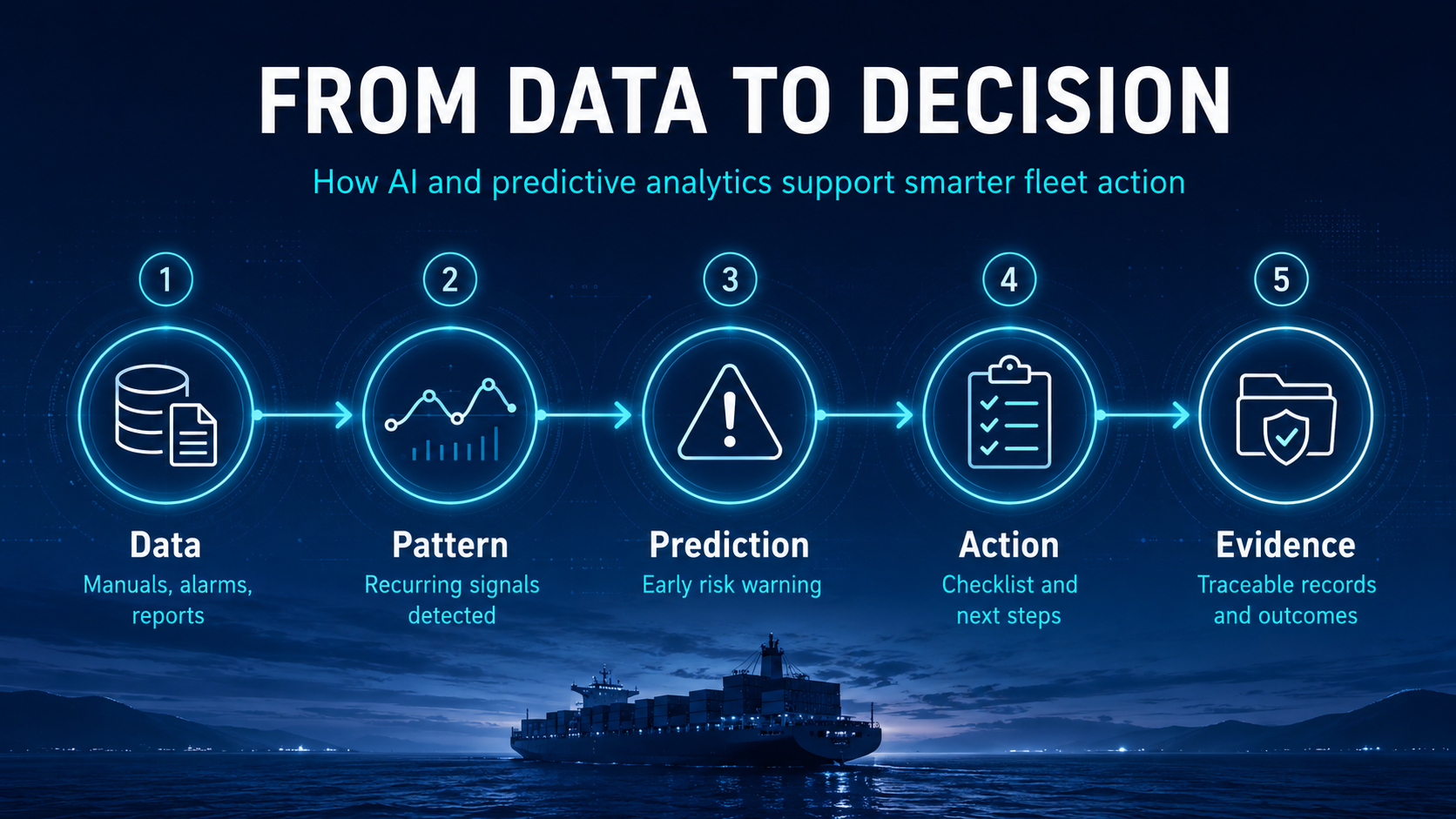
AI and predictive analytics are changing how shipping companies make decisions.
The biggest value is not another dashboard. The real value is helping fleet teams connect scattered data, detect early warning patterns, reduce troubleshooting delays, improve ship-to-shore coordination, and preserve evidence before problems escalate.
For maritime leaders, the question is not whether AI will enter fleet operations.
The better question is:
SmartSeas.AI supports this shift by helping fleets convert manuals, defect history, incident records, OEM knowledge, and ship-to-shore context into faster, clearer, and more practical decision support.
Explore how SmartSeas.AI helps fleet teams reduce troubleshooting delays, improve operational clarity, and make faster technical decisions across vessels.
It is the use of AI and data patterns to support better decisions in troubleshooting, maintenance, safety, compliance, and fleet operations.
AI connects manuals, defect history, incident records, and OEM guidance so crews and shore teams can find relevant answers faster.
Yes. It can help identify early warning signs and repeated failure patterns before they become major breakdowns.
No. AI supports marine engineers by providing faster access to technical knowledge and evidence-backed recommendations.
Useful data includes manuals, defect reports, PMS history, alarms, sensor trends, incident reports, service letters, and corrective actions.
SmartSeas.AI helps fleets unify maritime knowledge and support faster troubleshooting, better visibility, and smarter technical decisions.

Get Started Today
Transform the way you troubleshoot and manage maritime operations. Join the next wave of Maritime Digital Transformation with SmartSeas AI.




.svg)