.jpg)
May 13, 2026
Why Maritime Efficiency Digitalization Matters for Modern Fleet Management

May 13, 2026
Maritime efficiency digitalization is becoming essential because modern fleet management is no longer judged only by vessel movement. It is judged by how safely, efficiently, and reliably each vessel operates under pressure.
A fleet may have skilled crew, strong procedures, experienced superintendents, and approved systems. But if important information is scattered across manuals, PMS records, defect logs, reports, emails, spreadsheets, and port documents, efficiency still suffers.
The challenge is not always lack of data.
The real challenge is finding the right information quickly enough to make the right decision.
Shipping is becoming more complex.
Fleet managers now deal with fuel-efficiency pressure, decarbonization rules, digital port clearance, inspection demands, cyber risks, crew workload, and tighter commercial expectations.
UNCTAD’s 2025 maritime transport update highlights the need for greener, more resilient, and more digital shipping systems. It also notes that digital systems can help reduce costs and delays.
Source: UNCTAD, Review of Maritime Transport 2025
This means fleet efficiency is no longer only about speed.
It is about visibility, coordination, evidence, and decision quality.
A delayed decision can affect fuel use, port stay, maintenance planning, inspection readiness, and customer reliability.
Many fleets still depend on fragmented workflows.
A crew member searches for a PDF manual.
A superintendent checks defect history.
A technical assistant looks through emails.
A manager asks the vessel for more reports.
Someone else checks PMS records or service letters.
Each step may be normal.
But together, they create delays.
The vessel is waiting. The shore team is checking. The decision is not yet clear.
This is why maritime digital transformation matters. It reduces the time between “something happened” and “we know what to do next.”
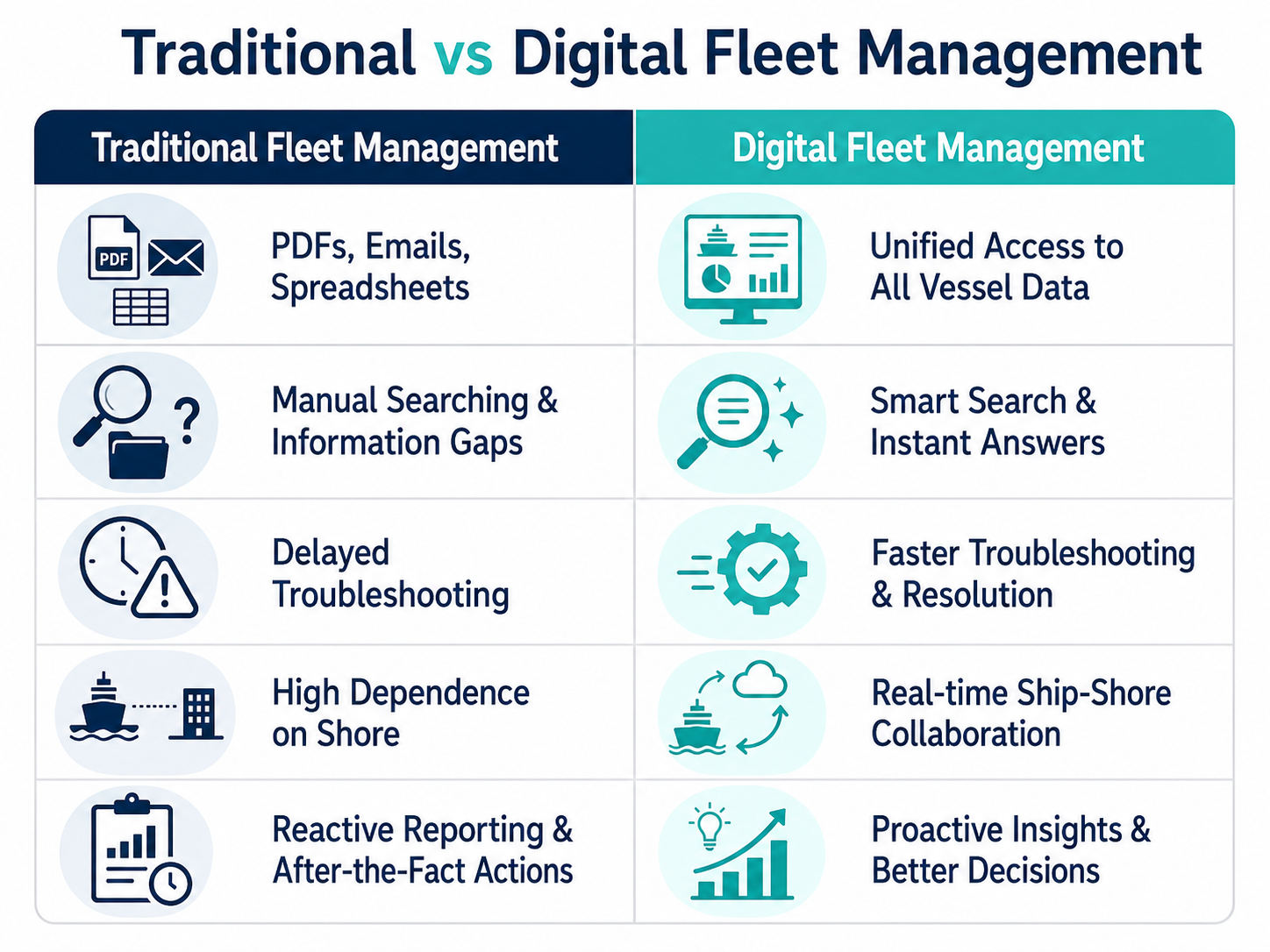
Maritime efficiency digitalization means using connected data, digital workflows, analytics, automation, and AI to improve fleet decisions.
It does not replace marine expertise.It helps teams use expertise faster.
A good digital system should help answer questions such as:
What is the vessel reporting?
Has this happened before?
Which manual section applies?
What action was taken last time?
This is where digitalization becomes valuable. It turns scattered fleet information into usable operational intelligence.
Most shipping companies already have large amounts of data.
They have manuals, service letters, PMS history, noon reports, voyage data, class documents, inspection findings, technical reports, purchase records, and defect logs.
But much of this information sits in separate systems. That creates a gap between information and action.
For example, a vessel may face the same equipment issue it had six months ago. The corrective action may be in an old report. The OEM guidance may be in a service letter. The procedure may be in the manual.
But if the team cannot connect these pieces quickly, time is lost.
Maritime efficiency digitalization closes this gap by making information easier to search, compare, and act on.
When machinery fails onboard, delay often happens before the repair even starts.
The crew must understand the symptom, search manuals, check alarms, compare previous cases, and communicate with shore.
Digital troubleshooting connects the current issue with relevant manuals, defect history, service guidance, and past corrective actions.
This is especially useful for repeated machinery problems.
A fleet should not solve the same issue from zero every time.
Many delays happen because ship and shore teams do not see the same information at the same time.
The vessel explains the symptom.
The shore team asks for readings.
The crew sends photos.
The superintendent checks history.
Someone searches the manual.
This back-and-forth is common, but slow.
Digitalization gives both sides a shared view of the problem.
When ship and shore teams work from the same context, decisions become faster and clearer.
Downtime rarely begins with the final failure.It often starts earlier with smaller warning signs:
Repeated alarms.
Incomplete defect closure.
Delayed troubleshooting.
Poor handover.
Digitalization helps fleets detect these patterns earlier.
It also helps technical teams compare similar issues across vessels. One vessel’s problem can become useful learning for the entire fleet.
Compliance is becoming more digital and evidence-driven.
Since 1 January 2024, IMO Member States have been required to use a Maritime Single Window for information exchange during port calls. IMO says this helps streamline arrival, stay, and departure procedures.
Source: IMO Maritime Single Window
Environmental reporting is also data-heavy. IMO’s Data Collection System applies to ships of 5,000 GT and above. Since 2023, DCS data has also been used to calculate a ship’s operational Carbon Intensity Indicator, or CII.
Source: IMO Data Collection System
This means fleet teams need accurate, traceable, and accessible records.
Digitalization helps teams prepare inspection evidence, survey documents, compliance records, and audit trails faster.
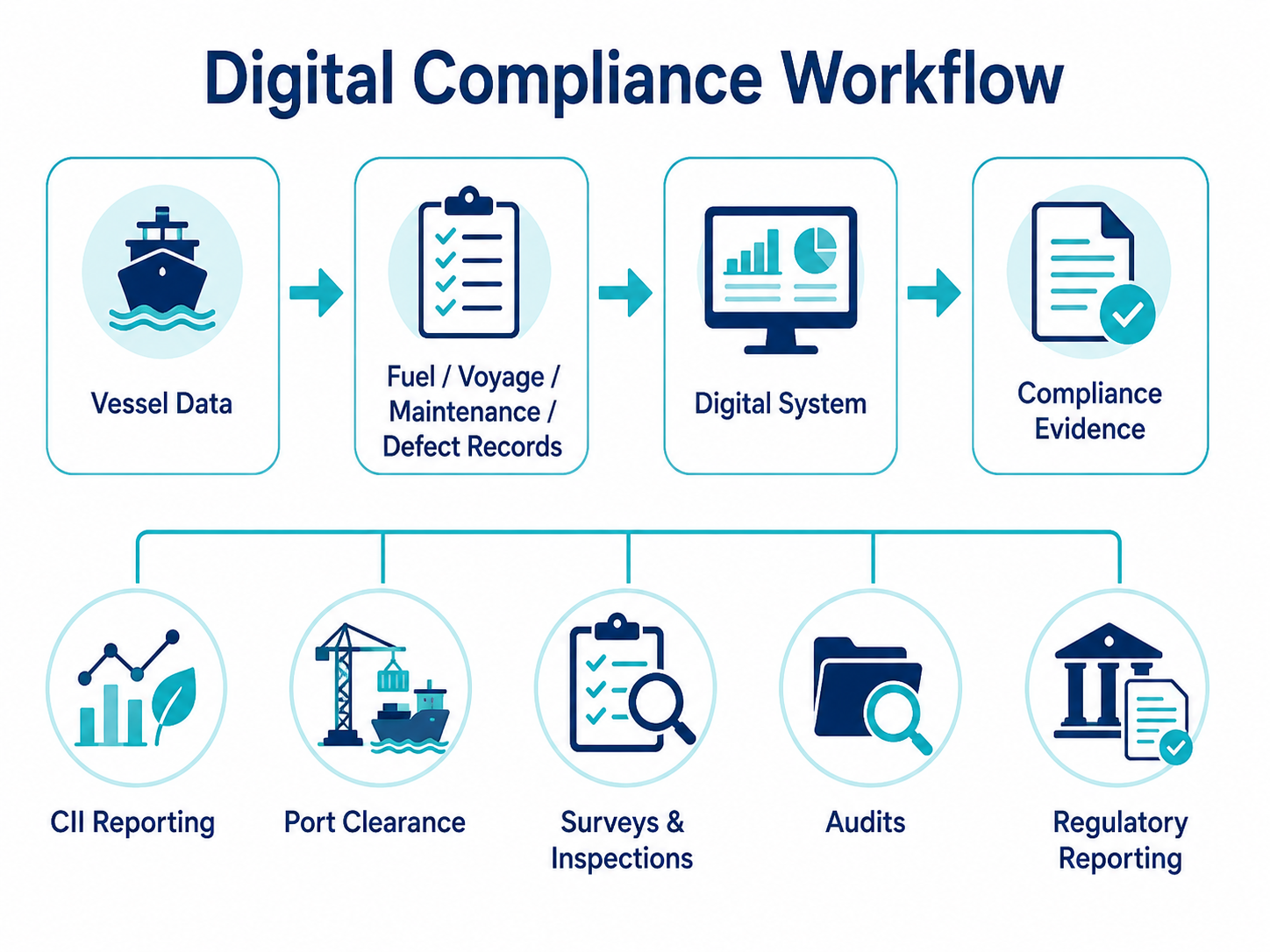
Source below image: IMO Maritime Single Window and IMO Data Collection System.
Fleet efficiency does not stop onboard the ship.
Port calls, clearance, documentation, cargo coordination, and stakeholder communication all affect vessel performance.
India’s Ministry of Ports, Shipping and Waterways reported that average turnaround time at major ports reduced from 93.59 hours in 2013–14 to 48.06 hours in 2023–24. The improvement was linked to measures such as mechanization, modernization, berth optimization, digital process streamlining, and better connectivity.
Source: Ministry of Ports, Shipping and Waterways, India / PIB
This example shows the value of streamlined workflows.
When documents are digital, clearance becomes smoother.
When data is connected, coordination improves.
When workflows are faster, vessels move with less delay.
The same logic applies inside fleet management.
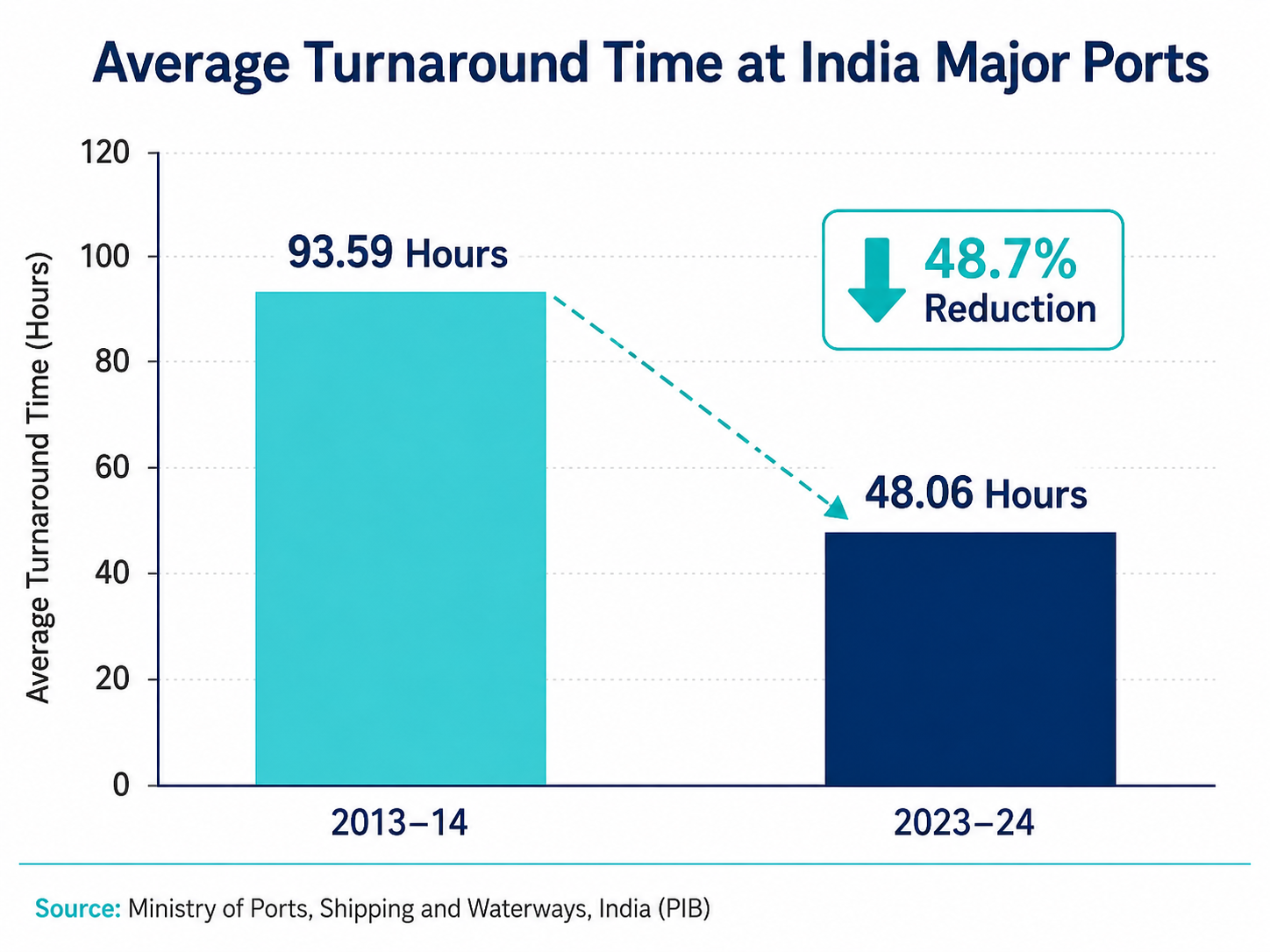
Source below image: Ministry of Ports, Shipping and Waterways, India / PIB.
Where AI Fits Into Maritime Efficiency Digitalization
Digitalization connects the data.
AI helps teams use that data faster.
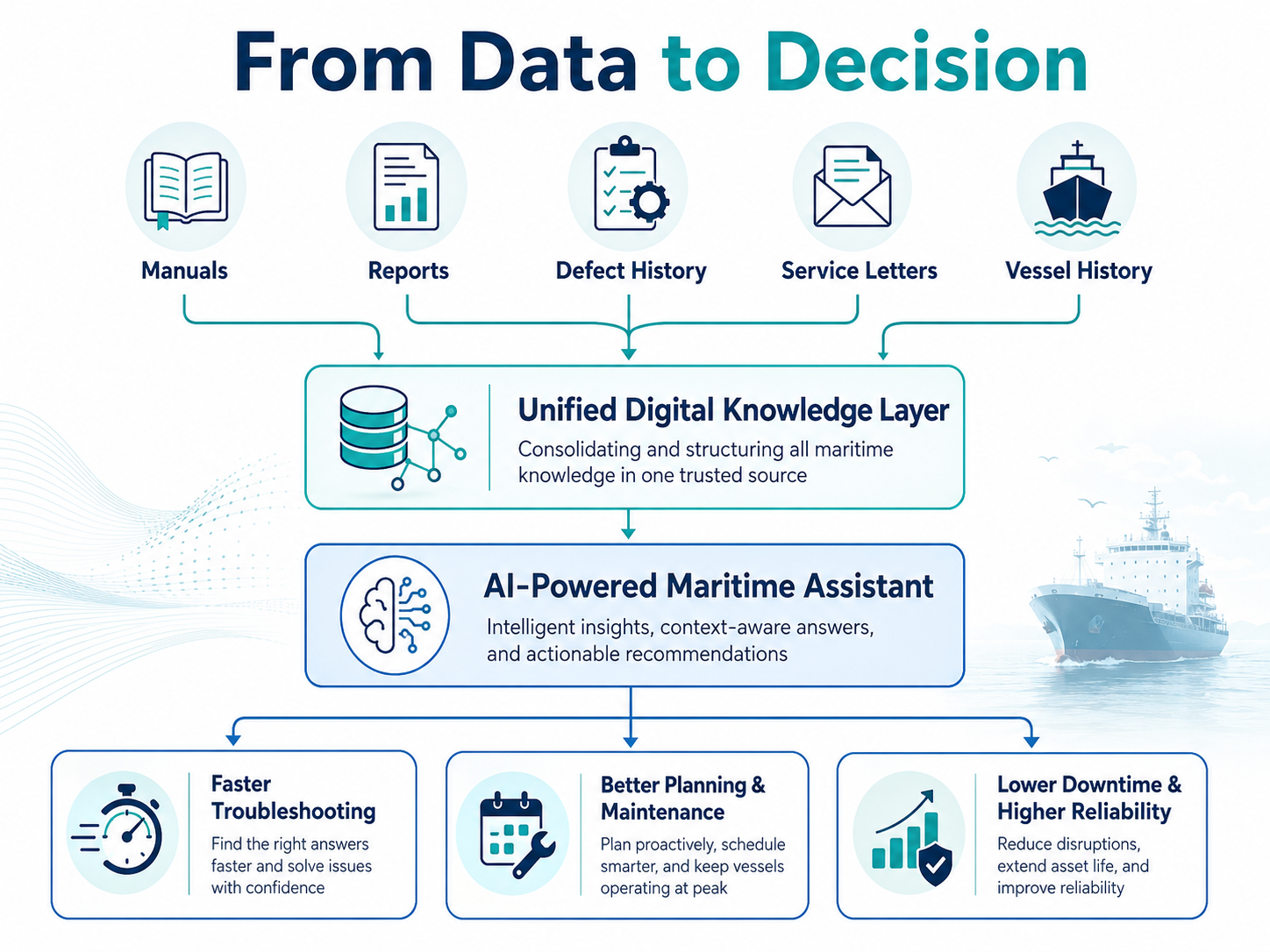
A maritime AI assistant can help teams search across manuals, reports, service letters, defect history, and technical records. It can summarize long documents, connect related issues, and guide users toward relevant next steps.
But AI must be grounded in maritime context.
Generic answers are not enough.
In vessel operations, the answer must connect to the right equipment, vessel, manual, safety context, and operational history.
That is the difference between general AI and practical maritime AI.
Manual workflows rely heavily on individual memory.
That can work when the same experienced person is available. But shipping does not always work that way.
The crew rotate.
Superintendents handle multiple vessels.
Reports sit in folders.
Old service letters get forgotten.
Lessons from one vessel may not reach another.
This creates knowledge loss.
Manual workflows often miss repeated equipment patterns, similar failures across sister vessels, old corrective actions, missing compliance evidence, and recurring downtime signals.
Digitalization helps preserve fleet memory and makes operational knowledge easier to reuse.
This is where a platform like SmartSeas.AI becomes relevant.
SmartSeas.AI is an AI-powered maritime platform that helps improve troubleshooting, operational clarity, safety response, and decision-making across ships and fleets.
For fleet teams, the issue is often not that information is missing. It is that information is scattered.
Manuals may be in one place.
Service letters may be somewhere else.
Defect history may sit inside PMS.
Reports may be in folders.
Technical discussions may remain in emails.
SmartSeas.AI helps bring these sources into a unified AI-powered workflow.
This helps teams move faster from problem identification to informed action.
The goal is not to replace marine engineers, superintendents, or fleet managers.
The goal is to support them with faster access to the knowledge they already depend on.
SmartSeas.AI supports AI-powered maritime troubleshooting, unified access to technical documents, better ship-to-shore visibility, faster issue resolution, and stronger operational transparency.
For modern fleet management, this is the practical value of maritime AI.
A successful digitalization strategy should be built in layers.
It should not start with AI alone.
AI is only useful when the data foundation is strong.

Source: No external source needed. Conceptual framework.
A vessel reports a main engine alarm.
In a manual workflow, the crew searches the manual, checks reports, contacts shore, and waits for guidance.
In a digital workflow, the team can quickly access the relevant manual section, similar defects, service guidance, and corrective actions.
This improves response speed and confidence.
A fleet sees repeated auxiliary engine issues across sister vessels.
Without digitalization, each case may be treated separately.
With connected defect intelligence, the technical team can compare patterns across vessels and identify whether the issue is linked to operating conditions, maintenance interval, component quality, or OEM guidance.
This helps the fleet move from repeated repair to prevention.
Before a class survey, vetting inspection, or internal audit, teams often spend time gathering records.
A digital workflow can help retrieve defect closure history, maintenance evidence, corrective actions, certificates, and supporting documents faster.
This reduces last-minute pressure and improves inspection confidence.
Digitalization can fail if it becomes only a dashboard project.
More screens do not automatically mean better decisions.
Some fleets invest in digital systems but still struggle because data is incomplete, disconnected, poorly structured, or not trusted by users.
Other systems create too many alerts without clear action.
That adds noise.
The best digitalization projects start with a practical problem:
Why does troubleshooting take too long?
Why are repeated defects not being prevented?
Why is inspection preparation stressful?
Why are shore teams missing vessel context?
When the problem is clear, the digital workflow becomes useful.
Maritime efficiency digitalization does not need to begin as a massive transformation project.
It can start with one repeated bottleneck.
Choose one problem that regularly wastes time, such as troubleshooting, defect closure, reporting, inspection preparation, or spare-part coordination.
Find where the information sits today: manuals, PMS, reports, emails, service letters, noon data, inspection records, or crew handover notes.
Do not digitize everything at once. Start with the data that helps teams act faster.
Track simple metrics such as time to find information, time to close defects, repeated issue count, inspection preparation time, and downtime linked to troubleshooting delay.
Once the workflow works for one vessel or vessel series, expand it across the fleet.
Maritime efficiency digitalization matters because fleet management is becoming more complex, time-sensitive, and evidence-driven.
The biggest gains come from reducing daily operational friction.
Digitalization helps teams search less, align faster, respond earlier, and learn across vessels.
AI becomes valuable when it is connected to real maritime data and operational workflows.
For modern fleet managers, the goal is not simply to collect more data.
The goal is to turn vessel data into faster, safer, and more reliable decisions.
Modern fleet management depends on fast, clear decisions.
When manuals, reports, defect history, and vessel context are hard to access, even strong teams lose time.
Maritime efficiency digitalization helps connect this information, reduce delays, improve compliance readiness, and support faster troubleshooting.
SmartSeas.AI helps ship and shore teams unify technical data and make faster operational decisions.
In modern shipping, efficiency is not just about moving vessels.
It is about moving decisions faster.
Maritime efficiency digitalization is the use of digital systems, connected data, analytics, automation, and AI to improve vessel operations, troubleshooting, compliance, maintenance, and fleet decision-making.
It helps reduce delays caused by scattered information, manual searching, unclear communication, and slow ship-to-shore decision-making.
It helps teams find technical information faster, compare past defects, detect repeated issues, and respond earlier to operational risks.
No. Large fleets benefit from cross-vessel visibility, but smaller fleets can also improve troubleshooting, record access, compliance readiness, and maintenance planning.
AI can help retrieve manuals, summarize reports, connect defect history, identify repeated issues, and guide teams toward relevant next steps.
Start with one repeated problem, such as slow troubleshooting, defect tracking, inspection preparation, or poor ship-shore visibility.

Get Started Today
Transform the way you troubleshoot and manage maritime operations. Join the next wave of Maritime Digital Transformation with SmartSeas AI.




.svg)


.png)