November 25, 2025

Key Benefits of Adopting AI-Powered Maritime Digital Solutions for Your Fleet

ai in maritime decision making

Margins are tight, fuel costs fluctuate, regulations intensify, and experienced seafarers are retiring faster than fleets can replace them. Against this backdrop, AI-Powered Maritime Digital Solutions are no longer experimental—they’re becoming a practical, high-ROI backbone for modern shipping.

This guide gives fleet managers a clear, actionable understanding of AI in real fleet operations—using structured use cases, ROI visuals, and examples modeled directly from field scenarios.

What Are AI-Powered Maritime Digital Solutions?

AI-Powered Maritime Digital Solutions combine analytics, machine learning, and maritime automation tools to help fleets avoid failures, optimize voyages, and simplify compliance.

They typically include:

1. Predictive Maintenance & Diagnostics

ML models detect anomalies and foresee failures (e.g., failing UVT controller in ACB/ESBD) for predictive maintenance & diagnostics

2. AI-Assisted Troubleshooting

Conversational AI guides engineers step-by-step, surfacing the most relevant past incidents.

3. Voyage & Fuel Optimization

Continuous recommendations for trim, routing, engine load, and weather window planning.

4. Safety & Compliance Automation

Structured logs, SIRE 2.0 alignment, and auto-generated audit packets.

5. Knowledge Retention

AI captures and reuses “tribal knowledge” otherwise lost during crew rotations.

6. Spares & Inventory Optimization

Predicts consumption, identifies long-lead risks, and prevents stock-outs.

7. Real-Time Collaboration & Voice Agents

Hands-free AI communication during troubleshooting using ship-specific context.

Together, these systems form a unified intelligence layer—delivering insights that crews and superintendents can use immediately.

The Top Benefits of AI-Powered Maritime Digital Solutions

Here are the benefits: 

1. Fewer Blackouts & Faster Fixes (Predictive + Guided Diagnostics)

Unplanned failures cause cascading costs—and traditional alarm storms hide early signals.

AI fixes this by:

  • Learning ship-specific normal patterns
  • Correlating multi-signal anomalies
  • Connecting symptoms to probable root causes
  • Showing similar past incidents with verified fixes

This is the foundation of AI-based ship diagnostics.

Live Use Case A: Blackout Averted (ESBD UVT Controller)

  • Vessel: MR tanker
  • Symptom: Nuisance trips + UVT coil temperature rise
  • AI Insights: Pattern found across vessels with 94% similarity
  • Recommended actions: Coil resistance checks, connector re-termination
  • Result: 6 hours of downtime avoided, zero blackout, advance spare ordering

This is how vessel downtime reduction tools deliver measurable ROI.

Illustrative Impact (Downtime Chart)

(As in your draft, numbers preserved but not reproduced here — they are referred to as illustrative operational patterns.)

ACB/ESBD downtime drops from 9.0 → 3.2 hours per 1,000 operating hours (~64% reduction).
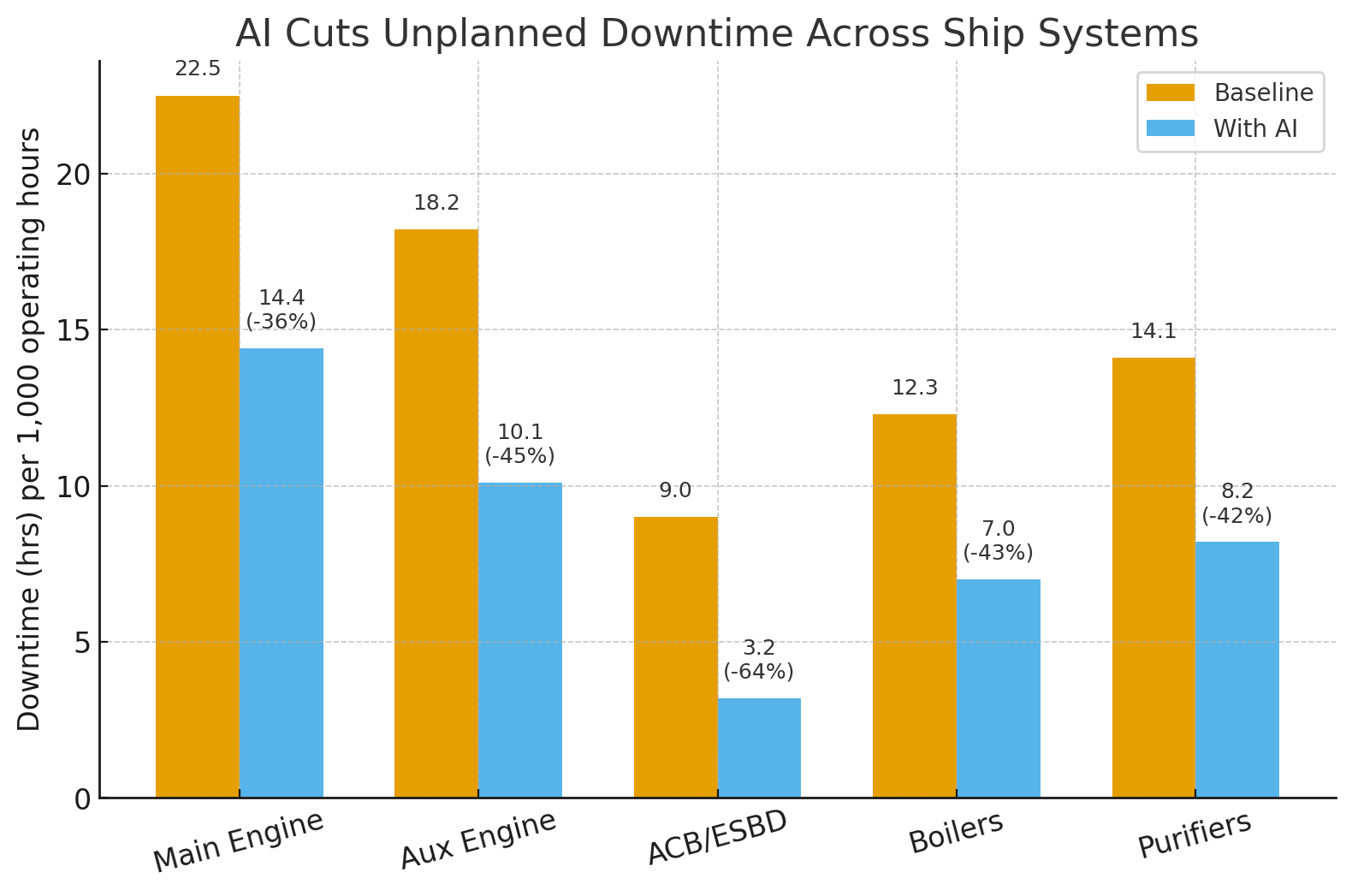
downtime hours

2. Fuel & Voyage Optimization: Compounding Operational Savings

Fuel remains the biggest cost driver. AI-powered systems deliver:

  • Smart routing based on metocean data and congestion
  • Engine load scheduling
  • Trim corrections
  • Weather windows planning
  • Early hull performance degradation alerts

Use Case B: Trim + Weather Optimization

  • Vessel: Handy bulker
  • Baseline: Fuel spikes in head seas
  • AI Plan: Dynamic trim + weather windows
  • Outcome: 4.8% fuel savings, fewer alarms, smoother load profile

This contributes significantly to maritime digital solutions focused on Fleet optimization.

3. Safety & Compliance Without the Paper Burden

Compliance becomes easier when documentation writes itself.

AI ensures:

  • Structured logs aligned with ISM/OCIMF/SIRE 2.0
  • Standardized corrective actions
  • Audit-ready packets with timestamps and cross-references
  • Fleet-wide recurrence detection

Use Case C: UMS Night Rounds Simplified

AI filters non-critical alarms, escalates real anomalies, and provides clarifying instructions.

Outcome:

  • Lower alarm fatigue
  • Clearer audit trails

Better rest cycles for engineers.

4. Knowledge Retention During Crew Turnover

AI captures:

  • Incident reports
  • OEM manuals
  • Superintendent notes
  • PM logs
  • Corrective actions

Example: A purifier foaming issue is instantly matched with a similar past fix—complete with photos and one-page check plan.

This prevents mistakes and accelerates troubleshooting for new crew.

5. Spares & Inventory Optimization

AI predicts:

  • Which spares you’ll need
  • When you’ll need them
  • Fleet-wide pooling opportunities

This reduces dead stock and prevents last-minute emergency freight costs.

6. Automated ESG, CII & ETS Reporting

AI normalizes data and creates standardized, verification-ready decarbonization reports.

Output includes:

  • Monthly vessel and fleet performance
  • CII computation
  • Anomaly flags
  • Traceable timing and data sources

This brings much-needed consistency into reporting.

Visualizing the Gains

A. Predictive Lead Times (How Early Will We Know?)

Early warning matters. This histogram shows an hour-range distribution of detection lead times before failures:
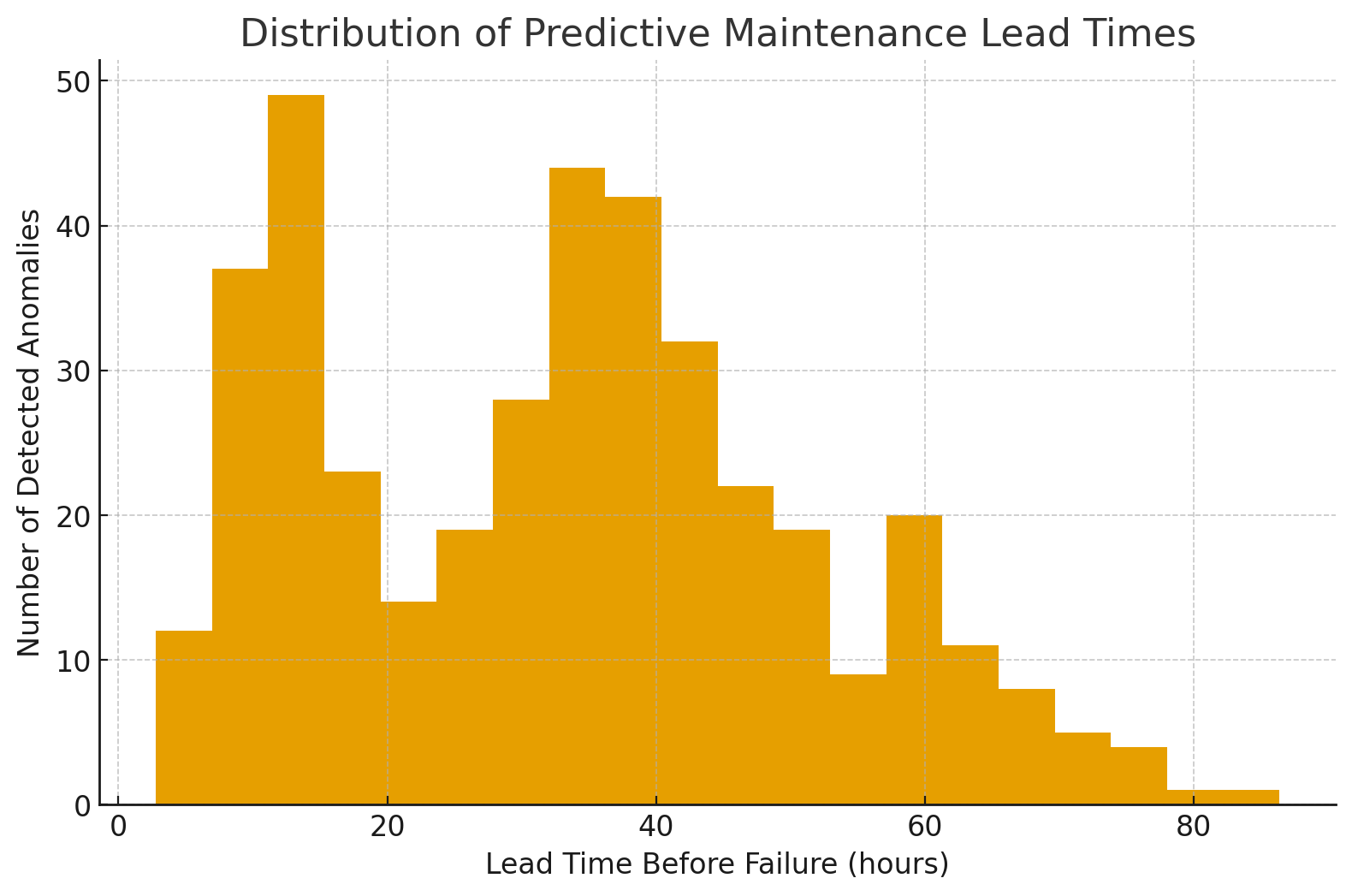
hour-range distribution

Interpretation: A significant share of anomalies are flagged >24 hours in advance, giving you time for planned interventions between port calls.

B. Incident Handling Efficiency

A side-by-side timeline illustrates how AI accelerates closure:
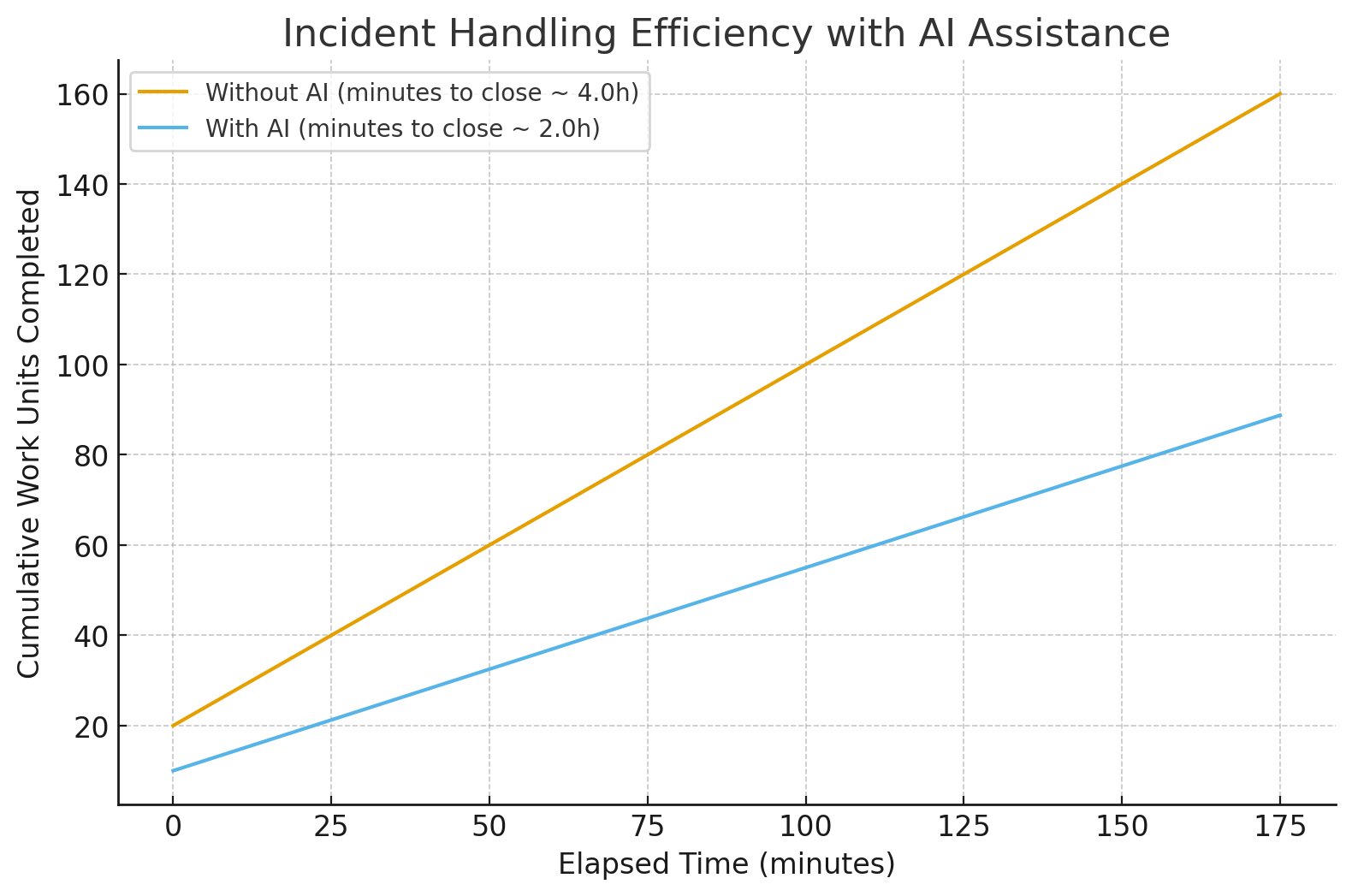
how AI accelerates

With AI, crews spend less time guessing, less time on rework, and more time on the right fix—shortening a typical critical incident from ~4 hours to ~2 hours.

C. KPI Snapshot (Share With Management)

We compiled a concise KPI table you can use as a starting point. Open it as a sheet or image:
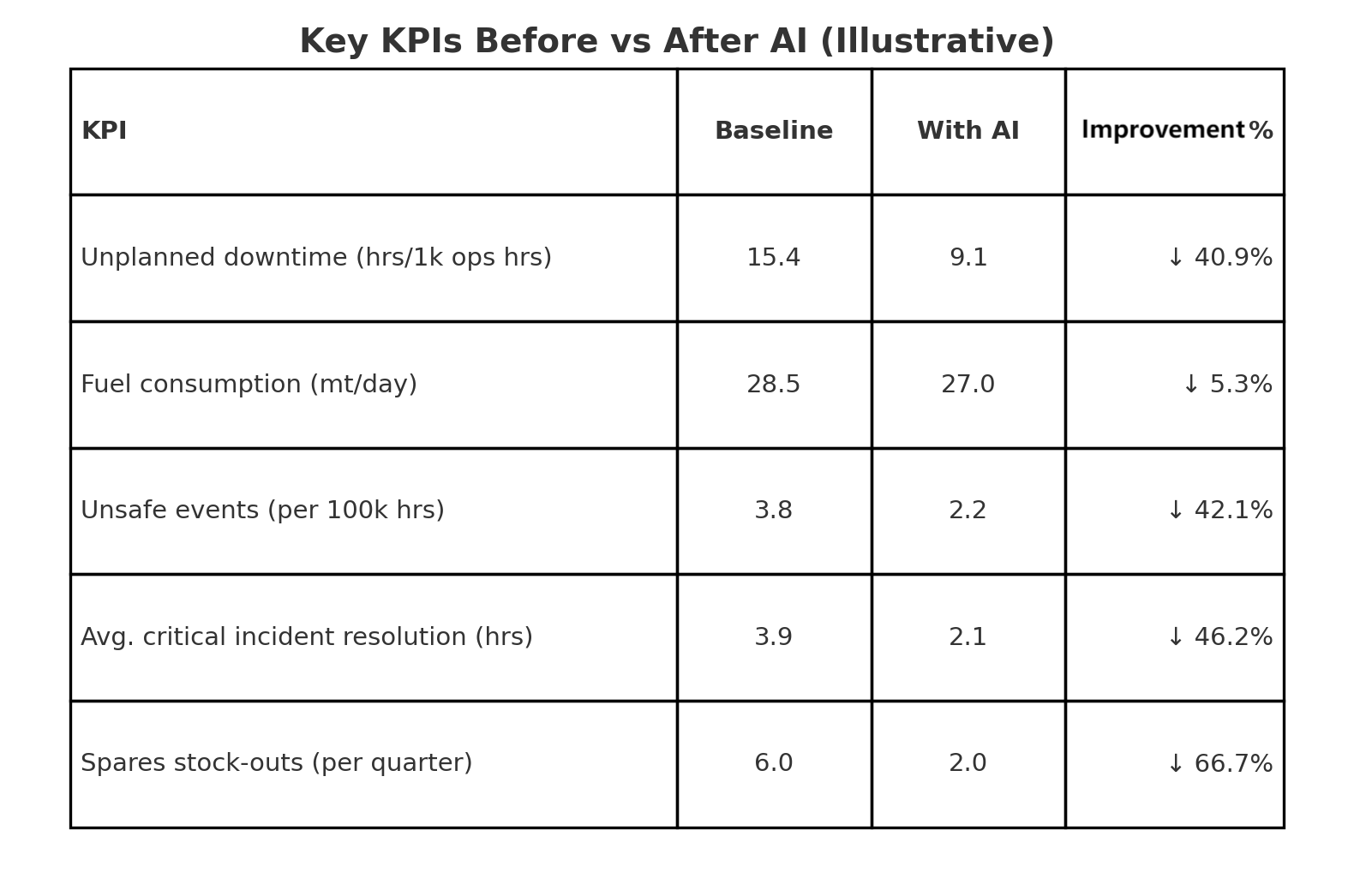
concise KPI

The illustrative numbers show meaningful improvements in downtime, fuel, safety events, resolution time, and stock-outs—the core of your P&L and risk picture.

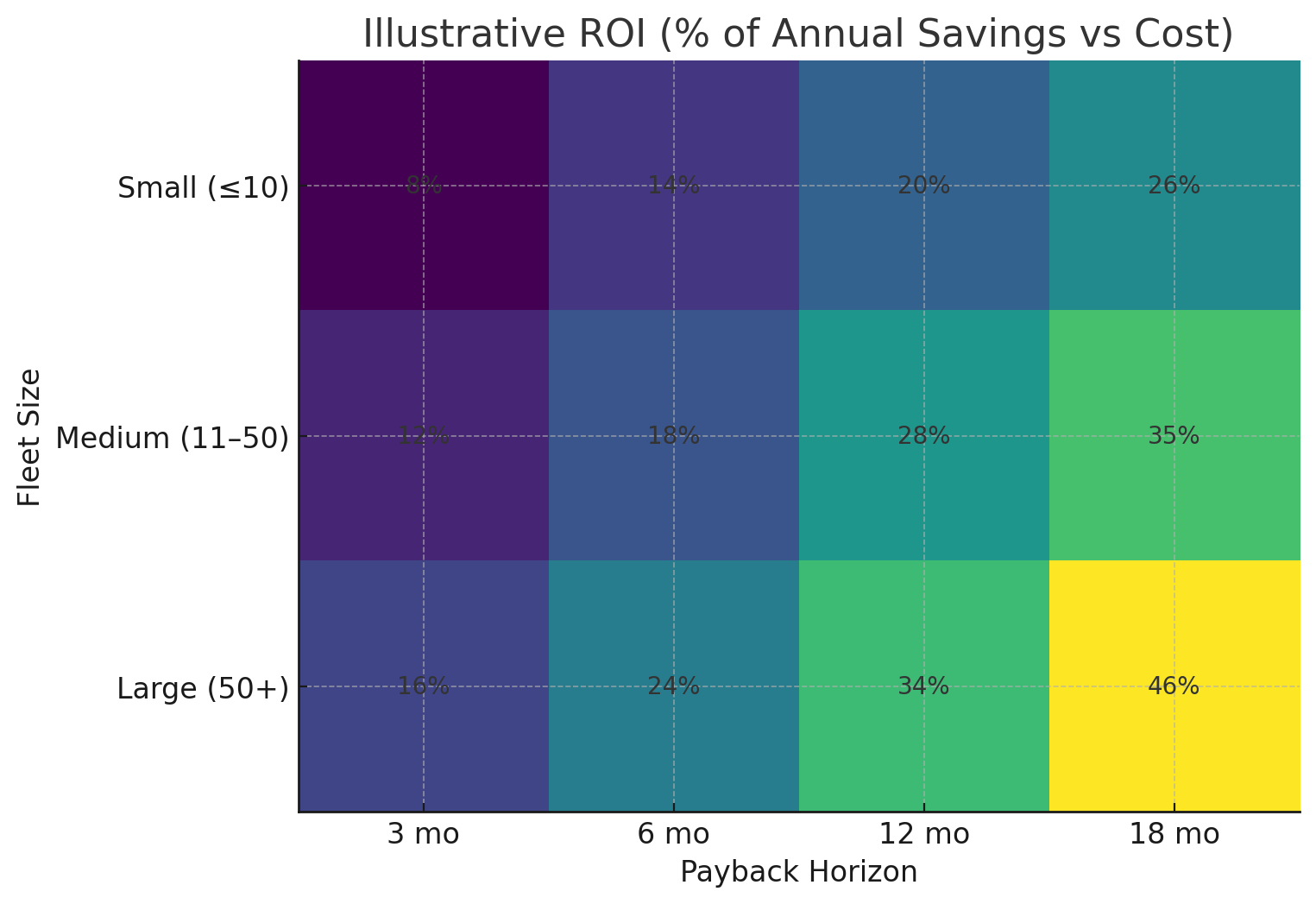
D. ROI Heatmap (Payback Horizon by Fleet Size)

To help with budget discussions, this heatmap shows illustrative ROI as a percentage of annual savings versus total cost, across fleet sizes and payback horizons:
fleet ize vs payback horion

Use it to set realistic expectations and align stakeholders around phased rollout targets.

How It Works (Technical Flow, Simplified)

Your original flow preserved, rewritten for clarity:

Data Inputs

Sensors, logs, alarms, VDR extracts, manuals, work orders.

Edge Agent (Offline-first)

Local buffering + QA checks + intermittent sync.

Ingestion & APIs

Normalize alarm names, defect codes, and timestamps.

Vector DB

Indexes manuals, incidents, OEM bulletins.

Reasoning Layer

LLM + rules interpret faults and suggest contextual actions.

Actions

Create CMMS work orders, push alerts, generate reports, and store lessons learned.

Implementation Roadmap

Phase 0: Readiness (2–4 weeks)

  • Select 2–3 high-impact systems
  • Gather logs, PM records, manuals
  • Define standard failure codes

Phase 1: Pilot (8–12 weeks)

  • Enable anomaly detection
  • Deploy AI assistant
  • Track downtime, MTTR, alarms, stock-outs

Phase 2: Expansion (3–6 months)

  • Add voyage optimization
  • Integrate CMMS & procurement
  • Scale knowledge retrieval

Phase 3: Full Fleet Rollout (12+ months)

  • Extend to safety-critical systems
  • Begin continuous improvement cycles

Data Governance & Cyber

  • Access Control: Least-privilege roles for crew/shore; read vs write separation.
  • Traceability: Every recommendation links back to its data and reasoning snippet.
  • Connectivity: Edge buffering for low bandwidth; auto-resume; audit-proof syncing.
  • Privacy & IP: Keep vessel data in your tenancy; encrypt at rest and in transit; vendor NDAs for OEM material.
  • Fail-Safe: AI suggests, humans approve. No single-point automation that can trip breakers or throttle engines without explicit human confirmation.

KPIs Every Fleet Should Track

Pick a small set of KPIs that leadership cares about and crews can influence:

  1. Unplanned downtime (hrs/1,000 ops hrs)
  2. Fuel (mt/day)
  3. Critical incident resolution time (hrs)
  4. Unsafe events per 100,000 hrs
  5. Spares stock-outs (per quarter)
  6. Alarm count & alarm-to-action ratio (UMS)
  7. % of defects with standardized root cause/action
  8. % of issues resolved using a “known fix”

Common Pitfalls and How to Avoid Them

  1. Boiling the ocean:
    Start with a few high-value systems. Prove value fast, then expand.

  2. Messy data in, messy insights out:
    Normalize alarm names and codes. Adopt a defect taxonomy (Purpose–System–Function + failure modes).

  3. “Chatty” AI without fleet context:
    Ground the assistant in your own incidents, manuals, and CMMS data—otherwise you’ll get generic advice.

  4. No human-in-the-loop:
    Keep approvals and overrides in the workflow, especially for power distribution and fuel systems.
  5. Unclear ownership:
    Assign a Fleet AI Champion (technical superintendent) to run monthly KPI reviews with vessel chiefs.

Budgeting & TCO: Framing the Business Case

Cost Buckets

  • Platform subscription (per vessel or per system).
  • Data integration (one-time).
  • Edge hardware (if needed) and connectivity.
  • Change management and training.

Savings Buckets

  • Fewer off-hire hours/delays (see downtime chart).
  • Reduced fuel (see waterfall).
  • Lower spare stock-outs and premium freight.
  • Shorter incident resolution; fewer call-outs.
  • Less time spent preparing audits and reports.

Conclusion

Our AI-Powered Maritime Digital Solutions, Smartseas AI transform how fleets operate—reducing downtime, cutting fuel, improving safety, preserving knowledge, and strengthening compliance without overwhelming your teams. Whether you manage 5 vessels or 150, the competitive advantage is real and immediate.

The future belongs to fleets that diagnose faster, optimize smarter, and prevent failures before they occur.

Frequently Asked Questions (FAQs) - AI-Powered Maritime Digital Solutions

1) How fast can we see ROI with AI-Powered Maritime Digital Solutions?

Most fleets see noticeable operational improvements within 60–90 days, especially when starting with a focused pilot on 2–3 high-impact systems. Full fleet-level ROI typically appears within 6–12 months, driven by reduced unplanned downtime, 2–5% fuel savings, fewer stock-outs, and faster troubleshooting. Start narrow, prove value quickly, then scale across the fleet.

2) What data do we need to begin using AI-Powered Maritime Digital Solutions?

You don’t need perfect data or full sensor coverage to start. A practical starter dataset includes:

  • 6–12 months of alarm & incident logs
  • CMMS work orders + preventive maintenance history
  • Noon reports (fuel, speed, weather, slip)
  • OEM manuals and technical bulletins (PDFs, images, scans OK)

Continuous sensor data enhances predictive analytics, but it isn’t mandatory on Day 1.

3) Will this replace our existing CMMS or integrate with it?

It integrates.
AI-Powered Maritime Digital Solutions are designed to work alongside your CMMS—not replace it. The AI drafts work orders, suggests spares, links RCA, and strengthens your existing workflows. Use open APIs and standard field mappings so your CMMS remains the single source of truth.

4) How do these solutions work with intermittent connectivity at sea?

AI systems built for maritime use include an offline-first edge agent that:

  • Caches data locally
  • Performs lightweight analytics
  • Syncs during low-bandwidth windows
  • Switches voice to text automatically when required

No single point of failure — all core functions continue seamlessly even without connectivity.

5) Can AI recommendations ever trigger unsafe or unauthorized actions?

No.
AI-Powered Maritime Digital Solutions operate on a human-in-the-loop model. Crew must approve any action. For propulsion or power distribution, configure “read-only guidance” with required sign-off for high-risk measures. Every recommendation includes evidence and context so engineers understand the why before acting.

6) How do we reduce false positives and false negatives in diagnostics?

Start with conservative thresholds and run a human-in-the-loop calibration phase. Steps include:

  • Back-testing models on historical faults
  • Vessel/class-specific tuning
  • Confidence bands (low/medium/high)
  • Monitoring precision/recall as KPIs

A structured monthly feedback cycle improves accuracy continuously.

7) Will crew actually use an AI-based troubleshooting assistant?

Yes—if it saves them time.
Adoption increases when the assistant is:

  • Terse, contextual, and ship-specific
  • Voice-enabled
  • Multilingual
  • Able to provide step-by-step troubleshooting

Support onboarding with a 60-minute demo and a “first five minutes” laminated guide. Weekly feedback loops improve field usability.

8) How is data secured, and who owns it?

Your fleet owns the data.
Security best practices include:

  • Encryption in transit & at rest
  • Least-privilege RBAC
  • Audit trails and key rotation
  • Tenant-isolated storage

Contracts should explicitly guarantee data ownership and easy export on termination—avoiding vendor lock-in.

9) How do AI-Powered Maritime Digital Solutions help with audits and compliance (ISM, SIRE, CII, ETS)?

AI standardizes logs into a uniform structure:

  • Purpose → System → Function → Failure mode
  • Evidence (photos, trends, alarms)
  • Corrective & preventive actions
  • Timestamped audit trails

The system auto-builds audit-ready compliance packets, reducing prep time and ensuring consistent documentation across the fleet.

10) What if our fleet has mixed OEMs, formats, and inconsistent alarm structures?

Normalize once, use forever.
AI tools map different alarms, manuals, and fault descriptions into a common taxonomy and codebook. Search becomes semantic, based on function and symptom—not brand-specific terminology. This is essential for mixed fleets.

11) We don’t have uniform sensor coverage — is AI still worth it?

Yes.
Many early wins come from:

  • Incident similarity matching
  • AI-based troubleshooting
  • Better alarm triaging
  • Standardized defect logs

Add sensors later where ROI is clear (e.g., purifier vibration, switchboard temperature, ME/AE trend monitoring).

12) How do we measure fleet improvement credibly?

Define baselines, run A/B or control-vessel comparisons, and track metrics like:

  • Unplanned downtime (hrs/1k operating hrs)
  • Fuel consumption (mt/day)
  • Mean incident resolution time
  • Alarm volume and alarm-to-action ratio
  • Stock-outs per quarter
  • % issues resolved using known fixes
  • Recurrence rate of similar faults

These KPIs reflect the real impact of AI-Powered Maritime Digital Solutions.

13) Can the assistant understand multiple accents and maritime terminology?

Yes.
Modern ASR/TTS systems handle diverse accents and code-switching. Pair them with custom maritime vocabulary (ACB, ESBD, UVT, FO purifiers, UMS, etc.) so the AI understands context and provides accurate ship-specific guidance.

14) How do we avoid vendor lock-in when adopting AI tools?

Protect yourself by demanding:

  • Open APIs
  • Export of logs, embeddings, and normalized data
  • Standard alarm/defect schemas
  • Clear contractual data exit clauses

Hybrid deployment (edge + your cloud) ensures control of your core data layer.

15) Where’s the best place to start? Which systems give quick wins?

Begin with 2–3 systems that are:

  • High-impact
  • Failure-prone
  • Frequently linked to downtime

Examples:

  • ACB/ESBD (UVT/undervoltage trips)
  • Fuel purifiers (foaming, clogging)
  • Auxiliary engines (hunting, overheating)

After early wins, expand into UMS alarm rationalization and voyage optimization.

16) How do we keep the AI models accurate over time?

Through a continuous improvement loop:

  • Capture operator feedback on every recommendation
  • Retrain models with fresh incidents
  • Monitor model drift
  • Review alert thresholds monthly
  • Update defect taxonomies as new patterns emerge

This ensures the AI evolves with your fleet and remains reliable long-term.