.jpg)
August 19, 2026
AI-Powered Fleet Management: How Maritime Teams Can Reduce Downtime and Improve Decisions

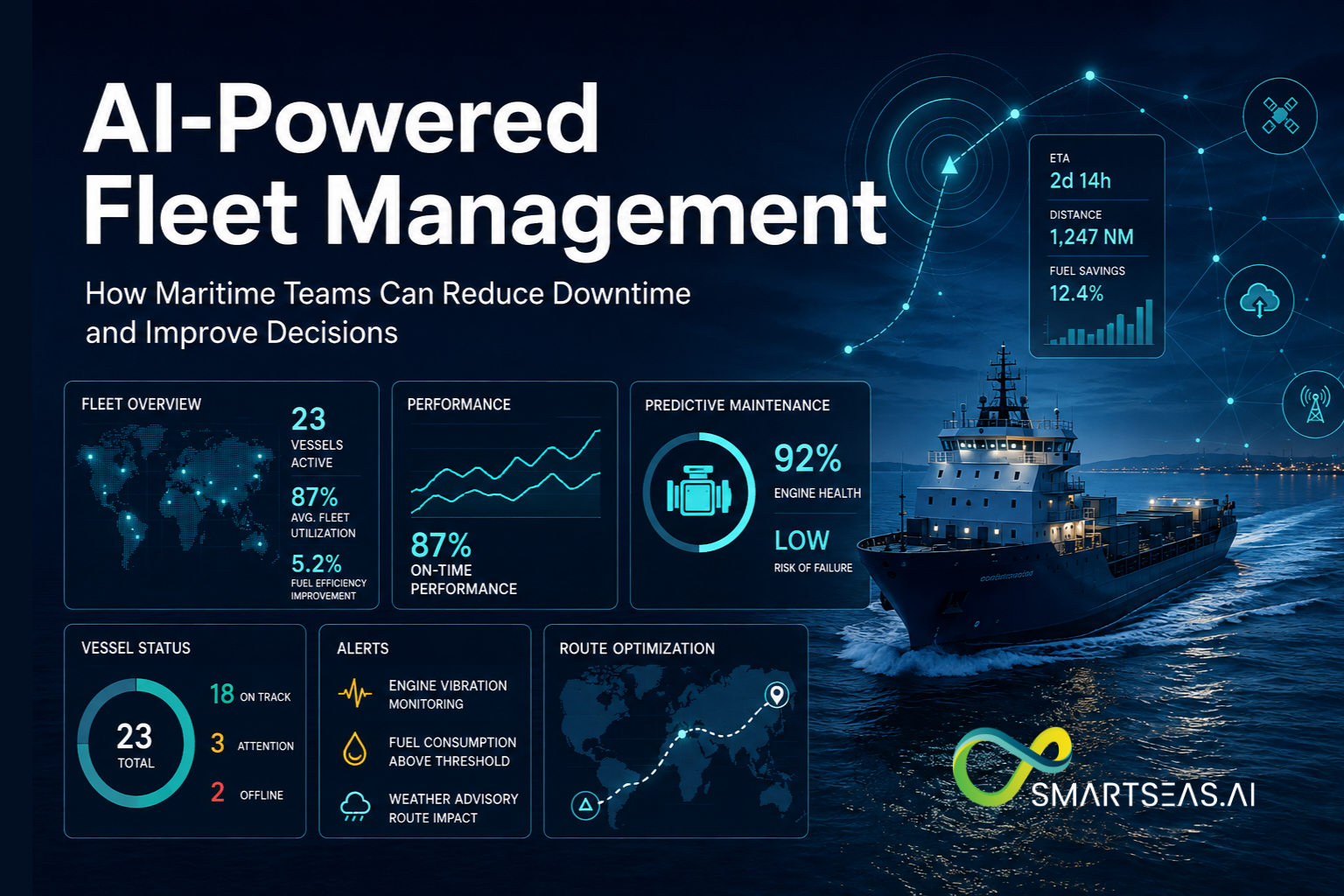
August 19, 2026
A machinery fault often sends fleet teams searching across manuals, defect records and maintenance history before they can decide what to do next. The information may already exist, but finding and connecting it quickly remains a challenge.
This is where AI-powered fleet management can help-by bringing relevant technical evidence together faster without replacing engineering judgement.
The need is clear: Allianz Commercial's Safety and Shipping Review 2026 recorded 2,818 shipping incidents in 2025, including 1,505 machinery damage or failure incidents. Better decision support can help fleets troubleshoot faster, reduce disruption and strengthen fleet learning.
Shipping fleets already generate large amounts of technical information through manuals, maintenance records, defect reports, machinery data, OEM advisories and technical emails.
The challenge is that this information is often stored across different systems.
A superintendent investigating a machinery problem may need to search several sources before getting a complete picture, creating unnecessary delays in troubleshooting and decision-making.
AI-powered fleet management can help by connecting relevant technical and operational knowledge around the issue being investigated.
This also reflects the wider direction of maritime digitalization, where DNV and IMO increasingly emphasize integration, interoperability and effective data sharing.
The next step is not collecting more data-it is helping fleet teams use existing data to make faster, better-informed decisions.
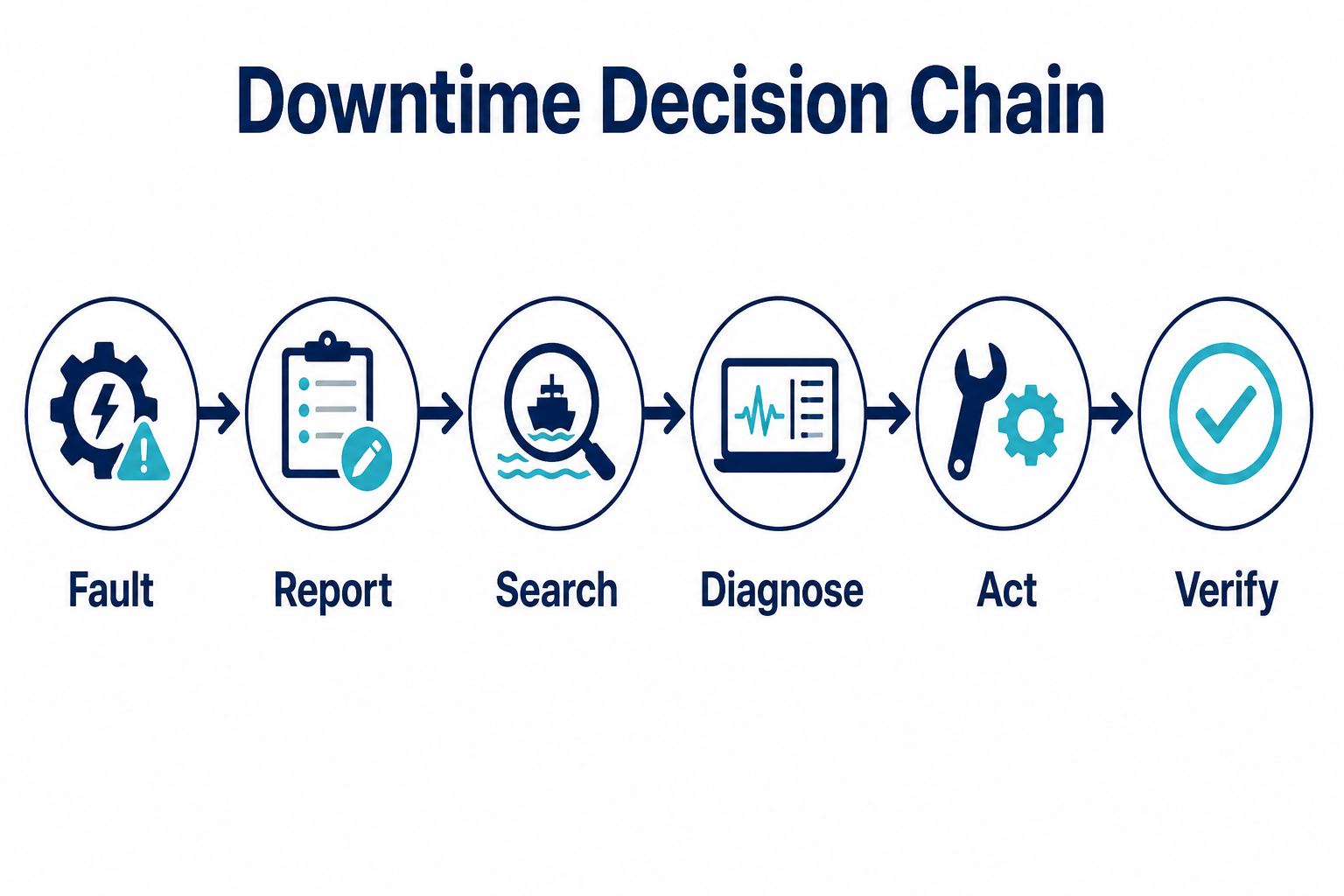
Downtime often increases before the actual repair begins.
For a repeated generator trip, shore may still need alarm details, load conditions, temperatures, pressures, recent maintenance, previous occurrences and checks already completed.
Several emails may be exchanged before troubleshooting starts, followed by separate searches across manuals, PMS records and defect history.
This creates a typical delay chain:
Fault → Report → Clarify → Search → Diagnose → Act → Verify
AI helps reduce these gaps by bringing relevant information together earlier, allowing technical teams to move from fault reporting to action faster.
A message such as “No. 2 generator tripped again” rarely gives shore enough information to act.
An AI-supported workflow can prompt the vessel for equipment-specific details such as alarms, load, temperatures, pressures, recent maintenance and checks already completed.
The aim is not longer reporting. It is a better first report, so troubleshooting can begin sooner.
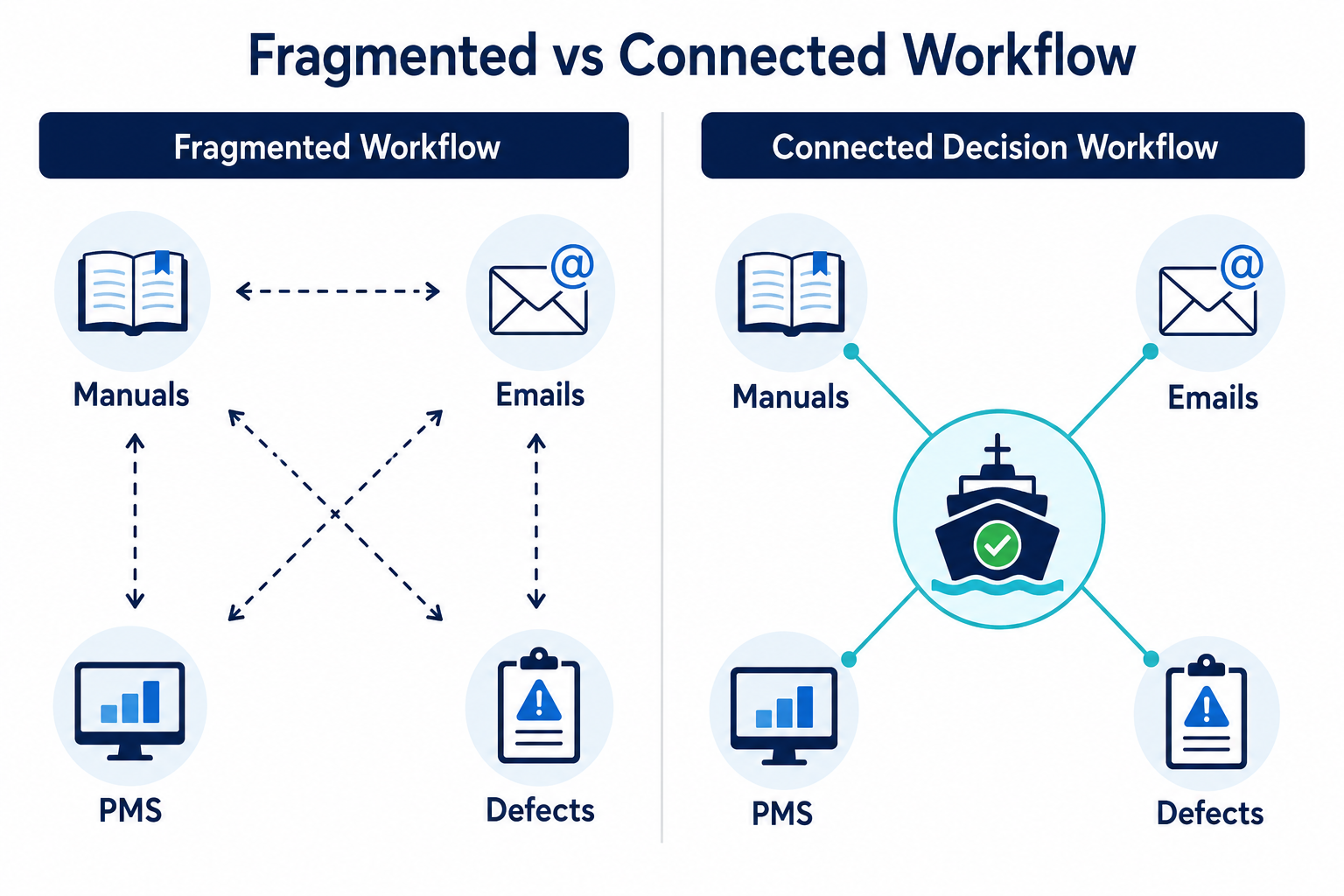
Engineers often need to review manuals, operating data, maintenance records, previous defects and OEM guidance before deciding what to do next.
Traditional workflows require these sources to be searched separately.
AI can bring relevant information together around the equipment and symptoms being investigated, helping technical teams reach useful evidence faster.
Source visibility remains important so users can distinguish approved guidance from historical records and AI-generated interpretation.
A resolved defect should not become forgotten history.
If another vessel later experiences similar symptoms on the same equipment, AI can help surface previous cases based on maker, model, alarm, symptoms and corrective action.
The earlier repair should not be copied automatically, but it can provide a stronger starting point and reduce repeated investigation.
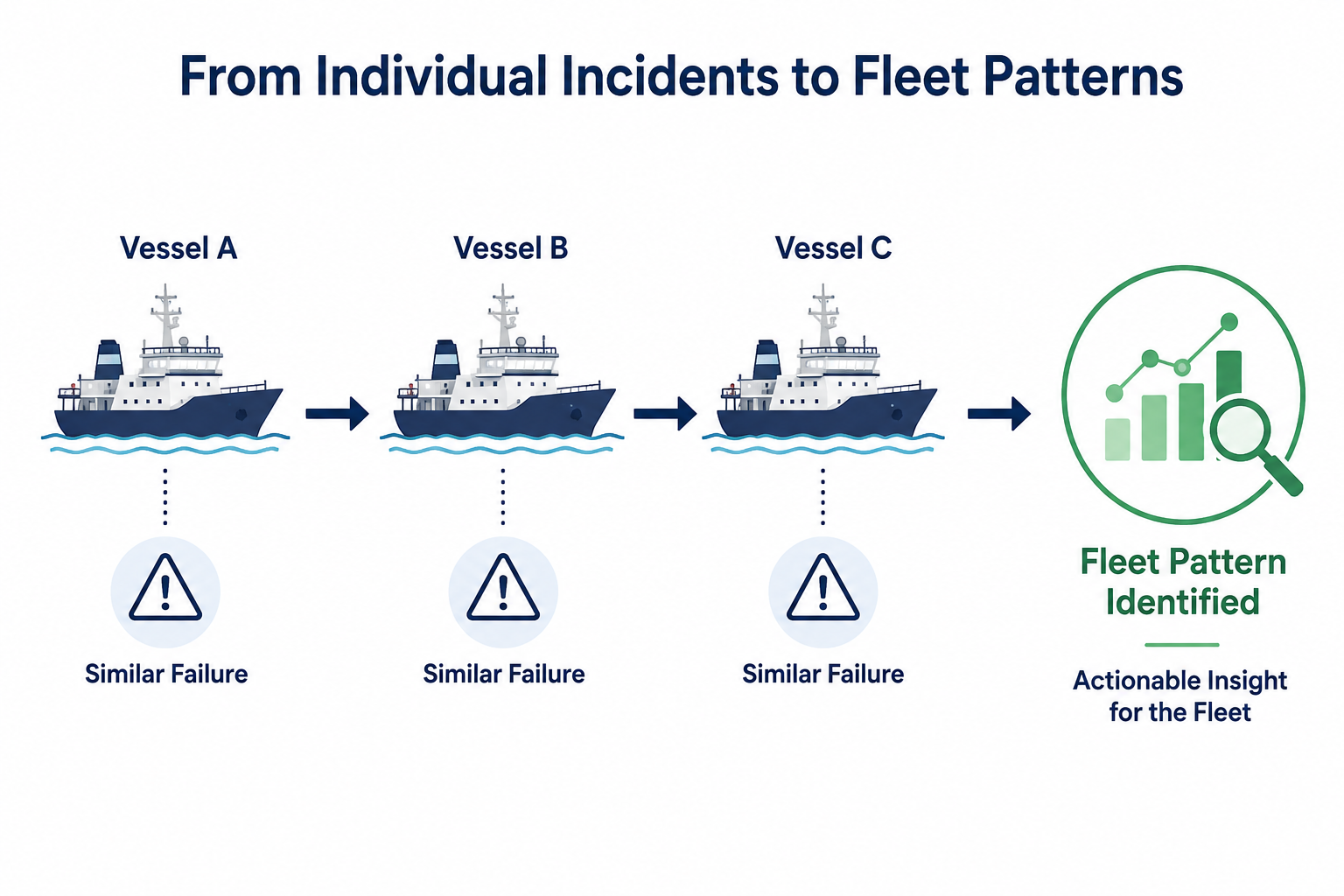
A closed defect can return weeks later.
AI-supported analysis can connect:
Symptom → Repair → Maintenance → Recurrence → Similar Vessel
This helps fleet teams identify recurring patterns that may be difficult to see when defects are reviewed individually.
Instead of asking only, “Has this happened before?”, teams can ask, “Where else did it happen, what was done, and did it return?”
Vessel teams understand the current machinery condition, while shore teams often have wider access to fleet history and previous repairs.
AI can bring both views together by connecting the current report, manuals, maintenance history, previous defects and sister-vessel cases.
This creates a clearer shared operational picture and reduces repeated emails, searches and clarification cycles.
Consider a vessel reporting high bearing temperature on a seawater pump.
The technical team collects:
The system surfaces the relevant maker temperature limits and bearing inspection guidance.
Two similar historical cases are identified.
One involved lubrication.
Another involved shaft misalignment following bearing replacement.
The current vessel shows rising temperature and vibration shortly after overhaul.
This does not prove misalignment.
But it gives the engineering team a more focused investigation path than beginning with a generic list of possible pump failures.
After repair, the confirmed cause and verification are recorded.
The next vessel experiencing similar symptoms can benefit from that learning.
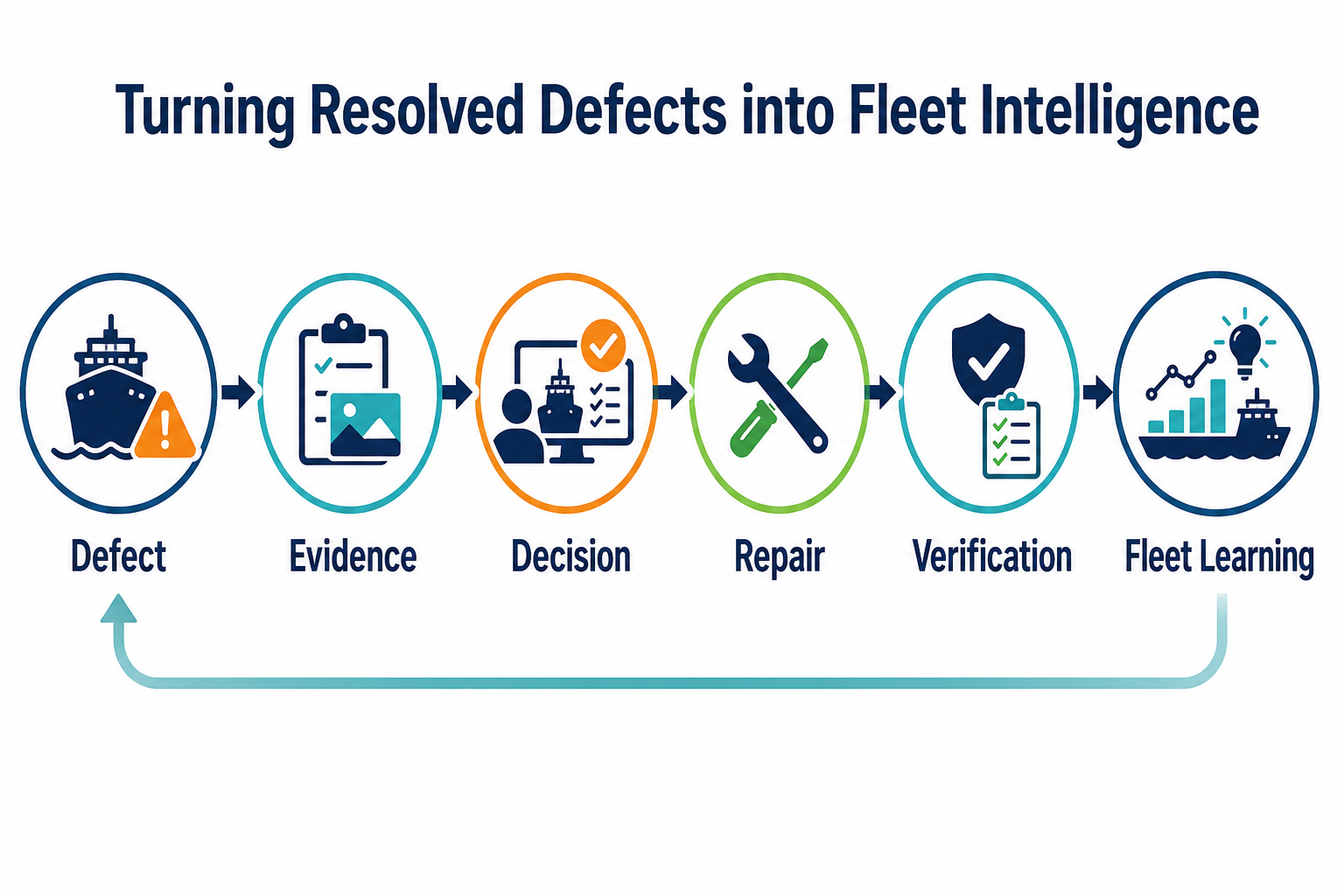
This creates a simple operational cycle:
Defect → Evidence → Decision → Repair → Verification → Fleet Learning
IoT sensors and machinery-condition systems are increasingly important sources for predictive maintenance.
Typical inputs may include:
These signals can help identify developing deterioration before equipment fails.
However, detecting abnormal behaviour is only part of the maintenance decision.
The technical team must still determine:
This highlights the difference between predictive and prescriptive support.
Predictive maintenance helps indicate what may happen.
Prescriptive decision support helps engineers determine what action should be considered next.
AI can help connect sensor signals with manuals, defect history and maintenance records so the engineering team has better context when making that decision.
Engineering judgement remains essential.
This is where SmartSeas.AI becomes relevant.
SmartSeas.AI helps maritime teams connect technical knowledge and historical fleet information around the vessel problem being investigated.
Instead of searching manuals, technical defects, incident records and previous fleet experience individually, teams can use AI-powered maritime troubleshooting to surface relevant information together.
For example, a fleet manager investigating a recurring machinery alarm may need to know:
SmartSeas.AI helps make these connections easier to access.
The principle is simple:
AI should help the technical team reach evidence faster-not replace the technical team.
This supports SmartSeas.AI's mission of transforming maritime operations through AI-powered decision-making while keeping maritime expertise at the centre of the process.
Fleet operators do not need to connect every system from day one.
A focused implementation is usually more practical.
Good starting points include:
Avoid objectives such as:
“Implement AI across the fleet.”
Choose something measurable:
“Reduce the time required to retrieve relevant technical information during machinery troubleshooting.”
For technical troubleshooting, the first sources may include:
Additional systems can be integrated once the workflow is proven.
AI-generated guidance should not become a black box.
Users should be able to identify whether information came from:
Source visibility helps technical teams verify recommendations before acting.
A record stating:
“Pump repaired. Tested satisfactory.”
provides little future value.
A stronger closure record includes:
Every properly documented defect improves future fleet learning.
Useful indicators include:
The objective is not to prove that people are using AI.
The objective is to show that operational decisions are becoming faster or better.
Maritime AI has clear limitations.
Incomplete vessel reports, incorrect equipment tags or inaccurate maintenance records can lead to weak results.
Maker manuals, class requirements, statutory obligations and company procedures remain authoritative where applicable.
A repair that worked on one vessel may not be suitable for another vessel operating under different conditions.
AI can retrieve, compare and organize information.
Chief engineers, superintendents and fleet managers still need to assess the evidence and determine the correct action.
Greater ship-to-shore connectivity also creates additional cyber exposure. Permissions, data governance and secure system architecture should therefore form part of any maritime digitalization programme.
The biggest opportunity in AI-powered fleet management is not simply faster search.
It is the ability to make every solved problem more useful to the rest of the fleet.
A vessel reports a defect.
The crew collects evidence.
The technical team identifies the cause.
The repair is verified.
The knowledge is recorded.
The next vessel experiencing a similar problem begins with stronger information.
Over time, fleet management becomes less dependent on isolated systems or individual memory.
That is the shift from storing operational information to building fleet intelligence.
Shipping companies already have valuable information inside manuals, PMS systems, defect reports, sensor platforms, service records and technical correspondence.
The challenge is getting the right information to the right technical person when a decision has to be made.
AI-powered fleet management can help reduce that gap.
It can improve vessel reporting, connect technical records, surface historical defects, highlight repeated failures and strengthen ship-to-shore visibility.
But the strongest maritime AI workflows keep one principle clear:
AI retrieves.
AI connects.
AI compares.
Maritime professionals decide.
Fleet operators should therefore begin with one operational problem rather than a broad AI programme.
Connect the most relevant knowledge.
Keep the source visible.
Measure the operational result.
Then expand.
That is how maritime AI can become a practical tool for reducing downtime and supporting better fleet decisions.
SmartSeas.AI helps fleet teams connect manuals, technical defects and operational knowledge so engineers and superintendents can investigate vessel problems with greater clarity.
Explore how SmartSeas.AI can support faster maritime troubleshooting and connected fleet decision-making.
AI-powered fleet management uses artificial intelligence to help maritime teams retrieve, connect and analyze vessel and fleet information to support operational decisions.
AI can reduce time spent collecting information, searching manuals, reviewing historical defects and identifying relevant previous cases during troubleshooting.
AI can support diagnosis by organizing possible causes and relevant evidence, but engineers should verify recommendations against actual vessel conditions and approved guidance.
Useful information includes equipment manuals, defect records, PMS history, sensor data, alarms, service reports, OEM advisories and sister-vessel experience.
Yes. AI can help identify similar symptoms, equipment, maintenance activity and repairs across vessels, allowing fleet teams to investigate possible recurrence patterns.
Start with a clearly defined operational problem, connect the most relevant data sources, test the workflow on a limited fleet scope and measure operational improvements before expanding.

Get Started Today
Transform the way you troubleshoot and manage maritime operations. Join the next wave of Maritime Digital Transformation with SmartSeas AI.




.svg)


.png)