.jpg)
August 28, 2026
How AI-Powered Fleet Management Improves Troubleshooting, Maintenance, and Fleet Visibility

August 28, 2026
A vessel machinery problem is often slowed not by a lack of information, but by how difficult that information is to find and connect.
AI-powered fleet management helps technical teams bring together vessel reports, manuals, maintenance history, previous defects, alarm data, and sister-vessel experience around the issue being investigated.
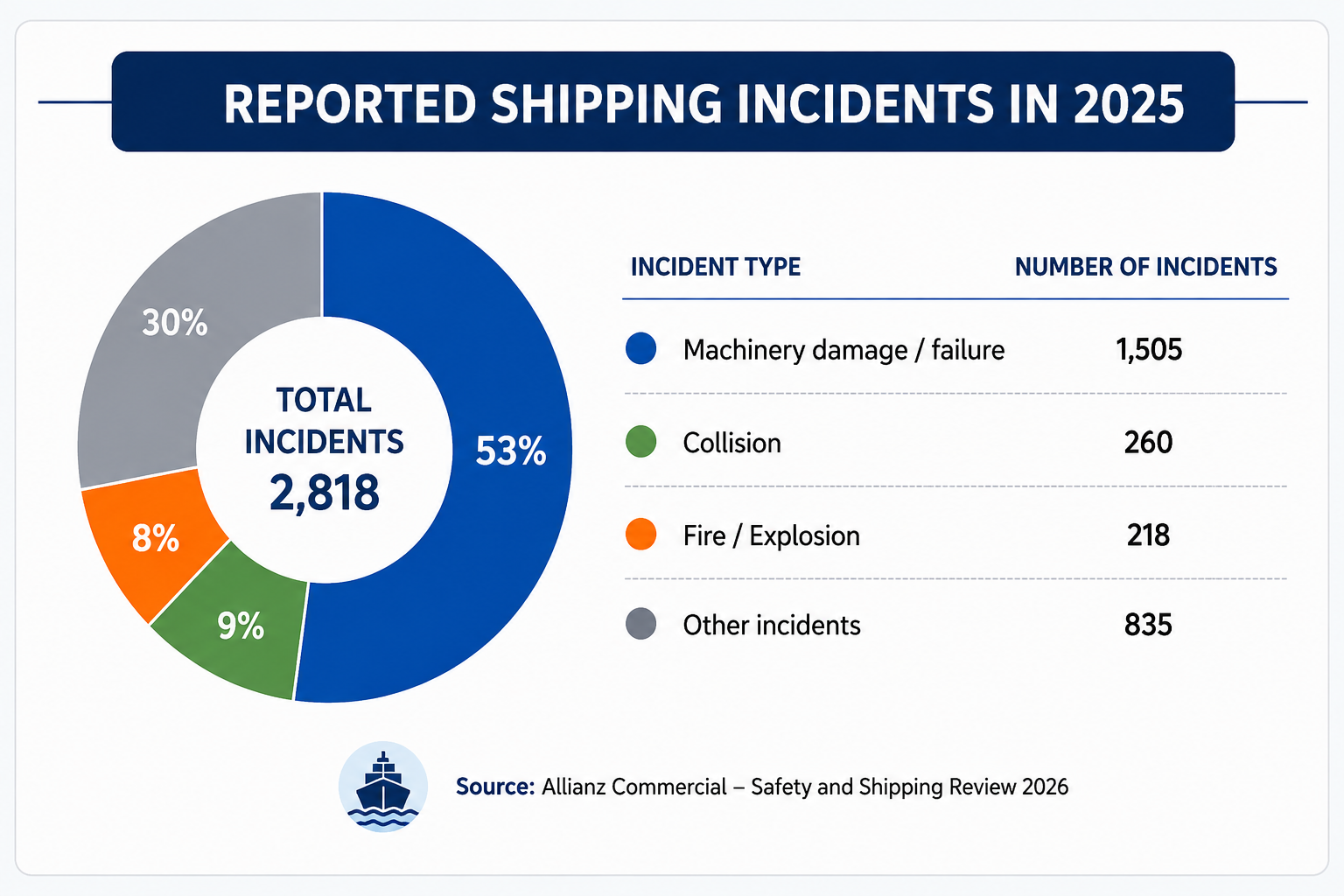
The need is clear. Allianz Commercial's Safety and Shipping Review 2026 recorded 2,818 reported shipping incidents in 2025, including 1,505 machinery damage or failure incidents—more than half of the total.
AI cannot prevent every machinery failure, but it can help teams troubleshoot faster, improve maintenance decisions, and identify recurring technical patterns across the fleet.
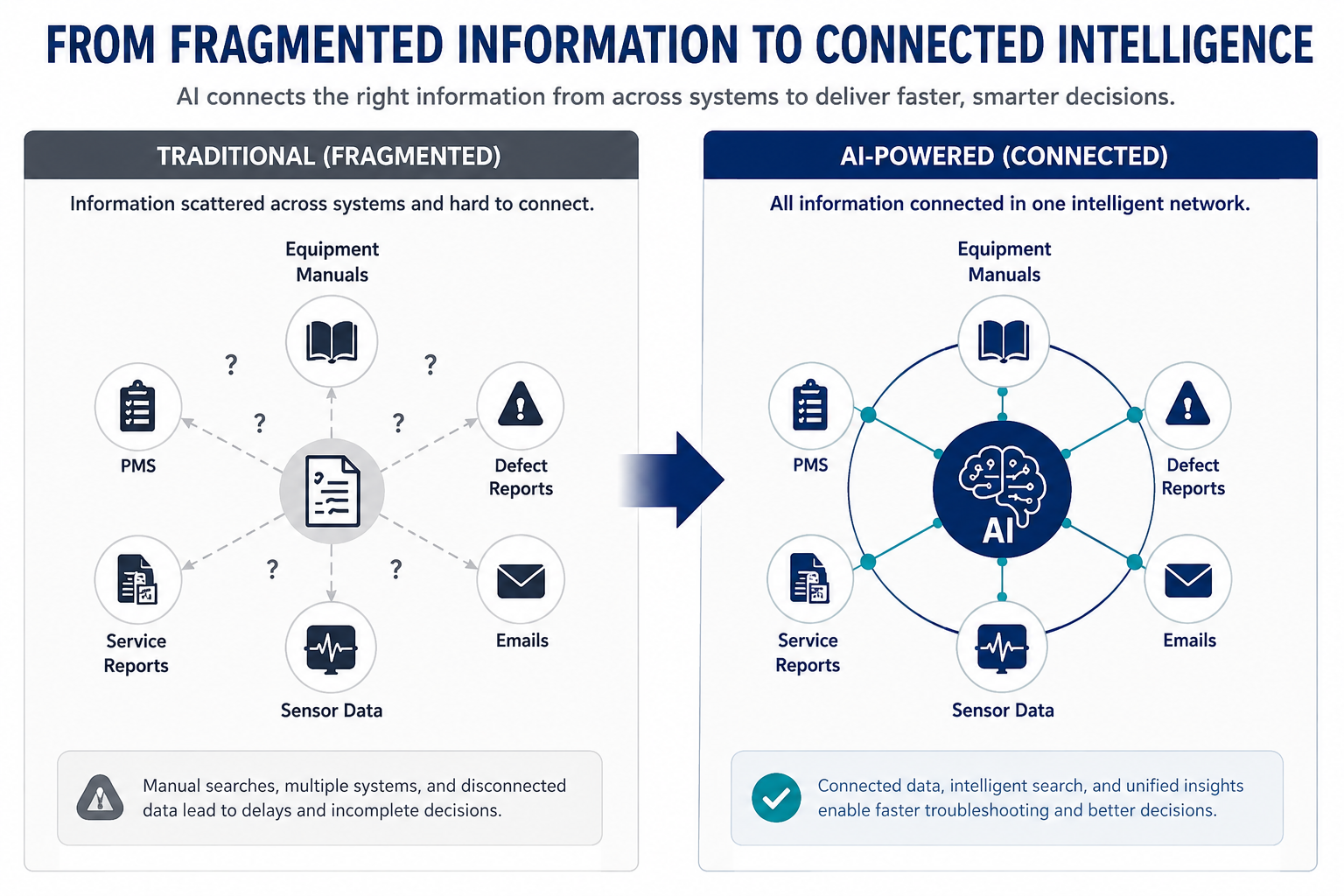
Ships now generate large amounts of technical data from PMS, machinery alarms, IoT sensors, defect reports, manuals, emails, service reports, and inspections.
The challenge is not always collecting more data. It is connecting the right information quickly enough to support a technical decision.
For example, a recurring cooling-water pump problem may require the manual, recent maintenance, operating readings, previous defects, and sister-vessel experience to be reviewed together.
This need for better-connected data also reflects wider industry change. In 2026, IMO’s Facilitation Committee approved its Strategy on Maritime Digitalization, with a focus on interoperability, data exchange, and more effective use of maritime information.
For fleet operators, the key question is:
How can existing vessel data be turned into faster technical decisions?
AI-powered fleet management uses artificial intelligence to connect vessel information, technical documentation, maintenance records, and fleet history around operational decisions.
It does not simply mean placing a chatbot inside ship management software.
A useful AI-supported workflow should help teams understand:
The strongest applications can be grouped into three areas:
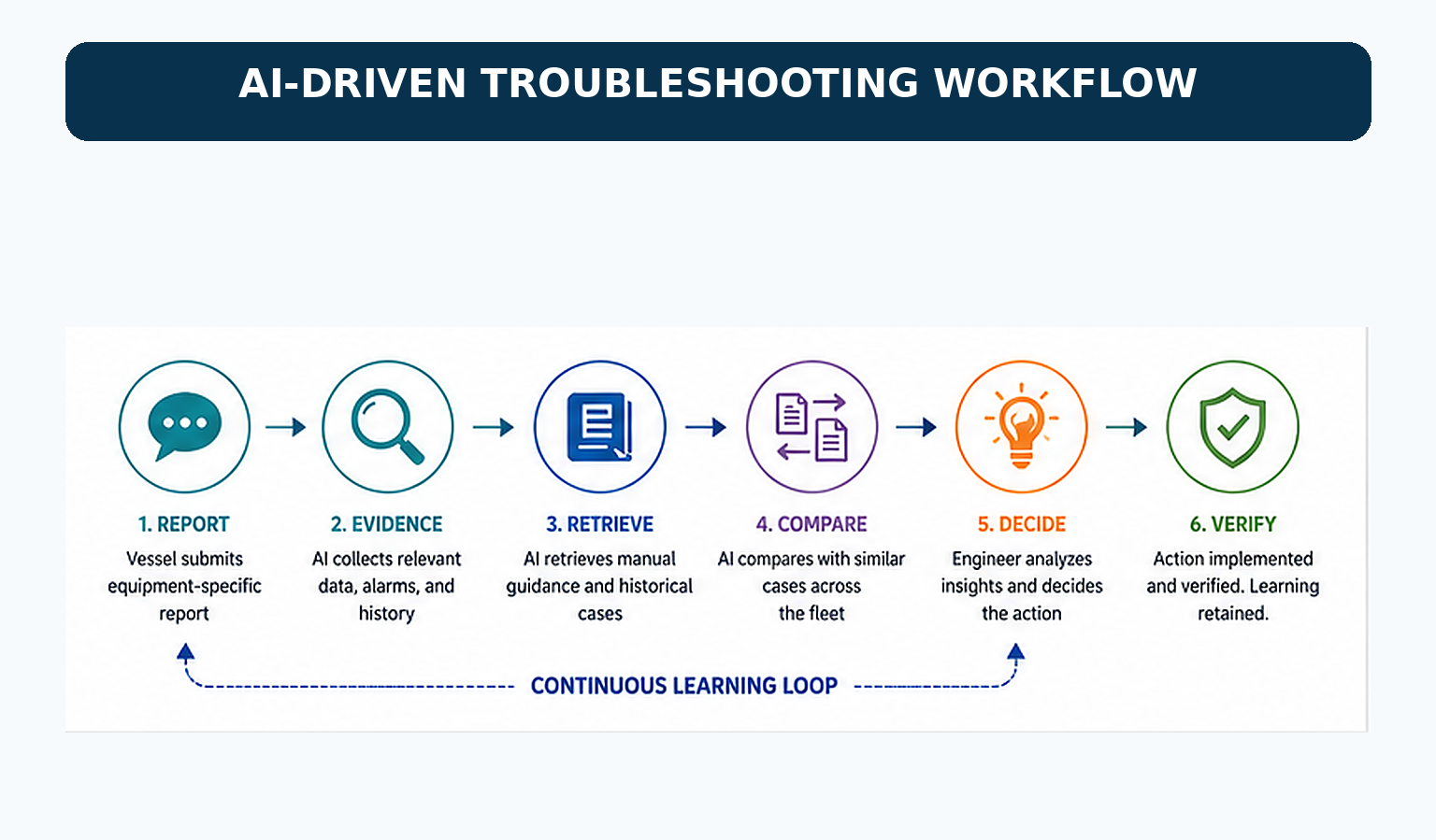
Troubleshooting often starts with a message such as:
“No. 2 generator tripped again. Please advise.”
That is rarely enough for diagnosis. Shore may still need load, alarm sequence, temperatures, pressures, recent maintenance, previous occurrences, and checks already completed.
AI can improve the first report by asking equipment-specific questions. A generator fault may require load and temperature data, while a pump problem may require suction pressure, discharge pressure, motor current, and valve position.
The aim is not to make reporting longer. It is to make the first report more useful, so shore teams can begin troubleshooting with better evidence.
Marine equipment manuals can be difficult to search during an active fault, especially when vessel terminology differs from the manufacturer's wording.
For example, “lubricating-oil pressure fluctuating” may appear in a manual under pressure instability, suction restriction, pump cavitation, or relief-valve malfunction.
AI-supported search can use the equipment and symptom context to surface relevant manual sections faster.
The source should always remain visible so engineers can distinguish between maker guidance, company procedures, historical records, and AI interpretation.
AI should accelerate access to trusted technical information, not replace approved sources.
A fleet may already have experienced a similar problem, but different vessels often describe the same fault differently.
For example:
Traditional keyword searches may not connect these records.
AI can compare equipment, symptoms, alarms, operating conditions, and repair history to identify similar cases across the fleet.
This can help superintendents see what was previously inspected, repaired, identified as the root cause, and whether the problem returned.
Previous repairs should not be copied automatically, but they can provide valuable evidence for the current investigation.
Troubleshooting restores equipment, but maintenance must also answer:
Why did the problem occur, and how can recurrence be reduced?
This requires connecting defect history with maintenance records and machinery-condition data.
AI does not replace sensors or condition-monitoring systems. Predictive maintenance depends on reliable data such as:
DNV has highlighted how sensor monitoring and digital models can improve understanding of asset condition and support predictive and preventive maintenance.
A practical AI-powered fleet management workflow is:
Sensor data → Condition change → Technical context → Engineering decision
AI helps connect these stages so technical teams can move from detecting deterioration to making better-informed maintenance decisions.
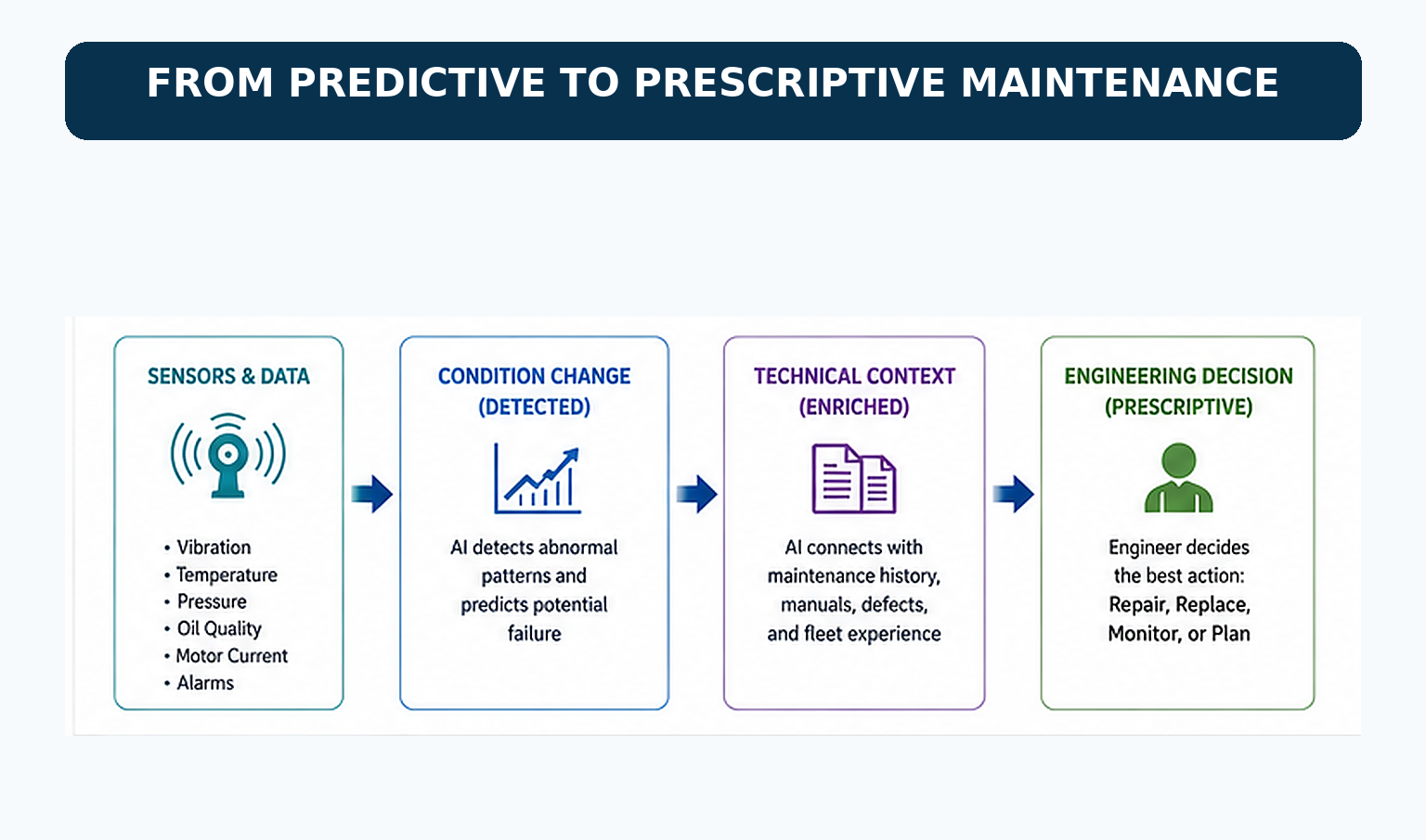
Predictive maintenance may indicate:
“This equipment is deteriorating.”
But the technical team still needs to decide what to do next.
If vibration is increasing on a seawater pump, the superintendent may need to review overhaul history, bearing replacement, alignment records, maker guidance, sister-vessel failures, and spare availability.
AI can connect the condition alert with this technical history.
This helps move the workflow from detecting deterioration to supporting a practical maintenance decision.
AI does not decide whether equipment should be stopped, repaired, or monitored. It provides the context engineers need to make that decision.
Closing a defect does not always mean the underlying problem has been resolved.
High temperature → Component replaced → Defect closed → High temperature returns
Viewed separately, each job may appear complete. Viewed together, they show recurrence.
AI can connect repeated symptoms, repairs, and component replacements to help teams investigate possible causes such as:
The value is not that AI automatically determines the root cause. It makes recurring patterns easier for engineers to identify and investigate.
Technical fleet visibility goes beyond vessel position, voyage performance, or fuel consumption.
Fleet teams also need to know:
AI-powered fleet management can connect these records and help teams move from vessel-by-vessel review toward fleet-wide pattern recognition.
For example, four vessels may report:
If they use the same equipment model and show similar repair histories, AI can help surface a possible common pattern for engineering review.
The question changes from:
“How many defects are open?”
to:
“Are these defects connected?”
The vessel and shore team often hold different parts of the technical picture.
The vessel sees the immediate condition, readings, sounds, and checks completed.
The shore team may have access to previous failures, OEM guidance, maintenance history, spare availability, and sister-vessel experience.
AI can bring these sources into a shared technical context, reducing unnecessary clarification cycles and improving operational transparency.
Ship-to-shore communication remains essential. AI helps make that communication more focused.
This is where SmartSeas.AI becomes relevant.
SmartSeas.AI helps maritime teams connect manuals, technical defects, maintenance records, and previous fleet experience around the problem being investigated.
A superintendent dealing with a recurring fault can more quickly review:
SmartSeas.AI supports AI-powered maritime troubleshooting by helping engineers reach relevant technical evidence faster.
The goal is not to replace engineering judgement, but to reduce the time spent searching for the information needed to make a sound technical decision.
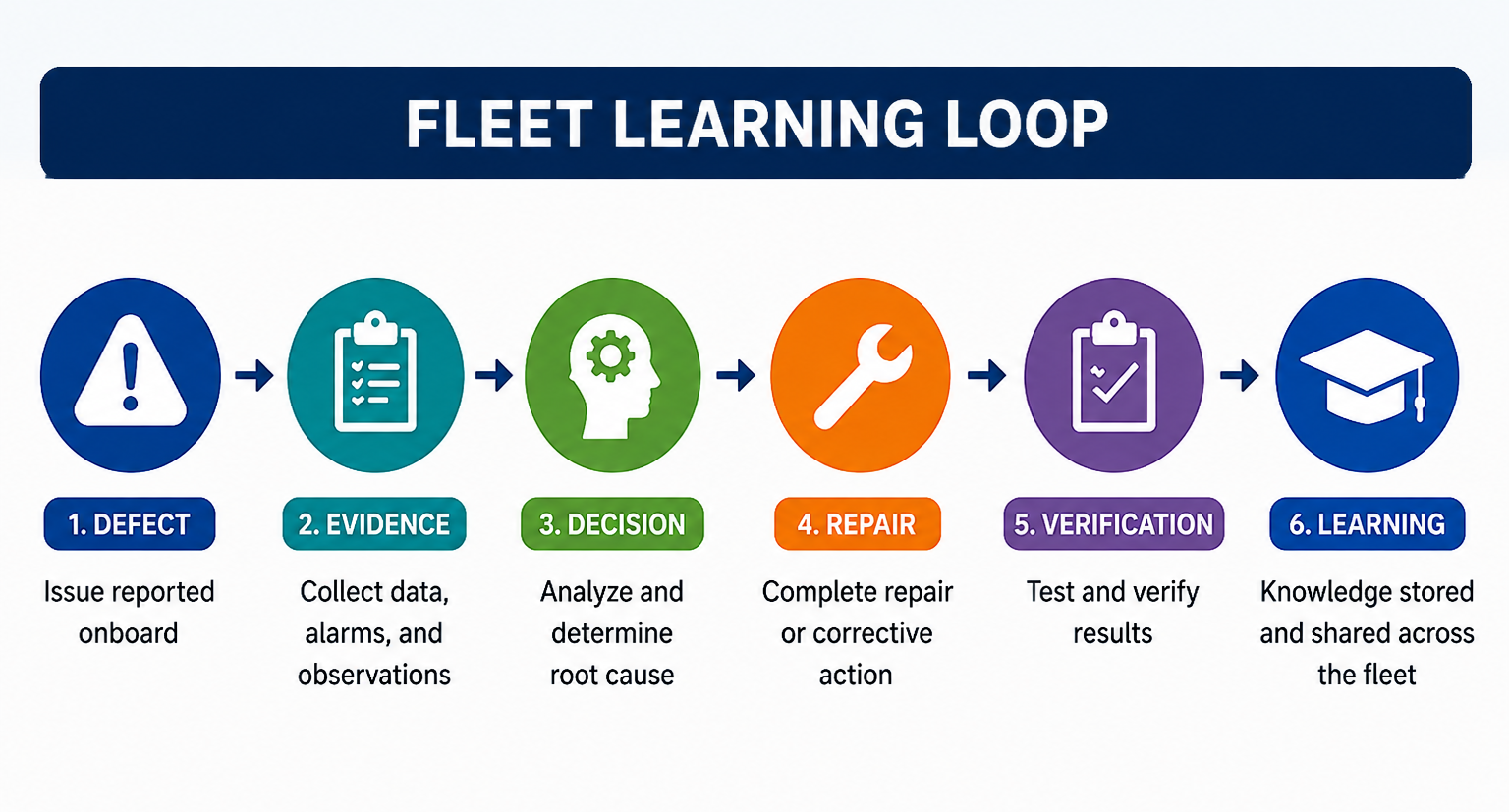
Every resolved defect can create useful knowledge.
But much of that knowledge is lost in short closure notes such as:
“Pump repaired. Tested satisfactory.”
A more valuable closure record includes:
This creates a simple fleet learning loop:
Defect → Evidence → Decision → Repair → Verification → Learning
When this information becomes searchable, one vessel's experience can support another vessel later.
This is one of the strongest long-term benefits of AI-powered fleet management.
Focus first on where technical teams lose time, such as repeated failures, slow troubleshooting, difficult manual searches, or poor sister-vessel knowledge sharing.
Bring together the sources engineers need most, including manuals, PMS records, defect history, sensor data, service reports, and OEM guidance.
The goal is not always to replace existing systems, but to connect them better.
Users should be able to distinguish between manuals, procedures, historical records, sensor data, and AI interpretation.
AI cannot physically inspect machinery or verify whether a component is functioning correctly. Qualified maritime professionals must remain responsible for technical decisions.
AI-supported fleet management depends on reliable data.
Poor equipment naming, incomplete records, inaccurate sensor data, and incorrect AI interpretations can reduce its value.
Cybersecurity also matters as vessel and shore systems become more connected. UNCTAD’s Review of Maritime Transport 2025 highlights the need to balance digitalization with stronger cyber resilience.
Safe adoption depends on:
Useful indicators include:
These measures show whether AI is genuinely improving fleet operations.
Shipping companies already hold large amounts of technical knowledge. The challenge is making it accessible when ship and shore teams need it.
AI-powered fleet management can connect vessel reports, manuals, maintenance history, machinery-condition data, previous defects, and sister-vessel experience into a clearer decision workflow.
For troubleshooting, this means faster access to relevant evidence. For maintenance, it means better context around equipment condition and recurring failures. For fleet visibility, it means identifying technical patterns across vessels.
The goal is not autonomous engineering. It is better-informed engineering.
SmartSeas.AI helps maritime teams connect technical knowledge so they can troubleshoot faster, make clearer maintenance decisions, and reuse fleet experience more effectively.
Explore how SmartSeas.AI can support AI-powered troubleshooting and technical decision-making across your fleet.
AI-powered fleet management uses artificial intelligence to connect vessel data, manuals, defects, maintenance records, and fleet experience to support faster operational decisions.
AI can improve fault reporting, retrieve relevant technical guidance, connect previous defects, and organize evidence around the problem being investigated.
No. Sensors remain important sources of machinery-condition data. AI helps connect those signals with maintenance history and technical information.
AI can help identify technically similar defects across vessels even when the wording of individual reports is different.
No. AI should support qualified maritime professionals. Technical and safety-critical decisions still require human judgement.
AI can help identify common equipment problems, repeated defects, sister-vessel patterns, and unresolved technical risks across the fleet.

Get Started Today
Transform the way you troubleshoot and manage maritime operations. Join the next wave of Maritime Digital Transformation with SmartSeas AI.




.svg)