.jpg)
September 11, 2026
Maritime Automation Tools vs Traditional Fleet Workflows: What Changes Operationally?

September 11, 2026
A generator trips at sea.
The vessel reports the fault by email. The superintendent asks for alarm details. The engineer searches the manual. Maintenance history sits in another system. A similar defect may have occurred on a sister vessel, but finding that record requires another search.
Nothing about this workflow is necessarily wrong. The problem is the amount of manual coordination required before a technical decision can be made.
This is where Maritime Automation Tools are changing fleet operations.
The objective is not simply to replace emails, spreadsheets, manuals, or experienced engineers with software. The bigger shift is from fragmented workflows—where people manually retrieve, compare, transfer and re-enter information—to connected workflows where relevant information reaches the right person earlier.
That distinction matters as maritime digitalization accelerates. In March 2026, the IMO Facilitation Committee approved a global maritime digitalization strategy emphasizing interoperability, standardization, data-sharing and data governance across maritime organizations.
So what actually changes operationally when a fleet moves from traditional workflows toward automation?
Shipping companies already operate with significant amounts of digital technology.
Vessels generate information through:
The difficulty is that digital information does not automatically create a digital workflow.
A superintendent may still copy information from an email into another system. An engineer may manually search a PDF. A technical manager may compare several spreadsheets before understanding fleet-wide trends.
DNV notes that maritime digitalization increasingly combines system integration, connectivity, automation, remote monitoring, data collection, sharing and analysis. It also highlights that sensor and system data can support monitoring, decision-making and predictive analytics.
The operational opportunity, therefore, is not simply digitizing documents.
It is reducing the number of manual steps between a problem occurring and the fleet acting on it.
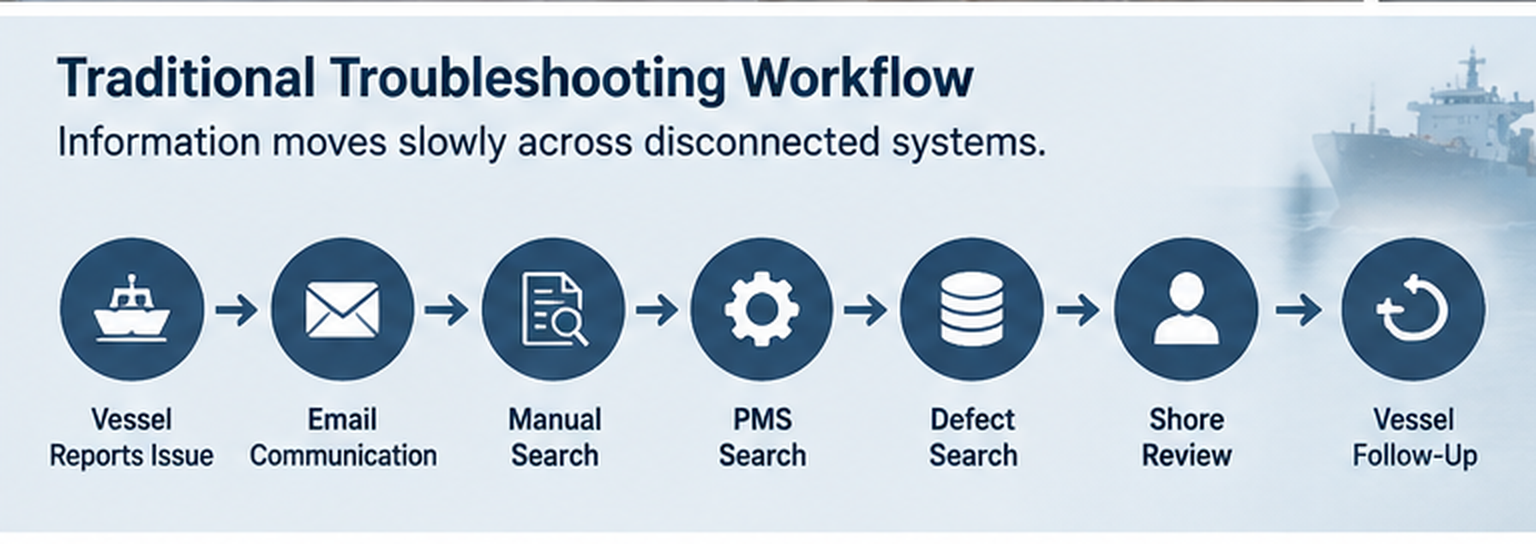
Traditional workflows usually evolved gradually.
Email solved communication.
The PMS organized maintenance.
Document-management systems stored manuals.
Spreadsheets handled additional reporting.
Defect systems tracked technical issues.
Each system may work well independently. Problems appear when one operational question requires information from several of them.
A technical superintendent may need:
In a traditional workflow, these may arrive through different systems and at different times.
The technical work therefore becomes partly a search-and-coordination exercise.
Experienced fleet personnel compensate for this through knowledge, memory and personal communication networks.
But those capabilities can be difficult to scale across larger fleets.
The biggest operational changes usually occur in five areas.

Traditional reporting often begins with free-text communication.
For example:
“No. 2 generator tripped again. Please advise.”
The superintendent then has to determine what information is missing.
A digital or AI-supported workflow can guide the crew according to the equipment and symptom.
For a generator trip, it might request:
A pump-pressure problem would trigger different questions.
Automation therefore does not necessarily make reporting longer.
It makes the first report more decision-ready.
Traditional: Report → clarification → more clarification → investigation
Automated: Guided report → relevant evidence → investigation
That can reduce repetitive ship-to-shore communication before troubleshooting begins.
A marine engineer already knows how to use a technical manual.
The operational problem is finding the correct information quickly when several sources are involved.
Traditional troubleshooting might require separate searches across:
Maritime Automation Tools can connect those sources around the equipment or fault being investigated.
Suppose a superintendent is investigating repeated high exhaust temperature.
Instead of independently searching every source, a connected workflow could retrieve:
Manual guidance → previous injector maintenance → historical exhaust-valve defects → sister-vessel cases → OEM guidance
The engineer still evaluates the evidence.
What changes is the effort required to assemble it.
This reflects the broader industry's focus on interoperability. DCSA identifies fragmentation across data, processes and technology as an obstacle to efficient shipping workflows and promotes standardized data exchange to enable automation and reduce manual processes.
Many fleet activities involve necessary but low-value repetition.
Examples include:
Traditional workflows depend heavily on personnel completing these steps manually.
Automation can handle some of the preparation while leaving approval and technical judgment with the appropriate person.
For example:
Open email → open defect system → find vessel → find equipment → search previous defect → download manual → compare information → write response.
Open issue → relevant defect history, documents and equipment context already connected → review → decide → record.
The number of systems may not even change.
The interaction between them does.
One common limitation of traditional workflows is that different people see different parts of the same issue.
The vessel knows what has physically been checked.
The superintendent sees correspondence and defect records.
The fleet manager may see the wider operational impact.
Management sees summarized KPIs.
Automation can create a more consistent operational picture by connecting:
Fault → evidence → actions → current status → technical decision → closure
This becomes particularly useful when responsibility changes between watches, vessels, superintendents or offices.
Instead of reconstructing the history from multiple emails, the next person can understand what happened and why previous decisions were made.
That is operational transparency—not merely another dashboard.
Traditional defect databases are valuable archives.
But an archive is useful only when people can find the relevant record.
Consider a fleet with several vessels using similar equipment.
Vessel A experiences a cooling-water pump problem.
The engineers investigate it, identify the cause and repair it.
Six months later, Vessel B experiences similar symptoms.
If Vessel B's superintendent does not know about Vessel A's case, much of the investigation may be repeated.
Automation and AI-supported retrieval can make historical cases easier to identify according to:
A resolved defect therefore becomes reusable operational intelligence rather than simply a closed record.
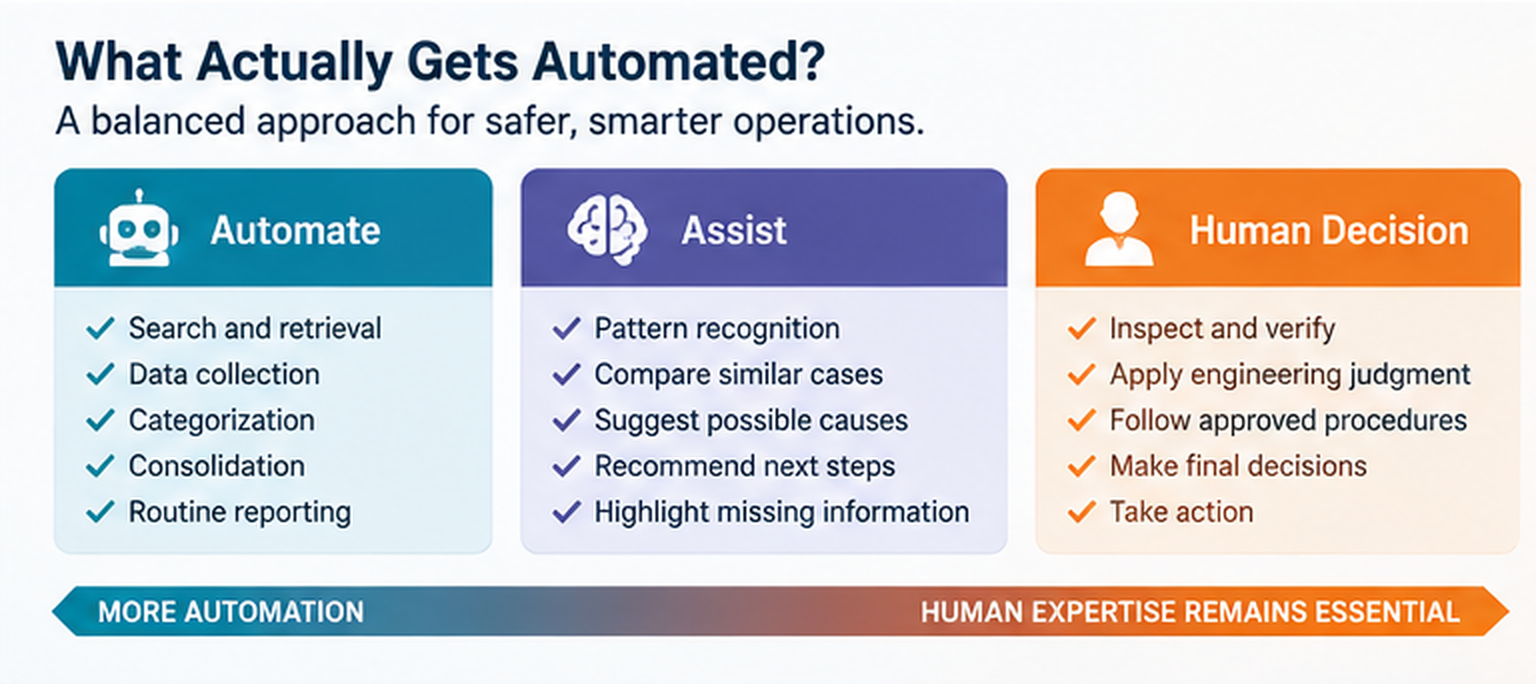
The important distinction is that automation should reduce information handling, not remove professional accountability.
Automation has limits—particularly in safety-critical environments.
Software cannot physically inspect a leaking seal.
AI cannot confirm whether a valve is actually open.
A prediction cannot prove that a bearing is damaged.
A generated troubleshooting recommendation should not override an approved procedure or maker instruction.
This is especially important as automation expands.
IMO specifically distinguishes enhanced automation from autonomous shipping: adding automated functions alone does not make a vessel a Maritime Autonomous Surface Ship. Human roles, system functions and responsibilities still need to be clearly understood.
Good maritime automation should therefore support decisions through evidence, traceability and context, rather than presenting software outputs as unquestionable instructions.
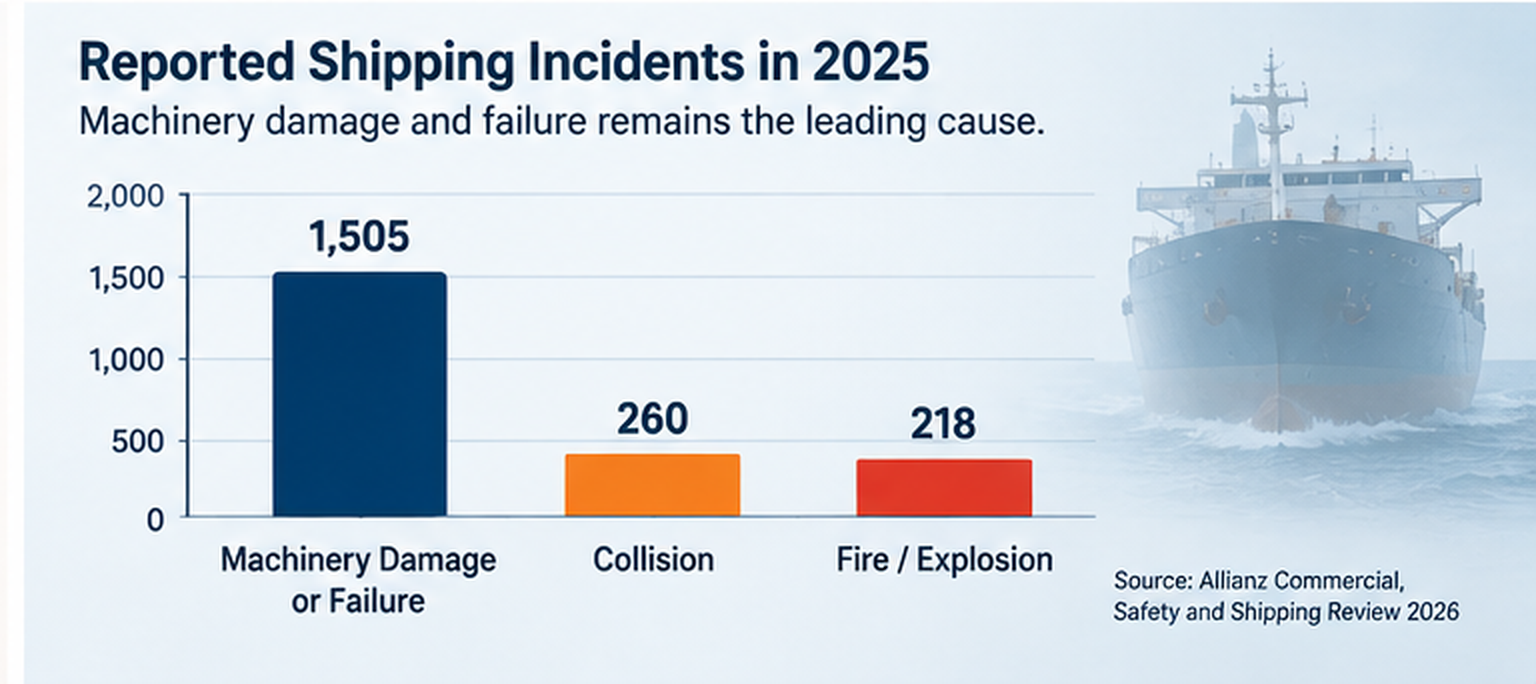
The operational case becomes clearer when looking at casualty data.
Allianz Commercial's Safety and Shipping Review 2026 recorded 2,818 reported shipping incidents involving vessels over 100 GT during 2025.
Machinery damage or failure accounted for 1,505 incidents—more than half of the total. Collision followed with 260 incidents, while fire/explosion accounted for 218.
Automation cannot eliminate machinery failure.
But better information workflows can improve how teams respond when failures occur.
That includes:
The result is not "AI fixing machinery."
It is technical teams spending less time finding information and more time evaluating the problem.
This is where SmartSeas.AI becomes relevant.
SmartSeas.AI is designed around the technical decision workflow rather than simply creating another isolated source of fleet information.
It can help connect information such as:
When a vessel reports a technical problem, the objective is to help technical teams reach the relevant evidence and previous experience faster.
For example, instead of a superintendent separately searching for a manual section, previous defect and similar sister-vessel problem, an AI-powered maritime troubleshooting workflow can bring those sources together around the issue being investigated.
The engineer remains responsible for assessing the actual equipment condition and verifying the recommended action.
SmartSeas.AI's role is to reduce the information friction surrounding that decision.
Buying software does not automatically improve operations.
DNV's work on maritime digitalization highlights not only technology but also organizational redesign, skills, system integration, data management and new operating methods.
That means automation projects should address three questions.
Identify repetitive actions such as copying, searching, consolidating and chasing information.
Define clearly where engineers, superintendents, masters and managers remain responsible.
Automation becomes much less useful when information remains trapped in separate platforms.
This is why interoperability matters as much as AI capability.
More connected systems also introduce new operational risks.
Automation operating on incorrect equipment tags, incomplete maintenance history or outdated documents can produce misleading results.
AI-generated answers should not be treated as substitutes for inspection, engineering judgment or approved procedures.
Greater connectivity increases exposure.
DNV notes that increasing integration between onboard operational technology and information technology creates additional cybersecurity risks and emphasizes cybersecurity as a key requirement alongside maritime digitalization.
Technology that adds additional reporting work will struggle.
Automation should remove unnecessary steps from existing workflows rather than simply adding another platform crews must maintain.
Start with an operational problem—not an AI project.
Choose an issue such as:
Then map the existing workflow.
Ask:
Where does someone search?
Where do they copy information?
Where do they wait?
Where is information missing?
Where does the same work get repeated?
Next, connect only the information required to improve that workflow.
Measure operational outcomes such as:
Automation should earn its place through measurable operational improvement.
Shipping is moving toward more connected, standardized and automated operations.
IMO's maritime digitalization strategy, industry work on interoperability, and growing adoption of remote monitoring and AI-supported decision tools all point in the same direction.
But operational value will not come from automation alone.
It will come from using automation to remove unnecessary information handling while preserving maritime expertise, verification and accountability.
For fleet teams, that means fewer searches, fewer repeated questions, stronger ship-to-shore context and greater reuse of technical knowledge already available across the fleet.
That is the operational difference between simply digitizing fleet work and actually improving the workflow.
If your technical teams are still searching across manuals, defect records and separate systems during machinery problems, explore how SmartSeas.AI can help create a more connected troubleshooting workflow.
Book a demo or discuss a pilot with SmartSeas.AI.
Maritime automation tools are software and digital systems that automate or assist repetitive operational tasks such as reporting, monitoring, data retrieval, technical analysis, documentation and information exchange between vessels and shore teams.
They reduce manual information handling, connect operational data, improve ship-to-shore visibility and help fleet teams access relevant technical information more quickly.
No. Automation can organize data, retrieve information and support technical analysis, but physical inspection, safety decisions and engineering judgment remain human responsibilities.
Automation executes predefined or digitally enabled workflows. Maritime AI can additionally interpret information, identify patterns, retrieve context and support decision-making. The two are increasingly used together.
Automation can structure initial reports, retrieve relevant manuals, identify similar historical defects and connect maintenance information around a reported equipment problem.
Common challenges include fragmented systems, inconsistent data, cybersecurity, poor integration, crew adoption and unclear responsibility between software recommendations and human decisions.
No. IMO explicitly states that enhanced automation alone does not make a vessel a Maritime Autonomous Surface Ship. Automation can support individual fleet and vessel functions while crew remain responsible for vessel operation.

Get Started Today
Transform the way you troubleshoot and manage maritime operations. Join the next wave of Maritime Digital Transformation with SmartSeas AI.




.svg)