.jpg)
August 25, 2026
Artificial Intelligence in the Marine Industry: Transforming Shipping Operations

August 25, 2026
A vessel may already have the data needed to solve a machinery problem—alarms, operating readings, manuals, maintenance history and previous defect records. The challenge is connecting that information quickly.
This is where artificial intelligence in the marine industry is becoming useful. AI can support troubleshooting, predictive maintenance, safety, compliance and ship-to-shore decision-making by helping maritime teams find relevant information faster and identify patterns earlier.
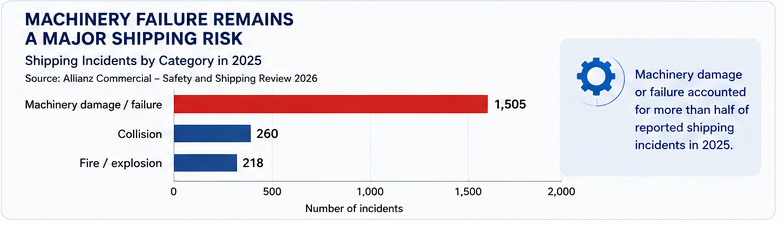
With machinery damage or failure remaining a major cause of shipping incidents, the opportunity is clear: shipping needs better ways to turn existing data into operational intelligence.
Modern vessels and shore teams already generate large amounts of information through:
The challenge is that much of this information is stored separately.
A superintendent investigating abnormal exhaust temperature may need the engine manual, operating readings, injector maintenance history and previous exhaust-valve defects.
If each source is in a different system, the delay comes from searching rather than engineering.
IMO’s 2026 maritime digitalisation strategy places emphasis on interoperability, data sharing and standardisation.
That shift is important.
Digital information becomes much more valuable when it can be connected around a real operational decision.
AI can help create that connection.
A vessel may report: “No. 2 generator tripped again. Please advise.” But meaningful diagnosis may require alarm sequences, operating readings, recent maintenance and checks already completed.
AI-supported troubleshooting can guide crews to provide more relevant evidence, retrieve applicable manuals and OEM guidance, and surface similar historical defects. This reduces repeated ship-to-shore exchanges and helps engineers begin diagnosis with better context.
The final technical decision still remains with qualified personnel.
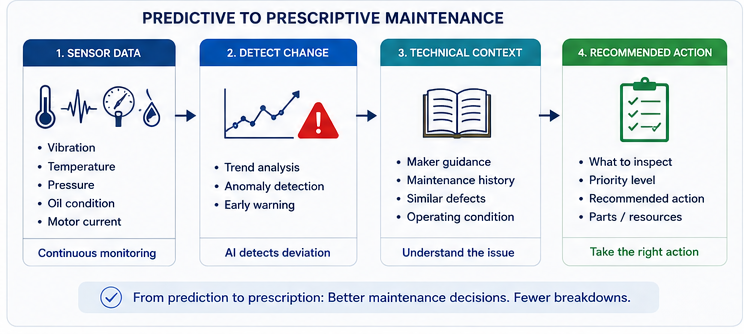
Machinery deterioration may appear through changes in vibration, temperature, pressure, motor current, oil condition or alarm frequency.
IoT sensors provide the condition data needed for predictive maintenance, while AI can connect these trends with maintenance history, maker guidance and previous defects.
Predictive maintenance identifies what may be changing. Prescriptive intelligence helps teams determine what to investigate or do next.
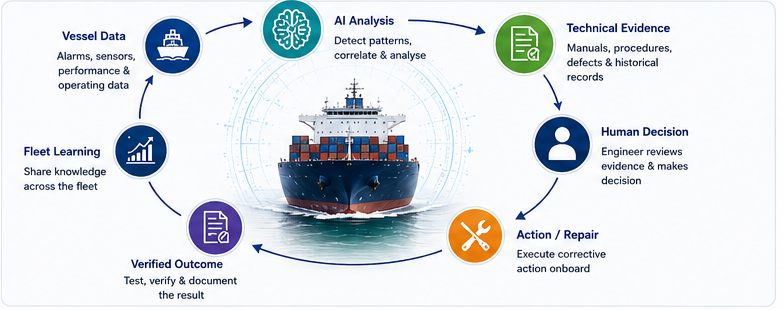
Detect → Understand → Investigate → Decide → Repair → Verify
AI can analyse speed, weather, currents, draft, trim, hull condition and engine performance to support voyage planning and fuel-efficiency decisions.
It can also help identify performance deviations—for example, whether increased fuel consumption may relate to machinery condition, hull fouling or operating conditions.
However, recommendations must still consider weather, charter requirements, machinery limits and port schedules. AI supports operational judgement rather than replacing it.
Similar defects are often recorded using different descriptions, making fleet-wide patterns difficult to detect.
Natural-language AI can connect related cases and help teams compare equipment, maintenance history, previous repairs and confirmed causes across vessels.
Instead of asking only “How do we fix this vessel?”, fleet teams can ask:
“Is the same failure pattern occurring elsewhere?”
This turns individual defect records into reusable fleet intelligence.
AI can analyse incident reports, near misses, inspection findings and corrective actions to highlight recurring patterns.
For example, separate events may reveal common issues such as weak procedures, poor familiarisation or ineffective preventive actions.
AI can help identify where further investigation is needed, but root-cause conclusions must still rely on evidence and professional judgement.
Inspection preparation often requires teams to retrieve findings, corrective actions, repair records, procedures and closure evidence from different systems.
AI can help locate and organise these records and identify repeated findings across vessels.
However, compliance information must remain traceable to approved regulations, procedures and class requirements. AI-generated summaries should support not replace the original source.
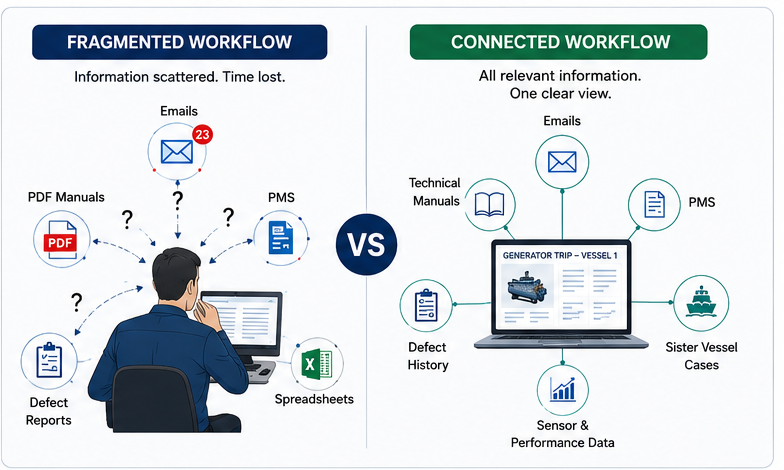
Shipping has already invested heavily in digital systems.
Yet operational information often remains difficult to use.
Manuals may be stored in one location.
PMS data in another.
Defects somewhere else.
Technical emails may sit in individual inboxes.
The systems may work well independently while the overall decision workflow remains fragmented.
The same equipment may appear as:
DG2
Generator 2
No. 2 Auxiliary Engine
This makes fleet-level search and comparison more difficult.
Engineers naturally describe problems differently.
AI can help identify semantic similarity instead of relying only on exact keywords.
A note such as:
“Valve renewed. Tested satisfactory.”
may close a defect administratively.
But it provides little useful fleet learning.
A better closure should capture:
cause, repair, verification and preventive action.
The better the fleet knowledge, the more useful AI becomes.
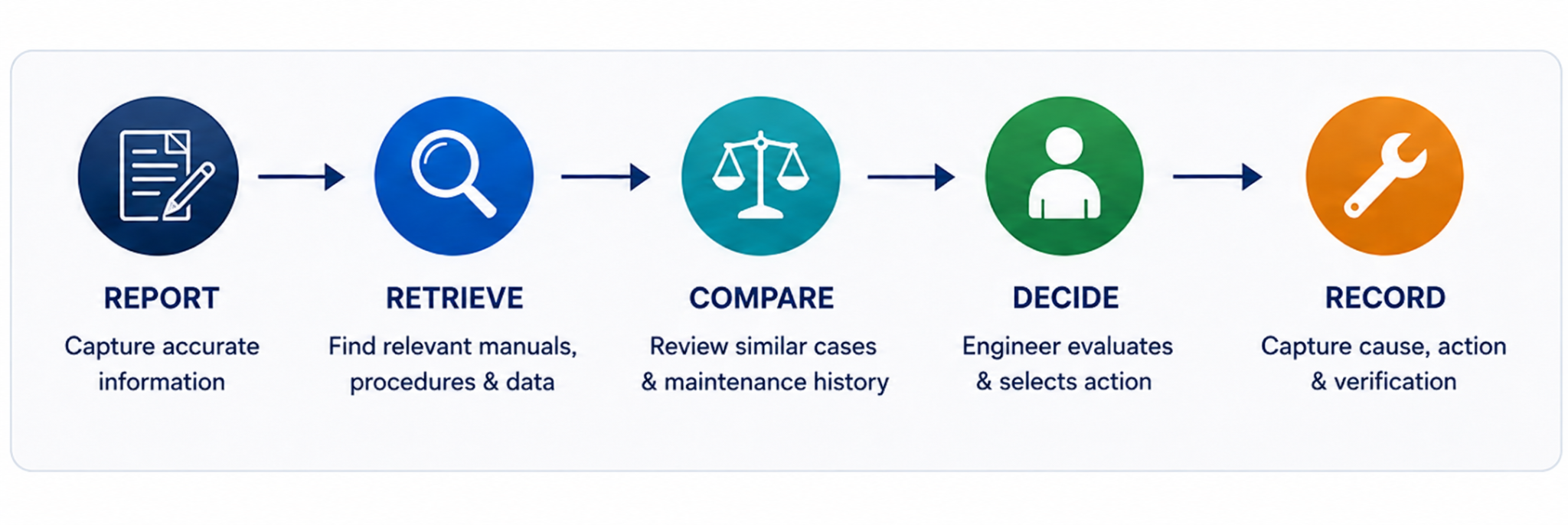
A practical AI-supported workflow can be simplified into six stages:
Report → Retrieve → Compare → Decide → Record → Learn
Capture enough evidence from the vessel.
Find relevant manuals, procedures and historical records.
Look for similar defects and maintenance history.
Allow qualified personnel to evaluate the evidence.
Capture the confirmed cause, repair and verification.
Make the completed case useful for future vessels.
That last stage is important.
Every resolved defect should improve the fleet’s ability to handle the next similar problem.
This is where SmartSeas.AI becomes relevant.
SmartSeas.AI focuses on one of the biggest operational problems in maritime technical management:
valuable fleet knowledge exists, but it is often difficult to find and connect when a real problem occurs.
SmartSeas.AI helps bring together information such as:
Instead of moving between:
email → manual → PMS → defect history → sister vessel
the technical team can work with information organised around the actual equipment issue.
This supports:
Relevant information can be surfaced earlier.
Previous repairs and sister-vessel cases can be reused.
Crew and shore teams can work from a clearer shared technical context.
AI interpretation should remain separate from approved manuals, procedures and historical evidence.
The engineer still decides.
SmartSeas.AI helps reduce the time spent searching before that decision.
AI can create operational value, but it also introduces risks.
Generative AI can produce information that sounds convincing but is incomplete or wrong.
Source verification is essential.
Incomplete or inconsistent defect records reduce the reliability of AI results.
Similar equipment names may refer to different makers or models.
The system must identify the correct vessel and equipment before retrieving guidance.
More connected systems increase the digital attack surface.
IMO and IACS continue to strengthen maritime cybersecurity requirements, making access control, governance and resilience important parts of AI implementation.
Users may trust AI recommendations too quickly.
AI should support professional judgement—not replace it.
Shipping companies do not need to begin with a fleet-wide AI programme.
A focused pilot is usually more useful.
Examples:
Identify where information sits and where delays occur.
For technical decisions, different sources should have different levels of authority.
A practical order may be:
OEM manual → approved procedure → vessel data → defect history → AI interpretation
Standardise equipment names and strengthen defect closure information.
Engineering, safety and compliance decisions should remain with qualified personnel.
Test the workflow on selected vessels and measure the results.
Useful metrics include:
AI success should be measured by operational improvement—not the number of AI searches.
The next stage of artificial intelligence in the marine industry will likely focus on connected operational intelligence.
Generic AI understands language.
Useful maritime AI must also understand:
vessels, equipment, makers, technical hierarchies and operating context.
Predictive analytics may detect abnormal machinery behaviour.
Generative AI can then retrieve relevant manuals, previous defects and recommended checks.
Together, they support a more complete technical workflow.
Agentic AI can perform multiple tasks in sequence.
In future maritime workflows, it may help:
collect defect evidence, identify missing information, retrieve technical guidance, compare similar cases and prepare a summary for superintendent review.
But greater autonomy also requires stronger controls, auditability and human approval.
Shipping does not suffer from a lack of information.
The bigger challenge is finding and connecting the right information when a decision needs to be made.
A vessel may already have the machinery data.
The maker’s manual may already contain the correct troubleshooting procedure.
A sister vessel may already have experienced the same failure.
The maintenance record may already contain the missing clue.
The problem is that these sources are often disconnected.
That is the real opportunity for artificial intelligence in the marine industry.
AI can help maritime teams reduce manual searching, identify repeated patterns, improve ship-to-shore visibility and turn completed defects into reusable knowledge.
The objective should not be AI for the sake of technology.
It should be:
better maritime decisions supported by reliable data, trusted technical evidence and experienced human judgement.
For SmartSeas.AI, that means practical AI that helps fleet teams troubleshoot faster, improve operational clarity and make better-informed technical decisions.
It refers to technologies such as machine learning, generative AI, predictive analytics and optimisation used to improve maritime operations.
AI is used for troubleshooting, machinery-condition monitoring, fuel optimisation, voyage planning, safety analysis and technical information retrieval.
AI can reduce avoidable delays by helping teams retrieve technical information faster and identify similar previous defects.
It uses AI to connect equipment symptoms with manuals, historical defects and fleet experience to support faster technical investigation.
No. AI is better suited to supporting engineers with information and analysis while qualified personnel retain responsibility for technical decisions.
Incorrect answers, poor data quality, cybersecurity risks, wrong equipment context and excessive reliance on AI recommendations.
Source: Allianz Commercial, Safety and Shipping Review 2026

Get Started Today
Transform the way you troubleshoot and manage maritime operations. Join the next wave of Maritime Digital Transformation with SmartSeas AI.




.svg)