.jpg)
May 13, 2026
Benefits of Big Data in Maritime Industry: How Data-Driven Shipping Improves Safety, Efficiency, and Fleet Decisions

May 13, 2026
Big data in the maritime industry is becoming a practical advantage for shipping companies that want faster troubleshooting, lower downtime, safer vessels, stronger compliance, and better fleet-wide decisions.
Every vessel produces valuable data every day: engine alarms, fuel reports, defect histories, maintenance records, manuals, inspection findings, voyage data, port documents, and emissions records. The problem is that this information is often scattered across PDFs, emails, PMS records, spreadsheets, onboard files, and separate shore-side systems.
For fleet managers, technical superintendents, ship managers, and marine engineers, the challenge is not the lack of data. It is using the right data at the right time.
International shipping transports more than 80% of global trade, making vessel reliability, port efficiency, and supply-chain visibility critical to global commerce. Big data helps maritime teams move from reactive decisions to earlier detection, faster response, and clearer operational control.
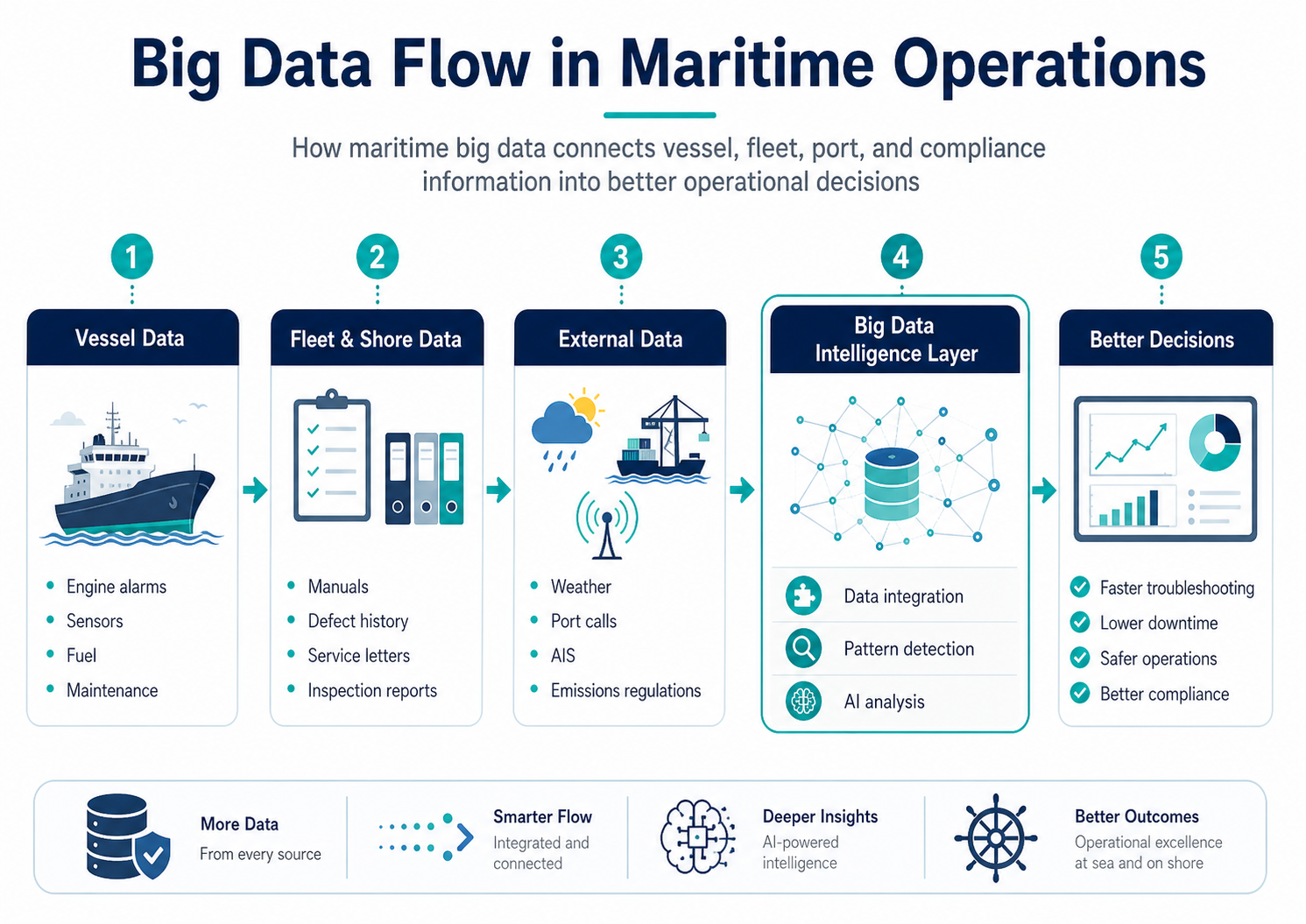
Source / data basis: IMO global trade data, IMO Maritime Single Window requirement, and UNCTAD digitalization guidance.
Shipping has always depended on experience. But modern fleets now generate more information than any person can manually process quickly.
A single vessel may produce data from engines, alarms, PMS records, voyage reports, inspections, fuel systems, and port-clearance platforms. Across a fleet, this becomes a large operational memory.
The problem is that this memory is often fragmented. Manuals, service letters, defect histories, inspection records, and fuel reports may all sit in different systems. When an urgent issue happens onboard, crew and shore teams can lose time searching instead of acting.
Big data connects these records and turns scattered information into operational intelligence.
The industry is already moving this way. IMO’s Maritime Single Window became mandatory from 1 January 2024, requiring IMO Member States to use a centralized digital platform for ship-port information exchange. UNCTAD’s Review of Maritime Transport 2024 also highlights digital technologies such as AI and blockchain for port efficiency, congestion reduction, and supply-chain resilience.
Big data in maritime means collecting and connecting large volumes of operational data from vessels, fleets, ports, maintenance systems, compliance workflows, and commercial operations.
It can include:
Engine and machinery sensor data
Alarms and fault histories
AIS, weather, route, ETA, and voyage data
Fuel and emissions records
PMS, work orders, and spare parts data
Manuals, drawings, service letters, and technical reports
Inspection findings, certificates, audits, and compliance records
Port-call and clearance information
The value appears when this data becomes searchable, connected, and useful for decisions.
Big data helps maritime teams answer practical questions faster: Which failures are repeating? Which vessel is consuming more fuel? Which defect may become serious? Which past case is similar to this issue? Which manual or service letter applies? Which compliance evidence is missing?
The value is not “more data.” The value is better action.

Source / data basis: Maritime data categories supported by IMO Maritime Single Window and IMO DCS requirements.
One of the strongest benefits of big data is faster troubleshooting.
When a vessel faces a machinery alarm or system failure, crew may need to check manuals, search previous defects, review service letters, and contact shore teams. In a manual workflow, this takes time.
Big data connects symptoms with manuals, defect histories, service letters, corrective actions, and similar fleet cases. This helps crew and shore teams find relevant information faster.
This matters because Allianz Commercial’s Safety and Shipping Review 2025 reported 1,860 machinery damage/failure incidents globally in 2024, making it the leading shipping incident category.
For fleet teams, big data makes troubleshooting less dependent on memory and manual searching. A predictive alert becomes more useful when the team can also see likely causes, similar cases, and next steps.
This is where SmartSeas.AI becomes relevant. SmartSeas.AI brings manuals, service letters, defect histories, technical reports, and operational records into one AI-powered maritime troubleshooting layer, helping ship and shore teams find the right context faster.

Source / data basis: Concept supported by Allianz Commercial 2025 machinery incident data.
2. Better Pedictive MaintenanceTraditional vessel maintenance is often based on calendar dates or running hours. This is useful, but it does not always show the real condition of equipment.
Big data supports predictive maintenance by analyzing sensor trends, alarms, operating history, failure records, and maintenance outcomes. This helps teams identify abnormal behavior earlier.
Instead of asking only, “When is this equipment due?”, fleet teams can ask: Is this equipment behaving normally? Has this fault pattern appeared before? Is vibration increasing? Should maintenance be advanced?
Wärtsilä describes predictive maintenance as using equipment condition to estimate when maintenance should be performed.
For ship managers, this means better planning, fewer unexpected failures, improved spare preparation, and more targeted maintenance.

Source / data basis: Based on Wärtsilä predictive and condition-based maintenance definitions.
Fuel is one of the largest cost areas in vessel operations. Big data helps teams understand fuel consumption in context.
A vessel may consume more fuel because of weather, speed, trim, draft, hull fouling, engine load, route deviation, waiting time, or port delays. If teams only review noon reports, the real reason may remain hidden.
A big data approach connects voyage data, weather, speed, engine load, hull condition, draft, route, port schedule, and historical performance. This supports better decisions on speed, routing, hull performance, trim, just-in-time arrival, sister-vessel benchmarking, and emissions performance.
Big data also supports compliance. IMO’s Data Collection System applies to ships of 5,000 GT and above, covering around 85% of international shipping CO₂ emissions. Since 2023, IMO DCS data has also supported CII calculations.
So fuel data is not only a cost issue. It is also a compliance and commercial-performance issue.

Source / data basis: IMO DCS requirements for 5,000 GT+ ships and CII calculations from 2023.
Maritime safety depends on early warning, pattern recognition, and clear response.
A single alarm may not look serious. One near miss may be closed as an isolated event. A minor defect may be repaired and forgotten. But when these signals are connected across vessels, equipment types, routes, and time periods, patterns begin to appear.
Big data helps identify repeated alarms, recurring near misses, repeated inspection observations, ineffective corrective actions, and higher-risk operating conditions.
Allianz Commercial reported 250 fire incidents in 2024, up 20% year-on-year. Its 2025 Safety and Shipping Review also identified machinery damage/failure as the leading incident category.
For safety teams, big data converts isolated records into preventive intelligence. It helps teams act before risk grows.

Source / data basis: Allianz Commercial 2025 shipping safety data on machinery and fire incidents.
Compliance in shipping is becoming more data-driven.
Fleet teams need to manage evidence across class, flag, port state control, ISM, MARPOL, SIRE, TMSA, IMO DCS, CII, company SMS requirements, and customer expectations.
The challenge is not only completing the work. It is proving that the work was done properly.
Big data helps connect defects, root causes, corrective actions, preventive actions, certificates, photos, inspection reports, and verification records into one evidence chain. This improves inspection readiness and reduces last-minute searching.
Digital documentation is also expanding. DCSA member carriers have committed to issuing 50% of bills of lading digitally within five years and 100% by 2030.

Source / data basis: IMO DCS, CII requirements, and DCSA electronic bill of lading commitment.
Port calls involve agents, port authorities, customs, immigration, terminals, pilots, tugs, surveyors, suppliers, charterers, and vessel managers. When information is exchanged through repeated forms, emails, calls, and manual updates, delays can happen easily.
Big data improves port-call efficiency through structured information exchange, better ETA accuracy, clearance readiness, berth planning, and stakeholder coordination.
IMO’s Maritime Single Window requirement is an important step in this direction. Since 1 January 2024, IMO Member States must use a centralized digital platform for ship-port information exchange.
Singapore’s digital PORT is a practical example. MPA Singapore stated that the platform consolidates up to 16 forms into one application and is expected to save around 100,000 man-hours annually.
For shipping companies, connected port data can reduce duplication, improve efficiency, and provide better visibility.
A common problem in fleet operations is that the vessel and shore office may not share the same operational picture.
The vessel may know the latest symptoms. The superintendent may remember a similar case. The office may have the service letter. The fleet team may see the recurring pattern.
But if these are not connected, decisions slow down.
Big data creates one connected operational context. It helps shore teams see what is happening onboard, what happened before, whether similar cases occurred elsewhere, and what actions were already attempted.
This is especially valuable during crew changes. Connected data preserves operational memory.
SmartSeas.AI helps transform scattered vessel knowledge into an AI-powered maritime intelligence layer. It brings together manuals, service letters, defect reports, emails, inspection records, and technical data so vessel and shore teams can find relevant information faster.

Source / data basis: SmartSeas.AI positioning visual, supported by IMO’s digitalization direction through Maritime Single Window.
Big data helps fleet leaders compare performance across vessels, routes, equipment types, and operating conditions.
It can benchmark fuel consumption, repeated defects, downtime, maintenance cost, alarm frequency, inspection findings, corrective-action closure time, and route performance. This helps companies identify outliers and prioritize improvement.
Big data also supports spare parts planning. If similar vessels repeatedly require the same sensor, seal, filter, bearing, or control card, the company can adjust inventory planning.
At management level, big data supports strategic decisions such as which vessels need retrofit, which equipment creates the most downtime, which routes are exposed to delay, and which digital investments are creating value.
Without connected data, these decisions may rely on assumptions. With big data, leaders can act based on fleet-wide evidence.
Seven benefits of big data in the maritime industry include troubleshooting, predictive maintenance, fuel efficiency, safety, compliance, port efficiency, and fleet benchmarking.
Source / data basis: Summary visual based on IMO, Allianz Commercial, Wärtsilä, DCSA, UNCTAD, and MPA Singapore references.
Many shipping companies already collect large volumes of data. But collecting data is different from using data.
Manual data management often misses four things.
First, it misses relationships. A defect report, manual, service letter, and previous vessel case may all be connected, but they may sit in different places.
Second, it misses recurrence. A single alarm may not look serious, but repeated across several vessels, it may reveal a wider issue.
Third, it misses speed. During a technical fault, the first few minutes matter. Searching through folders and emails delays action.
Fourth, it misses continuity. Crew changes and superintendent changes can interrupt knowledge flow. Connected data preserves operational memory.
This is why maritime digitalization should go beyond dashboards. It should create contextual intelligence that helps teams act faster.
Big data becomes more useful when combined with AI.
AI can help maritime teams search technical documents, summarize reports, match symptoms with previous cases, identify recurring defect patterns, retrieve manual sections, classify defects, and support ship-to-shore decisions.
However, AI must be grounded in trusted maritime data.
A generic AI tool cannot safely replace ship-specific manuals, OEM guidance, defect histories, or superintendent judgment. AI becomes useful when it understands vessel context, equipment context, fault history, and supporting evidence.
SmartSeas.AI is designed around this idea. It helps unify vessel manuals, service letters, defect histories, reports, and technical knowledge into an AI-powered maritime platform.
This supports faster troubleshooting, clearer ship-to-shore visibility, better knowledge continuity, and improved operational transparency.
Start with one high-impact problem. Good starting points include machinery downtime, recurring defects, fuel overconsumption, inspection preparation, or slow troubleshooting.
Identify the data needed. For troubleshooting, this may include manuals, service letters, defect histories, alarm logs, corrective actions, and maintenance records.
Standardize equipment and defect names. Inconsistent naming makes fleet-wide analysis difficult.
Connect ship and shore workflows. Crew need relevant knowledge onboard, while shore teams need visibility into vessel operations.
Make data searchable. A large document library is not enough. Teams should be able to search by symptom, equipment, vessel, system, or failure mode.
Use AI where it reduces work. AI should reduce manual searching, summarizing, classification, and comparison.
Keep maritime expertise in control. AI and big data should support expert judgment, not replace it.
Measure outcomes. Track troubleshooting time, repeat defects, downtime hours, fuel variance, inspection findings, spare part delays, and corrective-action closure time.
Big data is powerful, but it is not automatically useful.
Poor data quality can weaken analytics. Inconsistent equipment names, missing dates, duplicate records, scanned PDFs, and incomplete maintenance notes reduce value.
System fragmentation is another challenge. Many companies use separate systems for PMS, procurement, document control, voyage planning, emissions reporting, inspections, crewing, and email.
Dashboards can also become a problem if they only show what happened without explaining what to do next.
Crew adoption matters as well. If tools are slow or difficult to use, crew will not rely on them during real operations.
Cybersecurity and access control are also important. More connected systems require better governance, permissions, and security discipline.
The benefits of big data in the maritime industry are practical and operationally important.
Big data helps shipping companies troubleshoot faster, reduce downtime, improve predictive maintenance, optimize fuel consumption, strengthen safety management, improve compliance readiness, and make better fleet-wide decisions.
But the value does not come from data volume alone. It comes from connected, trusted, searchable, and actionable data.
For maritime leaders, the best way to begin is simple. Start with one repeated problem that costs time, money, or risk. Connect the data around it. Make it searchable. Apply AI carefully. Measure the outcome. Then scale.
Shipping companies do not need more scattered dashboards. They need clearer operational intelligence.
That is the direction SmartSeas.AI supports: transforming maritime operations through AI-powered decision-making, unified technical data, faster troubleshooting, and better ship-to-shore clarity.
Big data turns scattered maritime records into decision support.
It improves troubleshooting, maintenance, safety, compliance, fuel efficiency, and fleet benchmarking.
Digital requirements such as Maritime Single Window, IMO DCS, CII, and eBL adoption make data readiness more important.
AI adds value when it is grounded in trusted vessel-specific data.
SmartSeas.AI helps ship and shore teams access technical knowledge faster.
Big data in maritime refers to large volumes of vessel, fleet, port, maintenance, safety, compliance, and voyage data that can be analyzed to improve decisions.
It connects equipment symptoms with manuals, previous defects, service letters, corrective actions, and similar fleet cases, helping teams respond faster.
It analyzes equipment condition, sensor trends, alarms, operating history, and previous failures to detect abnormal behavior earlier.
Yes. It helps identify recurring alarms, defects, near misses, inspection trends, and weak signals that may indicate rising risk.
Compliance increasingly depends on structured evidence and accurate reporting. Big data helps connect defects, actions, certificates, emissions records, and inspection evidence.
AI helps search documents, summarize reports, match symptoms with past cases, identify patterns, and support faster decisions.
The main challenges are poor data quality, disconnected systems, inconsistent naming, scanned documents, cybersecurity concerns, and low crew adoption.
SmartSeas.AI helps unify manuals, service letters, defect histories, reports, emails, and technical knowledge into an AI-powered maritime platform for faster troubleshooting and better ship-to-shore visibility.

Get Started Today
Transform the way you troubleshoot and manage maritime operations. Join the next wave of Maritime Digital Transformation with SmartSeas AI.




.svg)


.png)