.jpg)
May 26, 2026
From Incident Response to Operational Control: The Role of Software and AI in Ship Safety Management


May 26, 2026
Ship safety management has traditionally focused on procedures, compliance, inspections, and incident response. But modern fleet operations are becoming too complex for fragmented workflows, scattered reports, and delayed communication.
Today’s vessels generate enormous volumes of operational data across machinery systems, bridge operations, maintenance records, defect reports, audits, alarms, and safety observations. The challenge is no longer the lack of data. The challenge is turning that data into faster and safer operational decisions.
This is where software and AI are starting to reshape ship safety management.
Maritime software is helping fleets move beyond reactive incident handling toward continuous operational control, real-time visibility, and faster decision-making across ship and shore teams.
For shipping companies operating under increasing regulatory pressure, tighter schedules, and growing machinery risks, this shift is becoming operationally important.
Maritime safety management is no longer limited to compliance documentation alone.
Fleet teams today manage:
At the same time, vessels are becoming more digitally connected.
According to the International Maritime Organization, Maritime Single Window regulations became mandatory globally from January 2024 to improve digital information exchange between ships and ports.
Source: IMO Maritime Single Window requirement.
Meanwhile, machinery damage and failure continue to remain one of the largest causes of shipping incidents globally.
According to Allianz Commercial, machinery damage or failure accounted for 1,860 shipping incidents in 2024.
Source: Allianz Safety and Shipping Review 2025.
These operational pressures are pushing fleets to modernize how safety information is managed and acted upon.
Many fleets still rely on disconnected operational workflows.
During a machinery issue or safety event, teams often search through:
This slows response time during critical situations.
In many cases, the issue is not the lack of procedures. The issue is delayed access to the right operational context.
A chief engineer may know a similar failure happened six months ago on another sister vessel. But if that information is buried inside reports or email chains, the learning is effectively lost.
The result can include:
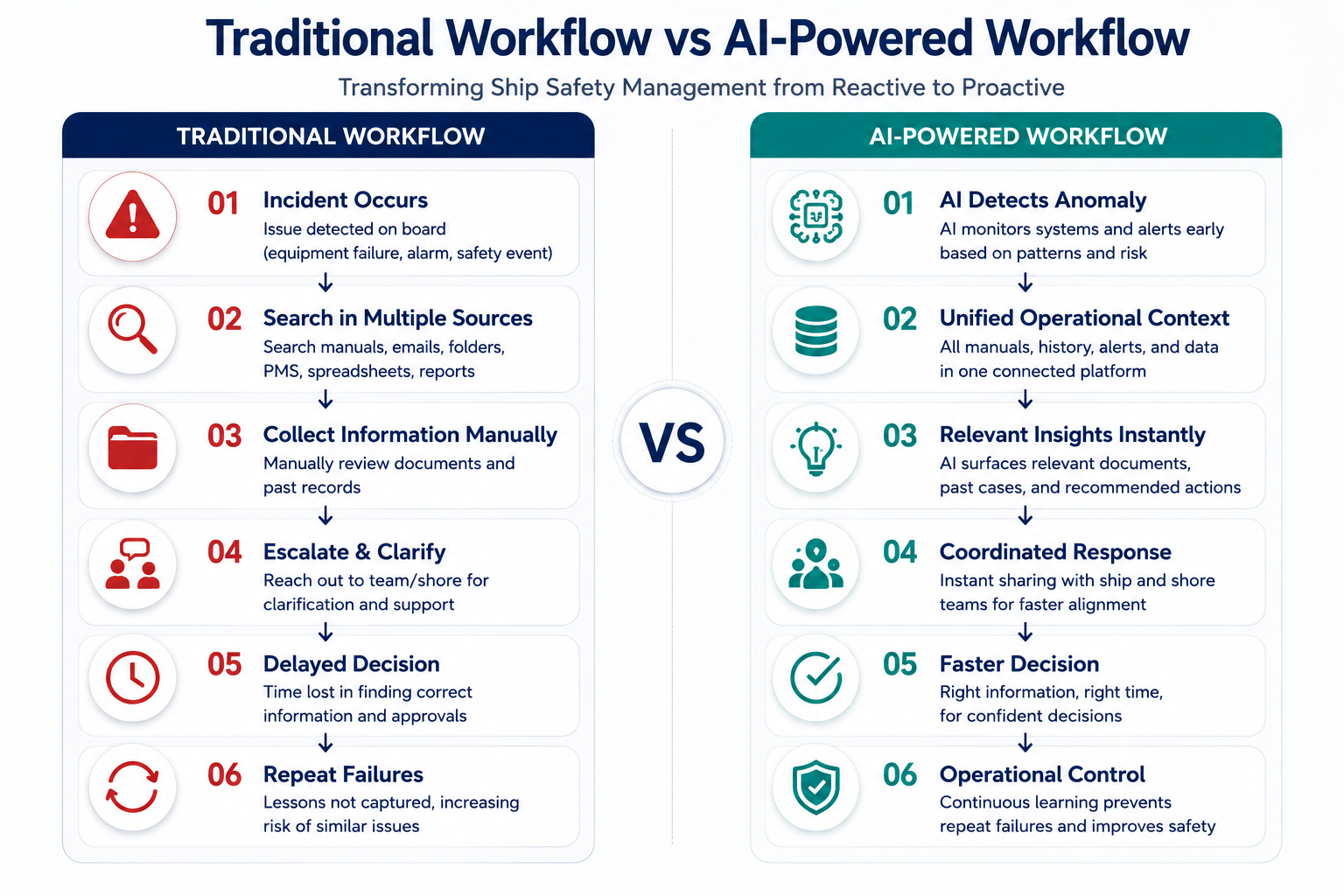
Maritime software helps organize operational information into structured workflows.
Instead of isolated documents, fleets gain centralized visibility across incidents, defects, maintenance records, and vessel history.
Software improves organization and visibility.
AI improves operational decision support.
This difference is important.
Traditional software stores information. AI helps teams interact with information faster and more intelligently.
For example, AI can help fleets:
Instead of manually reviewing hundreds of documents, crews and shore teams can access contextual operational guidance much faster.
This becomes particularly valuable during time-sensitive situations onboard.
Historically, maritime safety systems were reactive.
An incident occurred.
A report was filed.
Corrective actions followed.
Modern operational safety management is becoming more proactive.
AI and software now allow fleets to monitor operational trends continuously across vessels.
This includes:
The shift is important because many operational risks develop gradually before becoming incidents.
Faster visibility allows earlier intervention.

One of the biggest operational delays onboard vessels happens before the repair process even starts.
Teams often lose time identifying:
This is where AI-powered troubleshooting becomes highly relevant for ship safety management.
AI systems can unify operational knowledge across fleets and provide faster access to structured technical intelligence.
This is where SmartSeas.AI becomes relevant.
SmartSeas.AI helps fleets connect manuals, defect history, troubleshooting workflows, and operational knowledge into a single AI-powered maritime intelligence platform.
Instead of searching through disconnected systems, vessel and shore teams can access contextual operational support faster during incidents and machinery failures.
The goal is not replacing crew expertise.
The goal is helping experienced teams act faster with better operational visibility.
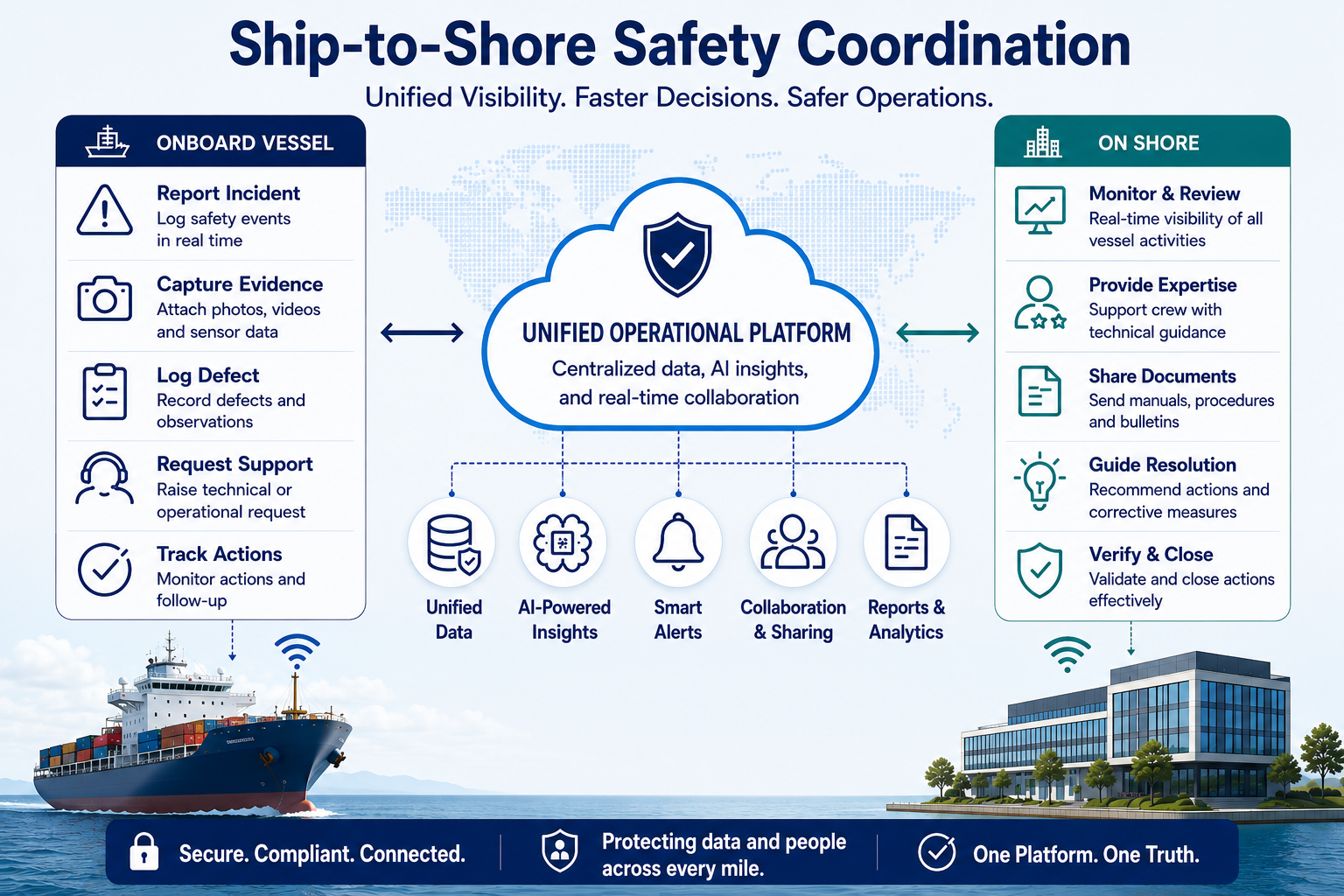
Safety management depends heavily on coordination between vessel and shore teams.
However, many fleets still rely on fragmented communication during operational issues.
This creates problems such as:
Modern software platforms improve this by creating shared operational visibility.
Both vessel and shore teams can access:
This reduces confusion during high-pressure situations.
Compliance requirements continue to increase across the maritime industry.
Safety audits, SIRE inspections, class surveys, and environmental reporting all require accurate operational records.
Manual preparation often consumes significant crew and shore time.
AI-supported compliance workflows can help fleets:
This becomes especially important as digital reporting expectations continue to grow globally.
According to the International Association of Classification Societies, remote survey frameworks and digital inspection practices are becoming increasingly structured across classification workflows.
Source: IACS Unified Requirement UR Z29.
When operational information is fragmented, risks increase.
Common consequences include:
In many fleets, operational knowledge still depends heavily on individual experience.
When experienced personnel rotate, valuable troubleshooting knowledge often disappears with them.
Structured operational intelligence helps preserve fleet learning over time.
The future of ship safety management is likely to become more connected, predictive, and operationally integrated.
The industry is gradually moving toward:
However, technology alone is not enough.
Successful implementation depends on:
The fleets that gain the most value will likely be the ones that combine operational expertise with practical digital workflows.
Ship safety management refers to the processes, procedures, and operational systems used to maintain vessel safety, regulatory compliance, and risk control onboard ships.
AI helps fleets analyze operational data faster, improve troubleshooting, identify recurring risks, and provide quicker access to technical knowledge and corrective actions.
Maritime safety software improves operational visibility, incident tracking, compliance management, ship-to-shore coordination, and structured safety workflows.
Operational visibility helps fleets identify risks earlier, coordinate faster during incidents, and reduce delays caused by fragmented information.
AI-powered troubleshooting helps crews quickly find relevant manuals, defect history, and corrective procedures during machinery or operational failures.
No. AI supports decision-making and knowledge access, but operational expertise and human judgment remain critical onboard vessels.
SmartSeas.AI helps fleets unify manuals, defect history, troubleshooting workflows, and operational intelligence to improve faster and safer operational decisions.

Get Started Today
Transform the way you troubleshoot and manage maritime operations. Join the next wave of Maritime Digital Transformation with SmartSeas AI.




.svg)