.jpg)
June 12, 2026
Maritime Analytics Market: Growth Trends, Opportunities, and Innovations for 2026


June 12, 2026
The maritime analytics market is gaining strong momentum in 2026 as shipping companies move from basic reporting to faster, data-driven decision-making.
For ship owners, ship managers, fleet managers, technical superintendents, and marine operations teams, analytics is no longer only about dashboards. It is becoming a practical tool for reducing downtime, improving fuel decisions, strengthening compliance, supporting troubleshooting, and improving ship-to-shore visibility.
This shift is being driven by rising operational complexity. Fleets are dealing with changing trade routes, emissions regulations, machinery reliability issues, cyber risk, and pressure to improve vessel performance. In this environment, maritime analytics helps teams turn scattered operational data into clearer decisions.
Shipping operations are becoming more complex and less predictable.
UNCTAD’s Review of Maritime Transport 2025 highlighted uncertainty across global shipping, including geopolitical disruption, rising costs, rerouting, port congestion, and the need for greener and more digital operations.
For fleet teams, this means decisions must be made faster and with better evidence.
Maritime analytics helps answer questions such as:
Instead of only reviewing what happened after the fact, analytics helps fleets understand what is happening now and what may need attention next.
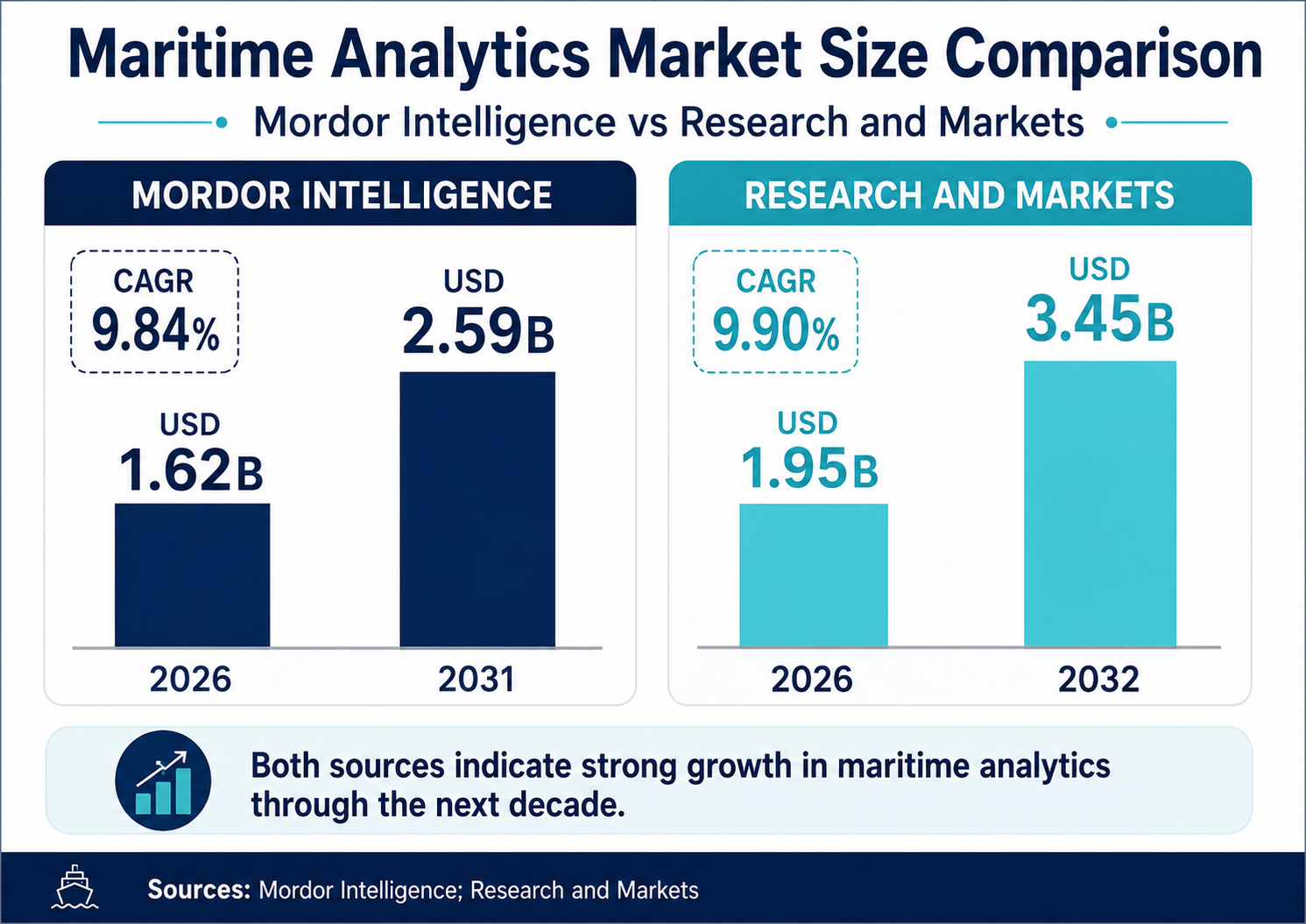
The market is expected to grow steadily through the end of the decade.
Mordor Intelligence estimates the maritime analytics market at USD 1.62 billion in 2026, reaching USD 2.59 billion by 2031 at a 9.84% CAGR.
Research and Markets places the 2026 estimate slightly higher at USD 1.95 billion, with growth to USD 3.45 billion by 2032 at a 9.90% CAGR.
The exact numbers vary, but the trend is clear: maritime analytics is becoming a major investment area for fleets, ports, ship managers, and maritime technology providers.
Maritime analytics is the use of data, software, AI, and decision-support tools to improve maritime operations.
It can support:
In simple terms, maritime analytics helps fleet teams move from scattered information to operational clarity.
For example, a technical superintendent may need to know whether a machinery defect is isolated to one vessel or appearing across multiple vessels with similar equipment. Without analytics, this may require manual searches through PDFs, emails, PMS records, defect logs, and old reports. With analytics, the pattern becomes easier to detect and act on.
Earlier maritime digital systems often focused on dashboards. These dashboards helped teams view data, but they did not always support action.
In 2026, fleets need more than visibility. They need systems that help answer:
This is why maritime analytics is moving toward predictive and prescriptive decision support.
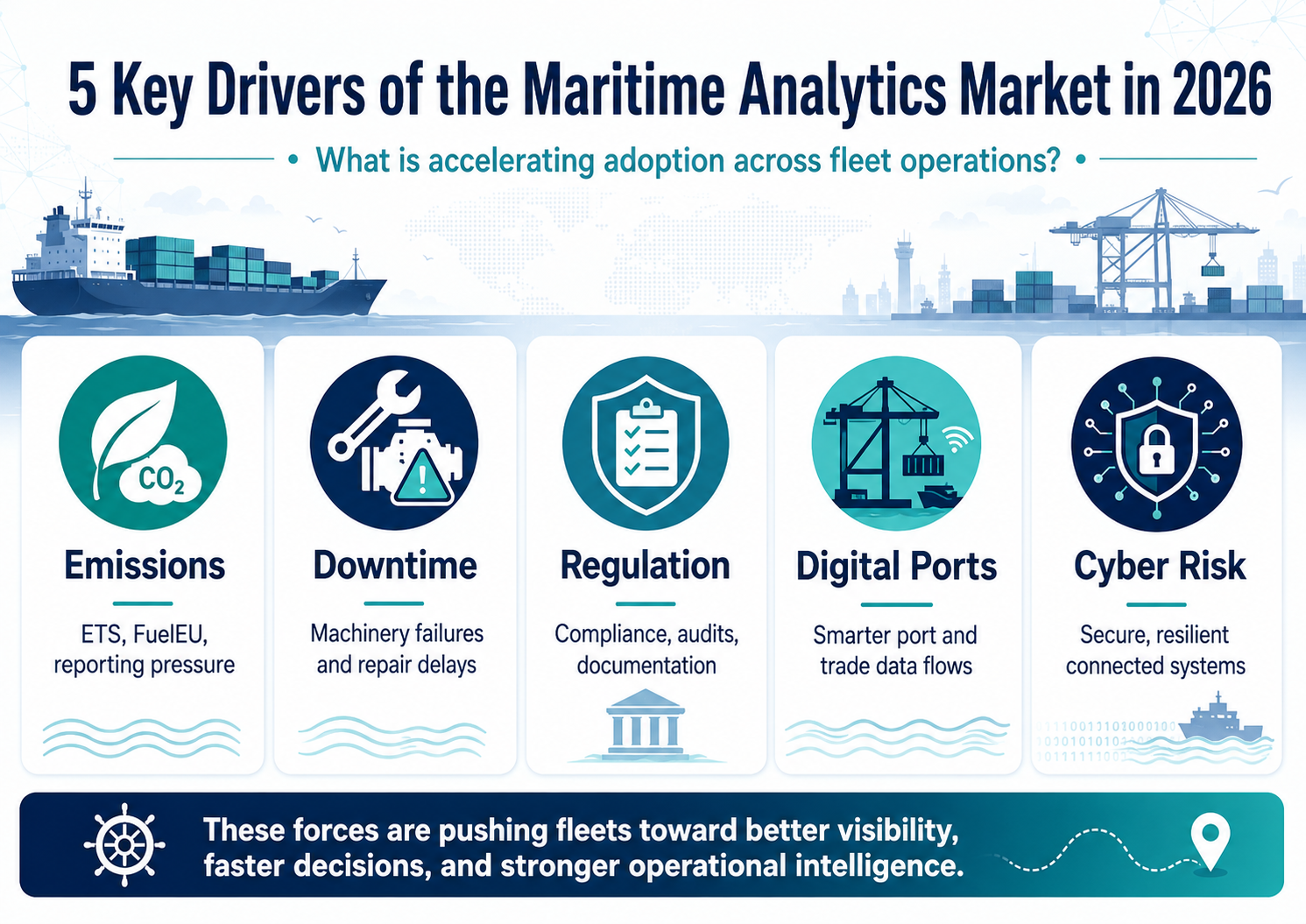
Environmental regulation is a major driver of maritime analytics.
The EU ETS has applied to shipping since January 2024 for large ships of 5,000 GT and above calling at EU ports. FuelEU Maritime also applies from 2025 and sets greenhouse gas intensity requirements for vessels trading in the EU.
These regulations make data quality more important. Fleets need better visibility into fuel consumption, voyage planning, emissions exposure, reporting accuracy, and compliance documentation.
As emissions costs become more closely connected to commercial performance, analytics becomes both a compliance tool and a cost-control tool.
Machinery failure continues to create downtime, safety exposure, and financial risk.
Allianz Commercial’s Safety and Shipping Review 2025 reported that machinery damage or failure accounted for well over half of global shipping incidents in 2024.
Many machinery problems do not begin as sudden failures. They often start as:
Analytics helps fleets detect these signals earlier and connect them with equipment history, manuals, and past corrective actions.
IMO’s Maritime Single Window became mandatory from 1 January 2024, requiring member states to use a centralized digital platform for ship arrival, stay, and departure information.
At the same time, electronic bills of lading and digital trade documentation are gaining momentum.
This wider digitalization creates more structured maritime data. As ports, carriers, and authorities digitize workflows, analytics platforms can support better planning, clearance, transparency, and coordination.
As vessels and shore systems become more connected, cyber risk becomes part of maritime analytics planning.
IACS cyber resilience requirements UR E26 and UR E27 apply to new ships contracted for construction on and after 1 July 2024.
This means analytics platforms must be assessed not only for features, but also for security, access control, data governance, and resilience.
Predictive maintenance remains one of the strongest use cases for maritime analytics.
The real value comes when fleets connect:
This helps teams identify repeated issues earlier and reduce the risk of recurring failures.
Troubleshooting is one of the most practical opportunities for maritime AI.
Traditional troubleshooting can be slow because engineers and shore teams often search across manuals, emails, defect records, and old reports. During urgent machinery issues, this delay can increase downtime and operational risk.
AI-powered maritime troubleshooting helps retrieve relevant information faster. It connects manuals, vessel history, defect reports, OEM notes, and past corrective actions into one workflow.
This is where SmartSeas.AI becomes relevant.
SmartSeas.AI helps fleets improve troubleshooting and operational clarity by connecting scattered technical knowledge across ship and shore. It supports faster access to vessel-specific information, defect intelligence, and practical decision support.
The goal is not to replace maritime expertise. The goal is to empower engineers, superintendents, and operations teams with the right information at the right time.
Fuel and emissions analytics will continue to grow in 2026.
Fleets need to understand:
Analytics helps connect operational decisions with regulatory and commercial outcomes.
One of the biggest challenges in fleet operations is the lack of shared context.
The vessel may report a technical issue. The superintendent may need more detail. The operations team may focus on schedule impact. The compliance team may later need evidence.
Analytics improves visibility by helping teams see:
This reduces repeated clarification and supports faster decisions.
Vessels do not always have reliable connectivity. Hybrid cloud and edge models allow some analytics to run onboard while broader fleet intelligence works from shore.
This is important for vessels operating in remote areas or with limited bandwidth.
Generative AI can help maritime teams search large volumes of operational knowledge.
But in shipping, AI must be grounded in trusted sources. It should retrieve approved manuals, vessel records, defect history, and procedures instead of giving unsupported generic answers.
The most useful maritime AI systems will be source-backed, auditable, and designed for human review.
Many fleet issues repeat across similar vessels or equipment types.
Analytics can help compare:
This helps fleets learn from past cases instead of solving the same problem repeatedly.
Maritime analytics have strong value, but fleets should avoid unrealistic expectations.
Common challenges include:
Analytics works best when it supports human decision-making rather than replacing maritime judgement.
SmartSeas.AI fits into the maritime analytics market as an AI-powered decision-support platform for ship and shore teams.
It helps fleets connect:
By unifying this knowledge, SmartSeas.AI supports faster troubleshooting, better operational clarity, improved ship-to-shore coordination, and stronger technical decision-making.
This aligns with SmartSeas.AI’s mission: transforming maritime operations through AI-powered decision-making.
Fleet teams looking at maritime analytics in 2026 should start with clear operational problems.
Good starting points include:
The best analytics projects are not only technology projects. They are operational improvement projects.
The maritime analytics market is growing because shipping companies need faster, clearer, and more connected decisions.
In 2026, analytics will play a larger role in vessel performance, emissions management, predictive maintenance, troubleshooting, safety, and ship-to-shore visibility.
For fleet teams, the opportunity is not just to collect more data. The real opportunity is to turn operational knowledge into faster action.
SmartSeas.AI supports this shift by helping fleets connect manuals, defect intelligence, and vessel knowledge into practical AI-powered decision support.
The maritime analytics market includes software, AI tools, and data platforms that help shipping companies analyze vessel, fleet, port, emissions, safety, and maintenance data.
It is growing because fleets need better visibility, faster decisions, emissions compliance, predictive maintenance, and stronger ship-to-shore coordination.
Main use cases include vessel performance monitoring, fuel analytics, emissions reporting, predictive maintenance, defect trend analysis, safety tracking, and AI-powered troubleshooting.
AI helps detect patterns, retrieve relevant information, compare past cases, identify anomalies, and support faster technical decision-making.
Yes. Ship managers can use analytics to reduce repeated defects, improve maintenance planning, support compliance, and strengthen operational visibility across vessels.
SmartSeas.AI helps ship and shore teams connect manuals, defect history, vessel knowledge, and operational records to support faster troubleshooting and clearer decisions.

Get Started Today
Transform the way you troubleshoot and manage maritime operations. Join the next wave of Maritime Digital Transformation with SmartSeas AI.




.svg)