.jpg)


Machine learning in shipping industry operations is helping maritime teams improve predictive maintenance, troubleshooting, fuel efficiency, safety, compliance, and fleet decision-making. Modern vessels generate large volumes of data from machinery readings, alarms, maintenance records, defect histories, voyage reports, manuals, and crew observations.
The challenge is turning this scattered information into useful operational insight. Machine learning can identify patterns across these data sources, highlight developing risks, and help ship and shore teams act earlier.
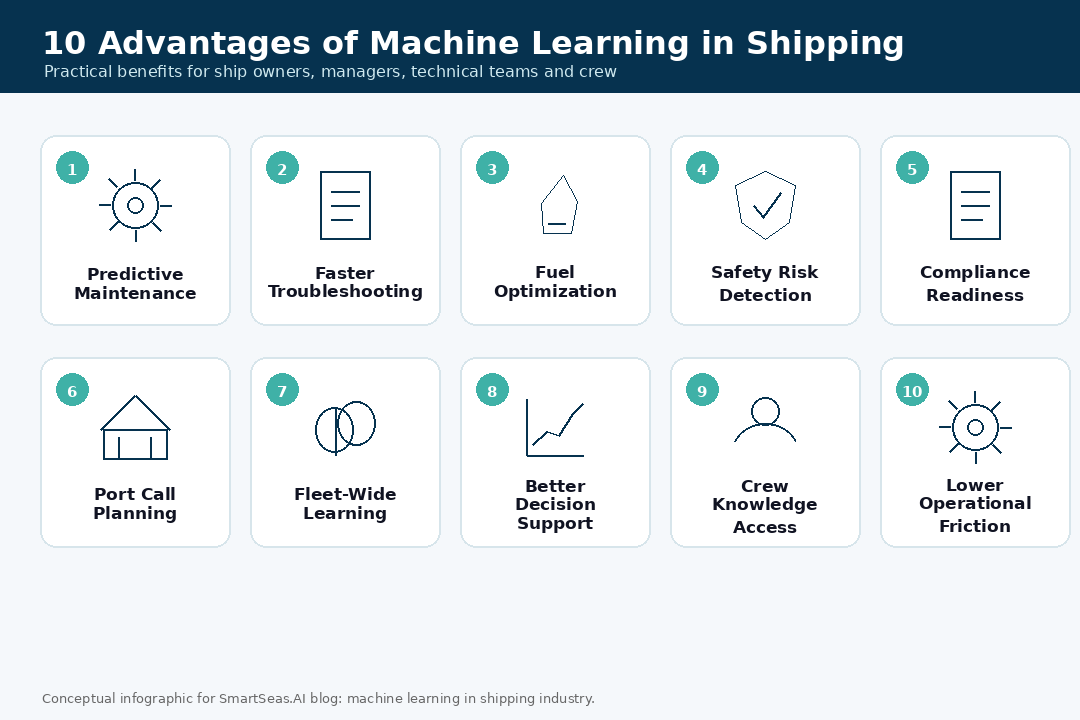
This article explains 10 practical advantages of machine learning in shipping and where it can support day-to-day fleet operations.
Shipping carries over 80% of world trade, making vessel reliability directly connected to global supply chains. UNCTAD reported that maritime trade grew by 2.2% in 2024 and was expected to slow to 0.5% in 2025 before averaging around 2% annually from 2026 to 2030.
Source: UNCTAD Review of Maritime Transport 2025.
At the same time, shipping risks remain high. Allianz Commercial reported that total losses fell to 27 vessels in 2024, but reported shipping casualties and incidents increased to 3,310 in 2024 from 2,963 in 2023.
Source: Allianz Commercial Safety and Shipping Review 2025.
DNV also reported that maritime safety incidents increased by 42% between 2018 and 2024, while the global fleet grew by only 10%. DNV linked the trend mainly to ageing vessels and machinery damage or failure.
Source: DNV Maritime Safety Trends 2014–2024.

This is why machine learning matters. It helps fleets detect weak signals earlier, act faster, and reduce the time lost in manual investigation.
Machine learning is a type of artificial intelligence that learns from data patterns.
In shipping, it can be used with:
The goal is not to replace maritime experience. The goal is to support crew, superintendents, fleet managers, and shore teams with faster, better-contextualized decisions.
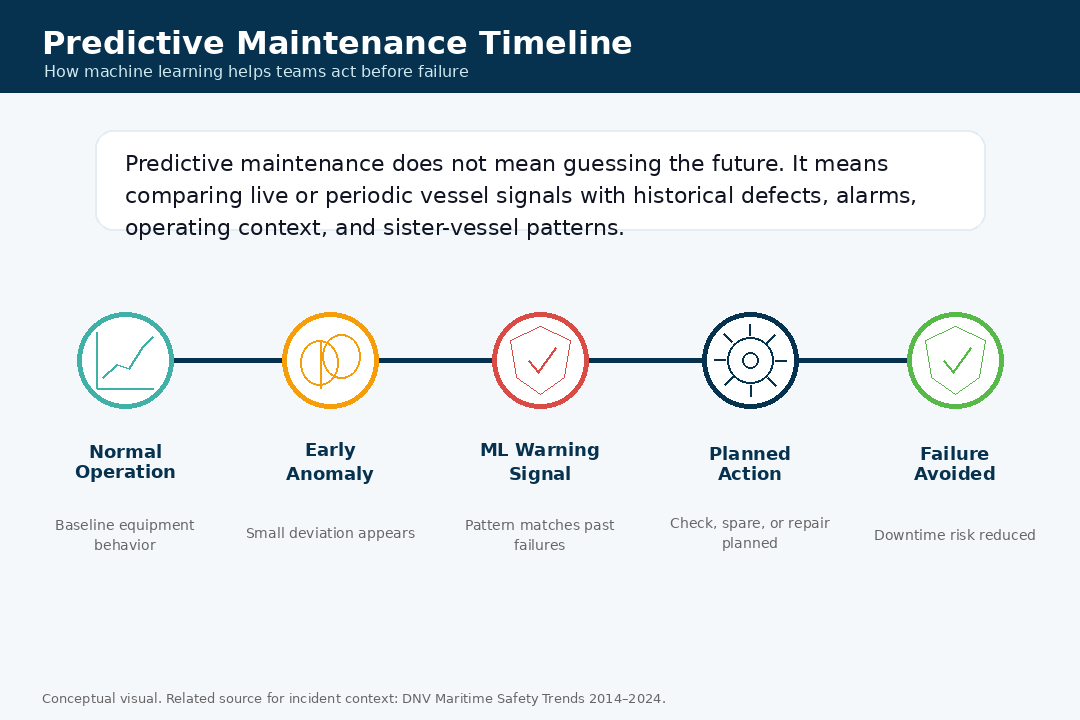
Predictive maintenance is one of the strongest uses of machine learning in shipping.
Instead of waiting for equipment to fail, machine learning can detect early signs of abnormal behavior. It can compare current equipment performance with past defects, maintenance records, sister-vessel trends, and alarm history.
For example, if a pump, purifier, compressor, auxiliary engine, or cooling system begins showing unusual patterns, the system can alert the team before the issue becomes a breakdown.
This is important because machinery damage and failure remain major contributors to maritime incidents. DNV identified machinery damage or failure as a key driver of rising casualty numbers, and Allianz reported a sharp increase in global shipping casualties and incidents in 2024.
Source:DNV and Allianz Commercial safety reports.
This is where SmartSeas.AI becomes relevant for technical teams. SmartSeas.AI helps connect defect histories, manuals, service letters, reports, and vessel-specific technical records so teams can understand whether an issue is new, recurring, or linked to similar cases across the fleet. This supports faster maintenance decisions and helps reduce avoidable troubleshooting delays before a defect turns into a bigger operational problem.
During a vessel incident, time is often lost before the actual fix begins.
Crew may need to search manuals. Shore teams may check old reports. Superintendents may review service letters or ask whether the same issue happened on another vessel.
Machine learning can reduce this delay by connecting a symptom or alarm with the right manual, past defect history, service letter, and corrective action.
For example, instead of searching multiple PDFs for an auxiliary engine alarm, the crew can ask a question in natural language and receive relevant technical context faster.
This is where SmartSeas.AI fits naturally. SmartSeas.AI helps unify manuals, service letters, reports, defect histories, and technical data so ship and shore teams can troubleshoot faster and reduce repeated delays.

Fuel is one of the biggest operating costs in shipping. Machine learning can help fleets understand why fuel consumption changes across voyages, vessels, routes, weather, trim, draft, speed, and hull condition.
Instead of only reviewing fuel performance after the voyage, machine learning can help detect deviations earlier.
This matters because the IMO 2023 GHG Strategy targets at least a 40% reduction in carbon intensity of international shipping by 2030 and aims for net-zero GHG emissions by or around 2050.
Source: IMO 2023 GHG Strategy.
The IMO Data Collection System also requires ships to report fuel oil consumption, and large ocean-going ships over 5,000 GT represent about 85% of international shipping CO₂ emissions.
Source: IMO Data Collection System and IMO net-zero framework information.

Machine learning can help detect safety risks before they escalate.
A safety issue may not come from one event. It may come from repeated alarms, ageing equipment, delayed maintenance, poor documentation, weak handover, or recurring defects.
Machine learning can connect these signals and highlight patterns across vessels.
A good example is cargo safety. In 2025, the World Shipping Council launched a Cargo Safety Program using AI-powered cargo screening to identify misdeclared and undeclared high-risk shipments before loading.
Source: World Shipping Council Cargo Safety Program.
SmartSeas.AI helps teams connect safety-related signals such as recurring defects, alarms, reports, service letters, and past corrective actions. This gives ship and shore teams better visibility into whether a technical issue has appeared before or could develop into a wider safety risk.
This shows how machine learning is being used in real maritime workflows, not only in theory.
Compliance is becoming more digital and evidence-driven.
Environmental reporting, port clearance, class surveys, vetting inspections, safety audits, and port state control all depend on accurate records.
Since 1 January 2024, IMO Member States have been required to use a Maritime Single Window to exchange information with ships during port calls.
Source note: IMO Maritime Single Window requirement.
Remote survey practices are also becoming more structured. IACS Unified Requirement UR Z29 on remote classification surveys entered into force on 1 January 2023.
Source: IACS UR Z29.
SmartSeas.AI helps teams quickly access manuals, reports, defect histories, service letters, corrective actions, and technical records in one place. This supports faster inspection preparation, easier evidence retrieval, and better visibility into repeated deficiencies across vessels.
Machine learning can help fleets find missing records, identify repeated deficiencies, connect corrective actions, and prepare inspection evidence faster.
Many shipping companies solve the same problem more than once.
One vessel may fix a technical issue, but the solution remains hidden in an email. Another vessel may face the same issue later, and the team starts again from zero.
Machine learning helps turn past defects, reports, and troubleshooting actions into reusable fleet knowledge.
This is especially valuable for sister vessels or vessels using similar equipment. If one vessel has already experienced a recurring purifier, pump, boiler, steering gear, or engine issue, machine learning can help identify whether the same pattern is appearing elsewhere.
This is where SmartSeas.AI fits strongly. SmartSeas.AI helps preserve technical knowledge across vessels, crew rotations, and shore teams by connecting manuals, defect histories, service letters, reports, and previous corrective actions. When a similar issue appears again, teams can quickly refer to what happened before, what action was taken, and what worked.
For fleet managers, this means better visibility, fewer repeated mistakes, and stronger technical learning across the fleet.
Shore teams often manage many vessels at once. They receive defect reports, inspection updates, alarms, emails, maintenance requests, and performance data every day.
The challenge is not just receiving information. The challenge is deciding what needs action first.
Machine learning can help prioritize issues based on severity, equipment criticality, vessel schedule, past failure history, spare availability, and safety impact.
This is where SmartSeas.AI becomes useful for ship-to-shore coordination. SmartSeas.AI helps vessel and office teams access the same technical context by connecting manuals, defect histories, reports, service letters, and previous troubleshooting actions in one place. This reduces repeated explanations, shortens communication loops, and helps shore teams understand the situation faster.
For superintendents and fleet managers, this means better visibility, clearer prioritization, and faster decisions across vessels.
Crew members operate under pressure, especially during technical problems.
Machine learning can help crew access relevant knowledge faster. A marine AI assistant can retrieve approved manuals, service letters, past defects, and troubleshooting steps based on a natural-language question.
This is useful because crew members do not always search using the same words found in manuals. They often describe symptoms.
A good maritime AI system should understand the symptom, retrieve trusted sources, and support the crew without replacing human judgement.
This is where SmartSeas.AI fits strongly. SmartSeas.AI helps crew ask practical troubleshooting questions and access relevant vessel-specific information from manuals, reports, defect histories, service letters, and previous corrective actions. Instead of searching through multiple PDFs or waiting for repeated clarification from shore, crew can reach the right technical context faster.
Advantage 9: Improved Port and Operations Planning
Port calls involve agents, terminals, pilots, customs, charterers, cargo interests, and vessel teams.
Machine learning can help predict delay risks, improve ETA accuracy, identify documentation gaps, and learn from repeated port-specific issues.
The IMO Maritime Single Window requirement shows that port data exchange is becoming more digital and standardized. This creates a stronger foundation for AI-supported port planning.
Source: IMO Maritime Single Window requirement.
Machine learning improves commercial performance by reducing uncertainty.
Unexpected breakdowns affect schedules. Poor fuel performance affects margins. Repeated defects increase repair costs. Slow troubleshooting extends downtime. Weak compliance records create inspection pressure.
Machine learning helps by giving teams earlier warnings, clearer context, and better decision support.
The result is not just better data. The result is better operational control.

Machine learning becomes most useful when it is connected to real maritime data.
A generic AI tool may answer general questions, but shipping teams need vessel-specific and equipment-specific clarity. They need answers based on manuals, service letters, reports, defect history, and technical context.
SmartSeas.AI helps vessel and shore teams bring this information together. It supports faster troubleshooting, better operational clarity, stronger ship-to-shore visibility, and more transparent technical decision-making.
For fleets trying to reduce downtime and repeated troubleshooting delays, SmartSeas.AI helps turn scattered vessel knowledge into faster action.
How Shipping Companies Can Start
Shipping companies do not need to begin with a large AI transformation project.
A practical starting point is one repeated operational problem, such as:
After choosing the problem, the company should connect the relevant data, structure it properly, test the use case, validate results with maritime experts, and then scale.
Machine learning is useful, but it depends on data quality.
Poor records, missing context, unstructured documents, and generic AI outputs can create weak results. Maritime AI must be source-backed, explainable, and validated by technical experts.
In shipping, AI should support human judgement. It should not replace the decisions of masters, chief engineers, superintendents, or fleet managers.
Machine learning in the shipping industry helps fleets detect problems earlier, troubleshoot faster, reduce downtime risk, improve fuel performance, strengthen compliance, and make better ship-to-shore decisions.
Its value comes from connecting scattered data and turning it into practical operational intelligence.
For ship owners, managers, and technical teams, the best approach is simple: start with one high-value problem, connect the right data, validate the results, and scale gradually.
SmartSeas.AI supports this shift by helping maritime teams unify technical knowledge and use AI-powered decision-making in a practical, operationally relevant way.
Machine learning in shipping uses vessel, machinery, fuel, safety, and operational data to identify patterns and support better decisions.
It detects early warning signs from alarms, defect history, maintenance records, and equipment trends before failures become serious.
Yes. It can match symptoms with manuals, service letters, past defects, and corrective actions to help teams respond faster.
Yes. It can identify fuel-performance deviations linked to speed, weather, route, trim, draft, and vessel condition.
Yes. It can help find missing records, repeated deficiencies, corrective-action gaps, and inspection evidence faster.
No. It supports marine engineers and superintendents by giving them better context and faster access to relevant data.
Start with one repeated problem, connect the right data, test the workflow, validate with experts, and scale gradually.

Get Started Today
Transform the way you troubleshoot and manage maritime operations. Join the next wave of Maritime Digital Transformation with SmartSeas AI.




.svg)


.png)