.jpg)

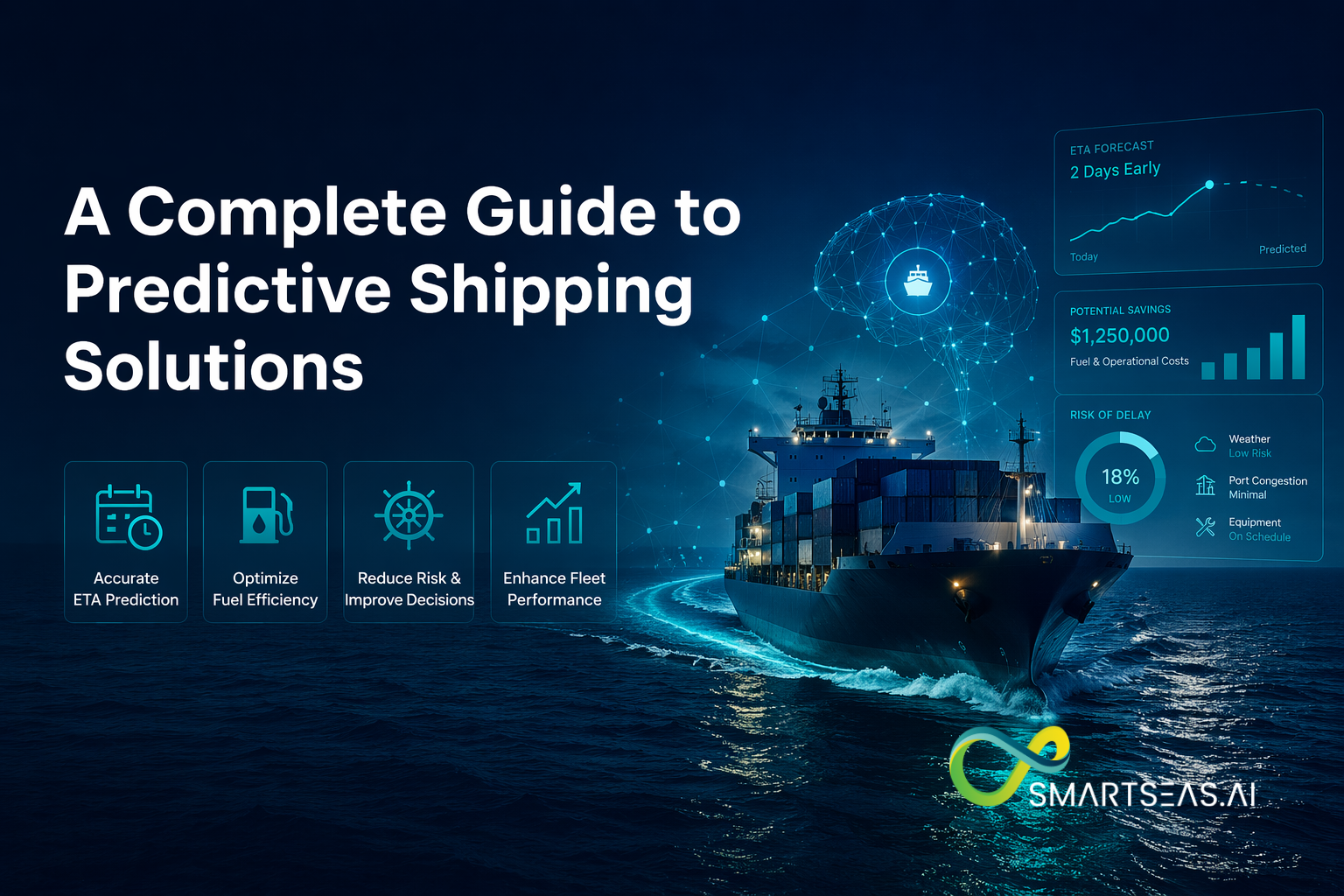
Predictive shipping solutions are changing how the maritime industry manages risk, efficiency, and operational performance. Shipping has always been a business of managing uncertainty, from weather and fuel cost to technical failures, port delays, and regulatory pressure. What has changed is the speed and volume of the decisions required to manage all of that well.
Global maritime trade grew by 2.4% in 2023 to 12.3 billion tons, and UNCTAD expects maritime trade to keep expanding through 2029. But that growth sits alongside geopolitical disruption, climate risk, chokepoint congestion, and rising pressure for reliability and cost control. In practical terms, fleets are being asked to do more with less room for waste, delay, or avoidable error.
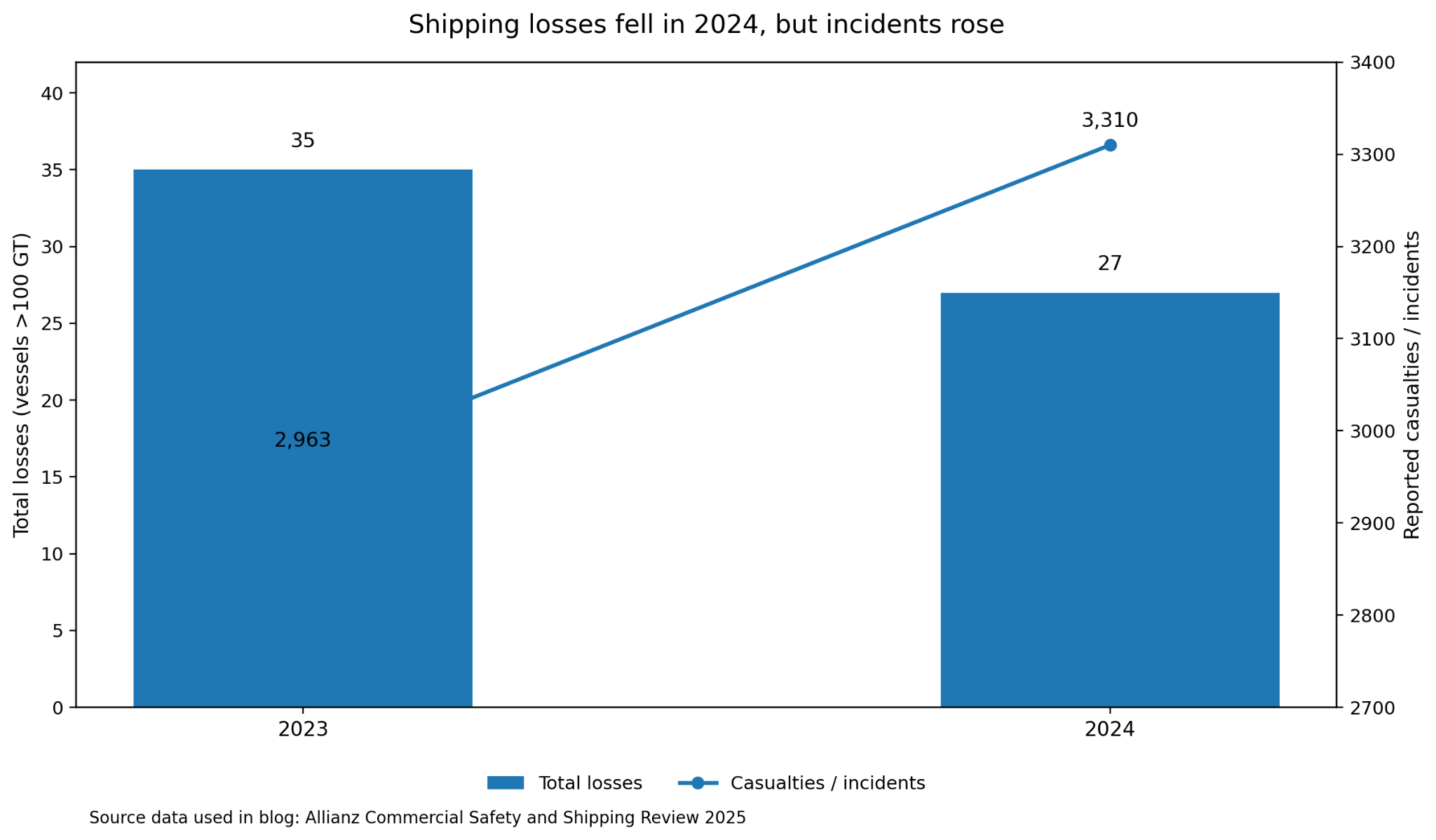
At the same time, maritime risk is changing shape. Allianz Commercial reports that total losses of vessels over 100 GT fell to 27 in 2024 from 35 in 2023, but reported shipping casualties and incidents rose to 3,310 from 2,963. Machinery damage or failure accounted for 1,860 incidents in 2024, while fire incidents reached 250, the highest annual total in a decade. That means the industry is getting better at preventing the final catastrophe, while still struggling with the daily failures that drain margin, disrupt voyages, and increase operational pressure.
This is exactly why predictive shipping solutions are becoming more important. Instead of reacting after a problem becomes expensive, operators can act when early signals first appear. A predictive system can flag abnormal machinery behavior, detect worsening fuel performance, improve ETA accuracy, support just-in-time arrival, or surface the most likely next step in a troubleshooting workflow before delay escalates.
A predictive shipping solution is not just “AI on a ship.” It is a practical operating framework for earlier decision-making. It combines data such as sensor readings, alarm trends, maintenance logs, voyage details, weather inputs, AIS, port updates, and defect history to estimate what is likely to happen next. Some solutions focus on machine condition. Others focus on route efficiency, fuel performance, arrival timing, cargo risk, or safety response. The best systems do not stop at analysis. They help ship and shore teams decide what to do next.
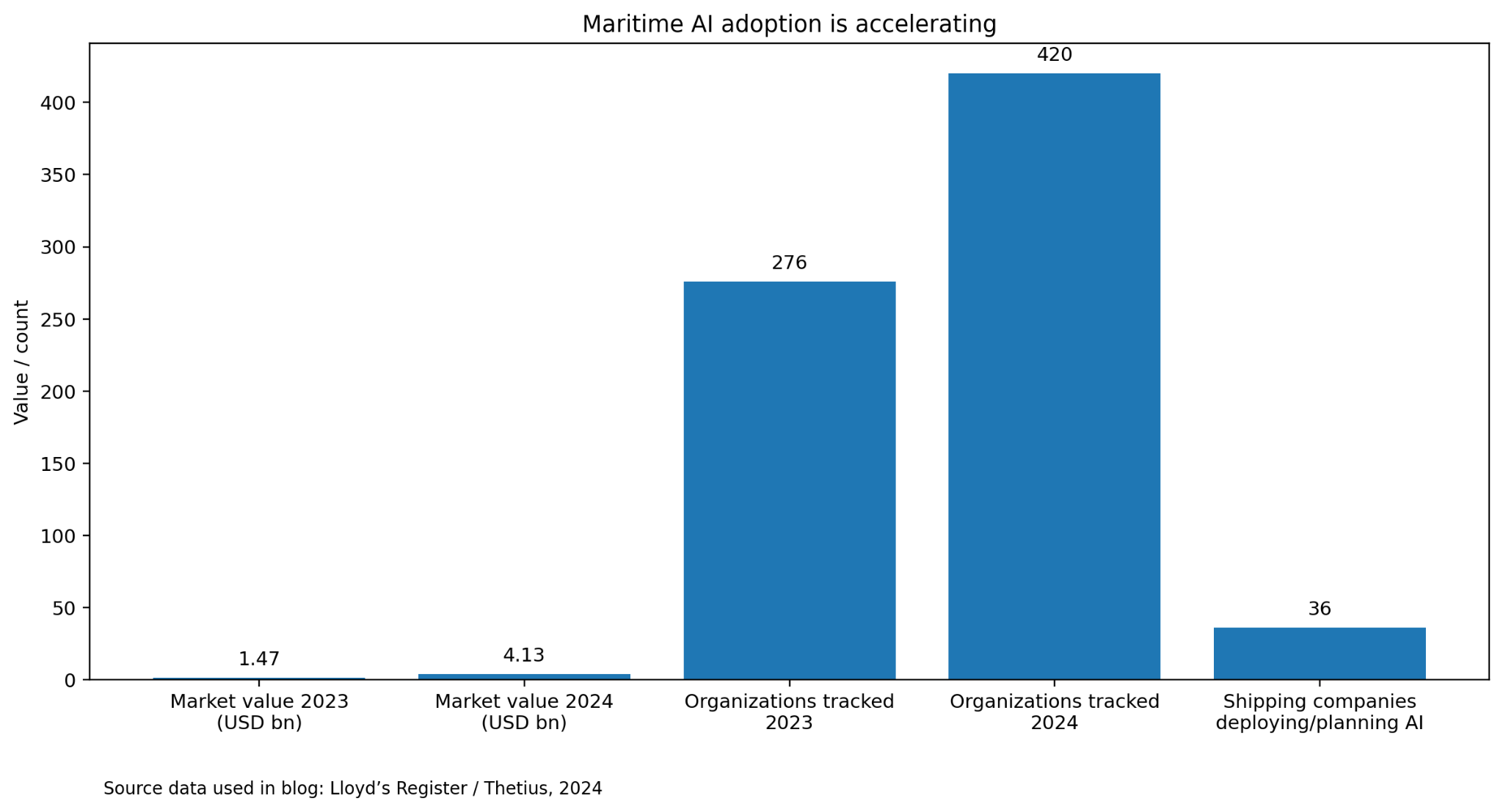
That direction is already visible in the market. Lloyd’s Register, citing Thetius research in 2024, said the maritime AI market had grown from $1.47 billion in 2023 to $4.13 billion, with a projected five-year CAGR of 23%. The same research identified 420 organizations involved in maritime AI and 36 shipping companies that had implemented or planned AI-enabled technologies. In other words, maritime AI is no longer experimental. It is moving into mainstream operational use.
At a practical level, predictive shipping solutions help maritime teams make better decisions earlier. These AI-powered maritime solutions can identify likely equipment failure, excess fuel burn, port delays, recurring maintenance issues, and the best next action for ship or shore teams.
Unlike traditional shipping software, which often shows what has already happened, predictive shipping solutions use maritime AI, forecasting, and ship performance analytics to estimate what is likely to happen next. This helps fleets reduce delay, improve response time, and turn scattered data into useful action.
That is why predictive shipping solutions matter to both technical and commercial teams. They support predictive maintenance in shipping, improve arrival timing through voyage optimization software, and help fleet leaders strengthen uptime, fuel efficiency, OPEX control, and maritime fleet optimization.
The need for predictive shipping solutions is no longer only about innovation. It is about resilience. Shipping companies are under pressure to control cost, reduce downtime, manage crew workload, and improve reliability, while also meeting stricter emissions and efficiency targets.
The IMO’s 2023 GHG Strategy has made this even more urgent by pushing the industry toward net-zero emissions by or around 2050, with key checkpoints for 2030 and 2040. That means every avoidable tonne of fuel burned adds both cost and compliance pressure.
This is why predictive shipping solutions and AI-powered maritime solutions matter more now. A ship that reduces waiting time, detects maintenance issues early, improves route and power decisions, and speeds up troubleshooting is not just operating better. It is also improving fuel efficiency, reliability, and regulatory readiness at the same time.
Predictive maintenance
This is the most common type of predictive shipping solution. It uses engine data, alarm patterns, equipment behavior, and maintenance history to detect early signs of deterioration before failure happens. This helps reduce unplanned breakdowns, improve maintenance timing, and lower downtime risk.
Predictive voyage and fuel optimization
These AI-powered maritime solutions use weather, AIS, voyage data, vessel performance, and engine behavior to improve route and speed decisions while the voyage is still underway. The main benefit is better fuel efficiency and lower operating cost across the fleet.
Predictive ETA and port-call optimization
This type helps vessels align speed with actual berth readiness, pilot timing, and port congestion. It reduces unnecessary waiting, fuel burn, and idling, making voyage execution more efficient.
Predictive safety and troubleshooting support
These systems look at symptoms, defect history, incident records, and technical documents to estimate likely causes and next actions. This helps crews and shore teams respond faster when issues happen and improves operational safety.
Predictive compliance and performance monitoring
This category helps fleets detect emissions drift, carbon-intensity decline, inspection exposure, and recurring inefficiencies early. For shipping companies under growing regulatory pressure, this supports better compliance and performance control.
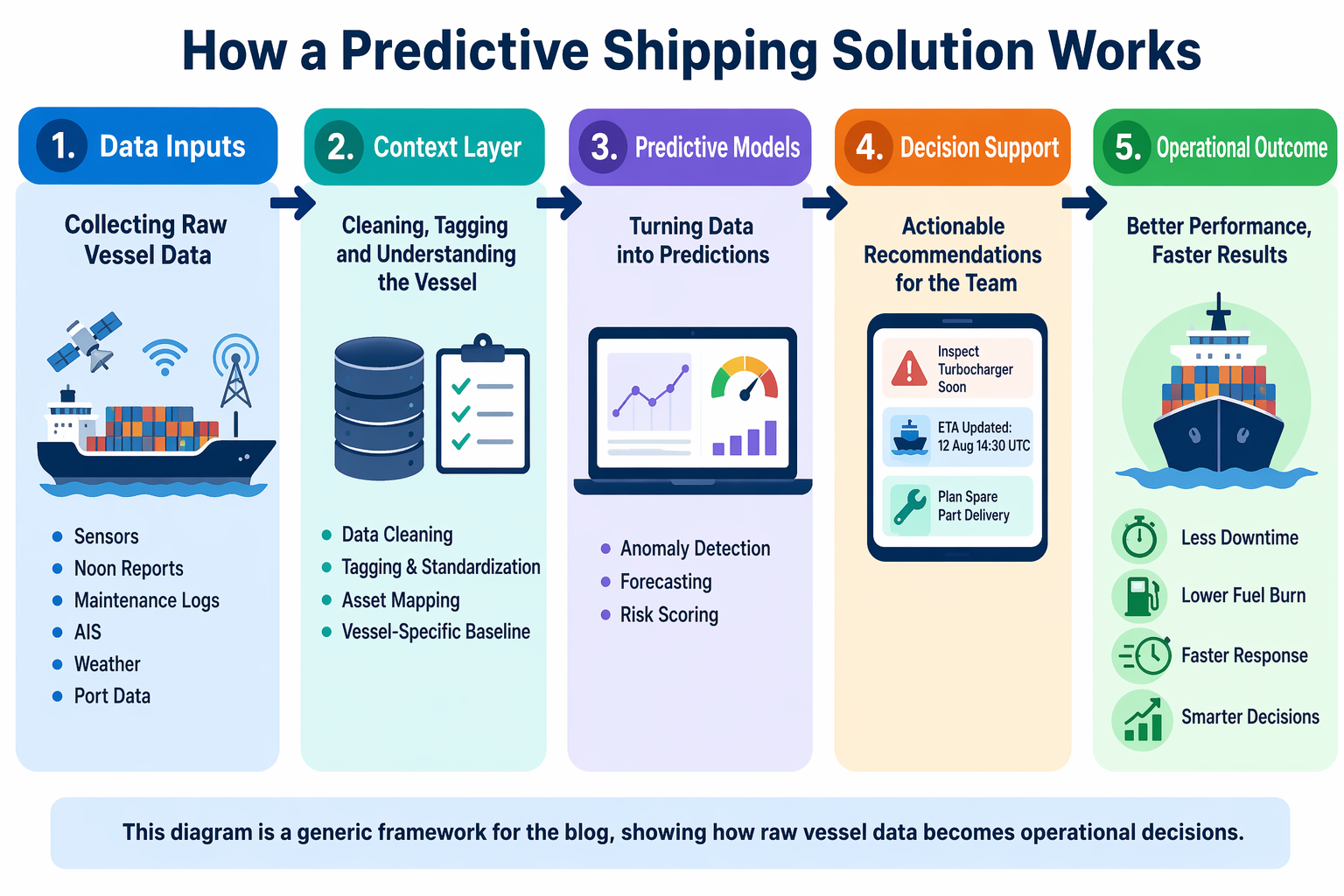
A strong predictive shipping solution works through a chain of operational logic, not just a single model. It starts by collecting inputs such as sensor data, noon reports, maintenance logs, PMS records, alarms, weather, AIS, bunker data, voyage plans, and defect history.
That data is then cleaned, tagged, and organized in a vessel-specific context, because shipping data is rarely uniform across fleets. Once that context is built, maritime AI and forecasting models can identify likely failures, inefficient speed patterns, better arrival windows, or probable root causes behind an issue.
The final step is the most important: turning that analysis into action. A good AI-powered maritime solution gives crews and shore teams a practical recommendation, whether that is an inspection prompt, routing adjustment, maintenance priority, or troubleshooting step.
The best way to understand predictive shipping is through real cases where earlier insight changed the outcome.
1. Early warning before engine failure
Wärtsilä reported that its Expert Insight service detected abnormal lube oil pressure on Aurora Spirit, helping identify a turbocharger-related bearing issue before it became a major engine failure. This is a strong example of predictive maintenance in shipping, where early detection reduces downtime, repair escalation, and commercial disruption.
2. Route intelligence that saved time and fuel
StormGeo reported a tanker case where a route adjustment south of Hawaii saved $54,000 in time and fuel. This shows how AI-powered maritime solutions can improve voyage decisions before losses grow.
3. Fuel savings through voyage optimization
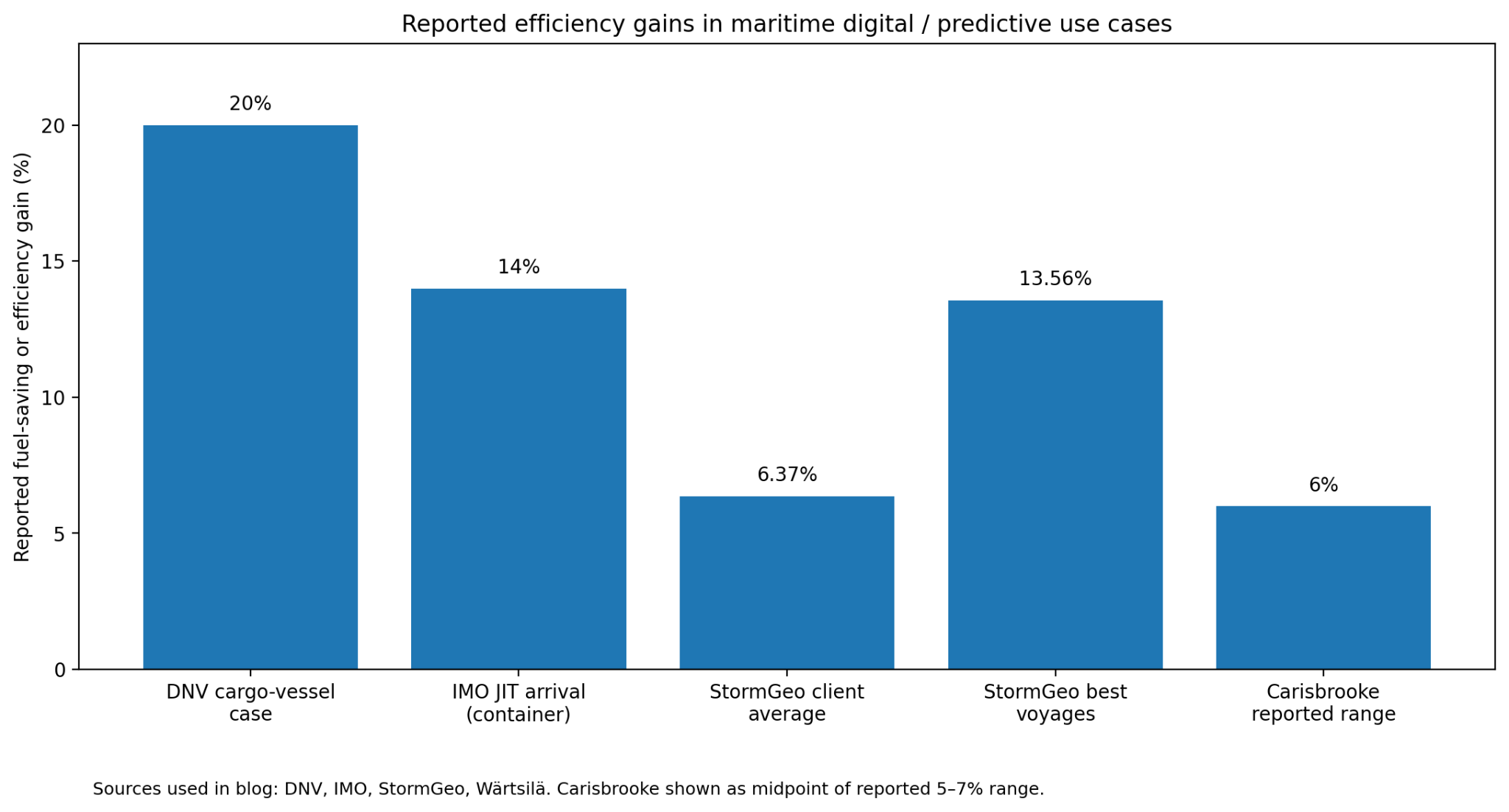
StormGeo also reported average fuel savings of 6.37%, with some voyages reaching 13.56%, in a 2024 case study using strategic power routing. This shows how voyage optimization software can become a major OPEX lever.
4. Fleet-wide efficiency gains
Wärtsilä said Carisbrooke Shipping achieved fuel savings of 5 to 7% across 31 vessels after adopting its Fleet Optimisation Solution. This proves that predictive shipping solutions can deliver repeatable gains in daily operations.
5. Just-in-time arrival and port efficiency
The IMO reported that just-in-time arrivals can cut containership fuel use and CO2 emissions by 14% per voyage. Singapore’s MPA also says JIT planning can reduce port stay, fuel burn, and emissions. This highlights how predictive systems improve coordination between ship, shore, and port.
6. Voyage-level savings at scale
DNV highlighted that for a large cargo vessel on a Brazil–Rotterdam voyage, a 20% energy saving could mean about $60,000 saved on a single trip. This shows why even moderate improvements from maritime AI and maritime fleet optimization can be financially significant.
These real examples show three key things about predictive shipping solutions. First, they create value early, before a problem becomes visible in the traditional way. Second, they work across more than just machinery, including routing, fuel use, berth timing, and recurring defect intelligence. Third, the best AI-powered maritime solutions do not just predict risk, they turn insight into action.
That is the real advantage of predictive shipping solutions. Maritime teams do not need more alerts. They need faster, clearer guidance that helps them make better decisions.
Predictive shipping solutions create value across the entire maritime organization, but the benefits look slightly different for each stakeholder.
For shipowners and fleet leaders, the biggest benefits include better asset utilization, lower fuel waste, fewer avoidable delays, reduced downtime exposure, stronger OPEX control, improved voyage reliability, and better return on fleet assets.
For technical management teams, these solutions support earlier fault detection, better maintenance timing, reduced repair escalation, fewer repeat defects, stronger defect visibility across sister vessels, improved spare planning, and better long-term fleet learning.
For operations teams, the benefits include more accurate ETAs, better voyage efficiency, improved port-call planning, less waiting time, lower idling, stronger ship-to-shore coordination, and faster response to changing voyage conditions.
For onboard crews, predictive shipping reduces time spent searching across manuals, reports, and past cases. It helps crews find the right information faster, respond with more confidence, reduce troubleshooting delays, and make better decisions under pressure.
For HSEQ and compliance leaders, it can support earlier identification of recurring safety risks, better visibility into operational patterns, improved compliance readiness, stronger audit support, and faster correction of issues before they grow.
For chartering and commercial teams, the value can include more reliable schedules, fewer disruption-related costs, better fuel performance, and stronger service consistency.
The benefit may vary by role, but the core principle stays the same: better timing leads to better outcomes.
This is also where SmartSeas.AI fits naturally. In many fleets, the biggest delay is not only spotting that something is wrong. It is finding the right technical context quickly enough to act well. By connecting manuals, defect history, OEM guidance, reports, and vessel-specific operational knowledge, SmartSeas.AI helps strengthen the decision layer of predictive shipping solutions, especially in troubleshooting-heavy environments.
Many shipping companies think predictive systems fail because they do not have enough data. In reality, the bigger issue is usually fragmented data. A good predictive shipping solution can use inputs such as engine and machinery sensor data, alarm history, noon reports, PMS records, maintenance logs, defect history, spare and work-order data, voyage plans, AIS, weather, bunker data, port signals, incident reports, and technical manuals.
Not every use case needs every data source. Predictive maintenance in shipping may start with engine data and maintenance history, while voyage optimization may rely more on AIS, weather, and fuel performance. The key is not having more data, but having relevant, structured, and connected data that can support faster decisions.
The most successful fleets do not start with a fleet-wide AI rollout. They start with one expensive and recurring problem. That could be repeated auxiliary-engine issues, fuel underperformance on a trade lane, recurring port delays, long troubleshooting times, cargo-condition issues, or repeated defect classes that increase inspection exposure. This helps predictive shipping solutions prove value where the business impact is already clear.
Once the use case is chosen, the next step is to create a baseline. Teams need to know the current downtime, diagnosis time, fuel loss, repeat-issue frequency, and waiting time around arrival before they can measure improvement. Without that baseline, even a strong AI-powered maritime solution will struggle to show its real impact.
The next stage is context-building, which is often underestimated. This includes asset mapping, equipment tagging, vessel normalization, source cleanup, and agreement on what “good” and “abnormal” look like. That matters because maritime data is rarely consistent across ships and systems. Only after that should the team test prediction logic.
A sensible rollout usually follows these steps: define the use case, connect and clean the data, establish the baseline, run the model in observation mode, compare forecasts with actual outcomes, introduce recommendations into workflow, measure savings and adoption, and expand only after one use case clearly works.
This approach may seem slower, but it is usually much faster than launching a broad system that nobody trusts.
One common mistake is treating predictive shipping solutions as a technology project instead of an operations project. Shipping companies do not invest in maritime AI just to build smarter models. They invest to reduce cost, improve reliability, and make faster decisions.
Another mistake is overloading teams with alerts. An alert without context can create more work, not less. The most useful AI-powered maritime solutions do not just detect issues. They also provide prioritization, explanation, and clear next steps.
A third mistake is expecting predictions to replace people. In real maritime operations, predictive systems should strengthen human decision-making, not replace it. The best results come when onboard teams, shore experts, and digital tools work together.
A fourth mistake is measuring success only by technical accuracy. Leadership should also track commercial and operational outcomes such as avoided downtime, reduced fuel burn, faster diagnosis, fewer repeat defects, less waiting time, stronger ETA reliability, and actual adoption across ship and shore teams.
Before investing in any predictive shipping solution, decision makers should ask a few direct questions. What exact operational decision does this product improve? What data does it require on day one? Can it work vessel by vessel, not only at fleet-average level? How does it explain a warning or recommendation? How is value measured and audited? What changes in the crew or shore workflow after an alert? Can it use both structured data and unstructured technical knowledge? And how quickly can it prove one use case?
These questions help reveal the difference between a real AI-powered maritime solution and a dashboard that looks impressive but adds little operational value.
A strong ROI case for predictive shipping solutions usually comes from three main areas. The first is to avoid downtime. Even one prevented failure or a faster troubleshooting cycle can justify the investment sooner than many teams expect.
The second is fuel and energy performance. A small percentage improvement may not sound dramatic, but when it is multiplied across voyages, vessel days, and bunker cost, the impact becomes significant. The third is labor and decision efficiency. Ship and shore teams lose valuable time when information is scattered, recurring problems are not learned properly, or the right next step is unclear.
That is why predictive shipping solutions should be seen as a business system, not just a technical tool. They help fleets reduce hidden operating waste that is often treated as normal.
As maritime trade grows and regulations tighten, fleets will need better timing across maintenance, voyage planning, fuel use, port calls, and troubleshooting. The companies that benefit most will not just have more sensors or more software. They will be the ones that connect data, context, and decisions better than others.
That is why predictive shipping solutions will continue to grow. The shift is already underway, and the next stage of maritime digital transformation is not just visibility. It is actionable. Decision makers do not only need systems that show what happened. They need AI-powered maritime solutions that help them understand what is likely to happen next and what action to take now.
Predictive shipping solutions are becoming essential because modern shipping is no longer judged only by whether a voyage is completed. It is judged by how efficiently, safely, and reliably that voyage is executed.
The industry may be seeing fewer major losses, but fleets still face recurring incidents, machinery issues, fuel waste, delays, and coordination gaps. That is where predictive shipping solutions create the most value. They help fleets act earlier, respond smarter, improve efficiency, and reduce avoidable operational loss.
For maritime decision makers, the best starting point is simple: begin with one repeated, high-cost problem, build the right data context, test carefully, connect insight to workflow, prove value, and then scale. In shipping, the biggest savings often come not from fixing failure after it happens, but from spotting the signal early enough to prevent it.
1. What are predictive shipping solutions?
Predictive shipping solutions are digital systems that use vessel data, maintenance history, weather, voyage information, and maritime AI to forecast risks, improve decisions, and help teams act before problems become costly.
2. How do predictive shipping solutions help shipowners and managers?
They help reduce unplanned downtime, improve fuel efficiency, support better maintenance planning, reduce delays, and give ship and shore teams earlier visibility into developing issues.
3. What is the difference between predictive shipping and traditional shipping software?
Traditional shipping software usually shows what has already happened. Predictive shipping solutions focus on what is likely to happen next and recommend actions before performance, safety, or cost is affected.
4. What kind of data is used in predictive shipping solutions?
These systems can use sensor data, alarms, noon reports, AIS, weather feeds, maintenance logs, defect history, fuel data, voyage plans, port updates, and technical manuals.
5. Can predictive shipping solutions reduce fuel consumption?
Yes. They can improve route planning, speed optimization, arrival timing, and vessel performance monitoring, helping fleets reduce unnecessary fuel burn and improve voyage efficiency.
6. Are predictive shipping solutions only for large fleets?
No. Large fleets may benefit at greater scale, but small and mid-sized operators can also gain value by applying AI-powered maritime solutions to recurring technical issues, fuel losses, or voyage inefficiencies.
7. Do predictive shipping solutions replace human decision-making?
No. They support human decision-making, not replace it. They help crews, technical teams, and shore staff make faster and better-informed decisions with the right context.
8. What are the most common use cases for predictive shipping solutions?
Common use cases include predictive maintenance in shipping, fuel and voyage optimization, just-in-time arrival planning, troubleshooting support, defect trend analysis, and operational risk monitoring.
9. How should a shipping company start using predictive shipping solutions?
The best approach is to begin with one high-value use case, such as repeated machinery faults, fuel inefficiency, or port delay. Prove measurable value first, then expand gradually across the fleet.
10. Why are predictive shipping solutions becoming more important now?
They are becoming more important because shipping companies face growing pressure to improve efficiency, reduce emissions, avoid downtime, manage risk better, and make faster decisions in a more complex operating environment.

Get Started Today
Transform the way you troubleshoot and manage maritime operations. Join the next wave of Maritime Digital Transformation with SmartSeas AI.




.svg)