.jpg)
April 13, 2026
Total Losses Are Down. Hidden Risk Is Up: Why Ship Managers Need a Faster Safety Response System


April 13, 2026
Maritime safety is improving in one very visible way, but maritime risk is becoming harder to manage in daily operations. The biggest catastrophes are happening less often. Allianz Commercial’s Safety and Shipping Review 2025 says total losses of vessels over 100 GT fell to 27 in 2024, down from 35 in 2023 and well below the levels the industry saw a decade ago. That is real progress. But the same report shows something much less comfortable for ship managers: reported shipping casualties and incidents rose to 3,310 in 2024 from 2,963 in 2023. In other words, the industry is getting better at avoiding the final disaster, while still struggling with the day-to-day failures that damage reliability, increase downtime, trigger inspections, and drain operating margin.
That gap matters because fleets are rarely hurt only by one headline casualty. They are hurt by dozens of smaller events that pile up quietly: recurring machinery faults, delayed troubleshooting, repeated fire-safety deficiencies, weak follow-through on corrective actions, crew injuries, near misses, and port state control findings that signal underlying weakness. DNV’s 2025 analysis reinforces this shift. It says maritime safety incidents increased 42% between 2018 and 2024, while the global fleet grew only 10% over the same period. That means the industry’s challenge is no longer just catastrophic-loss prevention. It is operational-risk management at speed and at scale.
For ship managers, that changes the core question. The issue is no longer only, “How do we stop the rare major casualty?” The more urgent question is, “How do we prevent smaller recurring failures from becoming expensive, repeated, and fleet-wide?” The latest safety, claims, and inspection reports suggest that modern maritime risk is increasingly shaped by decision delay, knowledge fragmentation, ageing assets, and inconsistent operational learning. Those are management problems as much as engineering problems.
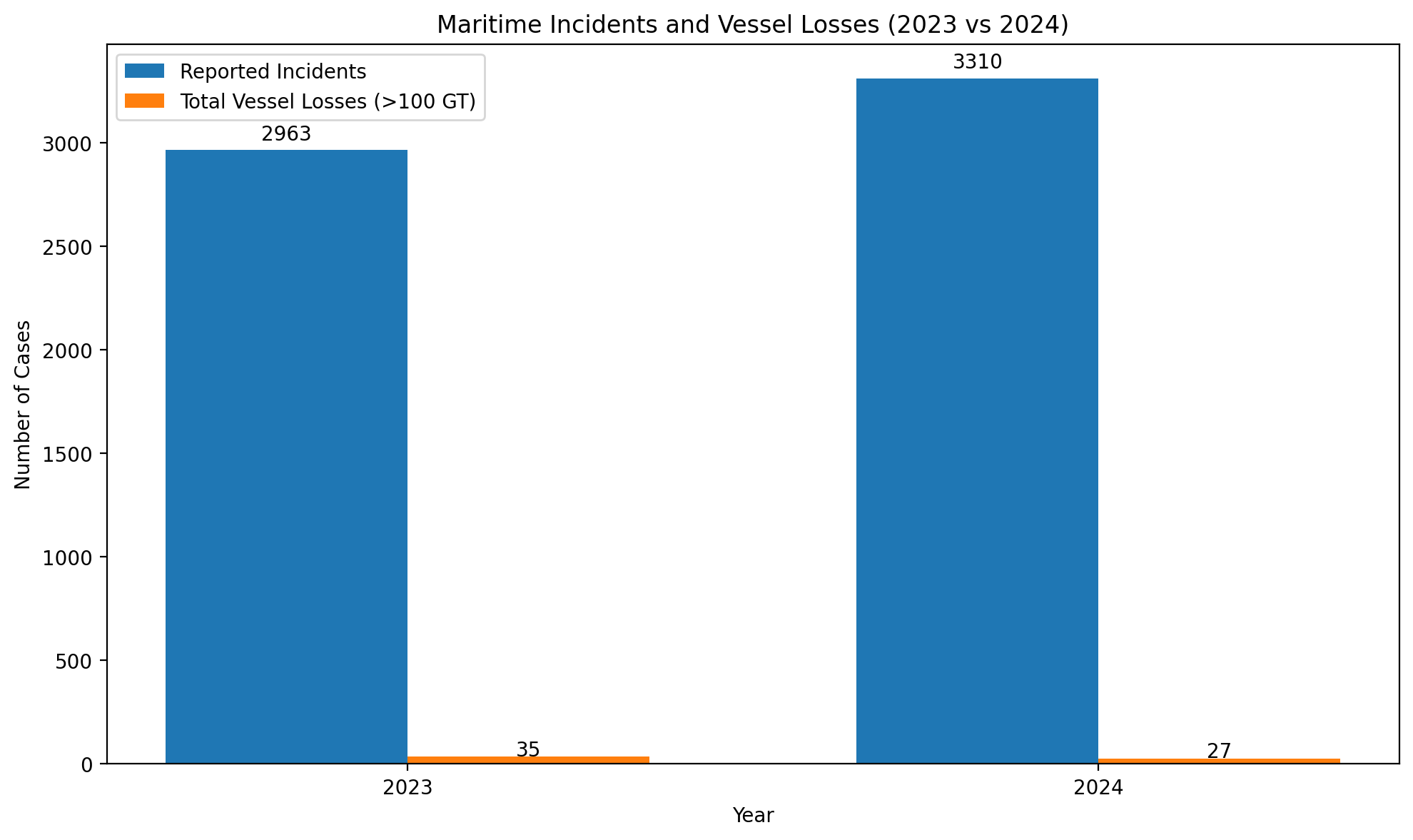
For years, the industry used total losses and major casualties as the clearest markers of safety progress. Those metrics still matter. But they are no longer enough on their own. A fleet can avoid a total loss and still experience higher commercial pressure because of repeat failures, off-hire exposure, detention risk, emergency repair spend, delayed voyages, and crew fatigue. Allianz’s 2025 data captures that paradox perfectly: fewer losses, more incidents. That is why ship managers need to read beyond the top-line safety headline. The real strain is sitting inside the operational layer.
DNV’s analysis makes the problem more concrete by linking recent incident growth to ageing tonnage. It says vessels older than 25 years accounted for 41% of all reported cases in 2024, up from 32% in 2014, while some 285 of the 358 additional incidents recorded between 2023 and 2024 came from ships over 25 years old. Of those, 236 were attributable to machinery damage or failure. That does not mean older vessels are inherently unsafe, but it does mean they demand tighter maintenance discipline, better access to technical history, and faster troubleshooting when symptoms appear.
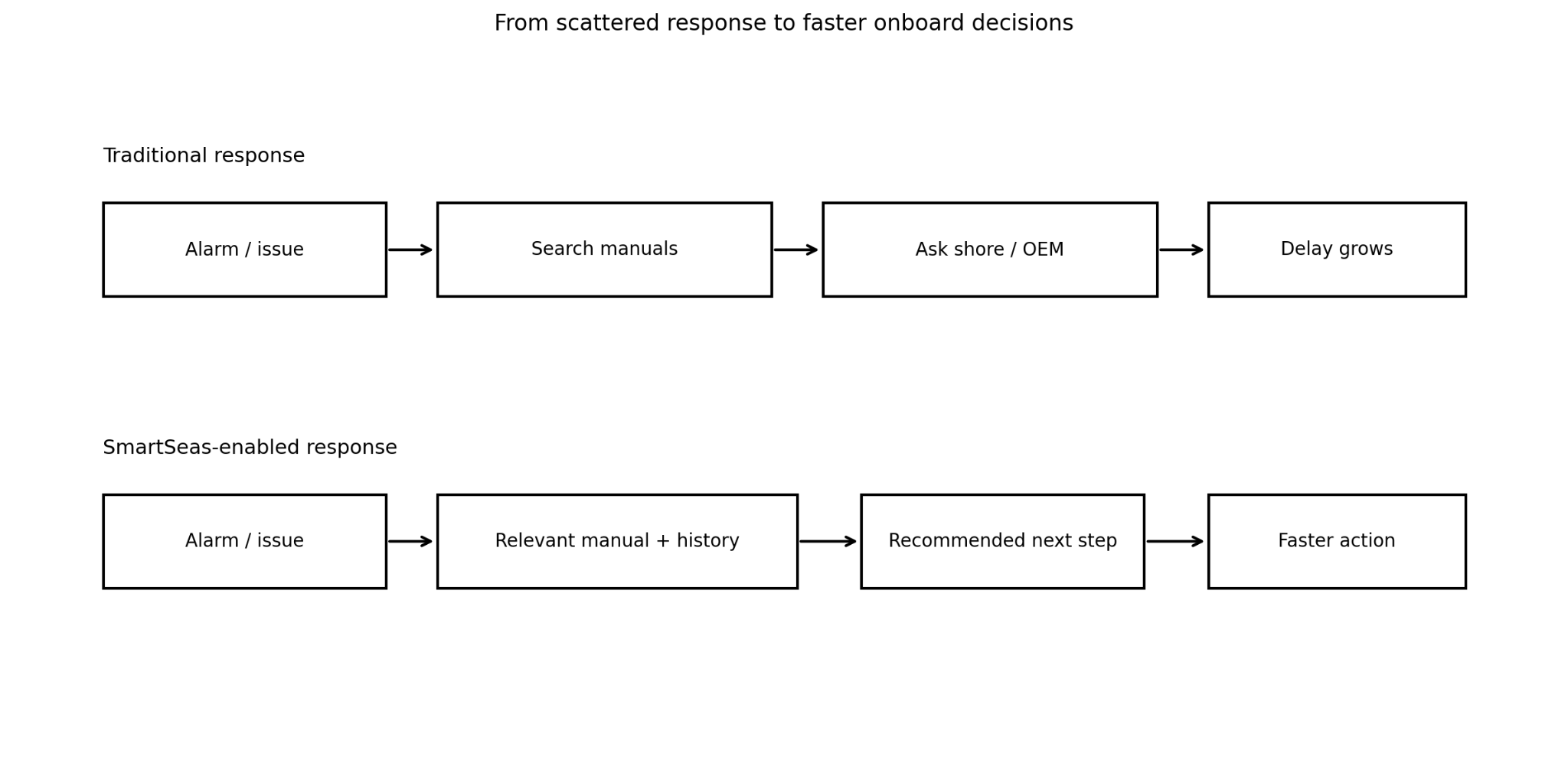
This is where many fleets get trapped. The manuals exist. The PMS exists. Previous defect reports exist. OEM guidance exists. The superintendent may even know the answer. But the answer is often buried in PDFs, old emails, spreadsheets, scanned reports, or individual memory. So when a real incident happens onboard, the first delay is not the repair itself. The first delay is figuring out what to do next. That time gap is now one of the most important hidden drivers of maritime risk. The reports do not always phrase it that way, but their patterns point strongly in that direction.
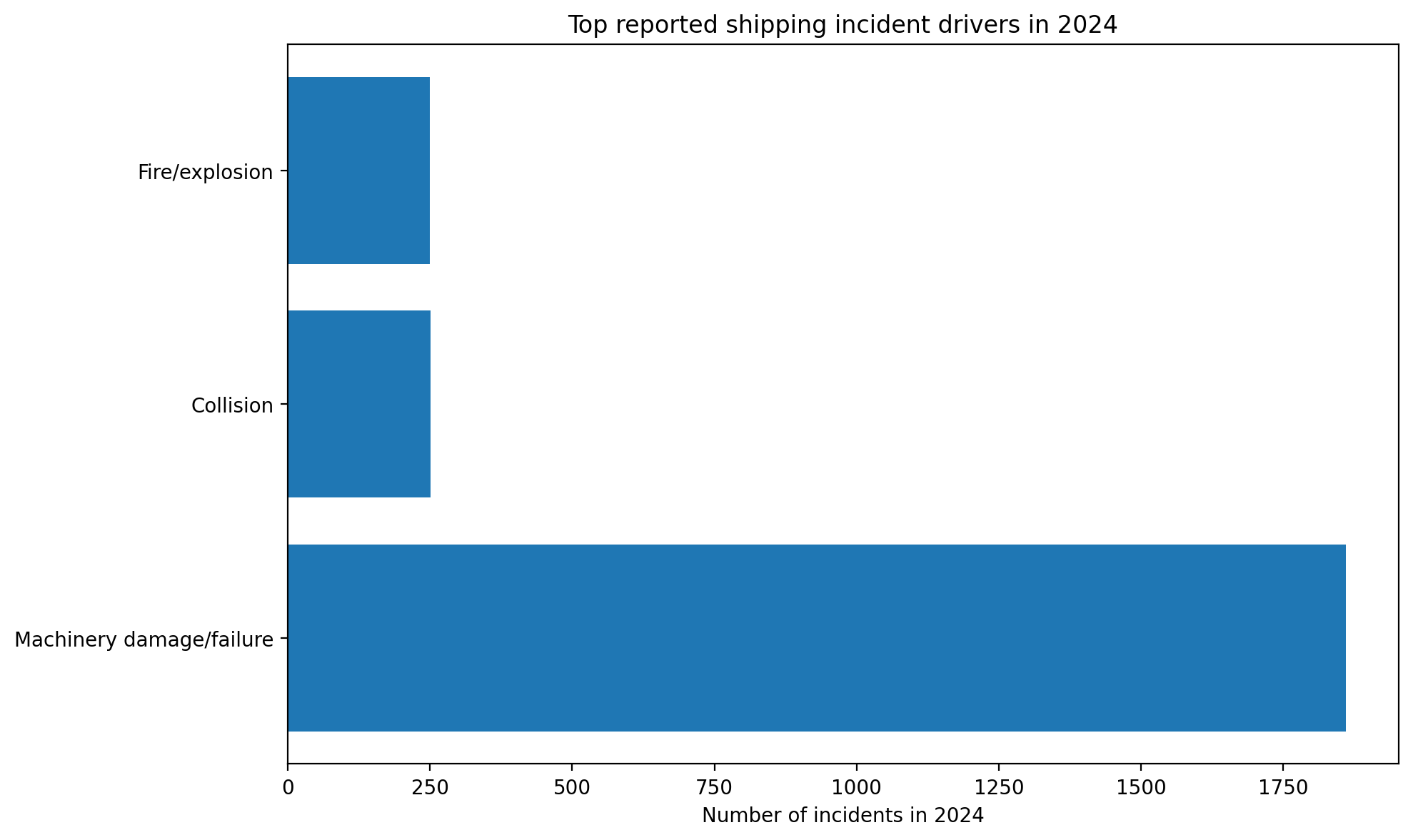
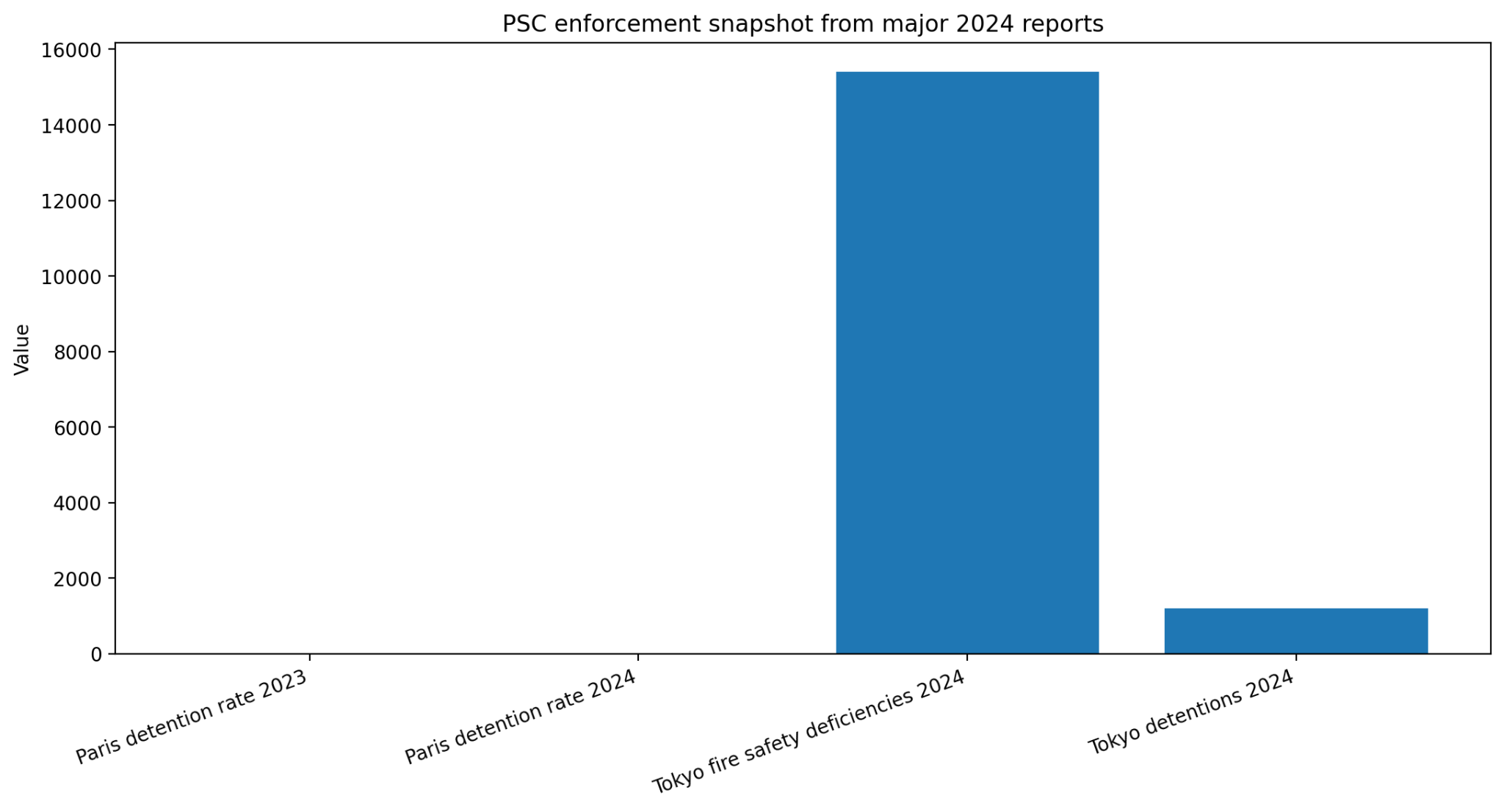
A few numbers from the latest reports tell the story clearly. Total losses fell to 27 in 2024, but reported incidents rose to 3,310. Machinery damage or failure accounted for 1,860 incidents, or more than half of all reported shipping incidents. Fire incidents reached 250, the highest annual total for a decade. Paris MoU’s detention rate rose to 4.03% in 2024 from 3.81% in 2023. Tokyo MoU recorded 1,189 detentions, 77,526 deficiencies, and 15,406 fire-safety-related deficiencies in 2024. Gard reported a 25% rise in the frequency of crew death claims when comparing the three years after Covid-19 with the three years before. The World Shipping Council reported 576 containers lost at sea in 2024, up from 221 in 2023, with route disruption around the Cape of Good Hope playing a significant role. Each number points to the same reality: the industry’s operational risk burden is still heavy.
For ship managers, the real meaning of these numbers is not statistical. It is practical. More machinery incidents mean more troubleshooting cycles and more dependence on experience-based diagnosis. More fire-related incidents and deficiencies mean more high-consequence inspection risk. More crew-safety claims mean leadership has to look beyond procedures and ask whether guidance is truly understood and actionable onboard. More route disruption means operational context is becoming less stable, which increases pressure on decision quality. Seen together, these are not separate issues. They are connected symptoms of a system that still loses too much time between signal and response.
The most important operational signal in the latest safety data is that machinery damage and failure remains the industry’s biggest incident driver. Allianz says it represented 1,860 incidents in 2024, or 56% of all reported shipping incidents globally. The next most common categories, collision at 251 and fire/explosion at 250, were far behind. DNV’s analysis aligns with that picture, saying machinery damage/failure accounted for 60% of all casualty cases in 2024, up from 38% a decade earlier.
That matters because machinery incidents are where technical, commercial, and human risk converge. A main engine fault, repeated generator shutdown, abnormal RPM fluctuation, steering anomaly, ballast system failure, or pump trip is rarely just a maintenance issue. It is also an information-access issue. The team must decide which manual applies, which equipment history matters, whether the problem has occurred on a sister vessel, whether there is a safe temporary action, whether spare parts are likely to be involved, and whether shore intervention is required. The more fragmented that search process is, the more expensive the incident becomes even before repair work starts.
This is why ship managers should treat machinery risk as a response-system problem, not only a maintenance-system problem. Planned maintenance and class compliance remain essential, but they do not automatically reduce time-to-decision when an unexpected fault appears under pressure. The latest incident data shows that fleets need faster access to equipment-specific knowledge, not just more documents. In practical terms, the winning fleets will be the ones that can move from symptom to relevant guidance faster than everyone else.
If machinery failure is the most common issue, fire remains one of the most dangerous. Allianz reports 250 fire incidents during 2024, up 20% year on year and the highest annual total for a decade. It also notes that more than 100 vessel total losses over the past decade have been caused by fire. That is a warning ship managers cannot treat as background noise, particularly in trades and vessel types where cargo complexity, ageing electrical systems, maintenance weaknesses, and storage practices can all combine to raise exposure.
What makes the fire trend more worrying is that inspection regimes are reporting the same weakness. Paris MoU says fire safety under SOLAS Chapter II-2 was the largest deficiency category in its 2024 analysis at 17.2%, while the detention rate rose to 4.03% from 3.81% the year before. Tokyo MoU similarly found 15,406 fire-safety-related deficiencies in 2024, making fire safety one of the largest categories of deficiencies discovered in the Asia-Pacific region. Frequent detainable items included fixed fire extinguishing installations, fire pumps and pipes, and fire prevention structural integrity.
For ship managers, the lesson is blunt: fire risk is no longer something to manage mainly through periodic drills, annual checks, and confidence that the SMS covers the subject. The latest reports suggest that fire safety is still failing in live execution. That usually means one of three things. Known weaknesses are not being closed fully. Lessons learned are not being transferred across vessels. Or crews do not have sufficiently clear, ship-specific operational guidance when they need it. All three problems are preventable, but only if fire safety is treated as a living operational system rather than a compliance topic that gets revisited when an audit is near.
One of the clearest patterns in current maritime risk reporting is that port state control continues to detect many of the same recurring problem areas. Paris MoU’s 2024 report says the detention rate has remained consistently high over recent years and specifically highlights recurring deficiencies in fire safety, structural conditions, electrical systems, welfare-related requirements, fire doors, seafarers’ employment agreements, and ISM-related issues. Tokyo MoU’s annual report shows a similar pattern through its mix of maintenance, lifeboats, ISM, and fire-safety-related deficiencies.
Ship managers should read that trend correctly. PSC is not only a compliance filter; it is a mirror. When the same kinds of deficiencies keep returning across different regions, it suggests the industry is not struggling with unknown risk. It is struggling with repeat risk. That means corrective actions are not always being standardized well, closure evidence is not always easy to retrieve, and the practical knowledge of “what fixed this last time” is not always traveling across the fleet fast enough. The consequence is not just embarrassment during inspection. It is wasted time, higher detention risk, more shore-side rework, and lower confidence in the consistency of safety management.
This is a major opportunity area. The fleets that reduce repeat PSC findings are usually not the fleets with the most paperwork. They are the fleets with stronger feedback loops between incident, defect, corrective action, verification, and reuse. In other words, they learn operationally, not just administratively. The latest MoU reports strongly suggest that the gap between those two things remains wider than it should be.
Crew safety data shows why operational clarity matters just as much as technical reliability. Gard’s 2025 Crew Claims Report is based on around 3,000 crew claims from 2024 and insights from more than 6,000 seafarers across 46 nationalities. It reports a 25% rise in the frequency of crew death claims in Gard’s P&I mutual portfolio when comparing the three years after Covid-19 with the three years before. Gard describes this as a troubling increase and frames it as a reason to prioritize both physical and mental wellbeing at sea.
RightShip’s enclosed-space analysis shows a similar operational truth in sharper detail. Since 2019, it reviewed 611 fatal incidents, identified 35 enclosed-space incidents, and counted 46 deaths in those cases. It also found 2,187 enclosed-space-related findings across 7,707 RISQ inspections between September 2021 and September 2024. These numbers are especially sobering because enclosed-space entry is not a new or poorly understood hazard. The risk is well known. The procedures are established. Yet failures continue because identification, control, permit discipline, ventilation, gas testing, supervision, and risk perception are still breaking down in practice.
For ship managers, that is the point. Crew safety does not fail only because policies are missing. It often fails because the shipboard environment is time-pressured, multilingual, interrupted, and operationally messy. Guidance that works on paper can still fail in the moment if it is hard to find, hard to interpret, or disconnected from the actual task. That means better safety performance increasingly depends on delivering relevant guidance in a way crews can use immediately, not simply proving that the guidance exists somewhere in the system.
The vessel itself is only one part of the risk picture now. The International Chamber of Shipping’s 2024–2025 Maritime Barometer says political instability remained the top perceived industry risk, followed by cyber-attacks, increasing administrative burden, and barriers to trade. It also highlights the growing concern around the availability of crew and trained personnel. These are not narrow technical issues; they are business-environment risks that directly affect operational stability.
The World Shipping Council’s 2025 update on containers lost at sea adds another layer. It says 576 containers were lost at sea in 2024, up from 221 in 2023, although still below the 10-year average of 1,274. The Council links part of that increase to disruption in the Red Sea and a 191% increase in transits around the Cape of Good Hope, where hazardous conditions contributed to around 200 containers lost in that region in 2024. This is a strong reminder that geopolitical events can quickly alter physical risk exposure for ships and cargo.
For ship managers, this wider context matters because even a technically well-run vessel now operates inside a more volatile system. Route changes, cyber risk, port congestion, trade disruption, crew constraints, and heightened reporting requirements all increase the need for fast, well-grounded decisions. Safety and reliability are no longer determined only by onboard condition. They are increasingly shaped by how quickly ship and shore teams can understand context and adapt under pressure.
A useful way to read the current safety data is through real use cases. The first is dry bulk detention risk. RightShip reports that bulk carriers had the highest incident ratio among the sectors it compared, at 1.49%, along with a 4.69% PSC detention ratio. It estimates that bulk carriers lost roughly 3,200 days to detentions in 2023, equivalent to about $48 million in lost revenue at a $15,000 day rate. That is not a compliance story alone. It is a commercial-performance story rooted in safety and operational discipline.
The second use case is enclosed-space entry. RightShip’s data shows a hazard the industry understands extremely well but still fails to control consistently. When a risk is that well documented and still produces repeated fatalities and inspection findings, the issue is no longer awareness. It is execution under real operational conditions. For ship managers, that means safety improvement has to include better task-specific access to guidance, better verification of controls, and better retention of operational lessons across crews and vessels.
The third use case is route-driven exposure. The increase in container losses in 2024 did not happen in a vacuum. The World Shipping Council directly links it to trade disruption and rerouting around the Cape of Good Hope. That illustrates a broader point: when the operating environment changes, risk can move quickly from geopolitical headline to physical safety exposure. Ship managers therefore need systems that do more than document what happened yesterday. They need systems that help teams interpret changing context and act on it quickly.
The fourth use case comes from SmartSeas.AI’s own case studies. On its case-studies page, SmartSeas.AI says it identified a critical dry sleeve bearing defect during a steering-system hand-steering seizure event, helping avoid more than $87,000 in potential delays and repairs. The same page says a 5.5-hour troubleshooting failure involving engine RPM fluctuations was resolved in minutes by surfacing sister-vessel intelligence regarding a solenoid valve leak. These are company-published examples rather than independent industry studies, but they are highly relevant because they show exactly where much of today’s hidden risk sits: not in the absence of information, but in the delay between fault signal and usable answer.
This is where SmartSeas.AI becomes strategically relevant for ship managers. On its “Why Us” page, SmartSeas.AI says it unifies ship manuals, past technical defects and incidents, and day-to-day operational data into one assistant designed to help crews resolve faults faster, prevent repeat issues, and keep vessels earning. It also emphasizes ship-specific configuration, retrieval-grounded answers, offline-capable deployments for on-vessel use, and integration with existing marine systems and workflows.
Its features and homepage descriptions add more detail. SmartSeas.AI says crews can access solutions based on technical defects, incident reports, OEM manuals, and other critical resources; retrieve equipment-specific manuals quickly; use multilingual and voice support; and collaborate with shore teams through real-time guidance. Its public materials also describe the platform as suitable for low-bandwidth or offline maritime conditions, which is important because many operational decisions cannot wait for stable connectivity.
That positioning lines up closely with the problems highlighted across the latest maritime safety reports. When machinery damage and failure accounts for more than half of incidents, crews need faster access to the right manual section and the right defect history. When fire-safety and ISM findings recur in PSC inspections, managers need a better way to carry one vessel’s learning to the rest of the fleet. When crew experience varies and language can be a barrier, voice and multilingual access matter. And when the operating environment is volatile, ship and shore teams need a shared decision layer, not just a shared archive. SmartSeas.AI is built around exactly those gaps.
SmartSeas.AI’s public “About” page also says it is currently deployed across 70+ ships with 10,000+ users, while the company’s materials emphasize consolidation of manuals, incident reports, emails, and technical knowledge into one place. Those are company-reported figures, but they reinforce the same core value proposition: preserving technical knowledge, shortening diagnosis time, and improving ship–shore collaboration so that recurring problems do not have to be rediscovered every time they appear.
The first practical move is to treat repeat issues as strategic signals, not routine noise. If the same categories of faults and deficiencies keep showing up in machinery, fire safety, maintenance, enclosed-space control, and inspections, they should be managed as recurring-risk patterns. That means tracking not just the event, but also the evidence path, the corrective action, the preventive step, and whether the lesson was reused elsewhere.
The second move is to reduce time-to-decision, not only time-to-repair. A fault that takes five hours to understand can still be expensive even if the physical fix is simple. The latest data makes it clear that a large share of maritime risk now lives in that interpretation window. Ship managers should therefore focus on systems that shorten the path from alarm or symptom to relevant procedure, past case, likely cause, and next-step guidance.
The third move is to run safety and troubleshooting as a live information system. Manuals, incident logs, corrective actions, OEM circulars, PMS records, and superintendent notes only create value when people can find and apply them quickly. The fleets that do this well will not just improve compliance. They will also reduce commercial leakage from delay, repeat effort, poor handovers, and person-dependent troubleshooting.
The latest maritime safety reports do not say the industry is becoming unsafe in a simple sense. They say the shape of risk is changing. Total losses are down, but machinery failures remain dominant, fire exposure is rising, PSC deficiencies continue to repeat, crew-safety pressures remain real, and the broader operating environment is more volatile than before. That means ship managers can no longer rely on traditional safety indicators alone. They need a faster operational response system for the risks that keep repeating every day.
1. Why are maritime safety risks still increasing if total vessel losses are declining?
Because fewer catastrophic losses do not mean fewer operational problems. Many fleets are still facing recurring machinery failures, fire incidents, PSC deficiencies, crew-safety issues, and delayed technical decision-making.
2. What is the biggest operational safety risk for ship managers today?
Machinery damage and failure remains the biggest operational risk because it affects uptime, repair cost, voyage schedules, and crew workload. It also creates repeated troubleshooting pressure across ship and shore teams.
3. Why is machinery failure such a costly issue in shipping?
Machinery failure is costly not only because of repair expenses, but also because of downtime, delayed voyages, off-hire risk, and the time lost finding the right technical guidance before action can begin.
4. Why is fire still one of the most serious maritime safety concerns?
Fire can escalate quickly, threaten lives, damage critical systems, and lead to major commercial loss. It also remains a recurring area of concern in inspections and port state control findings.
5. What do repeated PSC deficiencies tell ship managers?
Repeated PSC deficiencies usually show that known issues are not being resolved consistently across the fleet. They often point to weak corrective-action follow-up, poor knowledge transfer, or gaps in operational execution.
6. How does delayed decision-making increase maritime risk?
When crews and shore teams take too long to identify the right procedure, manual, defect history, or next step, a small issue can grow into a larger technical failure, safety event, detention, or costly delay.
7. Why is crew safety closely linked to operational efficiency?
Crew safety and operational efficiency are connected because unclear guidance, repeated faults, and high-pressure troubleshooting environments increase human error, fatigue, and unsafe decision-making onboard.
8. How do geopolitical disruptions affect maritime safety?
Geopolitical disruptions can force route changes, increase voyage duration, raise exposure to weather and cargo risk, and create added operational complexity that puts more pressure on crews and fleet managers.
9. How can ship managers reduce repeat technical incidents across the fleet?
Ship managers can reduce repeat incidents by capturing defect history properly, standardizing corrective actions, improving ship-shore communication, and making technical knowledge easier to access during live operations.
10. How is SmartSeas.AI positioned to help with these challenges?
SmartSeas.AI helps by bringing together manuals, defect history, incident learnings, and operational knowledge into one system so crews and managers can find the right information faster, respond more confidently, and reduce repeat issues.

Get Started Today
Transform the way you troubleshoot and manage maritime operations. Join the next wave of Maritime Digital Transformation with SmartSeas AI.




.svg)