.jpg)


Maritime has never been short on data. What it’s been short on is time—time to search through manuals during a machinery issue, time to stitch together an incident narrative from multiple emails, time to prepare an inspection evidence pack, time to interpret port disruption notices, time to standardize defect reports across vessels, time to translate technical guidance for a multinational crew, and time to convert all of that knowledge into repeatable best practice.
That’s exactly why Generative AI (GenAI) is showing up across shipping, ports, class, logistics, and maritime services. Not as “science fiction automation,” but as a practical layer that helps people find, understand, and produce operational work faster—while keeping humans responsible for safety-critical decisions.
This guide is written for any maritime leader or maritime professional who’s new to the topic and wants a clear, realistic understanding of:
Generative AI refers to AI systems (usually large language models, or LLMs) that can generate new content—like text, summaries, checklists, emails, procedures, explanations—based on patterns learned from large datasets. Think of it as a powerful “language engine” that can read and write in a human-like way.
ABB describes GenAI as using large language models to create fresh content based on learned patterns from data.
A critical beginner point: a general-purpose LLM does not “know your ship.” It doesn’t automatically know which manual revision applies to which vessel, what your SMS requires, what your superintendent prefers, or what your last five defects looked like.
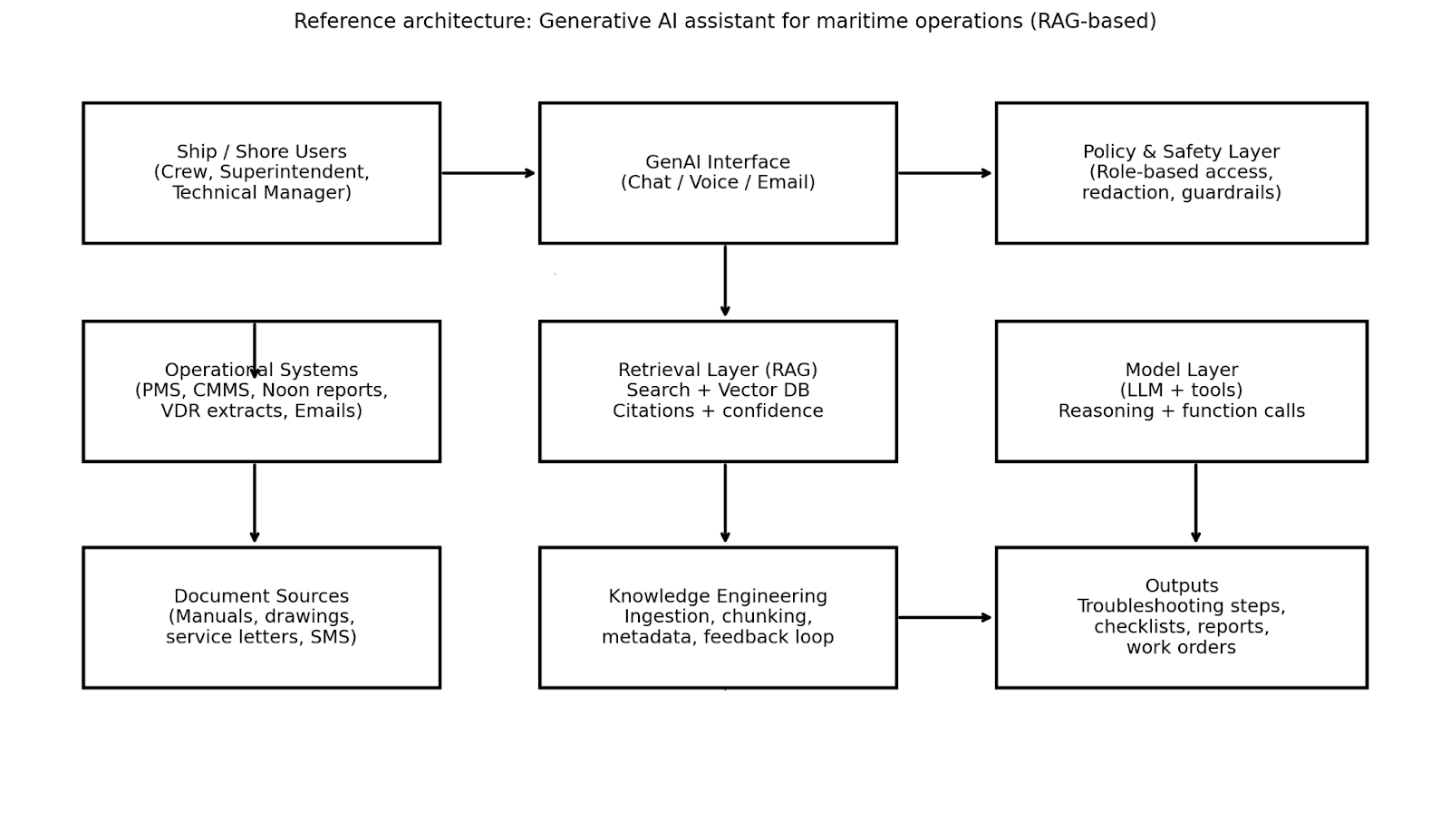
That’s why serious maritime GenAI systems are usually designed to work like this:
This pattern is commonly called RAG (Retrieval-Augmented Generation).
Maritime operations combine three conditions where GenAI excels:
Ships and shipping companies run on documents:
A big portion of maritime work is:
Crew rotation and operational urgency create a constant gap between:
GenAI reduces that gap by making knowledge queryable and reusable.
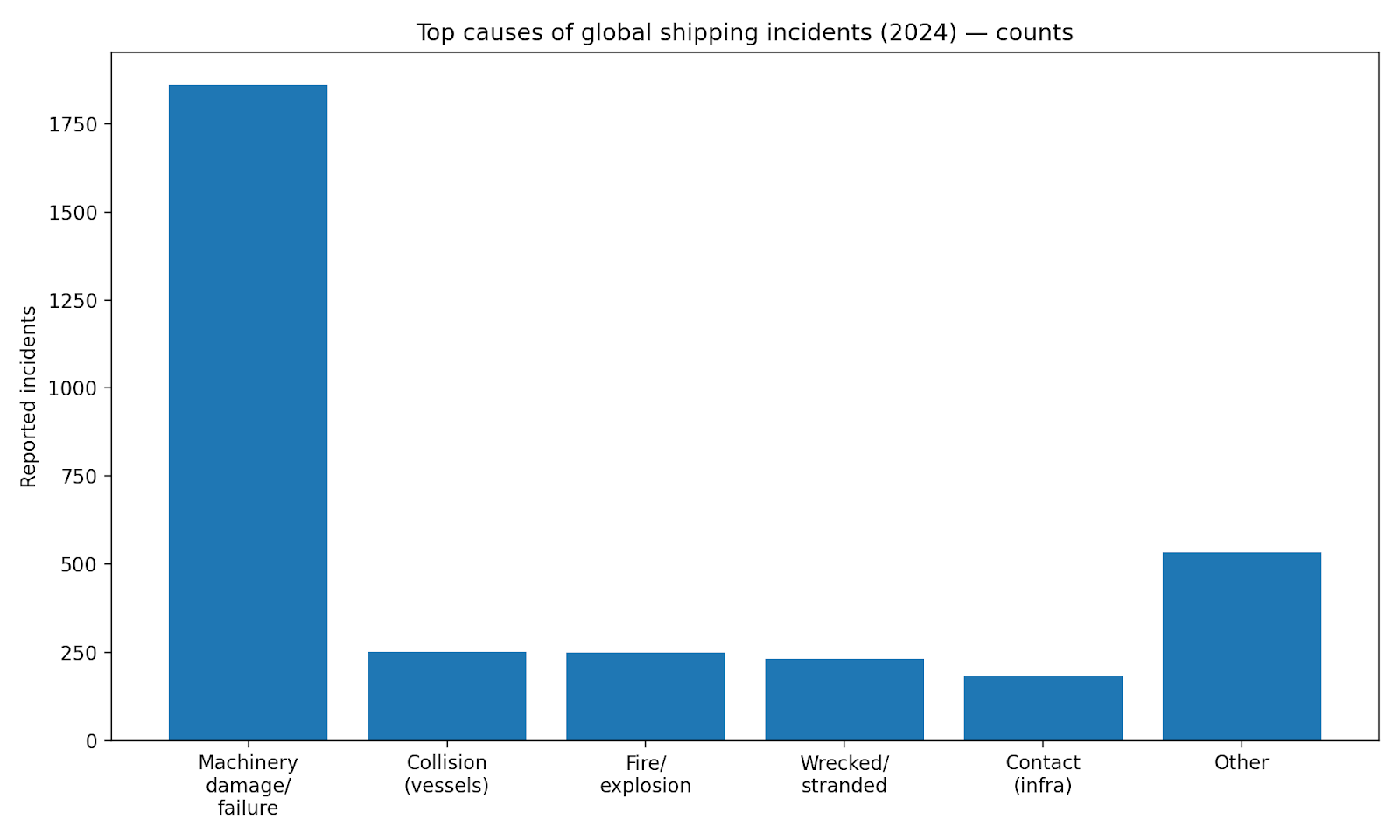
When deciding where to start, use industry signals. The Allianz Safety & Shipping Review 2025 reports that machinery damage/failure accounted for well over half of all shipping incidents globally (1,860) in 2024, followed by collision (251) and fire/explosion (250).
That doesn’t mean “GenAI fixes machinery.” It means the highest leverage beginner deployments are often around:
Below are publicly reported, concrete examples (not theoretical slides).
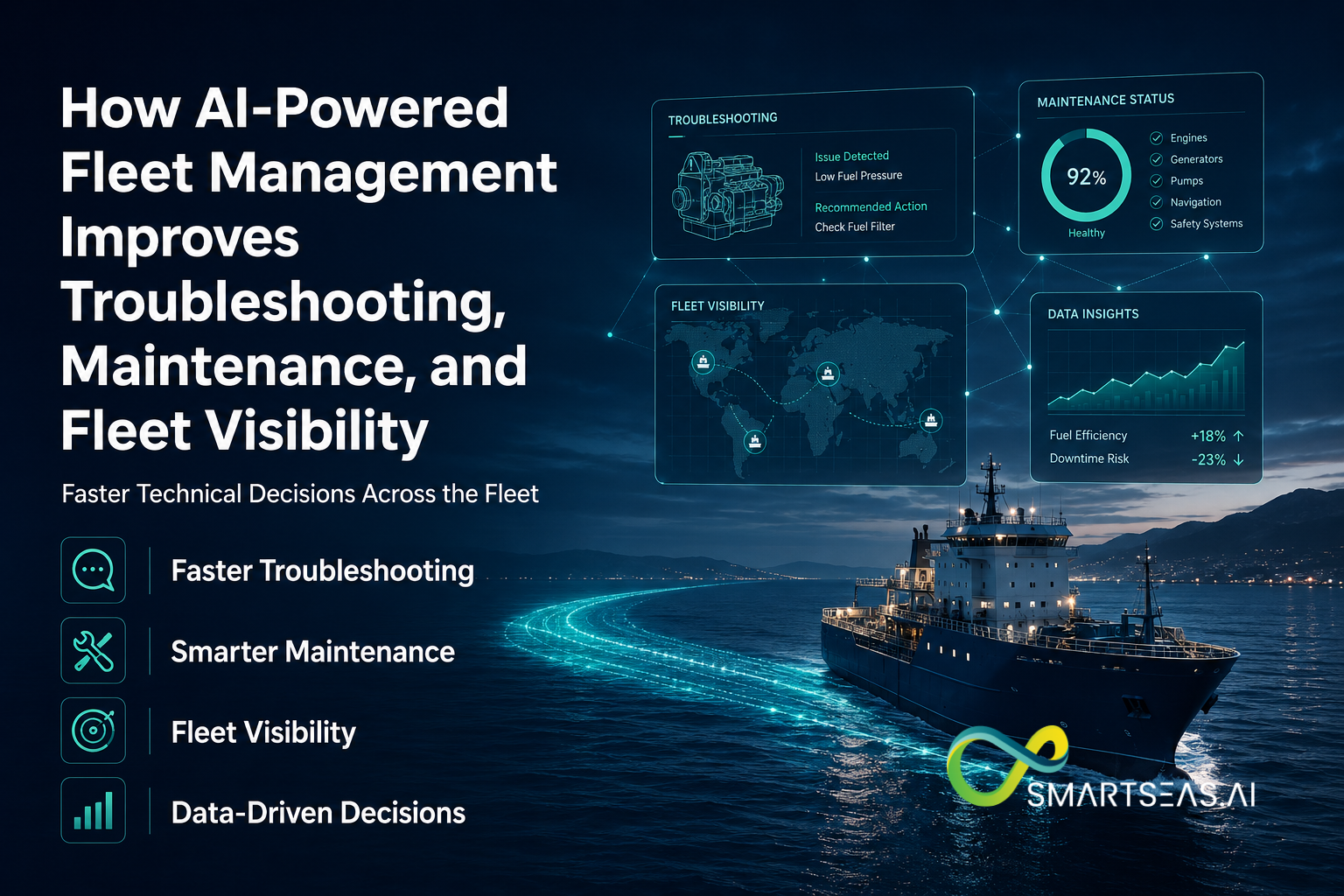
SmartSeas.ai is an example of generative AI being applied to everyday maritime operations—especially where teams need fast, accurate answers from scattered technical knowledge. SmartSeas.ai presents itself as an AI-powered maritime troubleshooting platform designed to make technical support and knowledge access quicker and easier.
SmartSeas.ai reflects a practical adoption pattern: connect GenAI to trusted operational knowledge (manuals + historical records) so maritime teams can resolve technical questions faster, standardize troubleshooting outputs, and improve consistency across ship–shore workflows.
Reuters reported CMA CGM’s partnership with Google (July 2024) to accelerate AI solutions across operations, including route optimization and logistics efficiency.
Reuters also reported CMA CGM’s €100m partnership with Mistral AI (April 2025) aimed at improving customer service—specifically handling over a million weekly customer emails and reducing response times.
What this proves: GenAI value is immediate in communication-heavy maritime workflows, even before touching onboard systems.
In September 2025, the World Shipping Council (WSC) announced an industry program combining AI-powered cargo screening and inspection standards to identify misdeclared/undeclared high-risk shipments before loading.
The Financial Times reported the tool scans millions of bookings in real time, and carriers representing about 70% of global container capacity opted to join.
WSC also notes the platform builds on a tool processing 10+ million bookings per month.
What this proves: The industry is applying AI to reduce major operational risk, not only to “improve productivity.”
Port of Rotterdam’s digital report describes how, when a terminal or depot sends a message about a disruption, AI picks it up and translates it into a message in Port Alert.
What this proves: Ports are increasingly using AI to convert unstructured messages into actionable operational updates—an ideal space for GenAI-style summarization and translation.
Lloyd’s Register announced it would use generative AI (built upon Microsoft Azure OpenAI Service) to enhance permitting capabilities for nuclear technology applications in maritime.
What this proves: GenAI also supports high-stakes, regulated documentation workflows, where traceability and process quality matter.
DNV published a report exploring how AI search and analysis could improve safety in offshore operations, initially focusing on dropped object incidents.
What this proves: “Search + analysis + structured learning” is a credible path for safety improvement—not only automation.
An arXiv case study examined using LLM-generated draft replies to support human experts responding to stakeholder inquiries in maritime—finding workflow benefits but emphasizing the need for human oversight for precision and safety-critical contexts.
What this proves: A beginner-safe pattern is: AI drafts, humans decide.
A model trained to predict and generate text. It’s great at:
LLMs can produce plausible-sounding wrong content. That’s why maritime GenAI must be grounded.
RAG reduces hallucinations by forcing the system to reference your approved documents.
Prompting is simply giving the model clear instructions:
Below are beginner-friendly use cases that apply broadly across operators, managers, technical teams, ports, logistics stakeholders, and maritime service providers.
Problem: People waste time searching PDFs and sometimes follow outdated steps.
GenAI approach: Ask natural-language questions and receive:
Typical outputs:
Beginner rule: No citations = no operational answer.
Problem: Defects are written inconsistently, which makes analysis harder and slows decisions.
GenAI approach: Convert free-text notes into a standard defect structure:
Why leaders like it: Better structured defect data improves recurring failure learning, reporting quality, and decision speed.
Problem: Incident learnings often live in long PDFs that don’t get reused.
GenAI approach: Turn incident documentation into:
Safety note: GenAI can help organize and draft—final causation is still human-led.
The WSC Cargo Safety Program shows how AI screening can flag suspicious bookings and reduce risk of misdeclared hazardous cargo.
Where GenAI fits: Beyond pattern detection, GenAI can:
This is often the fastest “first win” because it’s low disruption and high volume.
GenAI can:
CMA CGM’s investments show how significant this category is at scale.
Port of Rotterdam describes AI detecting disruptions as soon as they’re messaged and translating them into Port Alert updates.
GenAI can help maritime teams by:
Problem: Inspections and audits consume time because evidence is scattered.
GenAI approach: Build a “compliance pack generator” that:
Beginner safeguard: Keep access controls strict; don’t leak sensitive documents.
GenAI can convert:
This is particularly useful in maritime contexts with rotating personnel.
Avoid vague metrics like “AI adoption.” Use operational metrics.
Most successful deployments follow a staged approach.
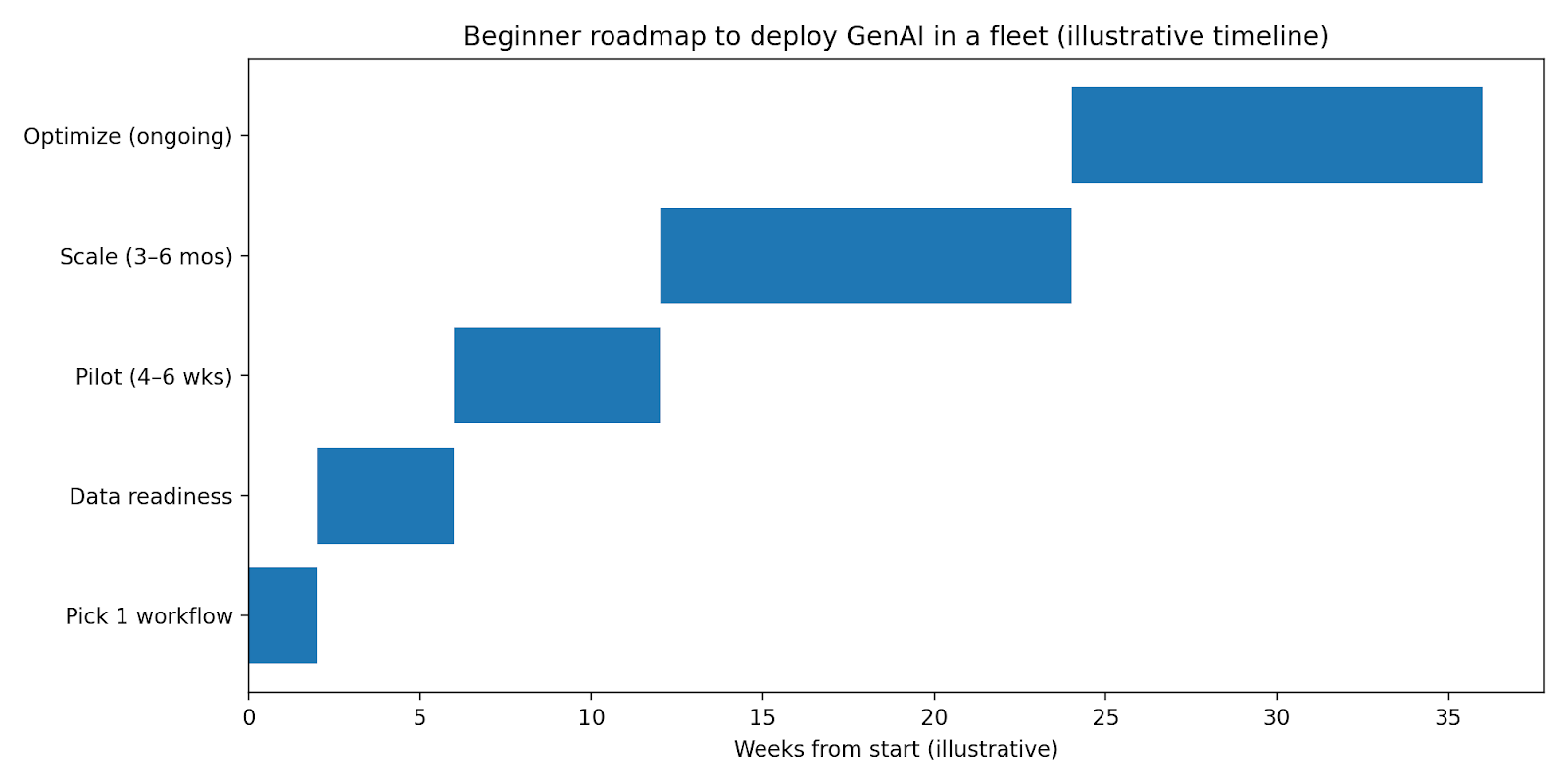
A simple interpretation:
Many beginners jump straight to “AI agent that does everything.” Don’t.
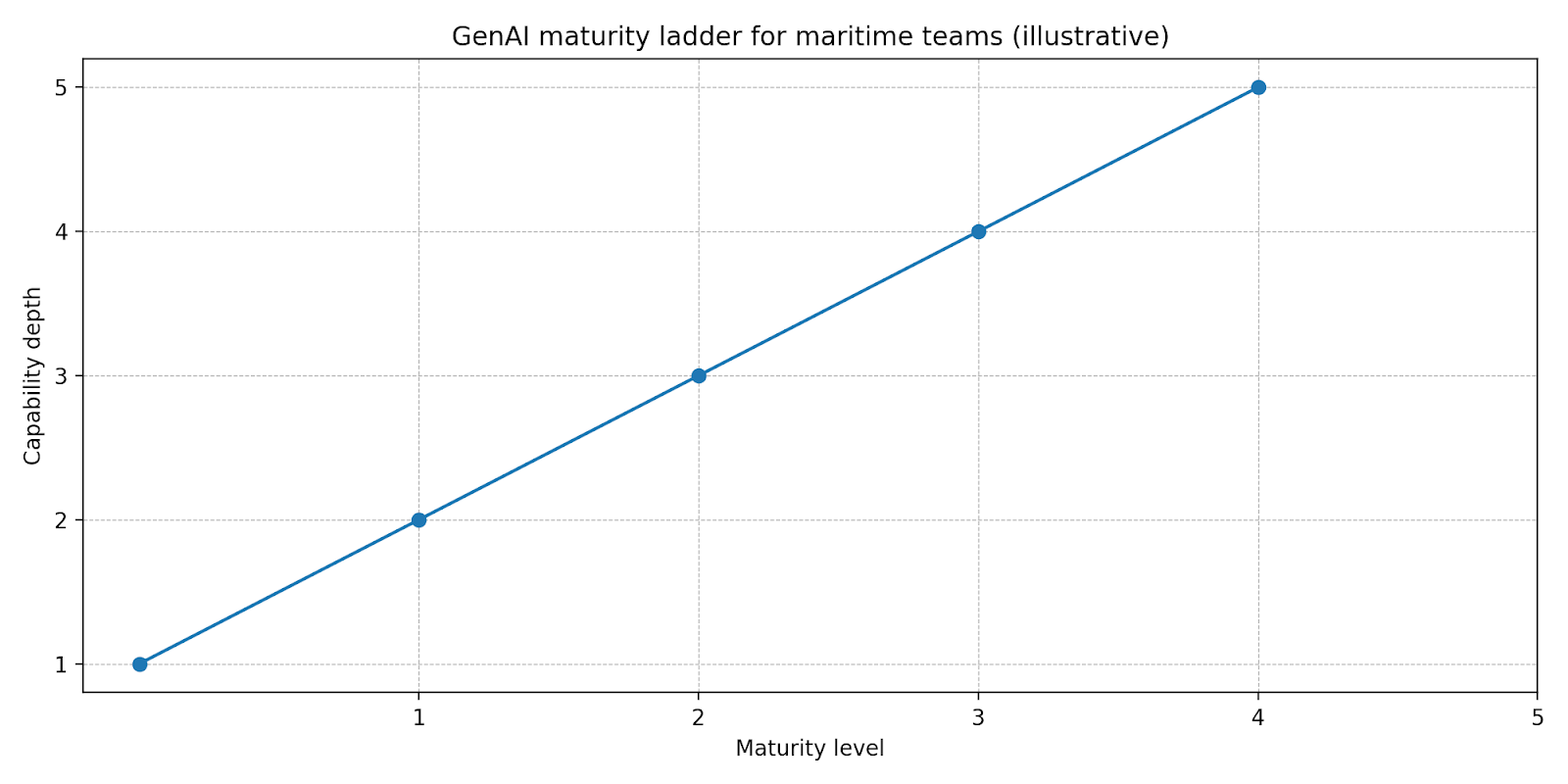
A safer maturity path:
Maritime leaders should treat GenAI as a safety-adjacent digital capability, not a casual tool.
IMO’s updated guidelines on maritime cyber risk management (MSC-FAL.1/Circ.3/Rev.3, April 2025) provide high-level recommendations and functional elements for cyber risk management.
“The Guidelines on Cybersecurity onboard Ships” (Version 5, published 14 Nov 2024) emphasize work processes, equipment, training, incident response, and recovery management.
Below are practical prompt templates maritime professionals can use in an approved GenAI environment.
“Summarize the following email thread into: (1) key facts, (2) decisions made, (3) open questions, (4) action items with suggested owners. Keep to 10 bullets max. If any technical claims appear, list them as ‘needs verification’.”
“Turn these notes into a structured defect report with headings: Symptoms, Conditions, Actions Taken, Suspected Causes (with confidence), Immediate Risk, Recommended Next Checks, Spares/Tools Required, Missing Information Questions.”
“Answer using only the provided excerpts. If the excerpts do not support an answer, say ‘Not enough information’ and list what document sections are needed. Always include citations.”
“Create a timeline from the following incident notes. Include timestamps where available. Identify gaps and list 5 clarifying questions.”
Fix: Choose one workflow with measurable outcomes.
Fix: Tag documents by vessel/equipment/version/date.
Fix: Enforce “no citations → no operational answer.”
Fix: Publish a clear policy + approved toolset.
Fix: GenAI drafts and assists; humans decide.
Research on LLM draft replies in maritime contexts reinforces that LLMs can streamline workflows but often need significant modifications and must remain under human oversight for safety-critical quality.
Generative AI is not a futuristic “autonomy switch.” It’s a practical capability that helps maritime organizations move faster through the work that consumes time every day: searching, summarizing, drafting, standardizing, translating, and preparing evidence.
The strongest beginner strategy is:
The industry examples are already clear: from large-scale customer communication initiatives (CMA CGM) to safety-focused cargo screening at industry scale (World Shipping Council), maritime is moving from experimentation into structured adoption.
Yes—when it’s deployed with cyber controls, access control, audit logging, and “human approval” safeguards aligned with IMO and industry cyber guidance.
Common first wins include: email/thread summarization, defect drafting standardization, and “ask-the-manual” Q&A with citations.
Use RAG grounded in approved documents, require citations, and force the system to say “Not enough information” instead of guessing.
No. Many successful pilots start with documents + communications, then integrate later once value is proven.
Track time-to-find information, time-to-draft responses, audit pack preparation time, repeat issue rates, and quality scores of reports.
No. Ports (e.g., disruption message processing), classification/regulatory workflows, logistics providers, and maritime service companies can all benefit.
Yes—when used to improve early detection, standardize learning, reduce miscommunication, and strengthen pre-loading risk screening (as shown by WSC’s AI cargo screening initiative).
Any safety-critical decision or action without human oversight. GenAI can assist, not replace accountability.

Get Started Today
Transform the way you troubleshoot and manage maritime operations. Join the next wave of Maritime Digital Transformation with SmartSeas AI.



.svg)


.png)