.jpg)
April 10, 2026
Shipping Low-Cost Digitalization: How It Can Transform Your Business


April 10, 2026
Shipping low-cost digitalization is no longer a future-looking idea reserved for large transformation budgets. It is becoming one of the most practical ways for maritime companies to reduce operating friction, improve visibility, and make better day-to-day decisions without waiting for a full technology overhaul. In shipping, many of the biggest losses do not start with a catastrophic failure. They start with repeated paperwork, delayed responses, scattered technical records, slow ship-shore coordination, and recurring issues that take too long to resolve. Those small inefficiencies quietly increase OpEx and reduce fleet performance.
That is why shipping low-cost digitalization matters. It focuses on improving the workflows that hurt the business most, using targeted digital tools that are easier to adopt, faster to deploy, and more realistic for everyday fleet operations. Instead of trying to replace everything at once, companies can digitalize the processes that create the most repeated delay: port-call documentation, inspection reporting, defect follow-up, technical knowledge access, maintenance visibility, and ship-shore handovers.
This matters even more now because the industry direction is clear. Since 1 January 2024, all IMO Member States are required to use a Maritime Single Window to collect and exchange information with ships calling at ports through a centralized digital platform. The purpose is to streamline arrival, stay, and departure procedures and improve the efficiency of shipping worldwide. Low-cost digitalization is how many operators begin adapting to that reality in a practical way.
Shipping low-cost digitalization does not mean using low-quality tools or cutting corners. It means solving high-friction problems with practical digital interventions before committing to a larger transformation program. In shipping, that often begins with digitizing forms, reducing duplicate data entry, improving inspection workflows, making vessel records searchable, and creating shared visibility between ship and shore. These are operational fixes first, technology projects second.
This approach works because many of shipping’s most expensive inefficiencies are repetitive rather than dramatic. A superintendent searching through email chains for the right corrective action, a crew re-entering the same information across multiple forms, or a shore team waiting for incomplete updates from a vessel may not look like major cost events individually. But multiplied across voyages, vessels, and months, they become meaningful financial drag. Digitalization at the right points removes that friction.
A good low-cost digitalization strategy usually starts with one question: where are we losing time every week for reasons that are avoidable? The answer often points to the best first project. For one fleet, it may be port-call documentation. For another, it may be maintenance follow-up. For another, it may be technical troubleshooting and knowledge reuse. The point is not to “go digital” everywhere at once. The point is to fix what is repeatedly slowing the business down.
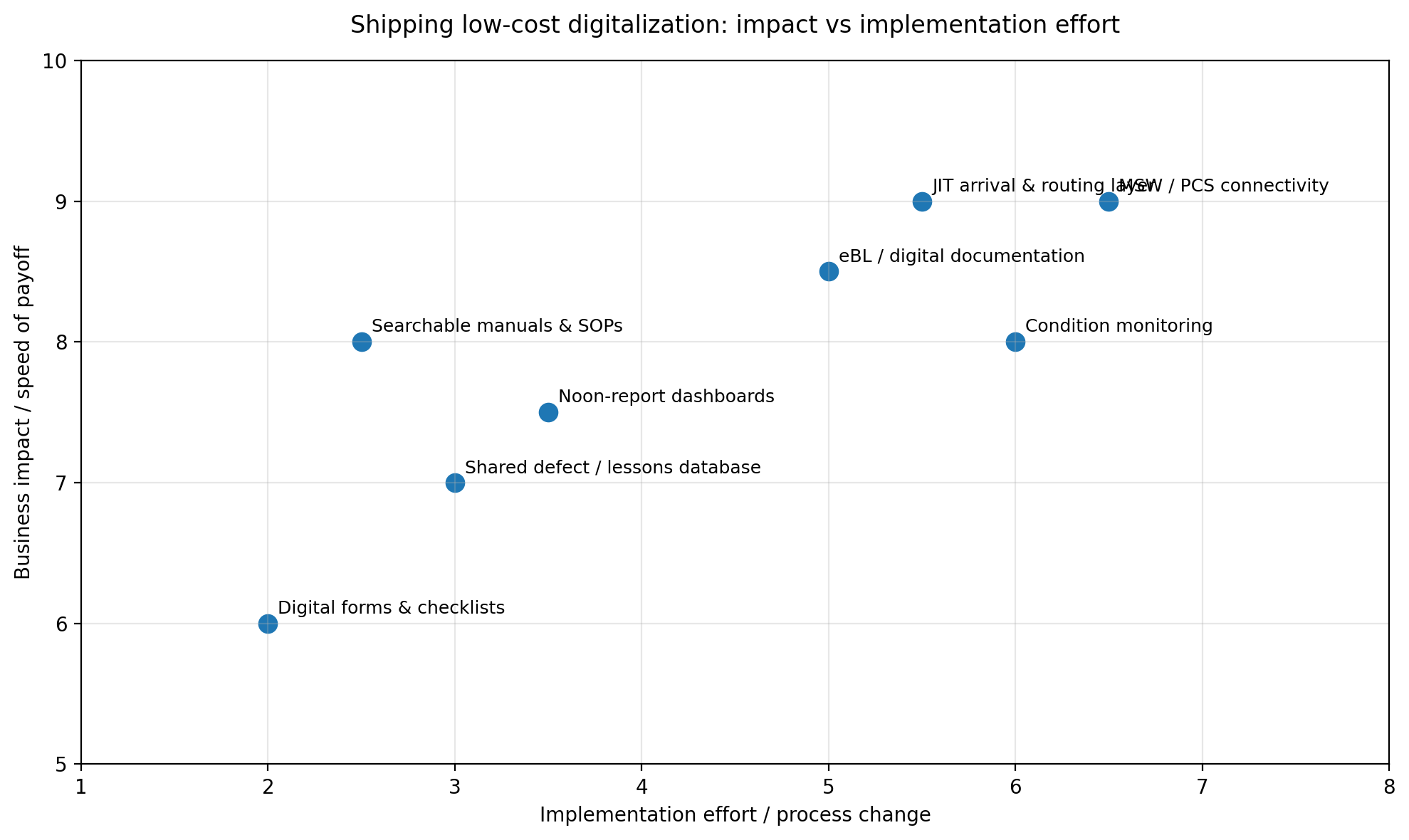
The shipping industry is already under pressure to exchange information more efficiently. The IMO’s Maritime Single Window requirement is one clear example, but the broader commercial case is just as important. The World Bank describes port community systems as collaborative digital platforms that reduce paperwork and administrative red tape while improving information exchange between customs, port authorities, shipping lines, logistics providers, and freight forwarders. It links these systems to quicker decisions, more streamlined operations, better competitiveness, stronger resilience, and lower emissions.
In practical terms, this means that digitalization is no longer only a compliance or modernization discussion. It is now an operations discussion. Companies that reduce documentation friction, improve reporting quality, shorten technical response cycles, and create better coordination around vessels and voyages are also improving service reliability and cost control. That is why the conversation has shifted from “Should we digitalize?” to “Which process should we digitalize first?”
It is also important because many maritime teams still work in mixed environments where paper, spreadsheets, PDFs, calls, and disconnected systems all overlap. That hybrid reality slows decisions. Low-cost digitalization helps remove the most painful gaps without forcing the business into a high-risk, all-at-once transformation.
A common mistake is assuming that digitalization becomes valuable only when it is large and expensive. In reality, some of the strongest returns come from digitizing the small operational processes that people repeat every day.
The World Bank reports that the Dutch port community system PORTBASE reduced annual costs for businesses involved in logistics by as much as €245 million. It also reports that Djibouti’s PCS cut turnaround time at terminal operators to 1 hour from 24 hours. UNCTAD separately notes that in Djibouti the PCS reduced manual processes from nine to five, cut clearance time per consignment by four to five hours, and enabled online booking in just one to two minutes. Dubai Trade says its digitized trade platform eliminated 12.74 million physical visits in the first half of 2023 and shifted 42.47 million paper exchanges to digital, saving around 3.82 million pounds of CO2 emissions.
These examples are important because they show what happens when operational information moves faster. Paperwork falls. Waiting time falls. Repeated handling falls. Decision speed improves. The exact same logic applies inside a shipping company. If a fleet can reduce friction in vessel reporting, maintenance follow-up, inspections, or troubleshooting, the value is not theoretical. It shows up in time saved, better decisions, and fewer delays.
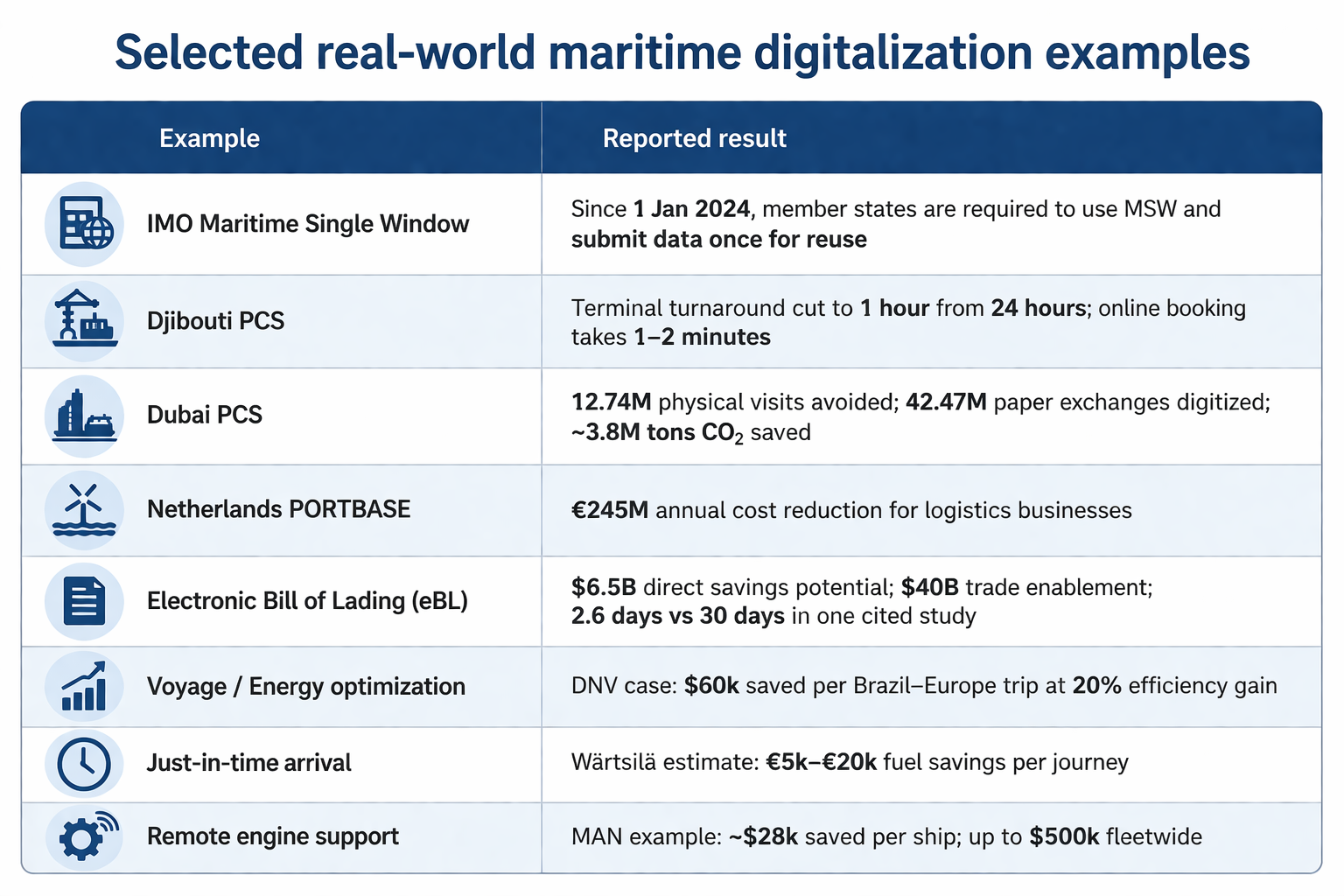
Shipping still depends on large volumes of information moving between ships, agents, terminals, authorities, operators, and commercial teams. When those exchanges remain manual or partly manual, the same data gets entered multiple times, delays become more likely, and small mistakes turn into follow-up work. The IMO’s Maritime Single Window framework is designed to reduce exactly that kind of fragmentation by enabling one centralized digital window for required data exchange.
For operators, this can mean fewer repeated entries, less time preparing submissions, better traceability, and a lower risk of version confusion or missing information. These gains are not flashy, but they directly improve operating efficiency.
Port calls are coordination events as much as physical events. A vessel may be ready, but if the information around the call is fragmented, delays still appear. Port community systems show the value of digital coordination clearly. The World Bank’s examples from Djibouti, Dubai, and the Netherlands demonstrate that better information exchange reduces waiting, cuts admin effort, and speeds up core processes.
For shipping companies, the lesson is simple: one of the most practical digital wins is often not a complex onboard technology roll-out but better process visibility before, during, and after port calls. When data is shared once, reused properly, and visible to the right stakeholders, turnaround improves.
A large share of inefficiency in fleet operations comes from the delay between onboard observation and shore-side response. The issue may be visible, but the supporting information is often incomplete, unstructured, or scattered across separate documents and people. Digitalization shortens this cycle by improving how information is captured, shared, and understood. DNV’s ShipManager Mobile Inspection App is a good example of this principle in practice: it allows QHSE reporting online or offline from mobile devices, supports templates, transfers results to shore automatically, and improves fleet overview of findings and incidents.
This is also where SmartSeas can be mentioned naturally. SmartSeas describes its platform as a maritime troubleshooting and fleet-intelligence system that unifies ship manuals, past technical defects and incidents, and day-to-day operational data into one assistant. On its official site, it also says crews can access ship-specific manuals and fault histories, with offline-first support and integration across existing fleet systems. In the context of low-cost digitalization, that is relevant because it shows how a focused knowledge layer can improve response speed without forcing the company to replace every core system first.
Not every digital improvement in shipping requires hardware retrofits or large automation budgets. Some of the most compelling gains come from better timing, better visibility, and better operational discipline. DNV says that for a typical large cargo vessel sailing from Brazil to Rotterdam, a 20% energy saving would equate to about USD 60,000 in fuel savings per trip. That illustrates how strongly voyage-efficiency improvements can affect economics.
The takeaway is that when fleets improve data visibility around voyage planning, arrival timing, and operational follow-up, they can unlock value that far outweighs the cost of the digital layer enabling it.
Suggested visual placement: Add a clean infographic here showing “sail fast + wait at berth = wasted fuel” versus “coordinated arrival + optimized speed = lower fuel burn.”
Shipping companies lose money not only when equipment fails, but when maintenance timing is poorly informed. Reactive work is expensive, but so is unnecessary planned work performed without a clear picture of actual condition. Wärtsilä’s Sapura Brazil case says its optimized maintenance agreement, including propulsion monitoring and dynamic maintenance planning, helped increase availability, reliability, and efficiency while reducing maintenance cost and risk. Wärtsilä’s propulsion condition monitoring service also says it helps improve vessel availability, reliability, and profitability while reducing maintenance costs and risks.
That is why maintenance is one of the strongest areas for low-cost digitalization. A fleet does not need to begin with an advanced digital twin. Better condition visibility, cleaner defect history, and improved maintenance follow-up can already create value.
Inspection quality shapes more than compliance. It shapes how well a company understands what is happening across its vessels. DNV says its Mobile Inspection App supports reporting online or offline, lets users build company inspection templates, automatically transfers results to shore, and supports picture attachments and fleet-level visibility of inspections, findings, accidents, and near misses.
That matters because digital inspections do more than replace paper. They improve reporting discipline, make closure tracking clearer, and help standardize how vessels document and follow up operational findings. Over time, that makes the fleet easier to manage.
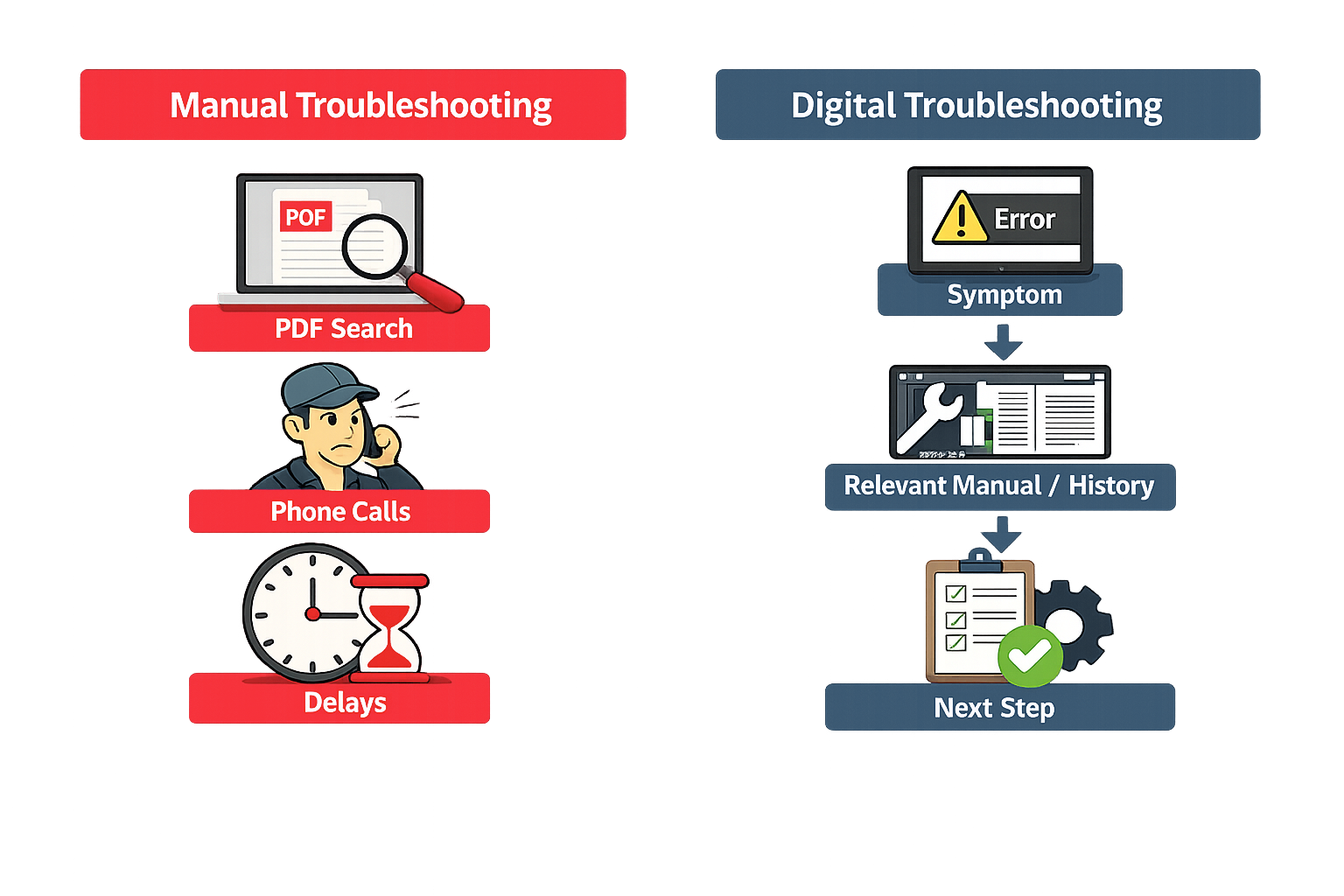
This is one of the most valuable and most overlooked digitalization opportunities in shipping. Many fleets already have the technical information needed to solve recurring issues. The problem is that the knowledge is scattered across manuals, incident reports, superintendent notes, OEM guidance, inspection records, and individual memory. When that happens, the organization keeps paying the same learning cost again and again.
This is where SmartSeas.AI fits most naturally into the topic. Its official “Why Us” page says it unifies ship manuals, past technical defects and incidents, and day-to-day operational data into one assistant. Its support and features pages also describe OCR for scanned manuals, multilingual voice-enabled interaction, offline mode for limited connectivity, access to troubleshooting guides and fault histories, and shared ship-shore visibility across integrated systems. These are useful examples of what low-cost digitalization can look like when the focus is not “more software,” but faster access to the right operational knowledge at the moment a team needs it.
The real value here is practical: less time searching PDFs, fewer repeated explanations over calls, better knowledge reuse across vessels, and more consistent troubleshooting response.
One clear use case is maritime port information exchange itself. The IMO’s Maritime Single Window requirement shows that standardized digital exchange is now part of normal shipping operations, not just a future aspiration.
Another is port community systems. The World Bank and UNCTAD examples show how digitized coordination platforms can reduce paperwork, cut turnaround time, shorten clearance cycles, and lower cost at ecosystem scale. Those same principles apply within fleet operations: when the right information is shared once and reused properly, friction drops.
A third use case is the electronic bill of lading. DCSA says moving away from physical paper bills of lading could save stakeholders around $6.5 billion in direct costs and enable $30 billion to $40 billion in annual global trade growth. DCSA also notes that ocean carriers issue around 45 million bills of lading a year. That makes eBL one of the clearest examples of how document digitalization becomes business transformation.
A fourth use case is maintenance planning. Wärtsilä’s Sapura Brazil example shows how condition visibility and dynamic planning can improve uptime and reduce cost. A fifth is digital inspections, where DNV’s online/offline inspection workflow illustrates how practical maritime digitalization must be designed for real vessel conditions, not just office connectivity. A sixth is searchable technical knowledge, where SmartSeas.AI’s ship-specific manuals, fault histories, multilingual voice interaction, and offline access show how operational intelligence can become easier to use onboard and ashore.
Leadership teams often underestimate digitalization because they evaluate each improvement in isolation. A small reduction in paperwork may seem modest. A moderate improvement in inspections may also seem modest. Faster troubleshooting access on its own may not sound transformational. But when those gains stack together across a fleet, the economics become much more meaningful.
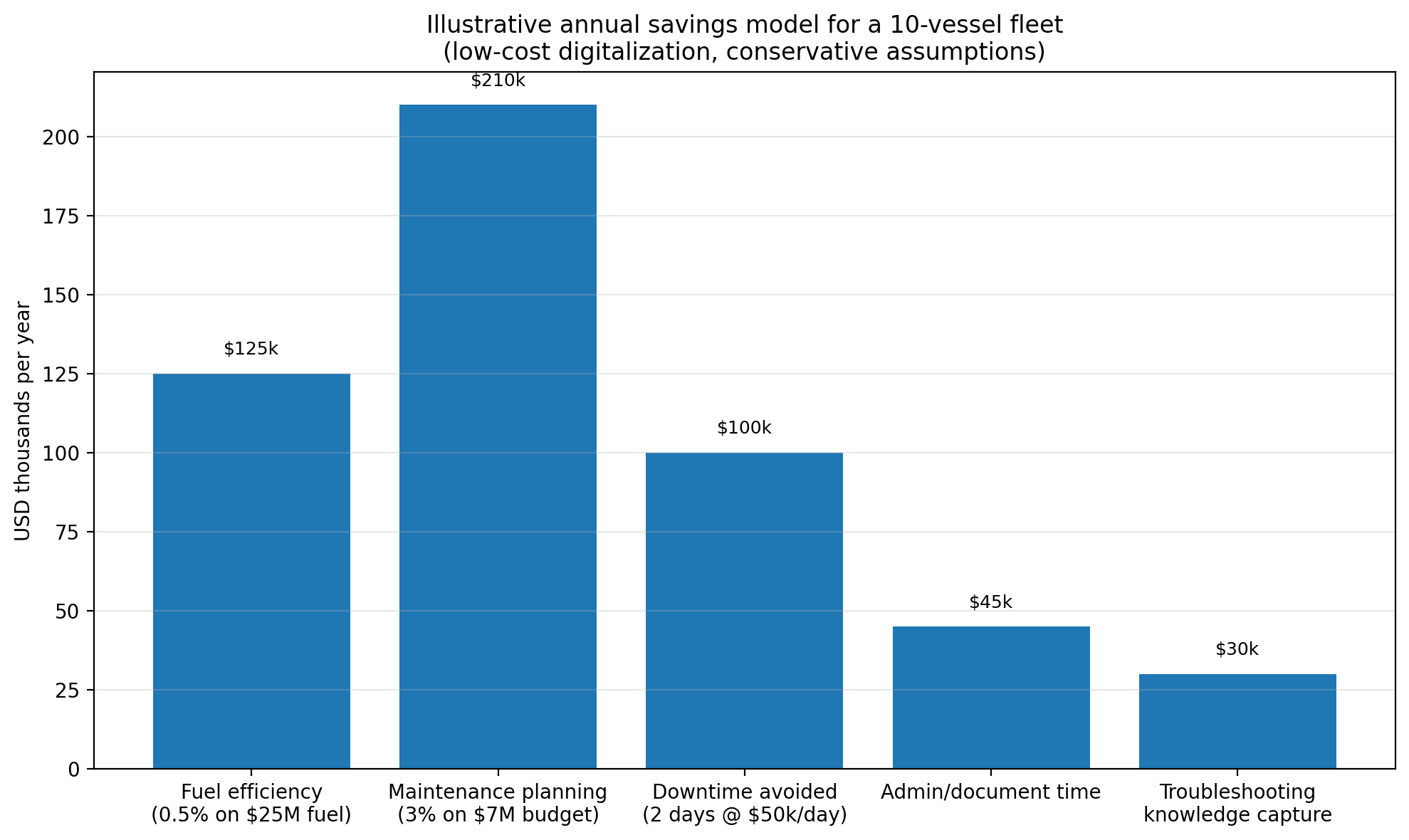
The model above is illustrative rather than predictive, but it shows the right logic. Conservative gains across fuel efficiency, maintenance planning, downtime avoidance, admin effort, and troubleshooting speed can add up quickly. That is why the more useful question is not “Can we justify one digital tool?” It is “How much are we already losing because these workflows are still slow, fragmented, or manual?”
The most effective way to approach low-cost digitalization is to start narrow and scale with evidence. Begin with one workflow that repeatedly causes delay or wasted effort. Standardize the data before scaling the system. Make sure ship and shore can work from the same context. Choose usability over complexity. Then measure business outcomes rather than software activity.
For many operators, a very practical early move is a knowledge workflow rather than a major transformation program. Making manuals, defect history, inspection findings, and technical context easier to search and reuse can improve response speed and knowledge retention quickly. That is one reason SmartSeas is relevant to this topic: it is positioned around a specific operational pain point rather than a broad “replace everything” promise.
One common mistake is trying to digitize too much at once. That usually creates adoption fatigue. Another is buying advanced tools before simplifying the underlying process. A third is ignoring onboard operating conditions; maritime tools need to work with limited connectivity, varied user familiarity, and real decision pressure. DNV’s emphasis on online/offline usability is a useful reminder that practicality matters as much as capability.
A fourth mistake is failing to capture learning. If recurring faults, inspection trends, and corrective actions are not turned into reusable knowledge, the company keeps repeating the same slow cycle. That is exactly the kind of hidden cost low-cost digitalization is meant to remove.
Shipping low-cost digitalization can transform a business not because it sounds modern, but because it removes the everyday friction that quietly damages performance. It reduces paperwork, improves port and voyage coordination, speeds up ship-shore response, strengthens maintenance planning, standardizes reporting, and turns fragmented technical knowledge into something teams can actually use.
The evidence across the industry already points in this direction. The IMO is driving standardized digital exchange through Maritime Single Window. The World Bank and UNCTAD show how digital coordination cuts time and cost. DCSA shows the scale of value tied to digital trade documentation. DNV and Wärtsilä show how practical digital tools improve inspections, maintenance, and operational performance. SmartSeas.AI fits into that broader shift by focusing on one of the most practical digitalization needs in shipping: faster access to structured technical knowledge, fault history, and ship-shore troubleshooting context.
For maritime decision-makers, the opportunity is not to wait for a giant transformation budget. It is to start where the friction is highest and the payoff is clearest. That is how low-cost digitalization changes the business: one practical improvement at a time.
It is a phased approach to improving shipping operations with practical digital tools that solve high-friction workflows without requiring a full system replacement.
No. It is often especially useful for small and mid-sized fleets because it allows step-by-step improvement with lower risk and lower upfront disruption.
Usually the best starting point is the workflow that creates repeated operational friction every week, such as documentation, inspections, defect follow-up, maintenance visibility, or technical troubleshooting access.
Yes. DNV’s voyage-efficiency case and Wärtsilä’s maintenance examples both indicate that better data, better timing, and better condition visibility can create meaningful economic value even before large hardware investments.
Because many fleets already have the information they need, but it is scattered across manuals, logs, notes, and email chains. Structuring that knowledge reduces time-to-action and improves consistency when issues occur. SmartSeas.AI is one example of a platform positioned around solving that exact problem.

Get Started Today
Transform the way you troubleshoot and manage maritime operations. Join the next wave of Maritime Digital Transformation with SmartSeas AI.




.svg)


.png)