.jpg)
December 20, 2025
How AI Vessel Operations Are Transforming Modern Maritime Management

December 20, 2025
Modern maritime management is being reshaped by two forces that don’t negotiate: cost pressure and measured compliance. Shipping’s share of global anthropogenic emissions rose to 2.89% in 2018, and the International Maritime Organization (IMO) has set the direction toward phasing out GHG emissions as soon as possible, with a net-zero ambition “by or around 2050” under the 2023 IMO GHG Strategy.
For fleet managers, this changes the operating model. You can’t “manage by exception” with monthly spreadsheets anymore—because performance, risk, and compliance are now continuous. That’s why AI vessel operations is moving from pilot projects to a core capability: it turns every voyage, port call, and maintenance event into a closed-loop system that learns and improves.
AI vessel operations are not one model, one dashboard, or one vendor module. It’s an operational layer that uses data and models to:
In other words: digitalization shows you the problem; AI helps you run the operation better, repeatedly.
The IMO’s short-term measures (EEXI and CII frameworks) moved from “guidance” into certification and reporting timelines beginning 2023, pushing operators to manage carbon intensity continuously. The IMO notes that amendments to MARPOL Annex VI entered into force in late 2022, with EEXI/CII certification effective 1 January 2023 and first ratings following reporting.
The EU extended its Emissions Trading System (ETS) to maritime transport from January 2024, with a phased-in surrender requirement (40% → 70% → 100%)
FuelEU Maritime added an additional operational lever: reduce the greenhouse-gas intensity of energy used onboard for ships (generally above 5,000 GT calling at EU/EEA ports), starting in 2025 and tightening over time.
When carbon becomes a line item, “best practice” becomes “best economics.” AI helps you choose the best action under constraints (ETA, safety, charter party, fuel, and compliance).
More mixed fuels, more reporting, more cyber requirements, tighter port windows, and global disruptions have made voyage execution and maintenance planning harder. AI doesn’t replace seamanship—it augments consistency across an entire fleet.
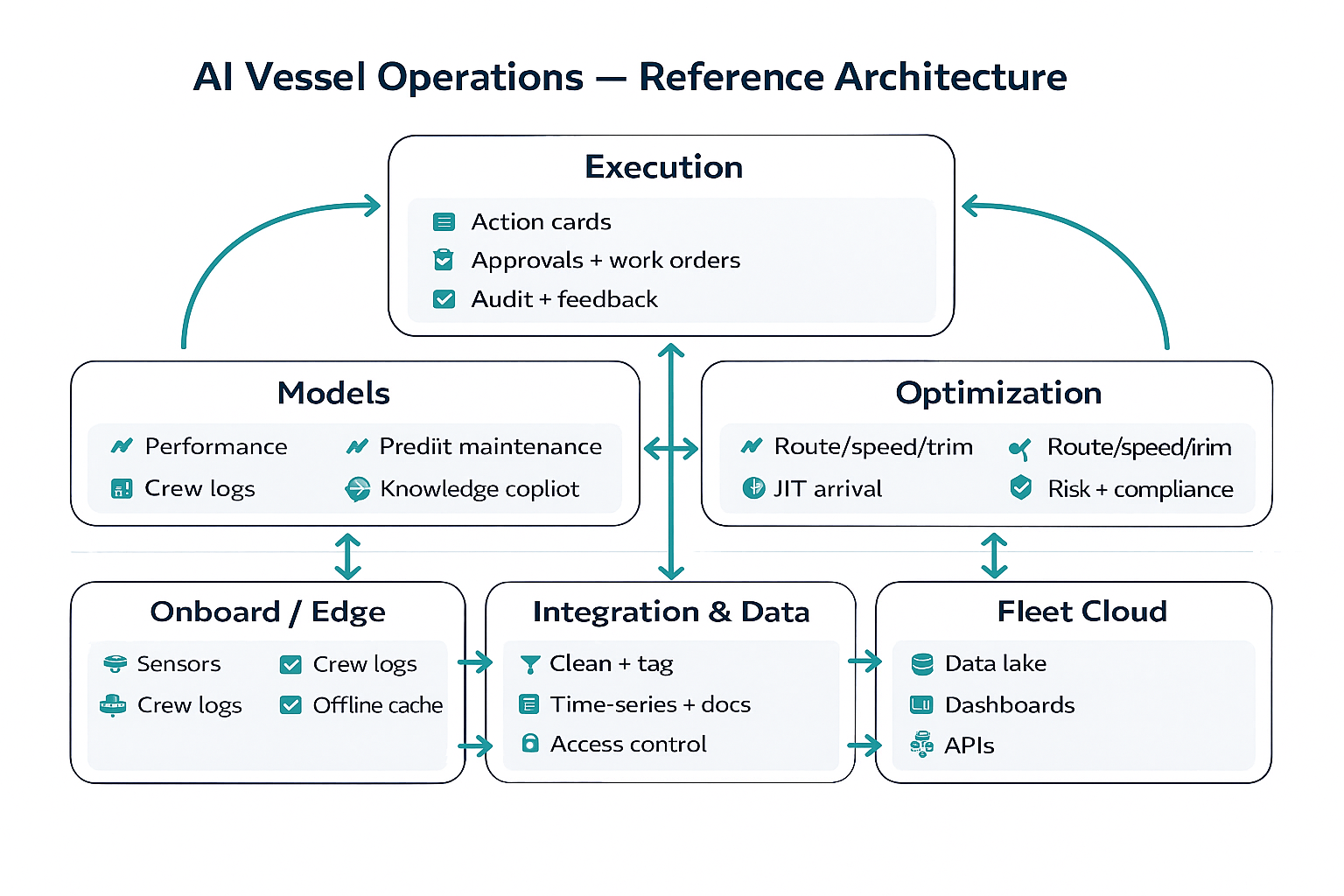
Think in layers:
Layer A — Onboard + shore data (the “truth”)
Layer B — Intelligence (the “brains”)
Layer C — Workflow + governance (the “muscle”)
Below are practical use cases fleet managers can recognize—supported by published examples and measurable levers.
Voyage optimization is often treated as a “pre-departure routing exercise.” AI vessel ops makes it continuous, updating decisions as conditions change (weather, currents, traffic, port windows, vessel condition, engine limitations).
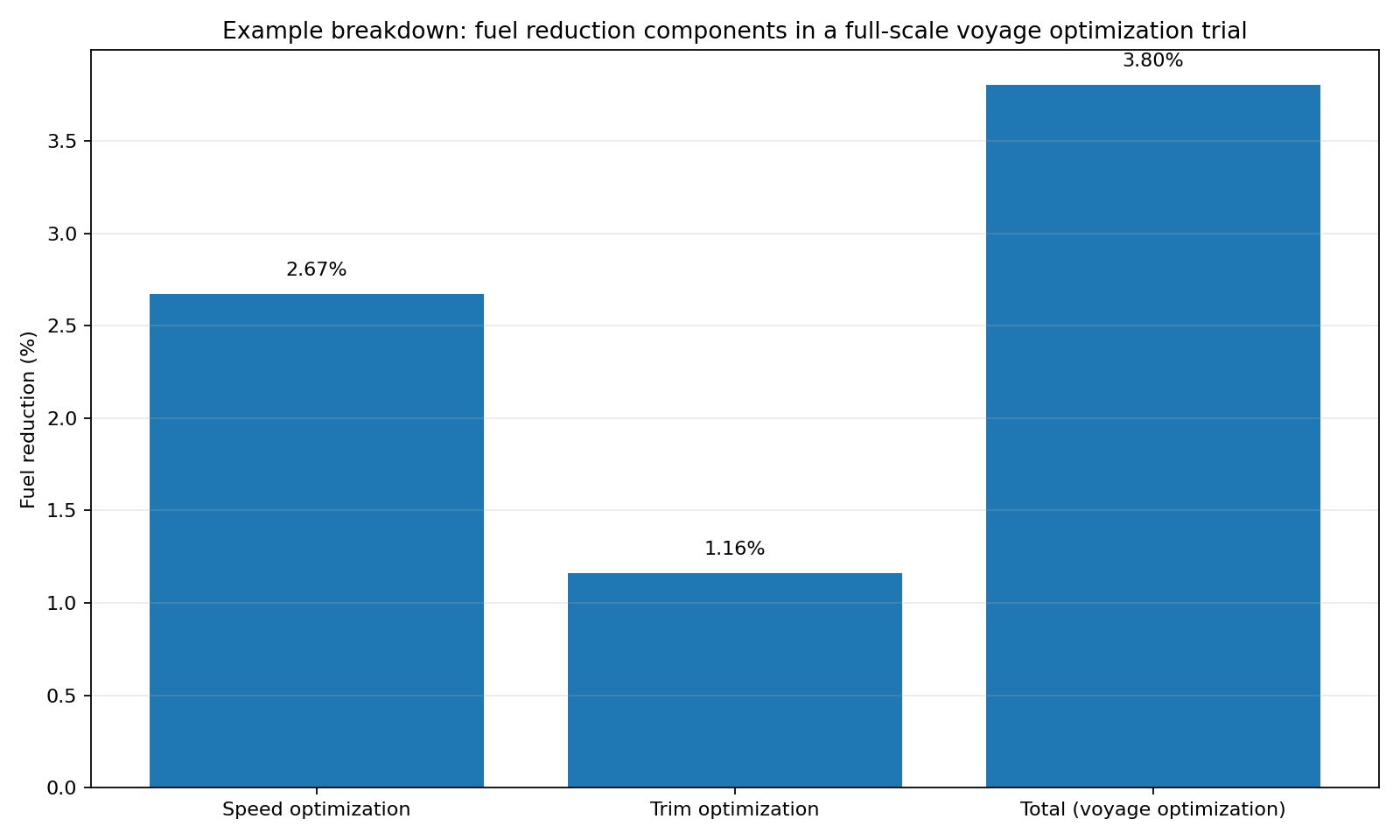
ClassNK and NAPA published a full-scale voyage optimization trial on an 8,000+ TEU container ship, reporting about 3.8% fuel reduction, with a breakdown indicating 2.67% attributed to speed optimization and 1.16% to trim optimization in that trial context.
Fleet managers don’t need to copy the same software to copy the value. The transferable lesson is operational discipline:
Waiting at anchorage costs money and emissions—and it’s often created by a mismatch between planned arrival and berth readiness.
A major study commissioned under IMO-Norway GreenVoyage2050 examined 339,390 container ship voyages and found that effective Just-In-Time arrival could reduce fuel consumption and resulting CO₂ emissions by about 14% per voyage (average), with smaller savings even when applied only near the end of voyages (e.g., 24-hour or 12-hour scenarios).
JIT arrival fails when incentives are misaligned. Successful programs bring together:
AI is the enabler; operational alignment is the multiplier.
AI for navigation is increasingly about assisting bridge teams with better detection and risk evaluation, especially in complex environments.
CMA CGM publicly described its collaboration with startup Shone to embed AI onboard ships, aiming to provide crews with decision support for maritime safety and piloting assistance. Industry coverage notes the approach includes fusing multiple sensor inputs (e.g., radar, camera, AIS) to improve detection and support collision avoidance with COLREGs context.
The operational win is not “autonomy.” It’s reduced cognitive load + better consistency in high-risk scenarios.
Predictive maintenance becomes valuable when it is connected to actions:
Wärtsilä announced a Lifecycle Agreement with CMA Ships (CMA CGM group) covering 14 large LNG-fuelled container ships, aimed at improving operational reliability through services that include AI-leveraged capabilities (reported in maritime industry coverage) such as predictive maintenance and dynamic maintenance planning.
For fleet management, the biggest impact is often avoiding the second-order cost: delays, missed berths, contractual penalties, reputational risk with charterers, and cascading schedule disruption.
This is where AI vessel ops becomes a finance tool as much as an engineering tool.
The EU’s shipping ETS obligations ramp over time:
That means route/speed decisions now have a carbon cost sensitivity.
FuelEU Maritime applies to large ships (generally >5,000 GT) calling at EU/EEA ports, pushing down the GHG intensity of onboard energy use over time, starting in 2025.
If compliance becomes reactive, it becomes expensive. AI helps you turn compliance into planned optimization, not fire drills.
Different ships, trades, and methods will produce different results—but published examples help fleet managers estimate order-of-magnitude potential and prioritize pilots.
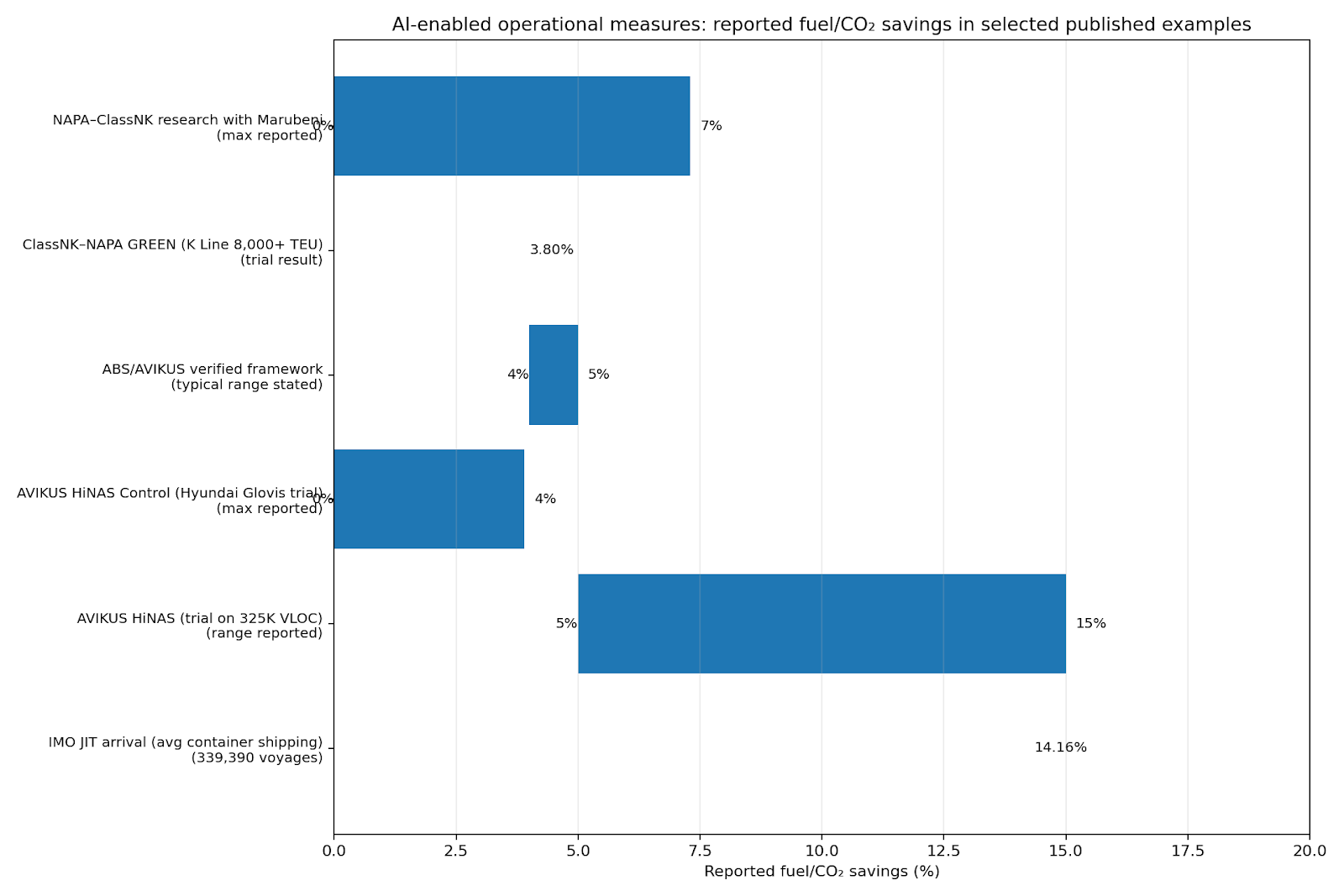
This chart includes published examples tied to:
The quiet truth in fleet operations is that many savings opportunities are already known—but not consistently executed across:
AI vessel ops creates a repeatable operating system:
This is why large operators are investing aggressively in AI deployment at scale. CMA CGM, for example, signed a global partnership with Google to accelerate AI implementation across operations—targeting improvements in routing, container handling, inventory management, costs, delivery times, and emissions.
To avoid “AI theatre,” track KPIs tied to outcomes:
Best starters:
Start with one loop because success requires tight measurement and change management.
A baseline should include:
This is where many pilots fail—not on AI quality, but on measurement credibility.
A recommendation must land as:
If it can’t become action, it won’t become value.
AI vessel ops touch critical systems and decision flows. Define:
Scaling is mostly people and process:
The maritime industry is moving into an era where operational performance is measured continuously—for cost, safety, and compliance. With shipping’s emissions share clearly documented and global policy tightening, fleets that rely solely on manual coordination and periodic reporting will face rising inefficiency and higher compliance friction.
AI vessel operations offer a practical way forward: they transform day-to-day execution into a closed-loop system that predicts, recommends, verifies, and learns—turning decisions on speed, routing, trim, maintenance timing, and port arrival coordination into repeatable performance improvement. Published trials and programs already demonstrate measurable outcomes, from voyage optimization savings and Just-In-Time (JIT) arrival reductions to AI-supported navigation safety and predictive maintenance reliability.
This is where platforms like SmartSeas.AI play a critical role. Instead of treating AI as isolated pilots, SmartSeas.AI helps shipowners and managers embed intelligence directly into operations—linking data, models, workflows, and governance into one operational layer. The focus is not just analytics, but actionable decision support with verification, auditability, and continuous improvement built in.
For fleet managers, the winning approach is not chasing “AI everywhere.” It is choosing one high-impact operational loop, building a defensible baseline, embedding AI decisions into real workflows, and scaling with playbooks and trust. With the right platform and disciplined execution, AI vessel operations won’t just be a project—they will become the operating system of modern fleet performance.
Not always. Many fleets start with existing data sources (noon reports, voyage plans, PMS/CMMS, fuel consumption logs, navigation datasets where available). New sensors help most in predictive maintenance and high-fidelity performance modeling—but the first wins often come from workflow + optimization.
Typically:
Use a baseline and normalize for draft, weather severity, and route class. Measure across enough voyages to avoid “one good trip” bias. Published trial disclosures (e.g., full-scale voyage optimization trials) also emphasize measurement credibility.
No. In strong implementations, AI supports decisions, documents trade-offs, and improves consistency. Accountability stays human—especially for safety-critical decisions.
AI used as decision support (sensor fusion, improved detection, risk ranking) is increasingly discussed and trialed, but it must be implemented with COLREGs context, strong human-in-the-loop design, and clear procedures for overrides.
It enables scenario planning and operational decision optimization (speed, routing, fuel choice impacts, pooling strategies), and it reduces reporting friction by improving data consistency. EU guidance clarifies shipping’s ETS inclusion and phased obligations.
Common ones:
A focused pilot (one loop, clear baseline, clear KPIs) can show measurable trends within a few voyage cycles—but it depends on route frequency, vessel type, and data readiness.
A digital twin is often a calibrated performance model (physics + data). AI may include ML and optimization layers that predict outcomes and recommend actions. In practice, strong systems combine both.
Smaller fleets can adopt it if they focus on 1–2 high-impact loops, keep tooling simple, and build operational playbooks. You don’t need “big-tech scale” to benefit from better decision consistency.

Get Started Today
Transform the way you troubleshoot and manage maritime operations. Join the next wave of Maritime Digital Transformation with SmartSeas AI.




.svg)